Atmospheric Integrity Records
Protects environmental evidence so the record can be independently examined.
One classroom. One environmental condition. One proposed HVAC consequence. Follow it from physical reality through AIR, intelligence, AEA, execution, verified outcome and new reality.
Observe it. Preserve it. Interpret it. Govern the proposal. Execute only after disposition. Verify what became real. Revalidate.
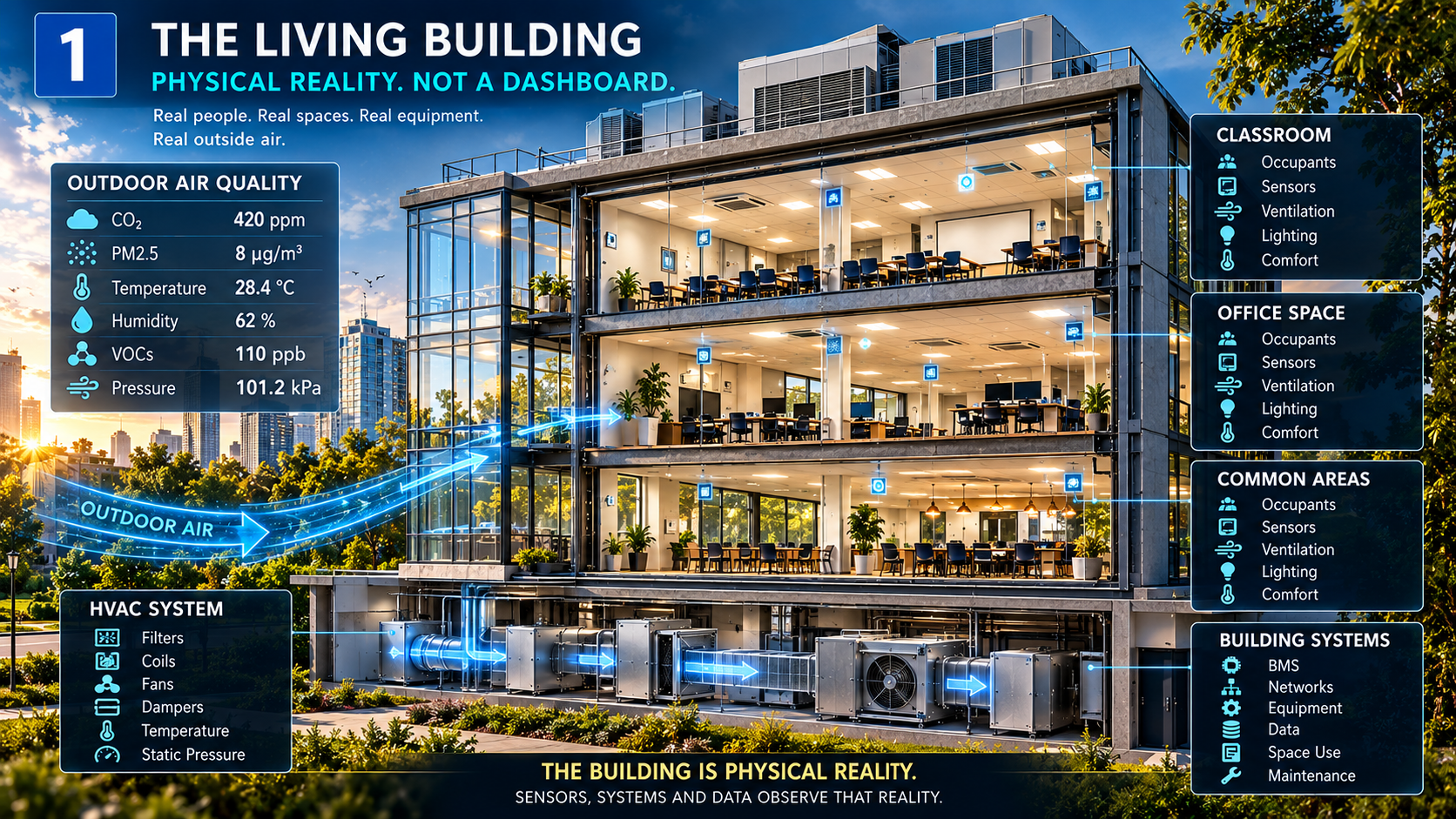
Begin with the building itself. Before there is a dashboard, model, alarm or recommendation, there is physical reality: outdoor air, occupied rooms, HVAC equipment, controls, people and changing environmental conditions. Sensors observe that reality. Software represents and interprets it. Environmental Integrity Governance begins by keeping those things distinct. The building is reality. The sensor is an observer. The dashboard is a representation. The model is an interpretation.
Transcript highlighting follows narration. The page does not auto-scroll.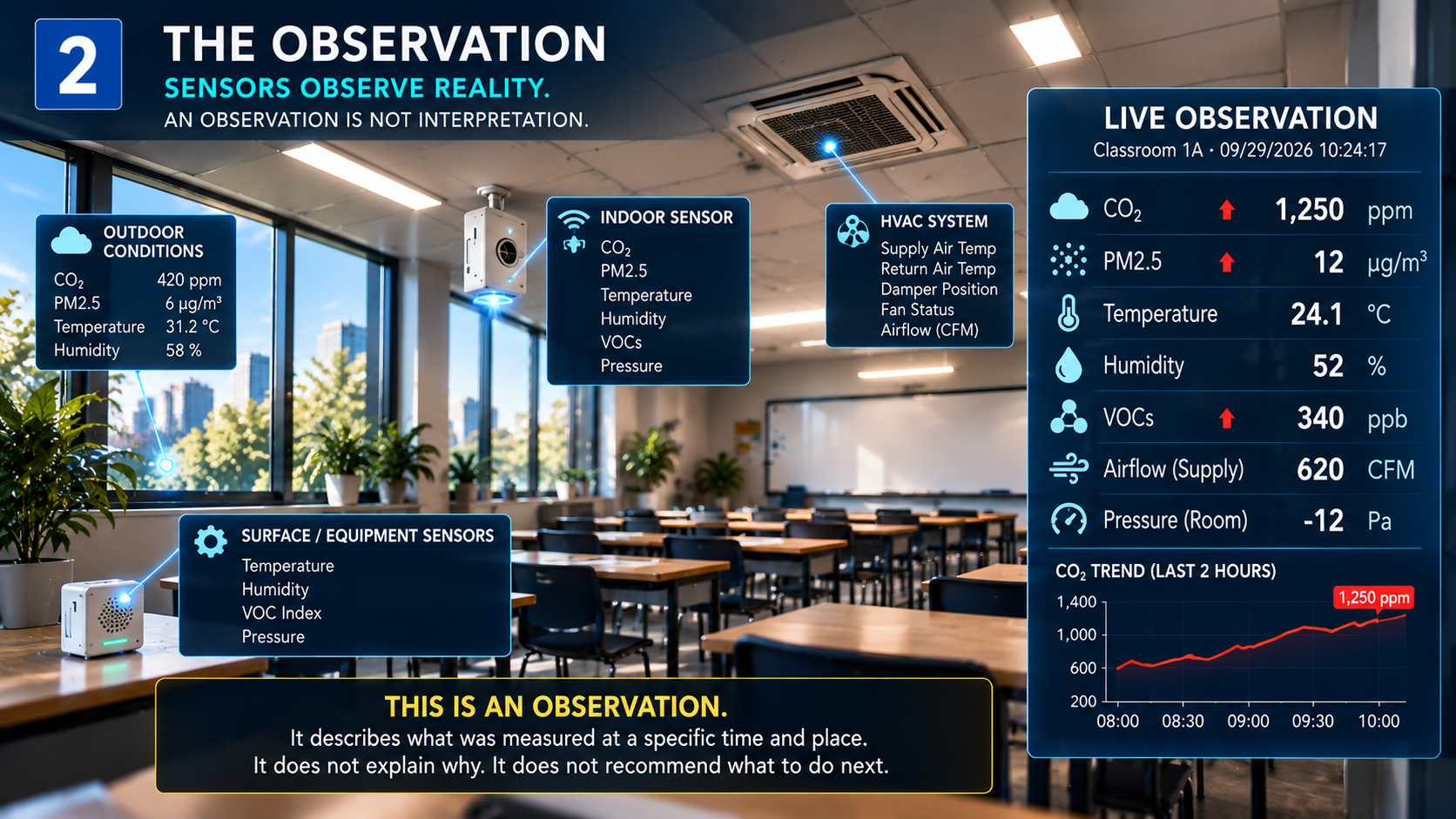
Now observe Classroom 1A. Carbon dioxide is twelve hundred fifty parts per million. The other measurements describe conditions at this time and place. They do not, by themselves, explain why the condition exists. They do not establish a diagnosis, recommend an intervention, or authorize one. Stop where the observation stops.
Transcript highlighting follows narration. The page does not auto-scroll.Choose what each statement actually is. Every selection should produce an immediate result.
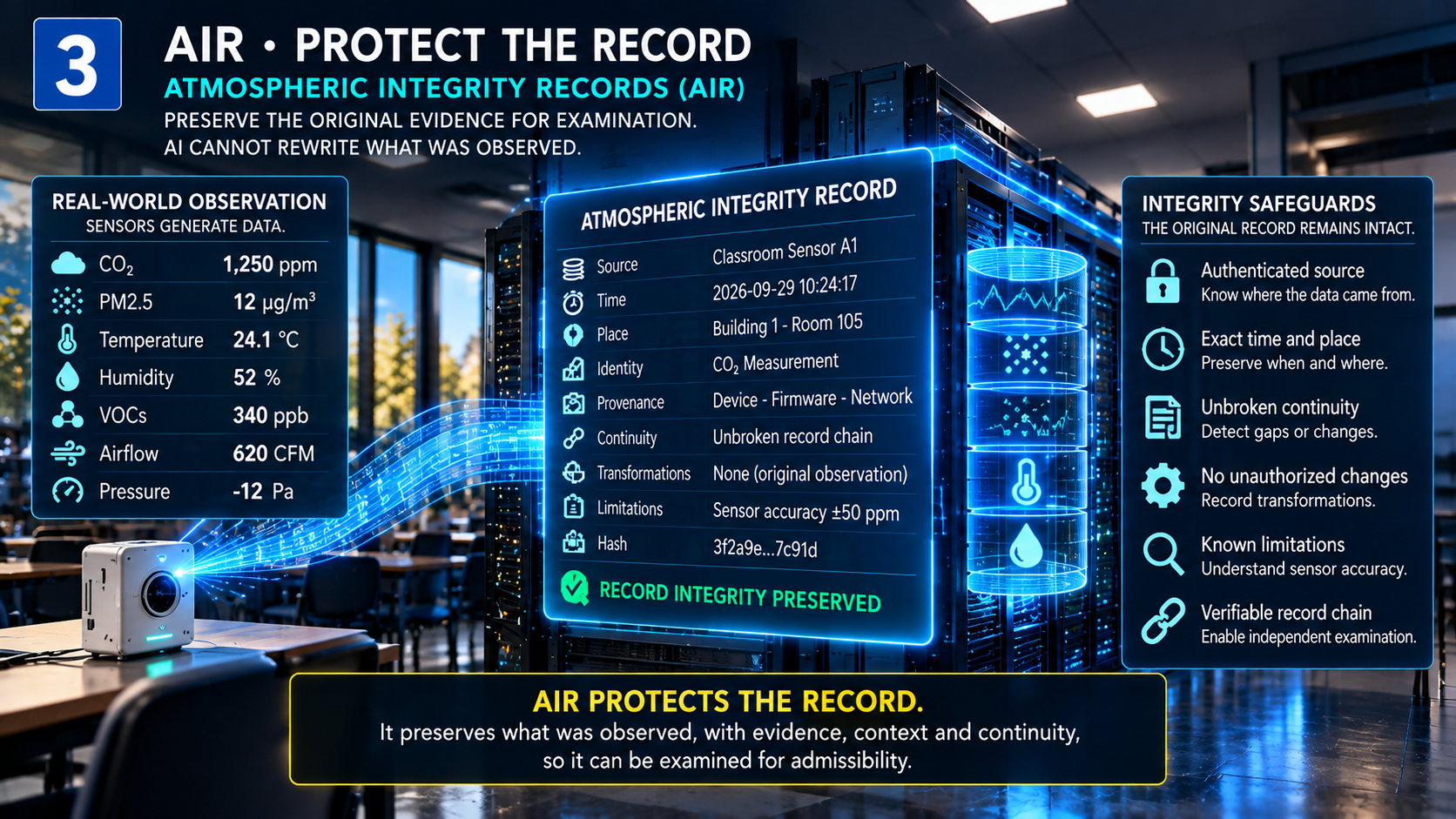
Before intelligence explains the observation, protect the record. Atmospheric Integrity Records preserve source, identity, time, place, provenance, continuity, transformations and limitations. AIR does not automatically declare a measurement admissible. It preserves the integrity dimensions needed to examine whether evidence is trustworthy and sufficient for a particular reliance. Later intelligence may reference the observation, but it does not silently rewrite it. AIR protects the record from intelligence.
Transcript highlighting follows narration. The page does not auto-scroll.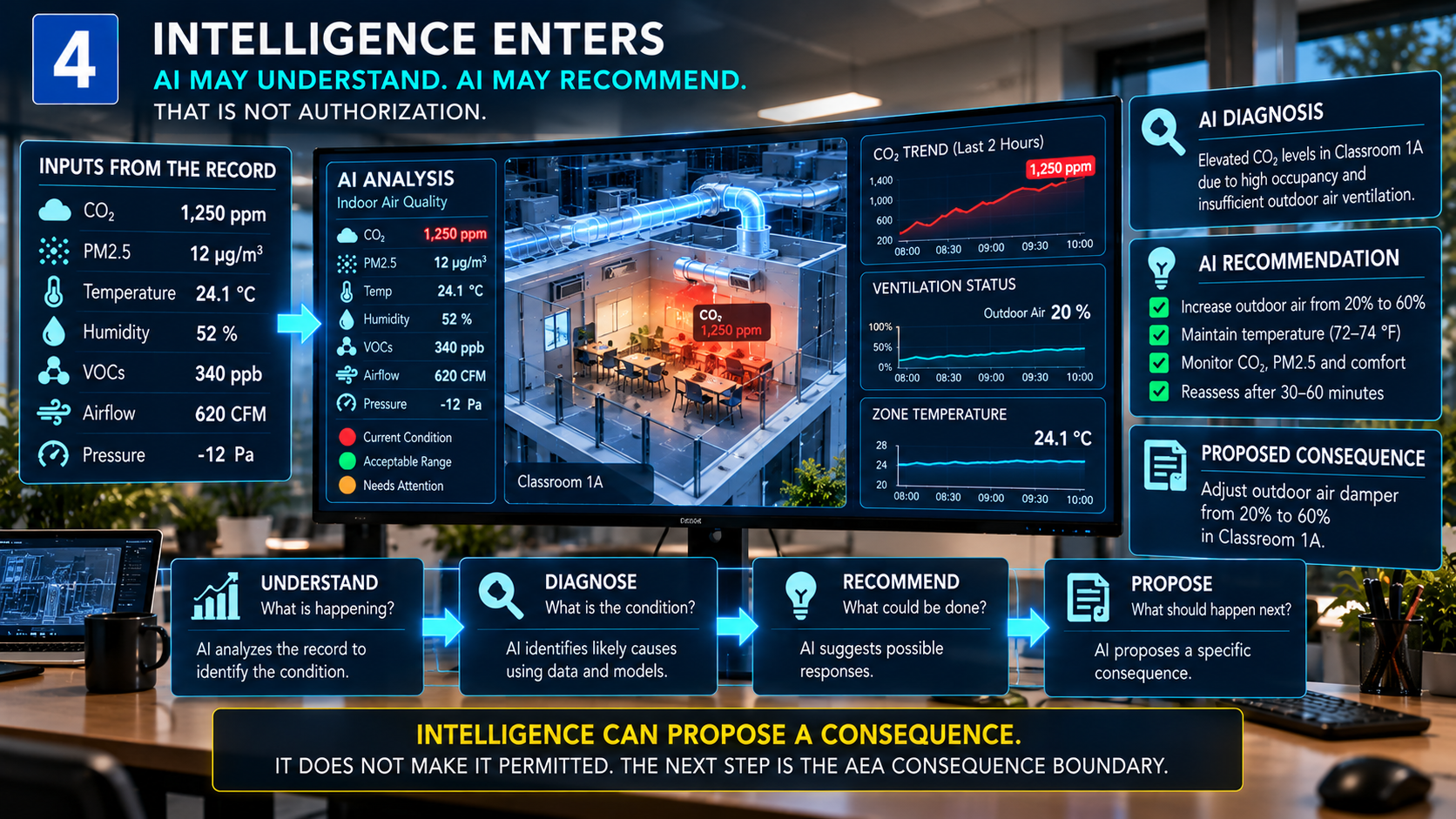
Now intelligence may enter. AI examines the preserved record and building context. It identifies elevated carbon dioxide and recommends increasing outdoor air from twenty percent to sixty percent. That recommendation may be technically sound. It is still a proposal. Capability is not authority. Understanding is not permission. The proposal must cross a separate consequence boundary.
Transcript highlighting follows narration. The page does not auto-scroll.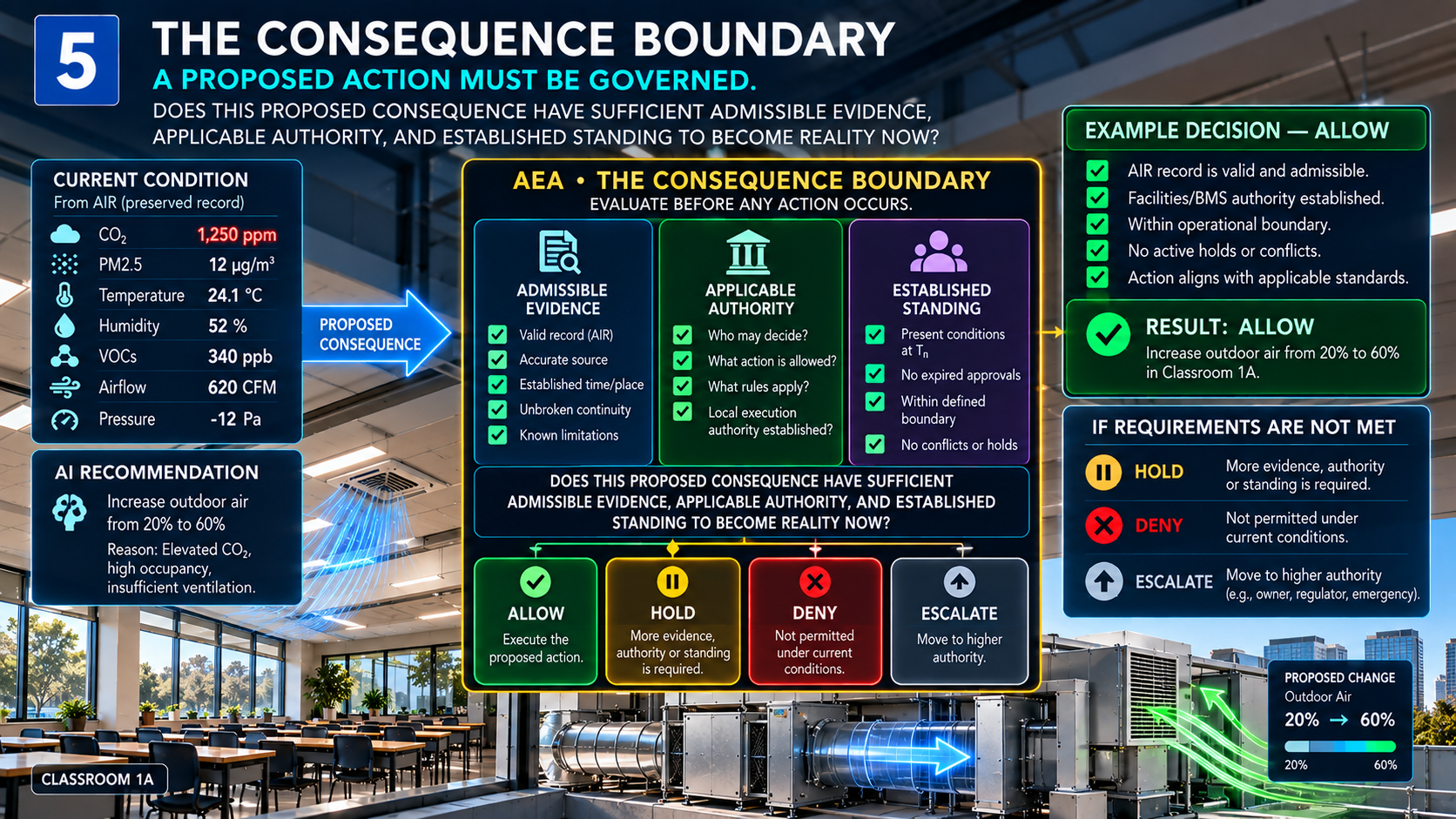
The proposed consequence is exact: increase Classroom 1A outdoor air from twenty percent to sixty percent. AEA asks whether this exact consequence has sufficient Admissible Evidence, Applicable Authority, and Established Standing to become reality now. The disposition may be ALLOW, HOLD, DENY or ESCALATE. Only after the consequence is admitted does execution begin.
Transcript highlighting follows narration. The page does not auto-scroll.Simplified teaching scenarios. Actual dispositions depend on the governing rules, evidence, authority, standing, target, scope and current conditions.
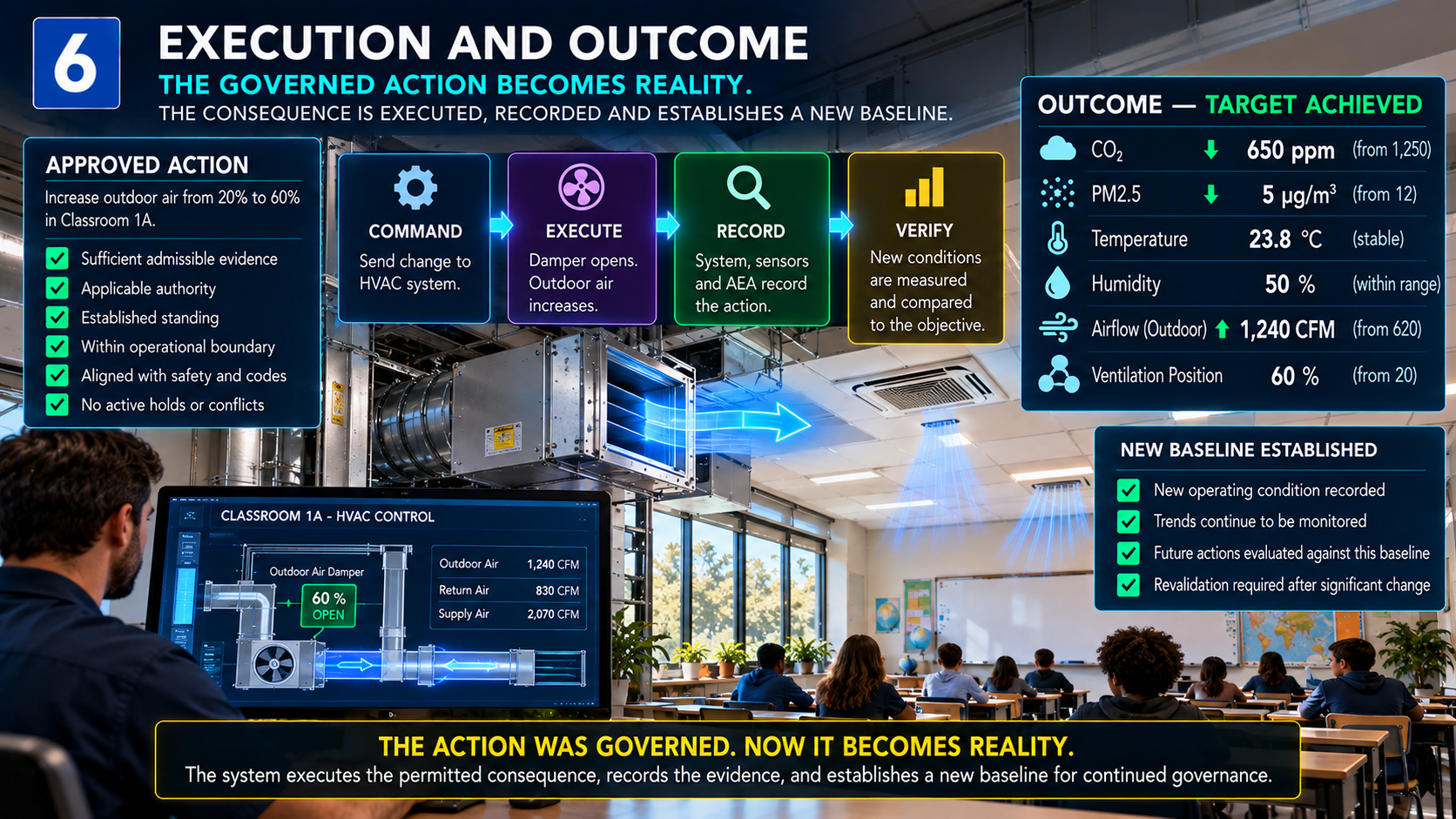
An ALLOW disposition does not prove the intended outcome occurred. It admits the bounded consequence to execution. The command is sent. The damper moves. Then the building must be observed again. Commanded position is not verified physical outcome. New evidence establishes what actually happened. The outcome becomes a new baseline.
Transcript highlighting follows narration. The page does not auto-scroll.Start the verification chain.
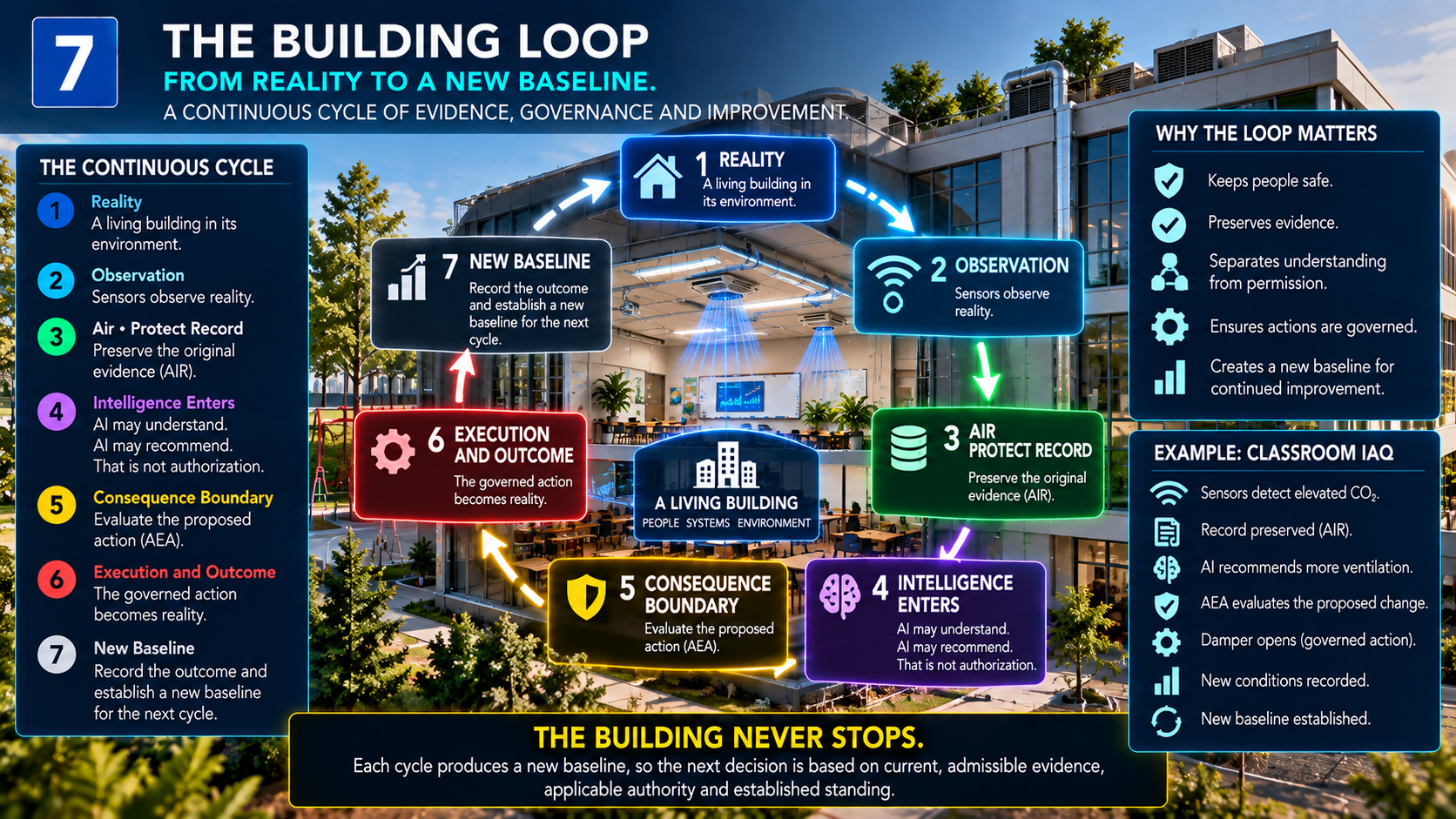
Now see the complete loop. Reality is observed. AIR protects the record. Intelligence proposes a consequence. AEA examines evidence, authority and standing. A permitted consequence executes. The outcome becomes new reality and the loop begins again. Yesterday’s ALLOW does not automatically establish today’s ALLOW. The building never stops. Governance therefore requires revalidation.
Transcript highlighting follows narration. The page does not auto-scroll.Protects environmental evidence so the record can be independently examined.
Protects the boundary between a proposed consequence and reality.
Governs environmental integrity across the complete lifecycle and revalidation.
NO ADMISSIBLE EVIDENCE. NO ADMISSIBLE EXECUTION. · CAPABILITY ≠ AUTHORITY. · UNDERSTANDING ≠ PERMISSION.