TA-14 · BLUE IOT / ENCOMPASS BLUE DISCUSSION SURFACE · PUBLIC TECHNICAL SHOWROOM
EVIDENCE TO ACTION
A bounded CO₂ example for examining the point between environmental intelligence and consequential building action: when does evidence become sufficient not merely to inform a response, but to support an authorized consequence now?
Evidence to action: the complete teaching sequence
Eight numbered illustrations explain the distinction between observation, admissible evidence, a bounded proposed consequence, applicable authority, established standing, external execution and verified outcome. The Classroom 214 examples and operational values are illustrative, not verified Blue IoT data or operating recommendations.
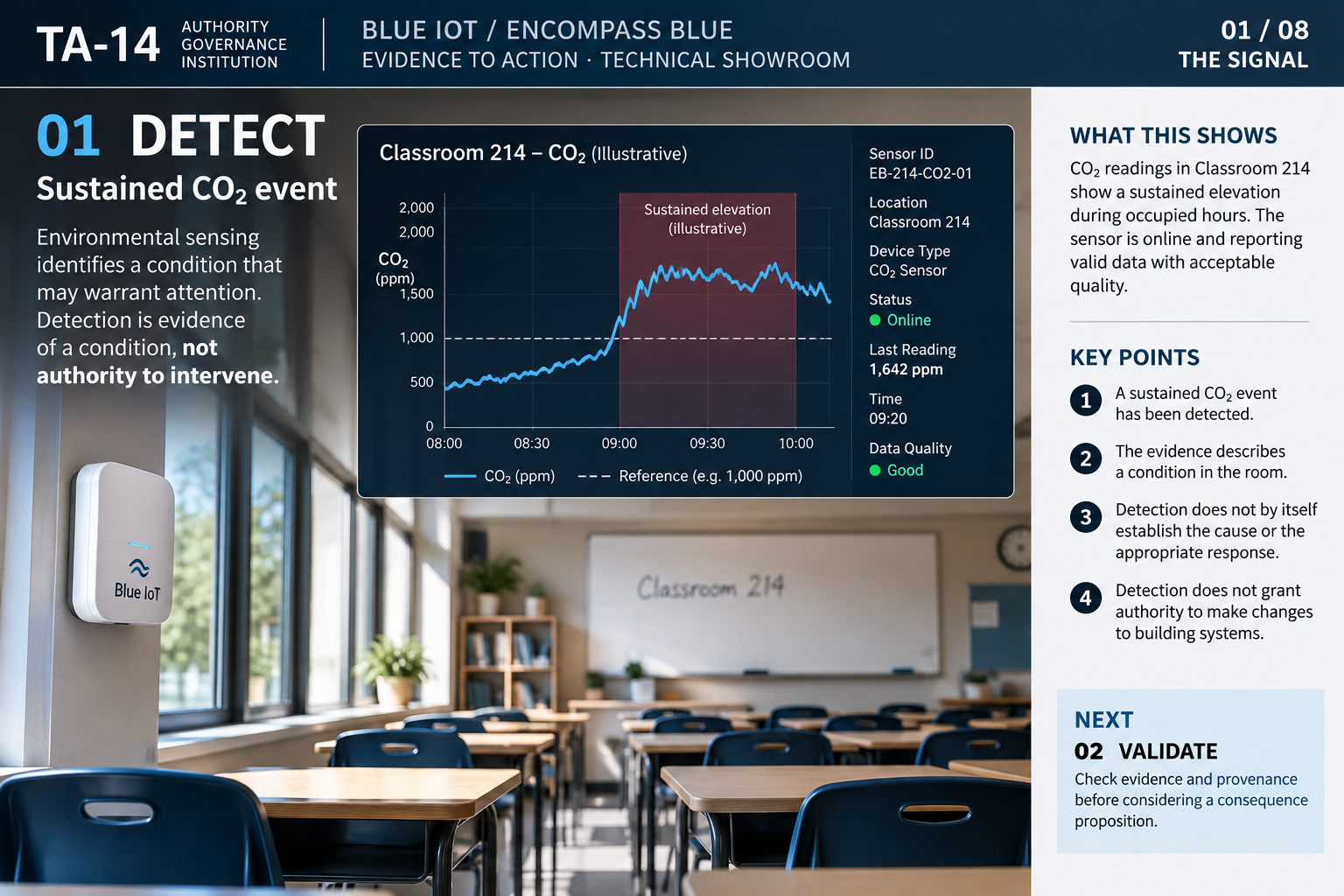
NARRATION SCRIPT: Start with what is actually observed. In this illustrative Classroom 214 case, a sensor reports sustained elevated carbon dioxide during an occupied interval. The observation may justify examining ventilation conditions, but it does not reveal the cause by itself. Occupancy, sensor placement, device condition, outdoor conditions and time history matter. At this stage we can say a condition was reported. We cannot yet say that a particular intervention is required, safe or authorized. Detection begins the examination; it does not make the decision.
WHAT YOU JUST LEARNED
You learned that a CO₂ observation can identify a condition worth examining, but it does not prove its cause or authorize a building change.
WHAT YOU WILL LEARN NEXT
Next, learn how to preserve the sensor, timestamp, raw readings and provenance so the observation can be independently examined.
02 / 08 · PRESERVE THE RECORD
ILLUSTRATIVE EXAMINATION
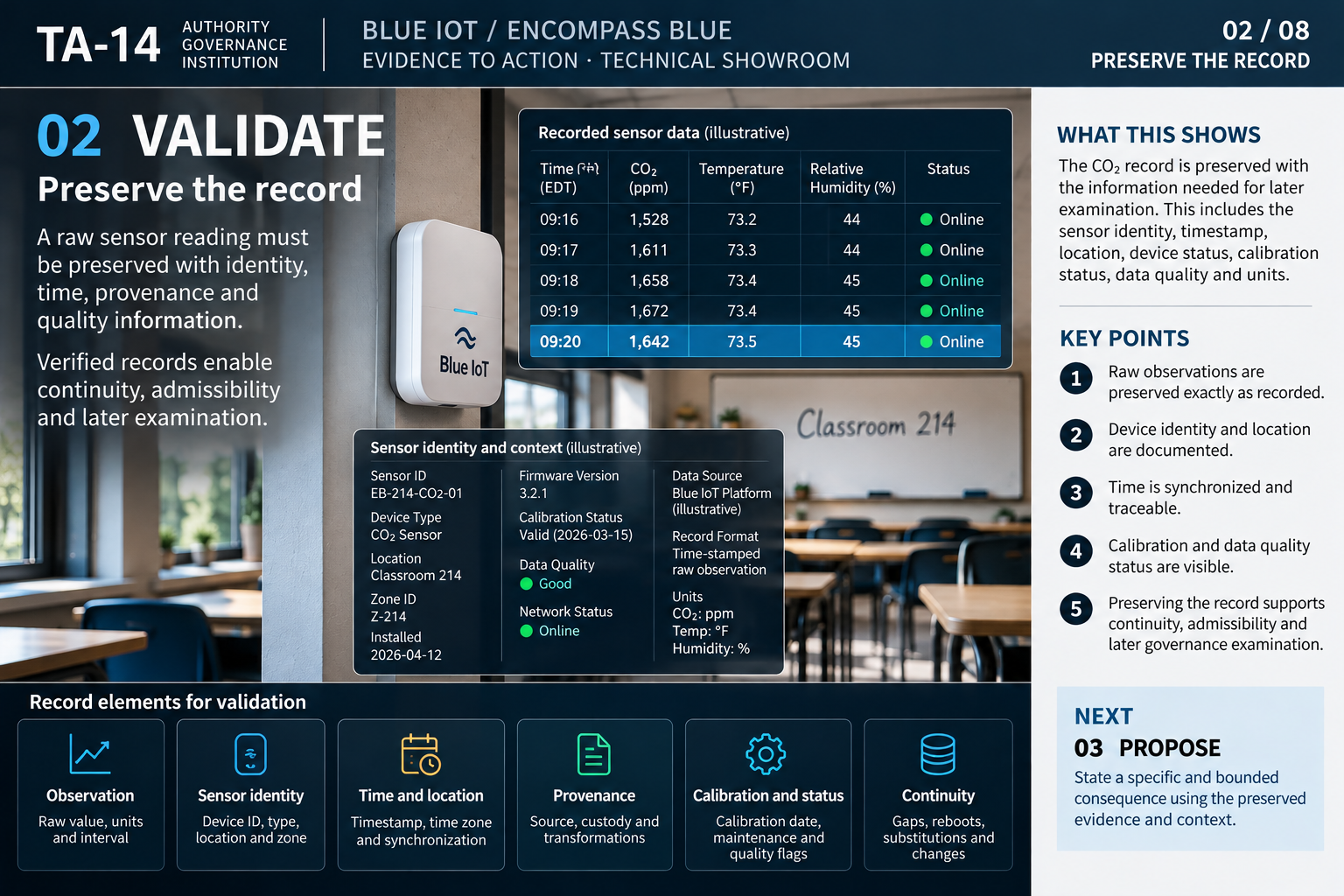
NARRATION SCRIPT: Before a signal can support a consequential decision, preserve its record. Identify the sensor, room, measurement units, timestamps, source history and available quality and calibration information. Retain raw observations as the primary record. If a dashboard smooths, adjusts or summarizes them, preserve the derived version separately with its method and source references. Look for gaps, clock drift and changes in sensor-to-room attribution. The result is not simply a pretty graph. It is a record that an independent examiner can reconstruct, challenge and trace.
WHAT YOU JUST LEARNED
You learned that raw evidence, provenance and continuity must survive the journey from sensor to dashboard; derived values cannot quietly replace originals.
WHAT YOU WILL LEARN NEXT
Next, learn how to turn preserved evidence into a specific proposed consequence without confusing a recommendation with a command.
03 / 08 · PROPOSE THE CONSEQUENCE
ILLUSTRATIVE EXAMINATION
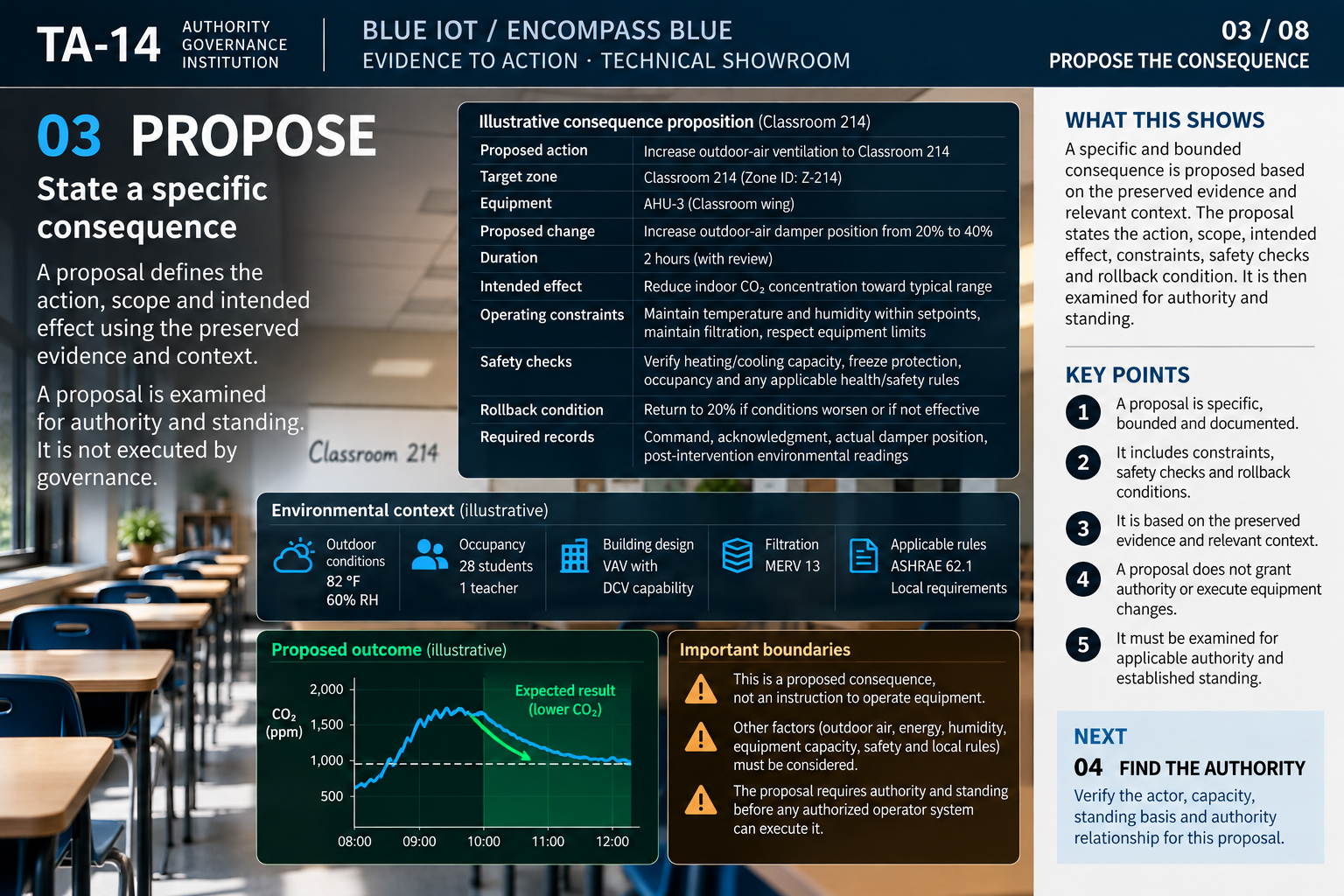
NARRATION SCRIPT: Now state exactly what action is under consideration. For this hypothetical case, the proposition is to adjust outdoor-air ventilation serving Classroom 214. Name the equipment, zone, initiating actor, proposed operating duration, conditions, limits and rollback criteria. Do not presume that more outdoor air is always beneficial: humidity, equipment capability, filtration, weather, safety and site rules may change what is appropriate. A dashboard recommendation is not a control command. This proposition is a specific question that must still pass evidence, authority and standing examination.
WHAT YOU JUST LEARNED
You learned to define the proposed ventilation action, its equipment and zone, constraints, purpose and rollback conditions before judging it.
WHAT YOU WILL LEARN NEXT
Next, learn who can invoke the applicable authority for this particular action, equipment and time.
04 / 08 · FIND THE AUTHORITY
ILLUSTRATIVE EXAMINATION
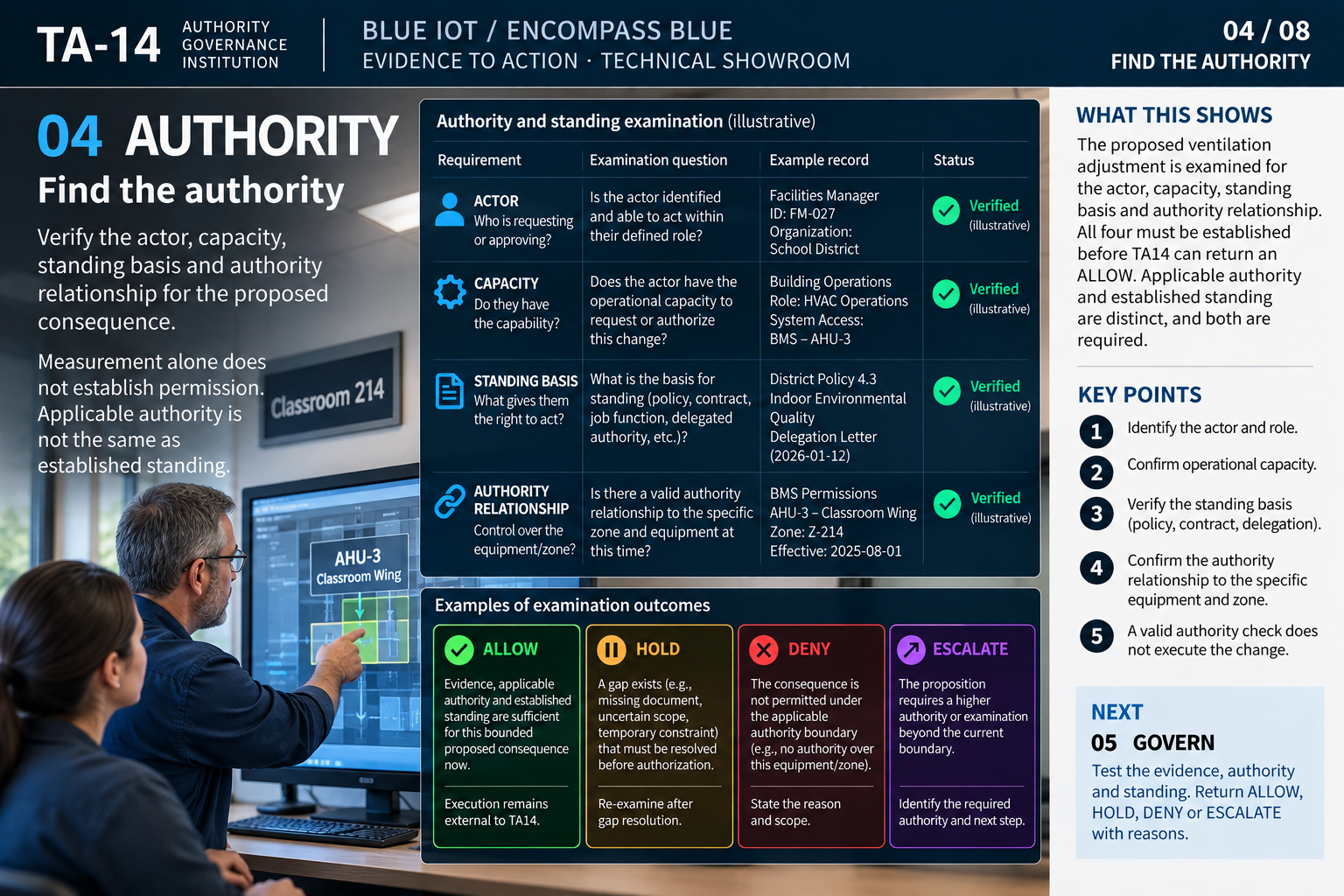
NARRATION SCRIPT: Applicable Authority and Established Standing are different tests. A building may have a policy permitting ventilation changes, but that does not prove that this particular person or system may invoke the policy now. Examine the four standing anchors: ACTOR, CAPACITY, STANDING BASIS and AUTHORITY RELATIONSHIP. Identify who is acting, in what role, by what established basis, and for which equipment, site, action and time. Authority context may travel between systems, but execution authority must be established locally. An API credential or technical capability does not, by itself, prove standing.
WHAT YOU JUST LEARNED
You learned why Applicable Authority is not the same as Established Standing, and how Actor, Capacity, Standing Basis and Authority Relationship must be examined.
WHAT YOU WILL LEARN NEXT
Next, see how TA14 brings evidence, authority and standing together at the consequence boundary to issue a bounded determination.
05 / 08 · THE CONSEQUENCE BOUNDARY
ILLUSTRATIVE EXAMINATION
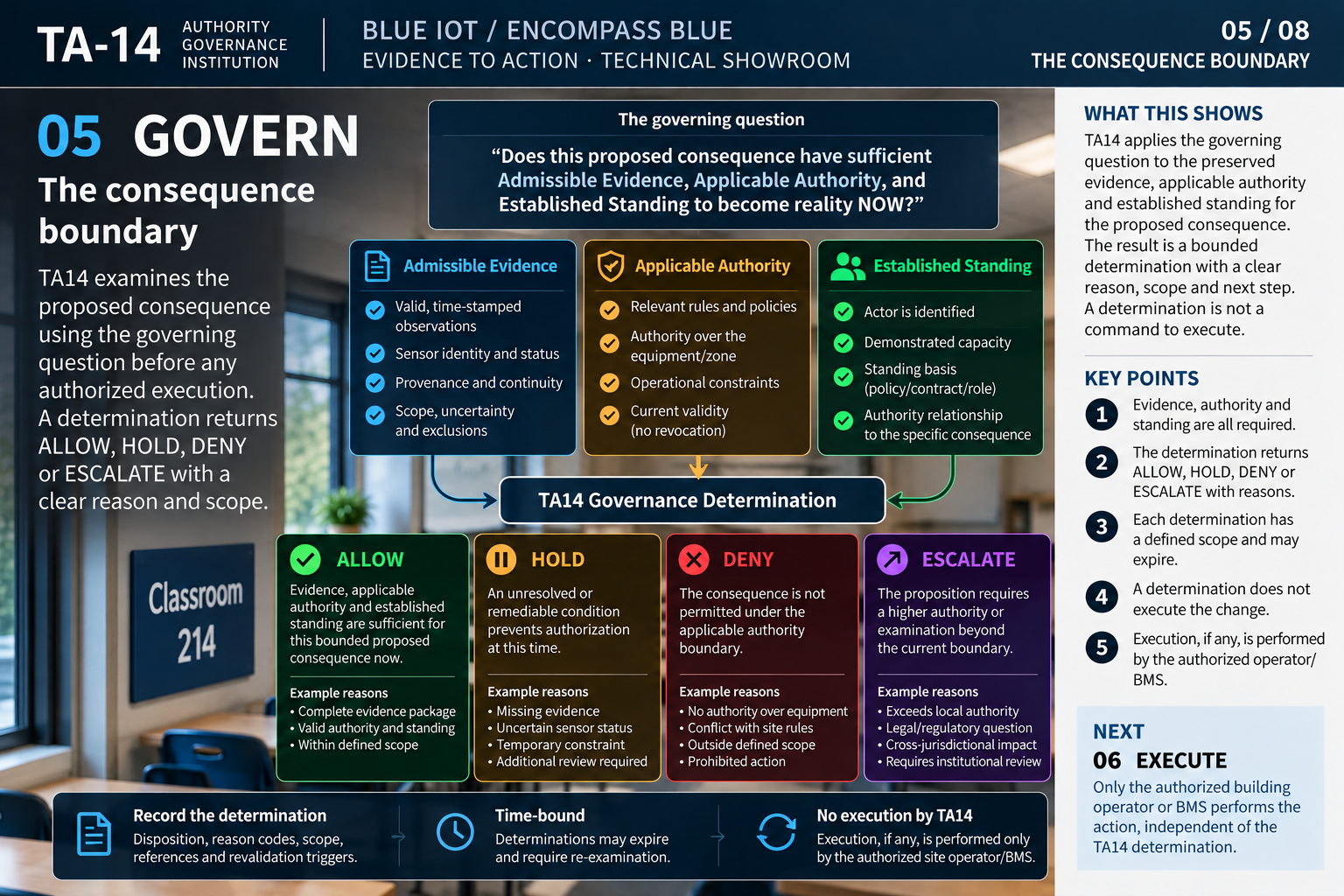
NARRATION SCRIPT: This is the TA14 consequence boundary. Ask the exact governing question: Does this proposed consequence have sufficient Admissible Evidence, Applicable Authority, and Established Standing to become reality NOW? The answer is scoped to this specific proposition and current conditions. A determination may be ALLOW, HOLD, DENY or ESCALATE. Record the reason, source references, time, limitations, and conditions requiring revalidation. Even an ALLOW is not a building-control instruction. It is a bounded governance determination, separate from physical execution.
WHAT YOU JUST LEARNED
You learned that TA14 examines the complete proposed consequence and records ALLOW, HOLD, DENY or ESCALATE with reasons, scope and validity, without operating the building.
WHAT YOU WILL LEARN NEXT
Next, test what happens when the evidence is sufficient but the actor’s authority relationship is missing.
06 / 08 · THE AUTHORITY GAP
ILLUSTRATIVE EXAMINATION
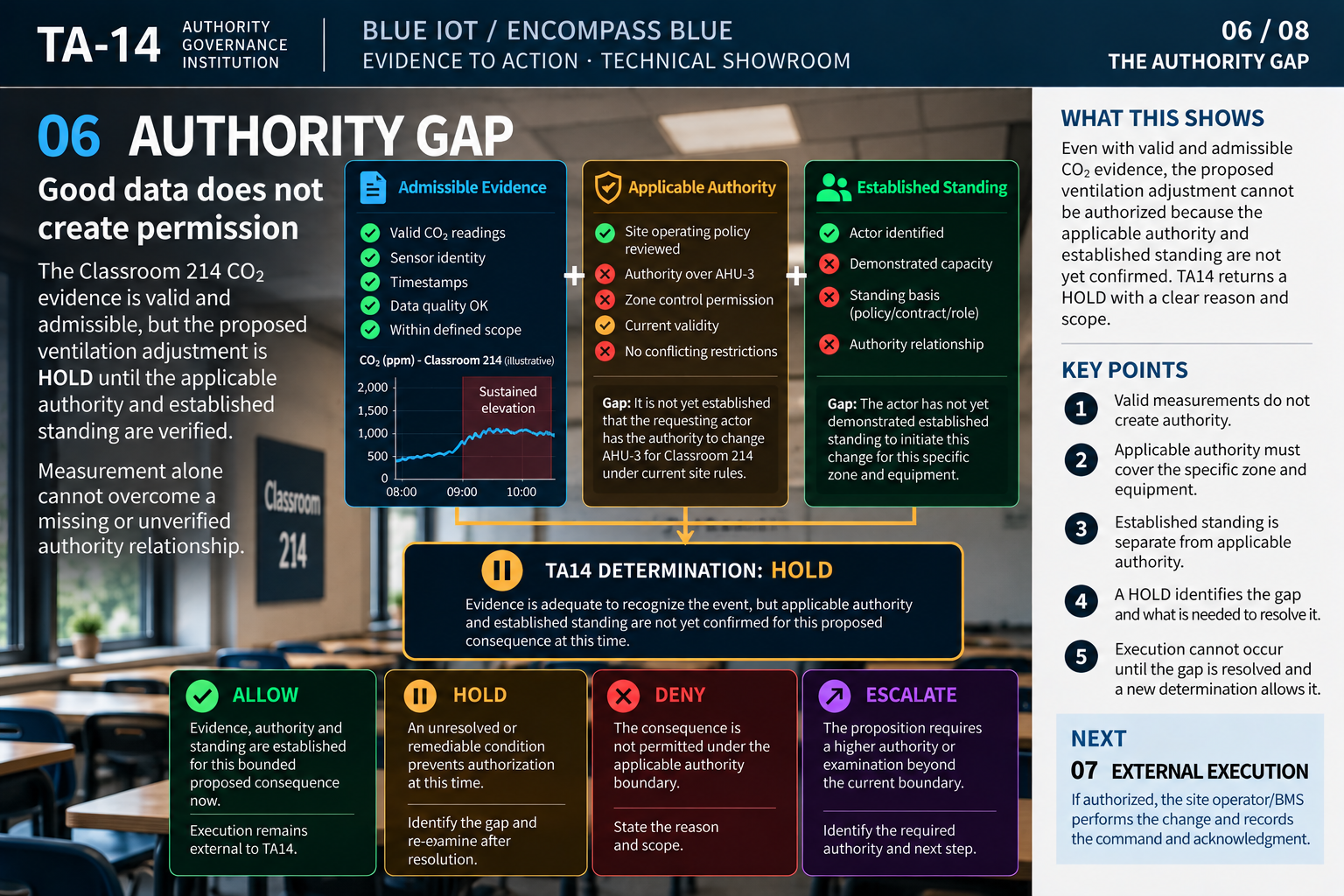
NARRATION SCRIPT: Consider the authority-gap branch. The Classroom 214 environmental evidence may be adequate, and the proposed action may be clearly described, yet the actor’s permission to change the relevant equipment remains unestablished. The correct illustrative determination is HOLD, with the missing authority relationship recorded. HOLD is not a failure to collect sensor data; it is successful recognition that good measurements cannot confer permission. Preserve the evidence, identify the remediable gap and require a fresh determination when the necessary standing is established.
WHAT YOU JUST LEARNED
You learned that admissible environmental evidence does not create missing permission. A HOLD preserves the case until the authority or standing gap is resolved.
WHAT YOU WILL LEARN NEXT
Next, learn why even an ALLOW does not execute a command: authorized site systems still control any physical intervention.
07 / 08 · EXTERNAL EXECUTION
ILLUSTRATIVE EXAMINATION
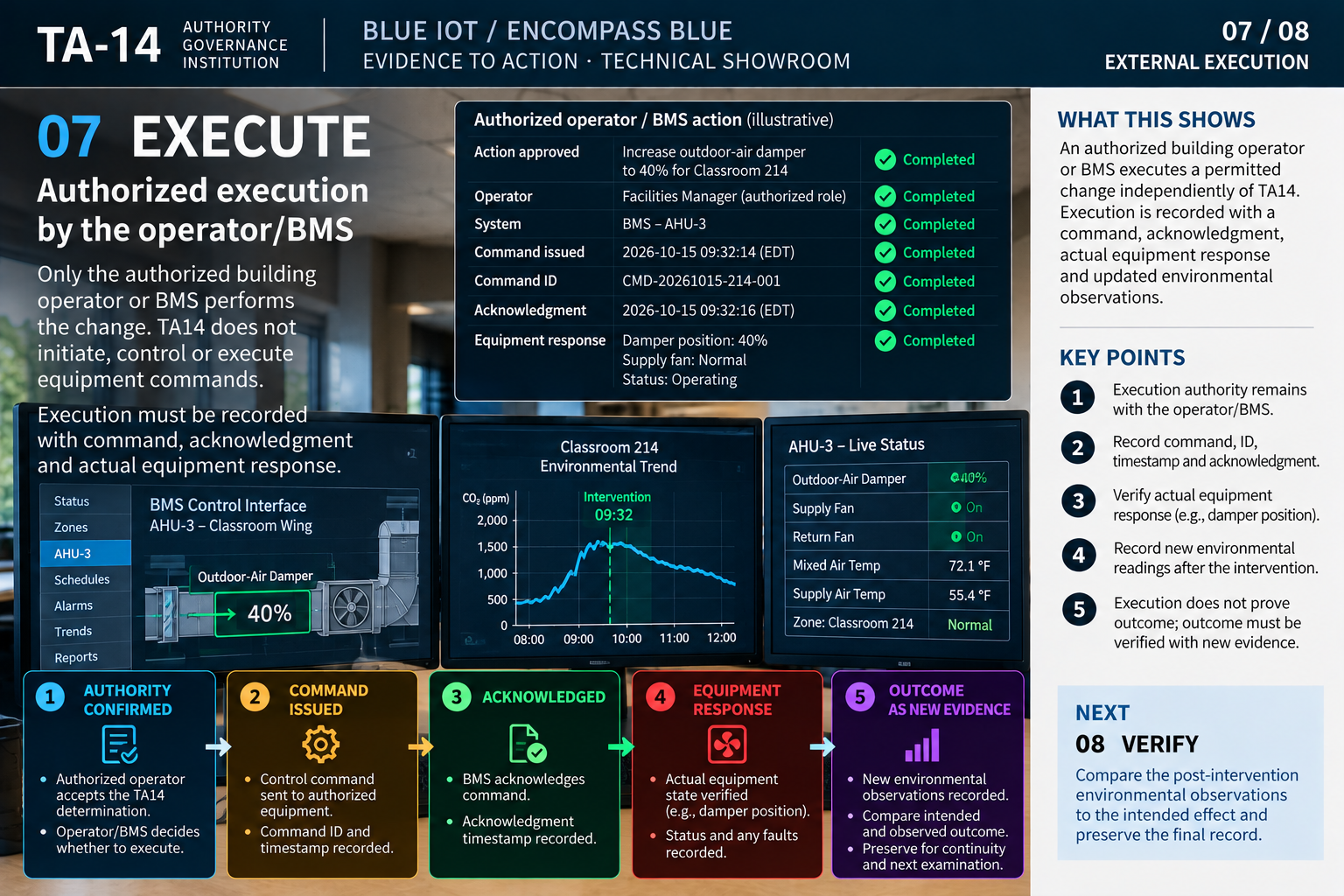
NARRATION SCRIPT: If the relevant conditions are established and a bounded ALLOW is issued, execution still belongs to the authorized site operator or building-management system. That system must independently apply its current safety and operating constraints. Record whether the action was accepted, declined, modified or attempted. If a command is issued, preserve its time, target, acknowledgment and observable equipment response. A successful acknowledgment only shows that a command was received. It does not establish that equipment changed as intended or that the air in Classroom 214 improved.
WHAT YOU JUST LEARNED
You learned that an authorized operator or BMS decides whether to execute, and that commands, acknowledgments and equipment responses must be separately recorded.
WHAT YOU WILL LEARN NEXT
Next, learn how post-action measurements establish what actually changed, and why a command acknowledgment is not proof of an environmental outcome.
08 / 08 · OUTCOME BECOMES EVIDENCE
ILLUSTRATIVE EXAMINATION
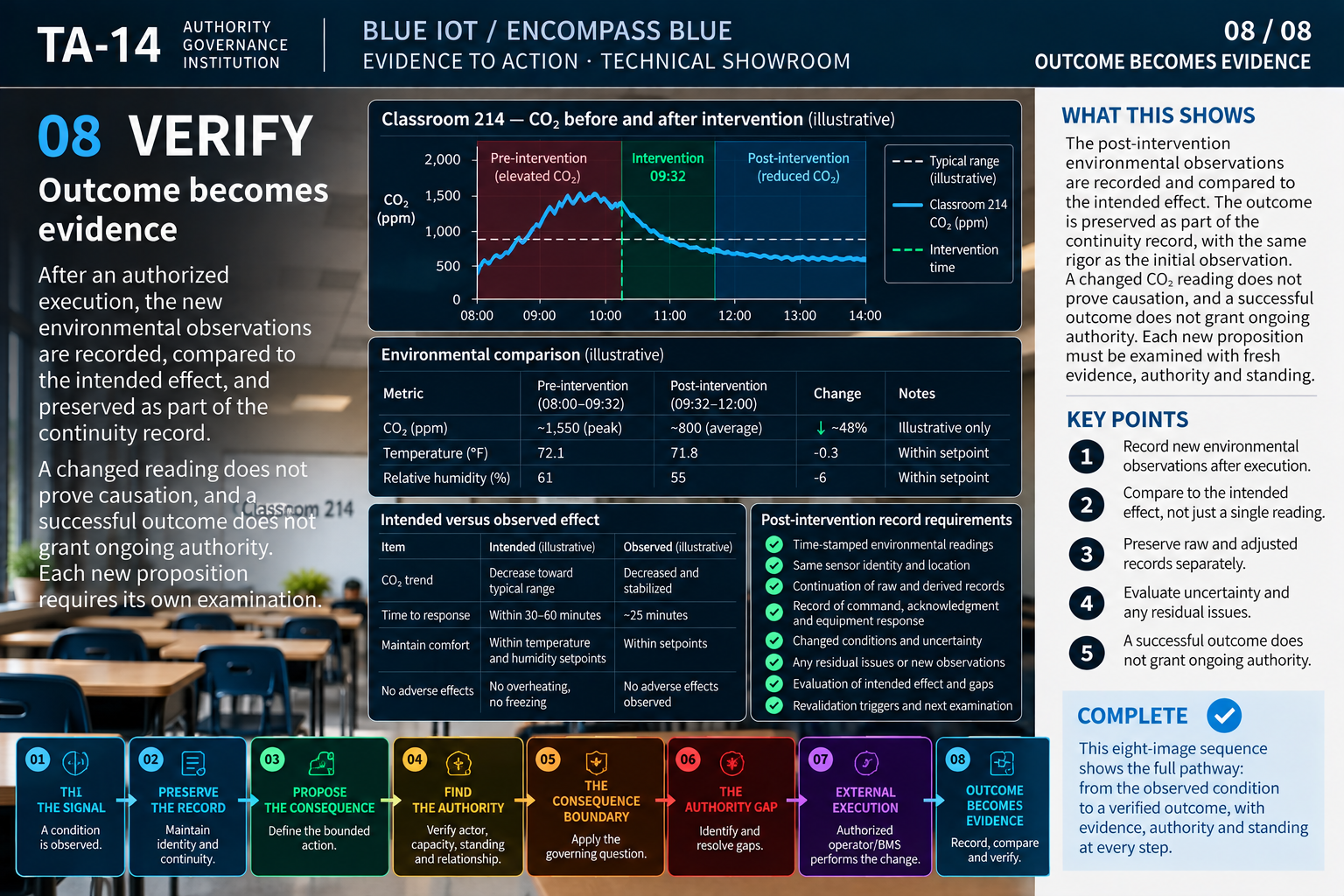
NARRATION SCRIPT: Finally examine what actually happened. Compare the proposed effect with post-action equipment states and time-stamped environmental observations, preserving changed occupancy, conditions, missing data and uncertainty. Distinguish NOT EXECUTED, EXECUTION UNCONFIRMED, EXECUTED WITH OUTCOME UNVERIFIED and VERIFIED OUTCOME. Do not infer causation from a single lower carbon-dioxide reading, and do not treat an apparent benefit as retroactive permission. Preserve the observed outcome as a new evidence record. That record informs the next examination; it does not automatically authorize the next consequence.
WHAT YOU JUST LEARNED
You learned to distinguish observed outcomes from intended results, preserve uncertainty and changed conditions, and treat the outcome as a new evidence record.
FINAL LESSON SUMMARY
The eight lessons establish a complete distinction between environmental observation, admissible evidence, a bounded proposal, applicable authority, established standing, authorized execution and verified outcome. The Classroom 214 simulation below illustrates these boundaries; it does not represent real building evidence.
Read-aloud controls use the visitor's browser/device voice. The Samantha voice is preferred automatically when installed, but is not guaranteed; this is not a studio-recorded Samantha audio track. Scripts remain visible for accessibility. Scroll freely through all eight images.
THE PRACTICAL PATHWAY
Sense it. Validate it. Govern the consequence. Verify the outcome.
01DETECTSustained CO₂ eventEnvironmental sensing identifies a condition that may warrant attention. Detection is evidence of a condition, not authority to intervene.
02VALIDATEEvidence + provenanceSensor identity, timing, continuity, attribution, and relevant environmental context are checked before the signal is treated as admissible evidence.
03PROPOSEExplicit consequenceA specific ventilation or HVAC consequence is stated—for example, increasing outdoor-air ventilation for the affected zone.
04AUTHORITYWho may approve or execute?The asserted authority is identified and checked against the equipment, place, scope, and current condition.
05GOVERNTA-14 consequence boundaryTA-14 asks whether the proposed consequence has admissible evidence, applicable authority, and established standing to become reality now.
06EXECUTEBMS / HVAC actionAny physical or operational intervention remains under the appropriate operational system and authority. A TA-14 determination is not the execution itself.
07VERIFYOutcome becomes new evidenceThe resulting environmental state is observed and preserved as the next record rather than inferred from the command.
RUN ONE · SUSTAINED CO₂ EVENT · ILLUSTRATIVE SIMULATION ONLY
Classroom 214 · proposed ventilation increase
Training simulation: buttons change this demonstration's displayed state only. No live evidence is validated, no real authority is established, and no command is sent to building equipment.
DETECTION
CO₂ remains elevated beyond the bounded observation period.
EVIDENCE
Sensor identity, timestamps, provenance, and continuity are addressable.
PROPOSITION
Increase outdoor-air ventilation for Classroom 214.
AUTHORITY
Building operator / control authority must be established for this consequence.
STANDING
Evidence and authority must apply to this room, equipment, condition, and time.
TA-14 CONSEQUENCE BOUNDARY
Does this proposed ventilation consequence have admissible evidence, applicable authority, and established standing to become reality NOW?
GOVERNED STATE
ENVIRONMENTAL CONDITION
SUSTAINED CO₂ EVENT
PROPOSED CONSEQUENCE
INCREASE OUTDOOR-AIR VENTILATION
TA-14 DETERMINATION
PENDING
EXECUTION STATE
NOT EXECUTED
Detection establishes a condition to examine. It does not itself establish intervention authority.
WHAT THE TECHNICAL DISCUSSION WOULD TEST
One event. Five questions. No assumed integration.
01
What evidence arrives?
Which CO₂ measurements, timestamps, sensor identities, and context are available to support the proposition?
02
What can Encompass Blue establish?
Which sensing, analytics, equipment relationships, recommendations, or control states are already represented?
03
Where is authority represented?
What identifies the person, policy, control system, or operating role permitted to approve this specific intervention?
04
What does TA-14 return?
What bounded determination and reason can be attached to the proposed consequence without taking over execution?
05
What proves the outcome?
Which post-action observations establish what actually changed and become the next environmental record?
WHERE THE SYSTEMS MEET
Environmental intelligence and execution governance remain distinct.
ENVIRONMENTAL / BUILDING SYSTEM LAYER
Sensing, environmental data, analytics, equipment context, recommendations, controls, and outcome observations may be provided by platforms such as Encompass Blue, BMS, HVAC, operators, and other building systems.
TA-14 GOVERNANCE LAYER
TA-14 evaluates the bounded proposition at the consequence boundary: whether it has admissible evidence, applicable authority, and established standing for that proposed consequence now. It does not replace the sensing platform, BMS, HVAC controls, or operator.
PROPOSED NEXT STEP
Run this exact CO₂ pathway together.
Use the states, evidence, equipment relationships, recommendations, control context, and post-action observations that Encompass Blue actually exposes. Then examine where the bounded consequence proposition reaches TA-14, what governance determination can be returned without taking over execution, and what evidence closes the resulting outcome.
BOUNDARY NOTICE
This showroom is a TA-14 discussion surface derived from the technical pathway proposed in correspondence with Robert Sharon. It does not state or imply that Blue IoT, Encompass Blue, Robert Sharon, or any associated party has adopted, integrated, certified, endorsed, or transferred authority to TA-14. The example is conceptual until a bounded technical examination is mutually defined and performed.