STOP THE CYBER ATTACK · OCTOBER 2, 2026 · 10–11 AM EDT
MAKE THE BUILDING PROVE IT
A coalition working examination using the RE1 building environment to test persistent identity, governed connection, lifecycle and evidence readiness, and the final local consequence boundary without turning any participant into the whole system.
01 · CAN IT CONNECT?≠02 · MAY THIS CONSEQUENCE EXECUTE?
WORKING DRAFT · OPEN FOR CORRECTION · COALITION TEST ENVIRONMENT
GUIDED VISUAL EXAMINATION
Eight lessons. One working examination.
Each lesson gives you a visual, an optional narrated walkthrough, a deeper explanation, and a clear handoff to the next boundary.
01
LESSON 01 OF 08
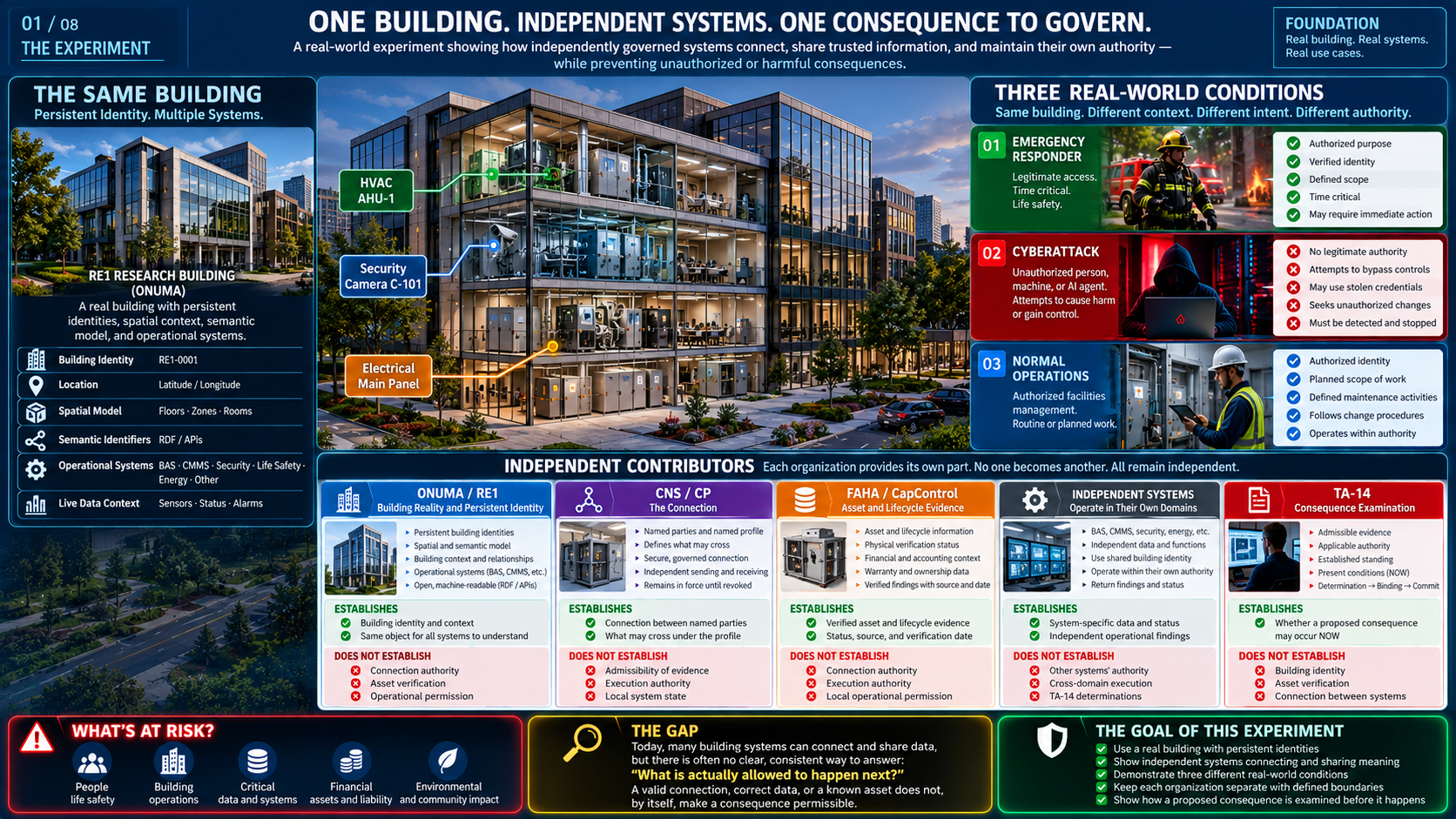
THE EXPERIMENT
COALITION VIEW · REAL BUILDING USE CASE
BEFORE YOU LOOK
Start with the building, not with any one architecture. The experiment exists to see whether independent systems can work together around the same real building without becoming one another.
🎧 LISTEN TO THIS LESSONUses Samantha when available on your device; otherwise an English system voice.
DEEPER EXPLANATION
Begin with the real building. The purpose of this experiment is not to make one platform control everything. It is almost the opposite. We want several independently governed systems to understand the same building, exchange only the information they are permitted to exchange, and still keep their own ownership, responsibilities, data, and authority. ONUMA / RE1 provides the building reality for the experiment: persistent identities, spatial and semantic context, system relationships, and access to machine-readable building information. CNS/CP gives us a way to describe the governed connection between named parties. FAHA / CapControl contributes independently established asset and lifecycle evidence. Building automation, security, maintenance, energy, and other systems continue to operate in their own domains. TA-14 does not replace any of those systems. Its specific role comes later, when a receiving domain asks whether a particular proposed consequence is sufficiently supported now. The experiment is intentionally designed around separation. Shared information does not mean shared ownership. Interoperability does not mean centralization. Connection does not mean authority. The technical question is whether we can make those boundaries observable enough to test.
WHAT YOU JUST LEARNED
ONUMA / RE1 supplies the shared building context and persistent identities. CNS/CP supplies the governed connection model. FAHA / CapControl contributes asset and lifecycle findings. Other building systems keep their own operational functions. TA-14 enters only at the local consequence question.
NEXT
Next we isolate the Connection Profile, because the experiment only works if we are precise about what a connection establishes—and what it does not.
LESSON 01 COMPLETECONTINUE TO 02 · THE CONNECTION PROFILE ↓
02
LESSON 02 OF 08
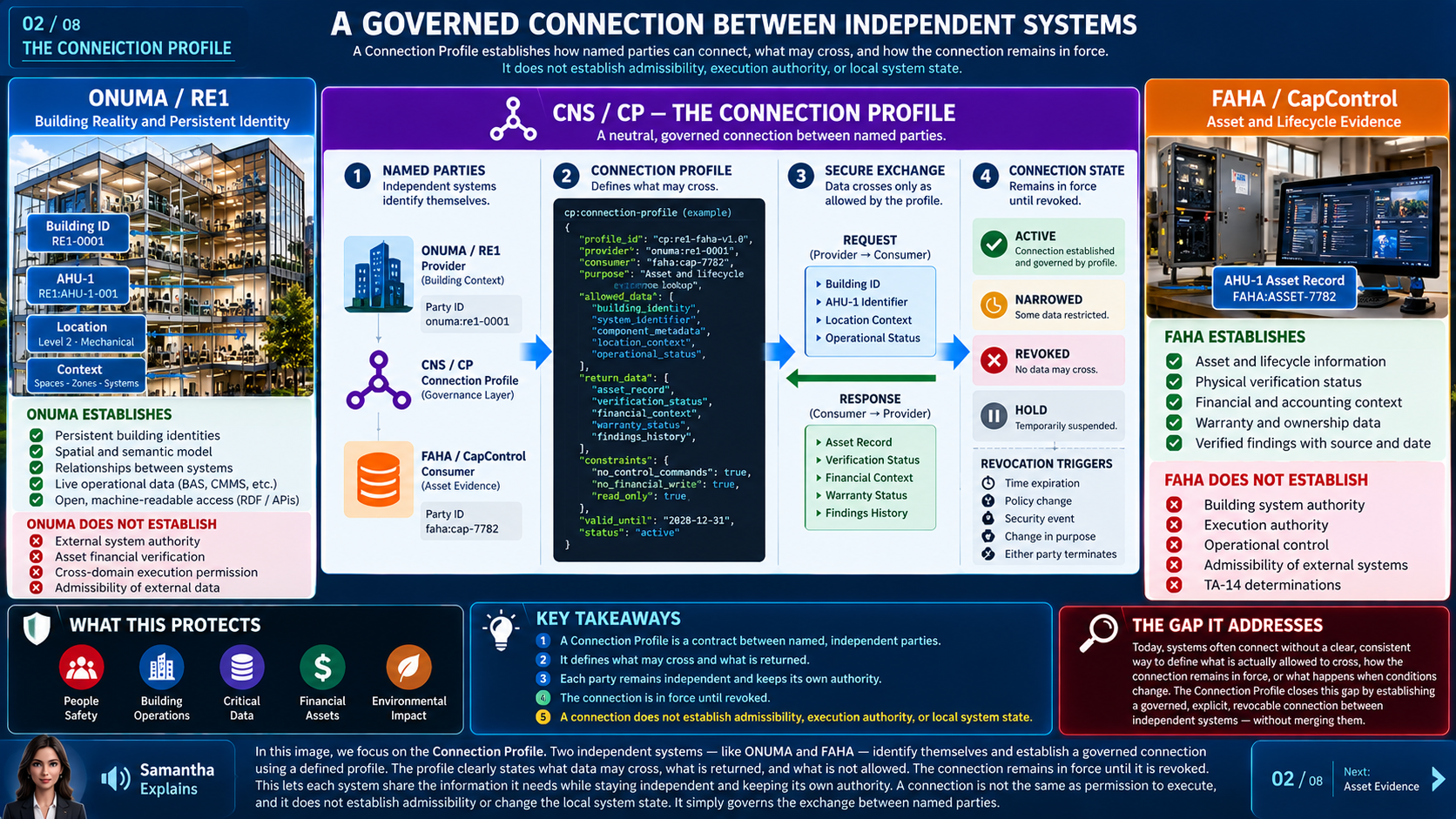
THE CONNECTION PROFILE
CNS/CP · NAMED PARTIES · NAMED PROFILE · REVOCABLE CONNECTION
BEFORE YOU LOOK
Focus on the agreement between independent parties. Ask: who is connecting, under what named Profile, for what purpose, what may cross, what may return, and when is the connection no longer in force?
🎧 LISTEN TO THIS LESSONUses Samantha when available on your device; otherwise an English system voice.
DEEPER EXPLANATION
This is the core of the Connection Profile idea. Two named parties in different organizations connect under a named Profile for a stated purpose. The Profile is not a hidden gateway that makes downstream decisions for either party. It is the contract the parties connect under. It defines the properties of the connection and therefore what is permitted to cross through that connection. One side may send information, the other side may return information, and the connection remains in force until it expires or one side revokes it. The important discipline is to stop CNS/CP where CNS/CP stops. It does not establish that evidence is admissible. A Profile may carry evidence of bounded rights or a valid delegation when those terms come from parties with authority to grant them, but the Profile does not itself establish that the exact proposed consequence has sufficient Applicable Authority. It does not decide standing or what a receiving building must do with the information. Those are questions for the appropriate governed domains. In this experiment, the Connection Profile is valuable precisely because it lets independent parties exchange defined information without forcing either party to surrender its independently governed responsibilities or become part of a single master system.
WHAT YOU JUST LEARNED
CNS/CP establishes the connection terms. The Profile defines what may cross; the parties act under those terms. It does not decide admissibility, Applicable Authority sufficiency, commit permission, or the state of either local system.
NEXT
Next we make the exchange concrete by following actual building and asset information through the governed connection.
LESSON 02 COMPLETECONTINUE TO 03 · THE SECURE EXCHANGE ↓
03
LESSON 03 OF 08
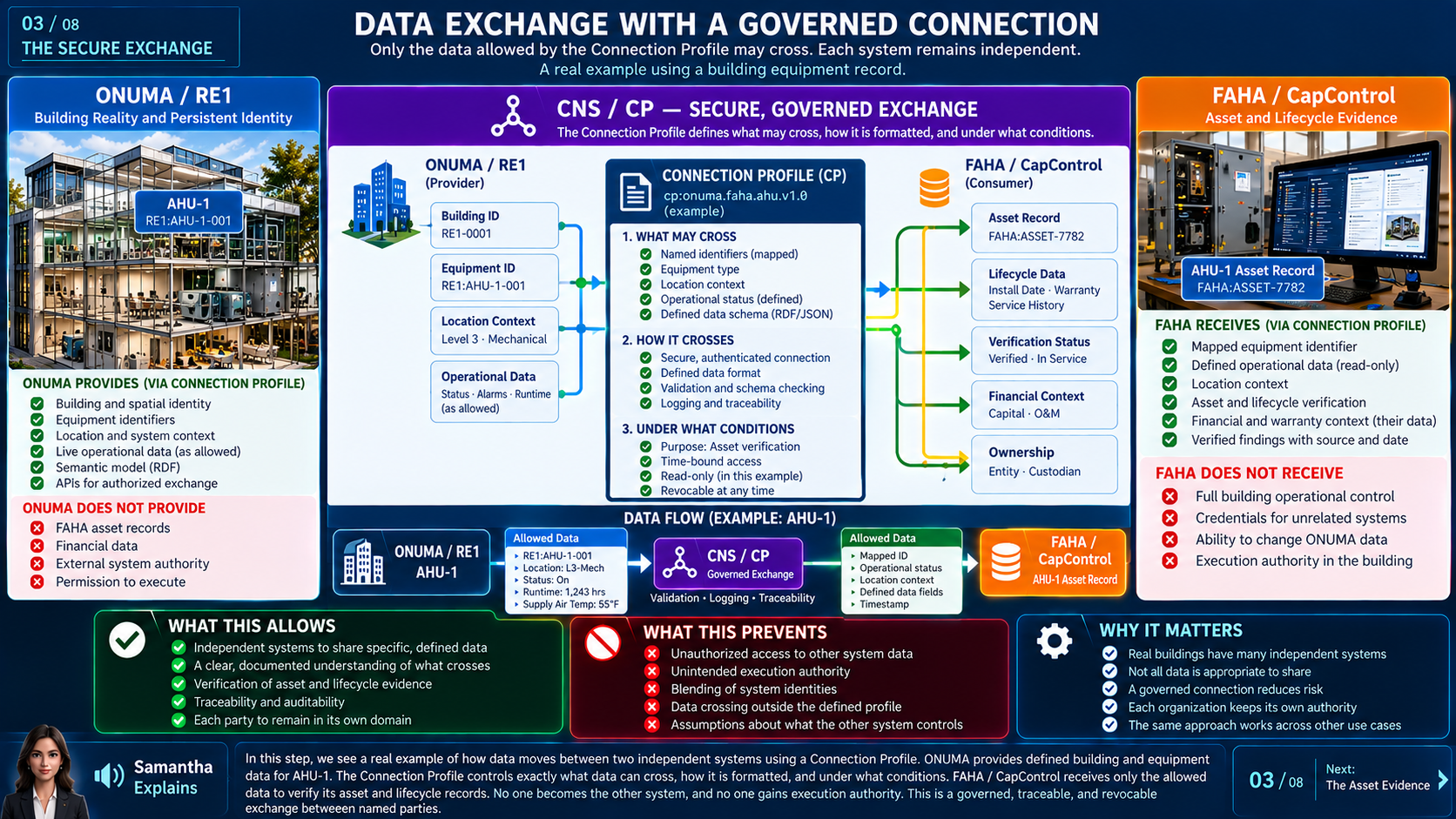
THE SECURE EXCHANGE
CNS/CP IN OPERATION · ONLY DEFINED INFORMATION CROSSES
BEFORE YOU LOOK
Trace the information itself. Which identifiers, context, status, or findings are allowed to cross? Which information is deliberately excluded? Which side owns the returned material?
🎧 LISTEN TO THIS LESSONUses Samantha when available on your device; otherwise an English system voice.
DEEPER EXPLANATION
Now we turn the Connection Profile into an observable exchange. ONUMA / RE1 can expose persistent building identifiers, spatial context, semantic relationships, and defined operational information that the Profile permits. A receiving domain can use those identifiers to understand which real building object the information refers to. It can then return its own independently owned information under the connection. The key is that the connection does not erase ownership. ONUMA still owns its building context. The receiving domain still owns the findings it creates. The Profile does not make one database authoritative over the other. It narrows the exchange to what the parties have agreed may cross. This is also where revocation matters. If the connection is revoked, the exchange ends. That connection state must be recorded separately from any local decision made using information that crossed earlier. This separation gives us something concrete to examine: what crossed, under what Profile, when, between which named parties, and what did not cross.
WHAT YOU JUST LEARNED
The exchange is narrow, explicit, traceable, and revocable. ONUMA can provide building identity and context. FAHA / CapControl can return its own findings. Neither side gains control of the other system.
NEXT
Next we slow down Angela’s domain and show why asset evidence is more than simply having another database.
LESSON 03 COMPLETECONTINUE TO 04 · ASSET EVIDENCE AND LIFECYCLE ↓
04
LESSON 04 OF 08
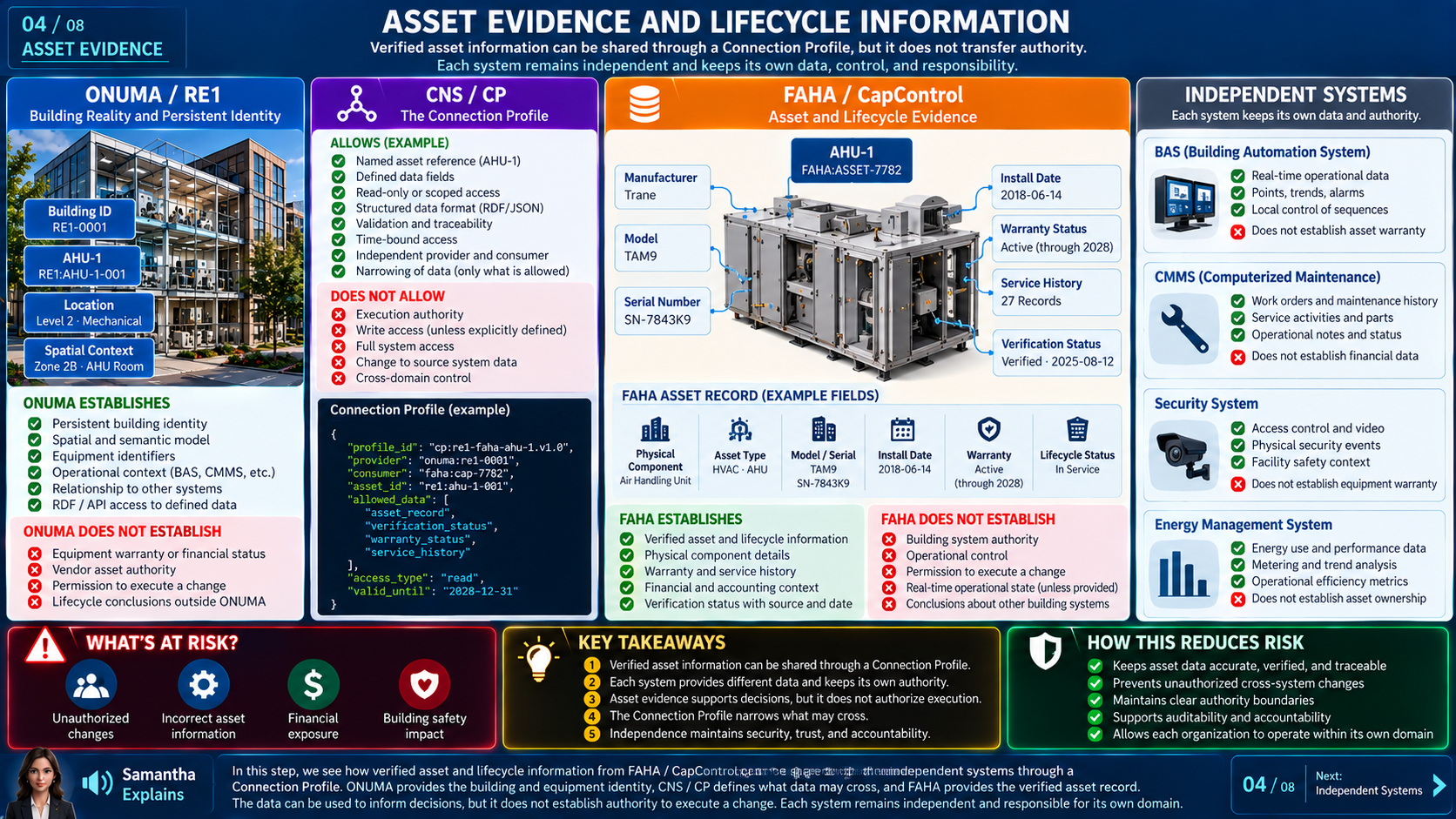
ASSET EVIDENCE AND LIFECYCLE
FAHA / CAPCONTROL · ASSET INFORMATION READINESS AND VALIDATION
BEFORE YOU LOOK
Look beyond the physical AHU. Ask whether the component maps to the correct accounting or asset record, when it was verified, what warranty or ownership context applies, and what findings are current.
🎧 LISTEN TO THIS LESSONUses Samantha when available on your device; otherwise an English system voice.
DEEPER EXPLANATION
This layer matters because a building component and a financial asset record are not always the same thing. ONUMA may identify AHU-1 as a precise physical component in the building. The owner’s fixed-asset register may capitalize that equipment as part of a larger HVAC system, a building improvement, or a project placed in service as a group. If we fail to map those identities correctly, the systems may appear connected while the financial or lifecycle evidence is actually attached to the wrong accounting unit. FAHA / CapControl therefore contributes more than raw data. It evaluates whether the asset record is complete, reconciled, physically verified, and current as of a stated date. It can contribute lifecycle status, warranty information, ownership or lease context, responsible cost center, financial context, and findings history with superseded findings preserved. What it does not contribute is permission to execute a building action. Financial approval history may be important authority context, but capital approval is not automatically operational authority. That distinction is exactly why the domains stay separate.
WHAT YOU JUST LEARNED
Angela’s domain evaluates whether asset and lifecycle information is complete, reconciled, physically verified, and current as of a stated date. It contributes findings and context—not execution authority.
NEXT
Next we step back and show the larger operating principle: independent systems can share information without merging.
LESSON 04 COMPLETECONTINUE TO 05 · INDEPENDENT SYSTEMS ↓
05
LESSON 05 OF 08
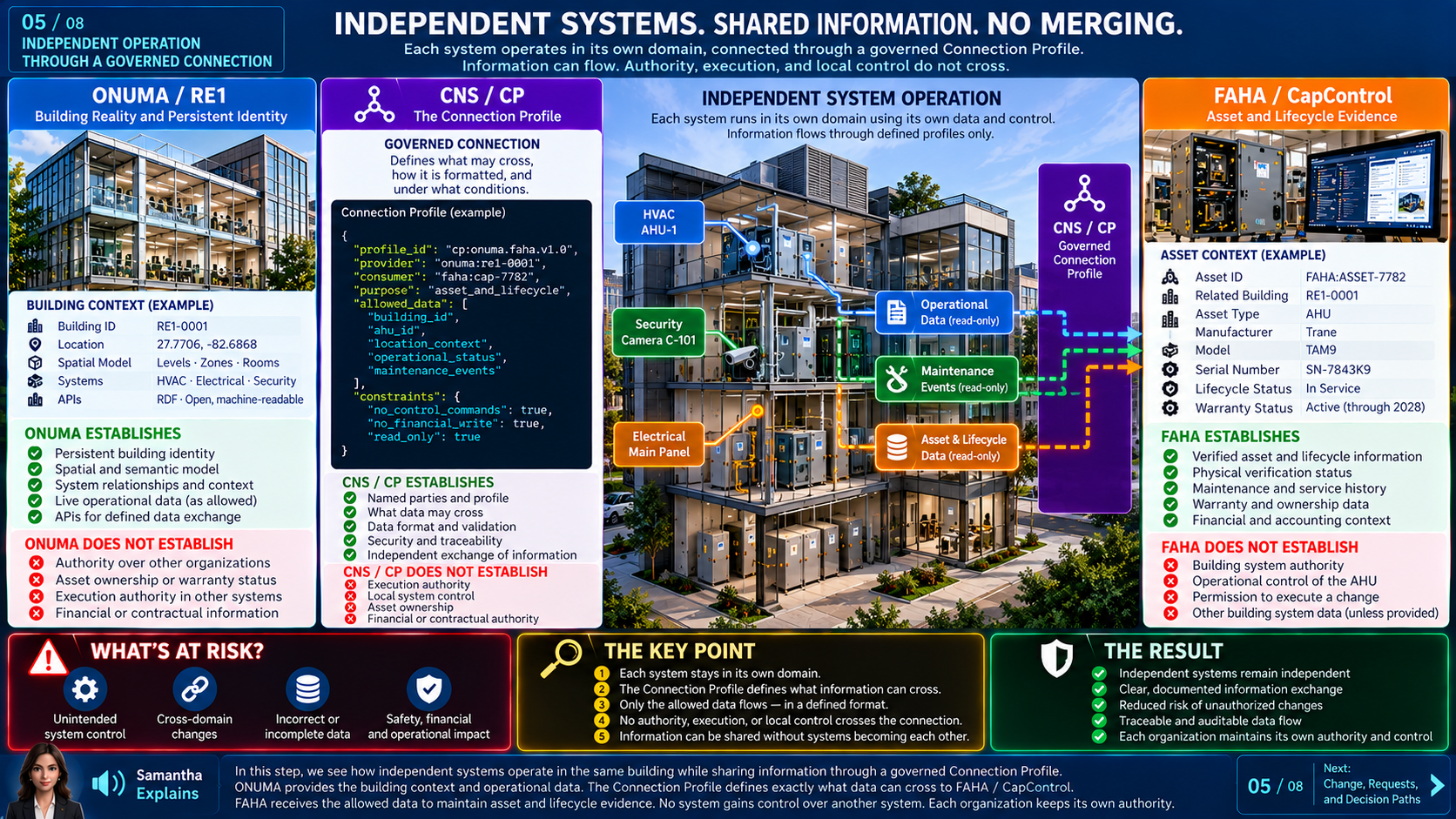
INDEPENDENT SYSTEMS
SEPARATION PRINCIPLE · INFORMATION CAN MOVE WITHOUT SYSTEMS BECOMING ONE
BEFORE YOU LOOK
Notice that every system keeps its own data, logic, controls, and responsibility. The connection gives them a governed way to exchange information; it does not merge their authority.
🎧 LISTEN TO THIS LESSONUses Samantha when available on your device; otherwise an English system voice.
DEEPER EXPLANATION
This image is about one of the most important design rules in the experiment: independence survives interoperability. A building automation system may own operational points and sequences. A maintenance system may own work orders and service history. A security system may own access events and camera information. An asset domain may own its findings and lifecycle analysis. ONUMA / RE1 may provide the persistent building identity that lets those records refer to the same physical thing. A governed connection allows defined information to move among those domains, but no system becomes the master of the others. That matters for cybersecurity, accountability, and trust. If one system could silently inherit another system’s authority merely because data crossed between them, interoperability would create a new attack surface. The safer model is explicit: information may cross under defined terms; system control remains independently governed; authority may be presented through a valid applicable source or bounded delegation; no system silently inherits authority merely because information or capability crossed a connection; and every system remains responsible for the claims it makes.
WHAT YOU JUST LEARNED
Interoperability means systems can understand and use shared information while remaining independently governed. No system silently inherits another system’s permissions or controls.
NEXT
Next we scale the same principle across multiple building domains instead of only two parties.
LESSON 05 COMPLETECONTINUE TO 06 · MULTI-DOMAIN INTEROPERABILITY ↓
06
LESSON 06 OF 08
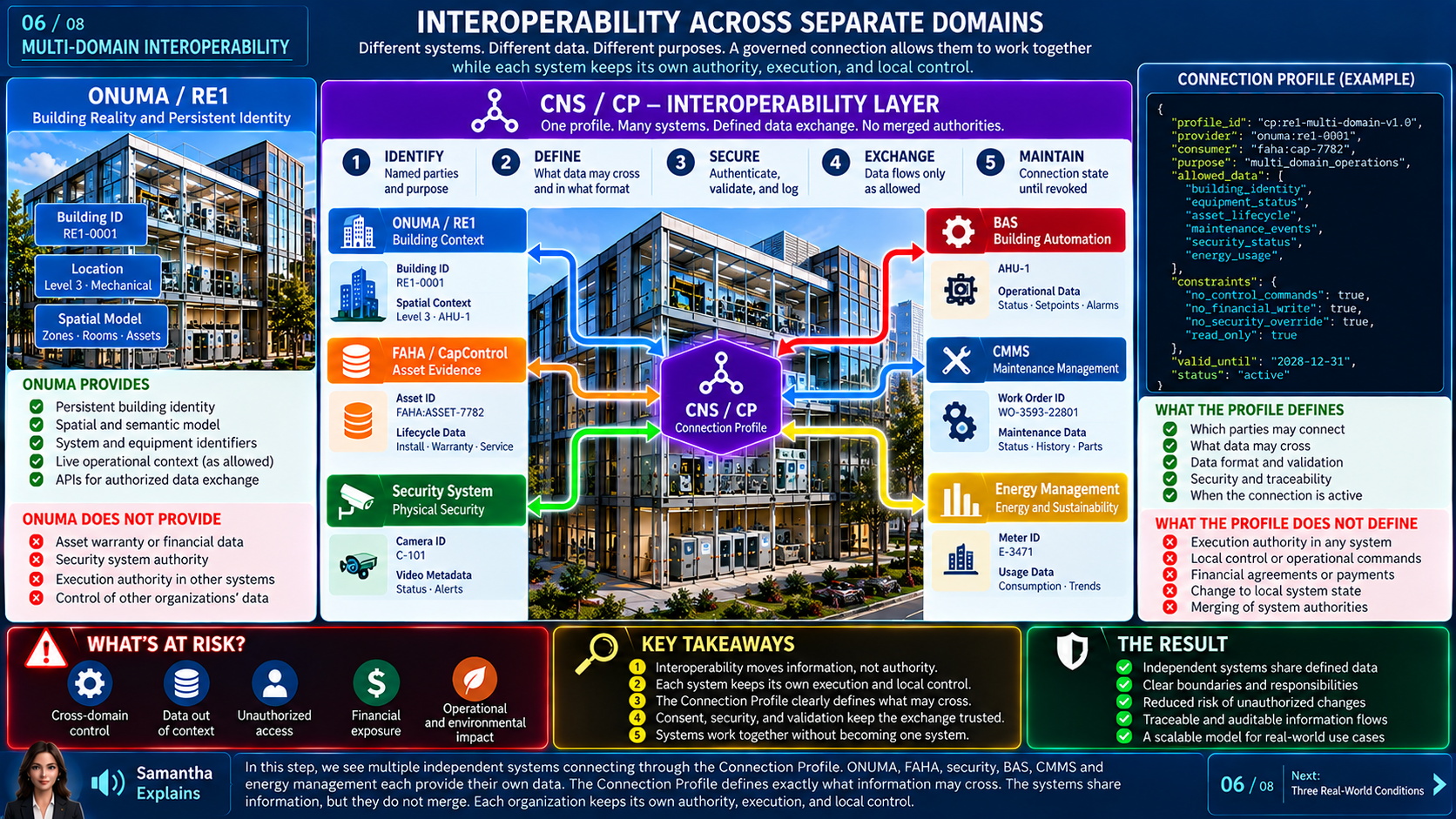
MULTI-DOMAIN INTEROPERABILITY
COALITION TEST · MANY DOMAINS · SHARED BUILDING IDENTITY
BEFORE YOU LOOK
Follow one building identity across multiple systems. Ask which domain created each piece of information and whether the connection preserves that provenance.
🎧 LISTEN TO THIS LESSONUses Samantha when available on your device; otherwise an English system voice.
DEEPER EXPLANATION
Now we scale the experiment. Real buildings are ecosystems, not single applications. Different systems know different things for different reasons. ONUMA / RE1 gives the ecosystem persistent building identity and context. CNS/CP gives named parties a governed way to connect and define what may cross. FAHA / CapControl contributes asset and lifecycle evidence. BAS, CMMS, security, energy, and other systems contribute their own operational information. The objective is not to centralize these systems. It is to make their relationships inspectable. A useful interoperability result should let us answer: which system produced this fact, what object does it refer to, when was it current, under what connection did it cross, and what authority—if any—does the receiving system actually have to use it for a consequential action? This is where the experiment becomes relevant to cybersecurity. A trusted data path is necessary, but it is not the same thing as a trusted execution path.
WHAT YOU JUST LEARNED
The coalition demonstrates that building context, asset findings, maintenance records, security information, BAS data, and energy data can interoperate without collapsing into one platform.
NEXT
Next we apply the architecture to different real-world requests against the same building and see why context changes the result.
LESSON 06 COMPLETECONTINUE TO 07 · THREE REAL-WORLD CONDITIONS ↓
07
LESSON 07 OF 08
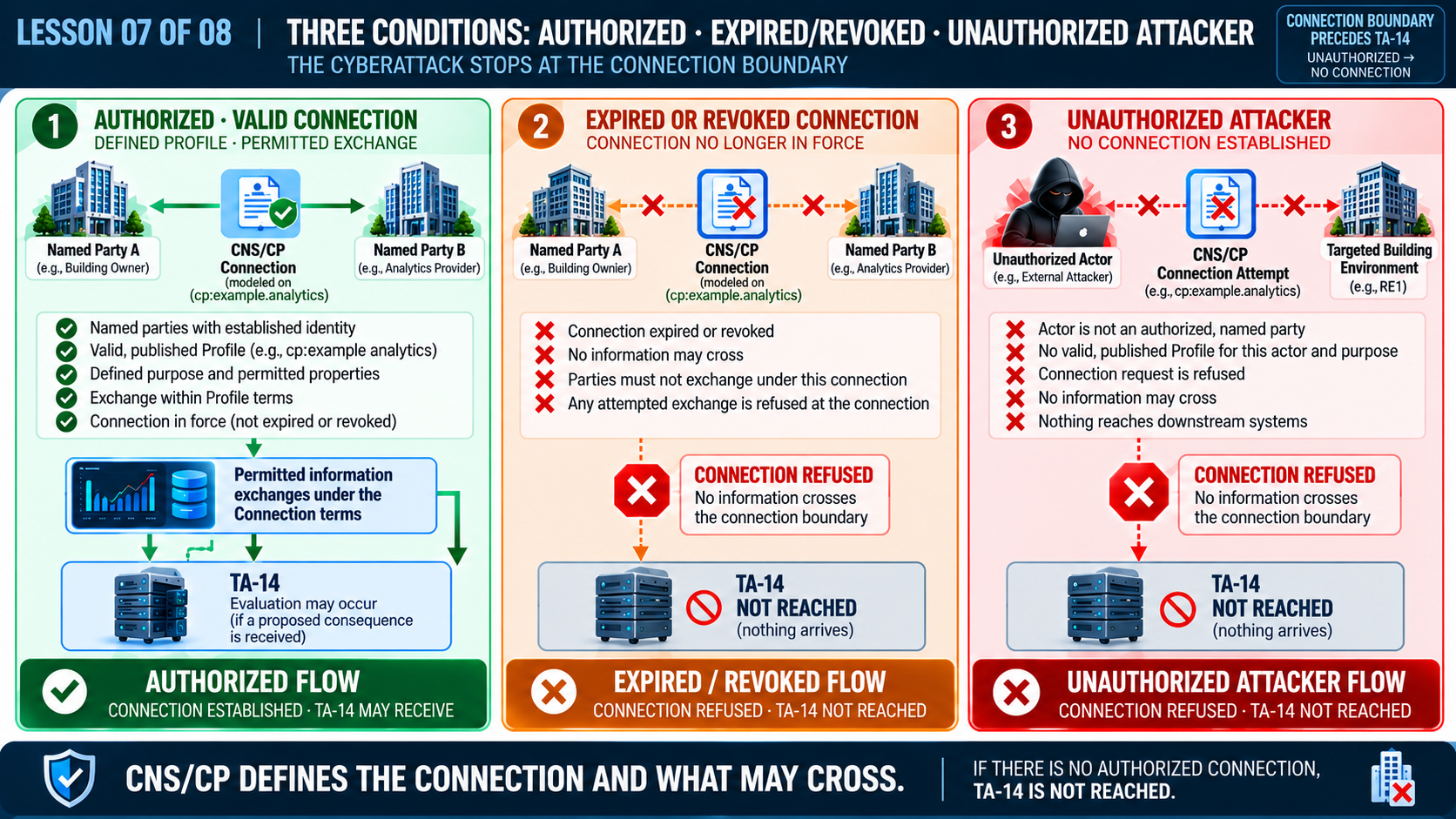
THREE REAL-WORLD CONDITIONS
USE-CASE TEST · SAME BUILDING · DIFFERENT CONTEXT
BEFORE YOU LOOK
Compare the requests, not just the equipment. The same building and the same persistent identities can appear in very different situations, and each request must earn its own result.
🎧 LISTEN TO THIS LESSONUses Samantha when available on your device; otherwise an English system voice.
DEEPER EXPLANATION
This is where the architecture has to prove that it can handle real variation. The same building may be involved in an authorized exchange, an expired or revoked connection, or an unauthorized external attempt. The persistent building identities may be the same, but connection state and party authorization are not. CNS/CP defines the connection and what may cross. The parties act under those terms. If a valid connection is in force, permitted information may cross and a downstream local consequence examination may later be reached if a proposed consequence is received. If the connection has expired or been revoked, the exchange stops at the connection boundary. If an unauthorized actor attempts to connect, no authorized connection is established and no information crosses through that path. In both stopped cases TA-14 is not reached; there is nothing for TA-14 to HOLD, DENY, ALLOW, or ESCALATE. This distinction is central to the cyberattack experiment: a connection-layer failure must remain a connection-layer result rather than being misrepresented as a downstream TA-14 decision.
WHAT YOU JUST LEARNED
The connection boundary is consequential. An authorized connection may permit defined information to cross. An expired, revoked, or unauthorized connection stops upstream; nothing reaches the downstream TA-14 consequence examination through that path.
NEXT
The final image brings every layer together and shows exactly where TA-14 enters the coalition architecture.
LESSON 07 COMPLETECONTINUE TO 08 · THE COMPLETE EXAMINATION ↓
08
LESSON 08 OF 08
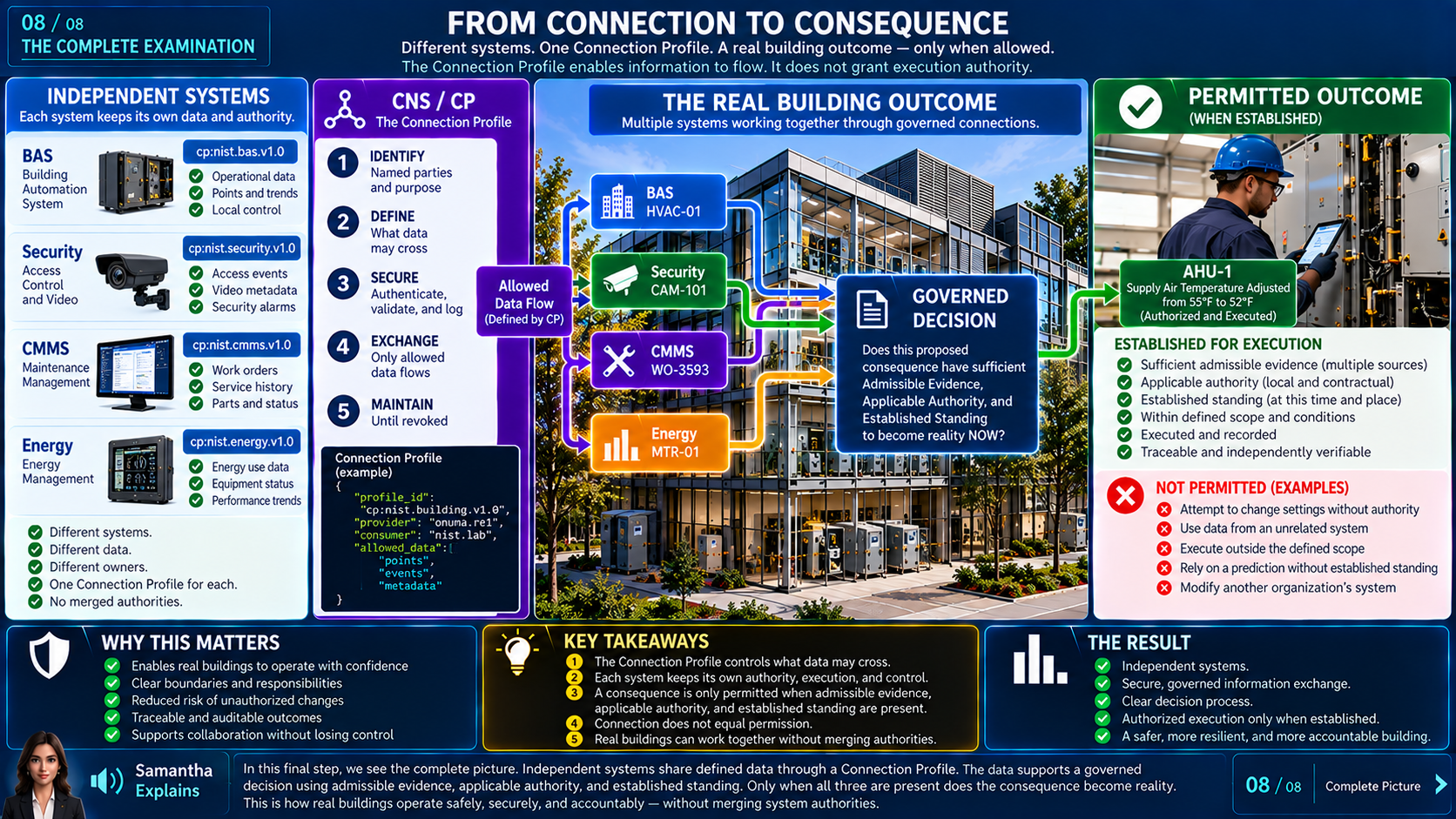
THE COMPLETE EXAMINATION
FROM CONNECTION TO CONSEQUENCE · TA-14 ENTERS AT THE LOCAL CONSEQUENCE BOUNDARY
BEFORE YOU LOOK
Read the complete chain from left to right. Keep asking who owns each fact, who owns each decision, and where a physical consequence can still be stopped.
🎧 LISTEN TO THIS LESSONUses Samantha when available on your device; otherwise an English system voice.
DEEPER EXPLANATION
The final image joins the pieces without pretending they are one architecture owned by one organization. ONUMA / RE1 provides the persistent building reality and shared identities. CNS/CP governs connections between named independent parties and defines what may cross. FAHA / CapControl and other independent systems contribute evidence, findings, status, or context from their own domains. Those contributions can travel and reconnect around the same building object without silently creating or inheriting authority. Any claimed delegation of authority remains evidence to be examined for applicability and sufficiency for the exact proposed consequence. Only after that upstream context exists does TA-14 perform its specific function: examining whether a proposed consequence has sufficient Admissible Evidence, Applicable Authority, and Established Standing to become reality now. Even an ALLOW determination is not the physical act. Binding, Commit, Execution, and Outcome remain distinct. The workshop question is therefore not whether one coalition member should control the whole system. It is whether the independent seams can be made explicit, testable, revocable, traceable, and resistant to assumptions. If an existing mechanism already performs one of these functions, the correct result is to map the overlap. If a gap remains, the experiment should show exactly where it is.
WHAT YOU JUST LEARNED
ONUMA establishes shared building context. CNS/CP establishes the governed connection and what may cross. Independent domains contribute their own evidence and findings. TA-14 then asks a narrow local question about the proposed consequence. Execution remains a separate governed step.
NOW USE THE EXAMINATION
Visual orientation complete. Use the live examination below to change conditions and observe which boundary changes.
One building. Three conditions. Independent domains.
This working room starts with the use cases and the real RE1 building environment. The objective is to observe what each independently governed domain can establish, what crosses between organizations, and where a proposed consequence can still be stopped.
COALITION RULE: No participant becomes the whole system. ONUMA / RE1 supplies the building test bed and persistent context. CNS/CP defines the governed connection between named parties. Fixed Asset Consultant / FAHA / CapControl contributes lifecycle, capital and evidence-readiness findings. TA-14 enters only at the downstream local consequence question.
BOUNDARY A · CONNECTIONWho is connecting? Under what named Profile? For what purpose? What may cross? What actually crossed? Is the connection still in force?
BOUNDARY B · LOCAL CONSEQUENCEAfter the upstream facts and findings arrive, what does the receiving domain establish locally before any consequential action can proceed?
THE USE-CASE TEST
Same building. Same persistent identities. Different context, connection and authority.
Kimon’s working experiment uses three conditions: emergency response by a legitimate responder, a cyberattack by an unauthorized person, machine or AI agent, and normal facilities management as the control case.
WHO ESTABLISHES WHAT?
Four contributions. Four boundaries. No master system.
ONUMA / RE1 · BUILDING TEST BEDPersistent building identities, spatial and semantic relationships, operational context, RDF and APIs make the use cases concrete. This establishes shared building context; it does not by itself establish downstream execution permission.
CNS/CP · CONNECTIONA Connection Profile is the named contract two parties in different organizations connect under. It defines the connection properties and what may cross. The parties perform their own security, validation, policy and decision functions under those terms. CNS/CP does not decide admissibility, authority, standing, consequence or local system state.
FIXED ASSET CONSULTANT · FAHA / CAPCONTROLLifecycle, Capital & Evidence Readiness: whether asset and financial information is complete, reconciled to the books, matched to physical reality and current as of a stated date. It contributes findings, source, verification date and status. It does not determine admissibility or authorize execution.
TA-14 · LOCAL CONSEQUENCE SEAMTA-14 DOES NOT ORIGINATE AUTHORITY. TA-14 verifies whether the Applicable Authority presented for the proposed consequence is sufficient. Only after upstream context exists does TA-14 examine the exact proposed consequence against Admissible Evidence, Applicable Authority and Established Standing NOW. An ALLOW permits progression to the next governed boundary; it is not the physical act.
ANGELA’S EVIDENCE-READINESS SEAM
The right identifier can still point to the wrong financial evidence.
ONUMA may identify a physical component such as AHU-1. The owner’s finance function may capitalize that component inside a larger HVAC system, building improvement or project. The examination therefore needs an explicit physical-component ↔ accounting-unit mapping before lifecycle or financial evidence is treated as belonging to the target.
01 · PHYSICAL COMPONENTPersistent RE1 identity and physical/spatial context establish which building component is being discussed.
02 · ACCOUNTING UNIT MAPPINGDetermine which owner financial record actually contains that physical component. Identity similarity is not enough.
03 · EVIDENCE READINESSAssess completeness, reconciliation, physical verification and currency. Preserve source, verification date, status and superseded findings.
04 · FINDING CROSSESWhat leaves this domain should be a finding with its source, verification date and status—not an assumption that financial approval equals operational authority.
CONCRETE FAILURE: If the record has not been verified against the field, or the component-to-accounting-unit mapping is not established, the evidence gap is real. The system should expose that gap instead of letting an “Established” toggle hide it.
CNS/CP OBSERVATION
Make the connection itself testable.
01Name the parties and the organizational boundary they are crossing.
02Name the Connection Profile and the stated purpose of the connection.
03Record exactly which Profile properties may cross in each direction.
04Observe the bind and distinguish the Profile terms from functions performed by the parties.
05Record what actually crossed and any returned decision, receipt or narrowing material.
06Revoke the connection and verify that the exchange ends without rewriting downstream local history.
DO NOT COMPRESS THE LAYERS: The Profile defines the terms of the connection and what may cross. The parties act under those terms. The receiving domain decides what to do with what arrived.
EXAMINATION RUNRE1-COALITION-ER-001-T0
CONNECTION OBSERVATIONMADE
LOCAL CONSEQUENCEALLOW
OBSERVABLE PATH
Watch which domain is reached—and which one is not.
01ACTOROBSERVED
02CROSSINGMADE
03EXCHANGEPROFILE-DEFINED
04LOCAL CHECKALLOW
05BINDINGNEXT
06COMMITNOT EXAMINED
07EXECUTIONNOT OCCURRED
08OUTCOMENONE
ALLOW ≠ EXECUTION. ALLOW permits progression to the next governed local boundary; it does not itself authorize an effect.
01 · USE CASE / RE1
EMERGENCY RESPONSE
Legitimate responder requests a bounded building interaction.
Organizational boundary?
YES
Proposed consequence
Candidate emergency electrical-disconnect consequence. Exact RE1 object identifier remains to be frozen by the working team.
→
02 · CNS/CP CONNECTION OBSERVATION
MADE
Observe the named parties, named Profile, stated purpose, permitted properties and connection state separately from every downstream decision.
Governed crossing
OBSERVE CONNECTION INSTANCE · MODELED ON A NAMED PROFILE
Connection result
MADE
What crossed?
Profile-defined properties; actual values and returned material must be recorded
STOP CONNECTION LAYER ENDS
03 · LOCAL CONSEQUENCE EXAMINATION
TA-14 enters here only if the upstream path actually reaches the local consequence boundary. It does not reinterpret ONUMA, CNS/CP or Angela’s domain. A refused, expired, revoked, or unauthorized connection does not become a TA-14 HOLD; nothing arrives for TA-14 to examine through that path.
CANDIDATE WORKSHOP DETERMINATION
ALLOW
Present test inputs support this candidate consequence proceeding to the next local boundary.
Does this proposed consequence have sufficient Admissible Evidence, Applicable Authority, and Established Standing to become reality NOW?
NEXT: BINDING → COMMIT EXAMINATION
INDEPENDENT RETURN / RECONNECTION
Shared RE1 identities can reconnect without merging the systems.
The working record has observed independently owned companion material reconnect around shared RE1 identities. That is useful interoperability evidence. It must not be converted into a claim that the Connection Profile, asset domain, or semantic bridge created authority.
ONUMA / RE1Building identity and context remain independently owned.
CNS/CPThe named connection defines what may cross between the parties; connection state remains separately observable.
FAHA / CAPCONTROLAsset/lifecycle findings remain independently owned and carry their own source, verification date and status.
LOCAL RECEIVERUses what arrived according to its governed rules and Applicable Authority. No upstream domain silently inherits this decision.
COALITION TEST CONDITIONS
What should the experiment make observable?
USE-CASE FIRSTEmergency responder, cyberattack and normal FM are tested against the same building rather than invented around a single object.
PERSISTENT IDENTITYRecords from different domains must reconcile to the same real target, including Angela’s physical-component ↔ accounting-unit seam.
CONNECTION STATENamed parties, Profile, purpose, allowed properties, actual exchange and revocation are recorded independently of downstream action.
EVIDENCE READINESSAsset findings expose source, verification date, status, completeness, reconciliation and physical verification instead of arriving pre-labeled as established.
LOCAL CONSEQUENCEEvidence, authority and standing are evaluated for the exact proposed consequence NOW, after the upstream contributions are visible.
EXECUTION SEPARATIONBinding, Commit, Execution and Outcome remain separate observations. Connection success and local ALLOW are not execution.
RUN THE COALITION TEST
Freeze the baseline. Change one condition. Preserve who established what.
01Select one of the three use cases against the RE1 building.
02Establish the persistent building identity and relevant spatial/semantic context.
03Identify the named parties and the connection instance, including the named Profile it is modeled on, its purpose, permitted exchange and present connection state—or document that the normal-FM control stays local.
04Record what actually crossed and what came back. Do not attribute party enforcement functions to the Profile itself.
05Attach Angela’s evidence-readiness finding where relevant: source, verification date, status and physical-to-accounting mapping.
06Freeze the exact proposed consequence and exact RE1 target before making a downstream determination.
07At the local consequence boundary, record ALLOW / HOLD / DENY / ESCALATE without treating ALLOW as execution.
08Observe Binding, Commit, Execution and Outcome independently; then change one condition and preserve a new run rather than overwriting the baseline.
WORKSHOP CHALLENGE
Try to break the coalition seams.
Challenge the experiment at the boundary where the claim is actually made: wrong physical target, wrong accounting mapping, stale finding, invalid or revoked connection, unauthorized actor, missing Applicable Authority, bypass path, or an enforcement point that cannot really stop the consequence.
WHAT FAILED?Name the exact domain and claim that failed instead of blaming “the system” in the abstract.
WHAT EVIDENCE WOULD RESOLVE IT?Name the observation, source, verification or returned finding needed to establish or reject the claim.
WHO OWNS THE NEXT DECISION?Keep the handoff explicit. Connection, evidence readiness, Applicable Authority examination and physical execution belong to different boundaries.