This showroom examines the evidence boundary between a correctly commissioned condition and a later operational consequence. It does not replace commissioning. It asks what must still be true after handoff before yesterday's verified condition can support today's action.
TA-14 AUTHORITY · NINE FULL-WIDTH VISUALS · EIGHT LESSONS
The complete architecture. Then every lesson.
Scroll through all nine images in order. Each illustration fills the available page width, with Samantha's explanation below it. No tabs, hidden images or side-by-side panels.
OVERVIEW · THE COMPLETE ARCHITECTURE
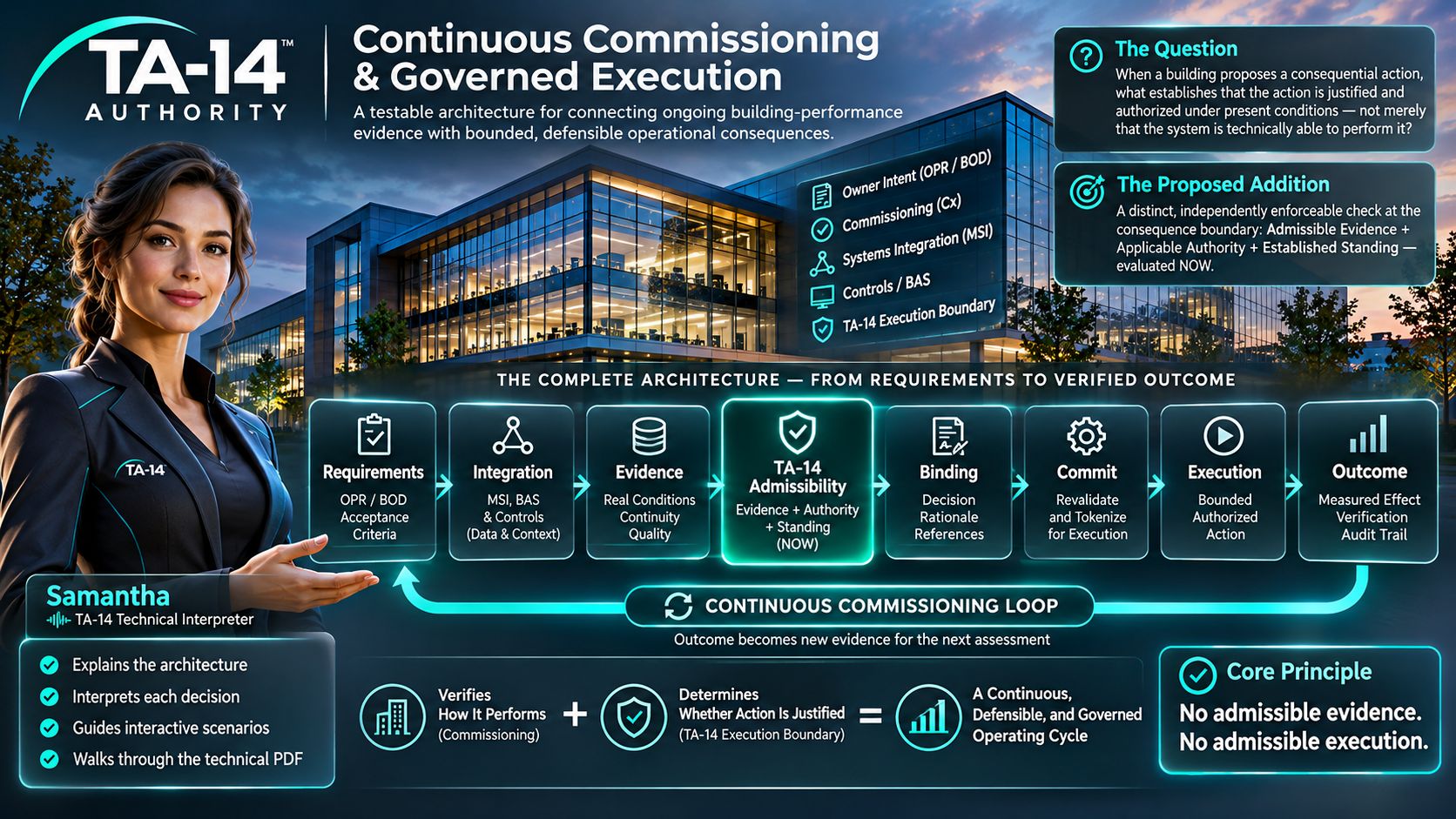
Continuous Commissioning & Governed Execution
Commissioning establishes verified performance against owner requirements. Master Systems Integration connects operational systems. TA-14 examines whether a particular proposed consequence has admissible evidence, applicable authority and established standing NOW. The eight lessons below follow that distinction through record continuity, commitment, bounded execution and verified outcomes.
LESSON 01 OF 08 · SAMANTHA'S TECHNICAL WALKTHROUGH
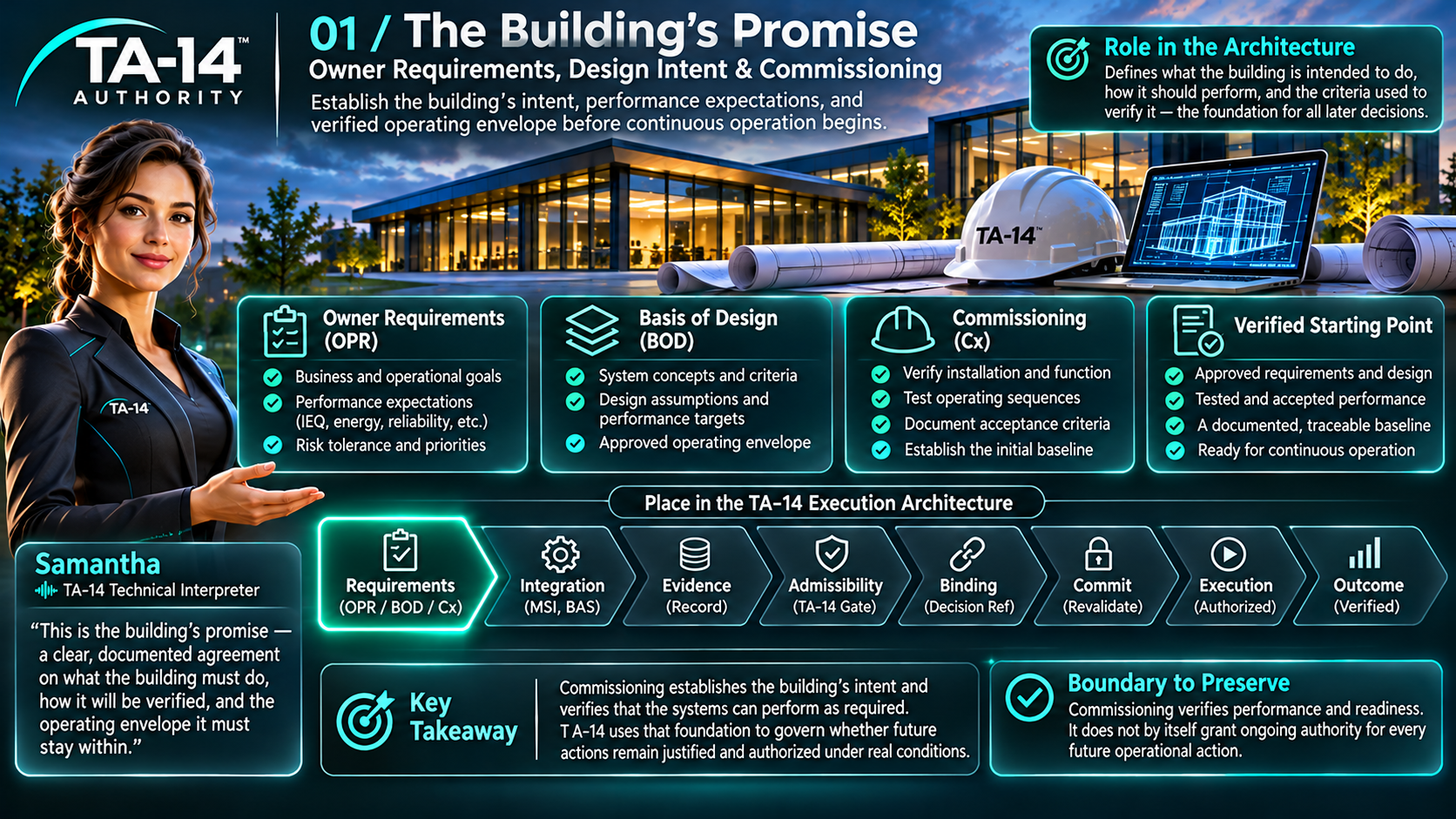
The Building’s Promise
Samantha explains
Owner requirements define what the building is meant to do. The Basis of Design connects those requirements to intended system operation. Commissioning checks installation, sequences, performance and acceptance criteria. This makes a documented starting point, not a permanent authorization for every future action. A later sensor replacement, control update, changed schedule or altered load can invalidate the assumption that the accepted condition still exists. TA-14 preserves this foundation and asks whether the next proposed consequence remains justified now.
Narration uses the visitor's browser voice. The full explanation remains visible as text. No building equipment is controlled by this educational showroom.
SAMANTHA · CONNECTING THE LESSONS
What you just learned
Commissioning establishes a documented baseline: what was required, tested and accepted. That evidence describes a condition at a particular time.
What you'll learn next
Next, we connect the equipment and controls through Master Systems Integration—and learn why communication alone is not proof or permission.
LESSON 02 OF 08 · SAMANTHA'S TECHNICAL WALKTHROUGH
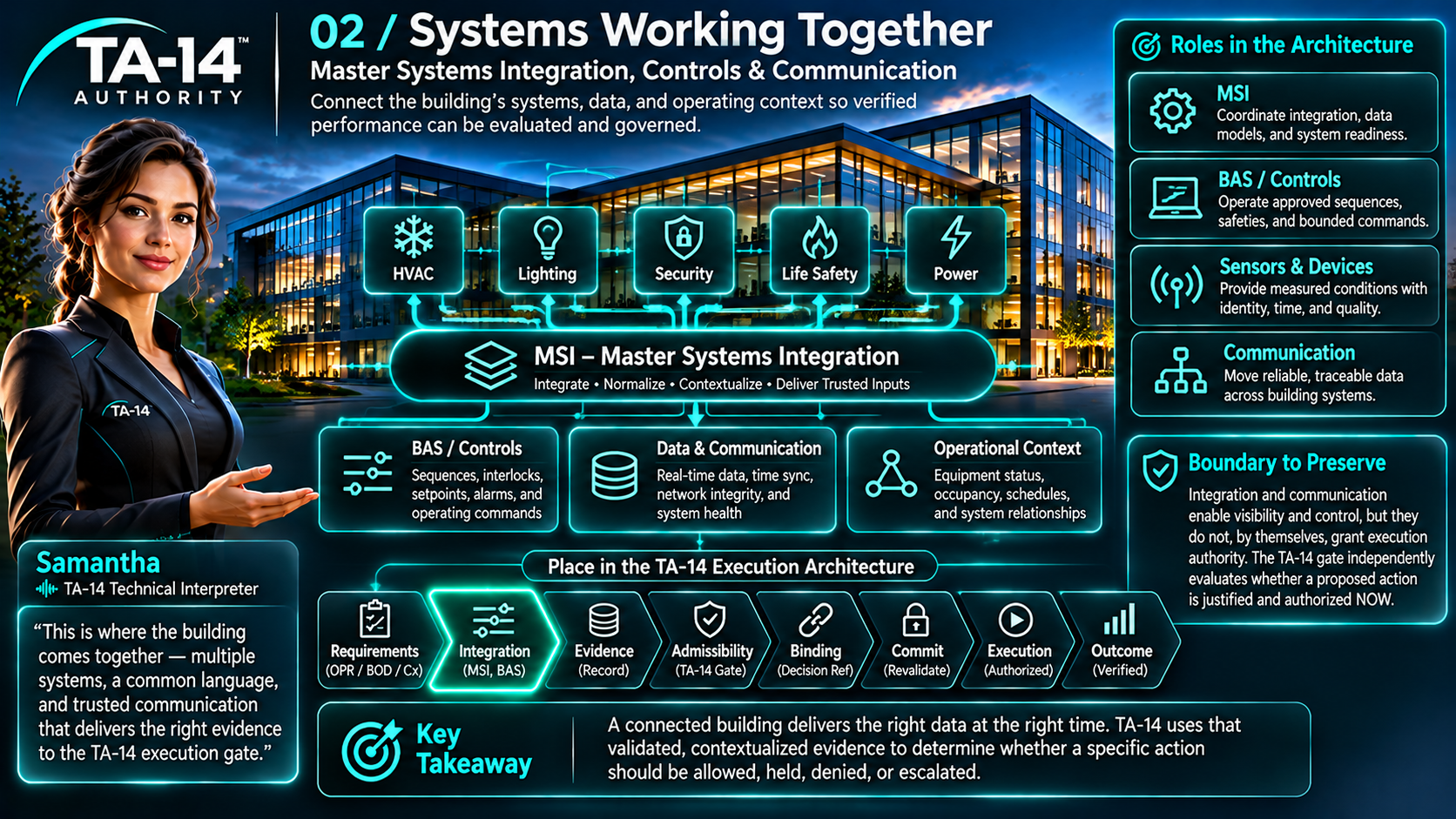
Systems Working Together
Samantha explains
Master Systems Integration connects the equipment, control points, protocols and operational relationships that allow a building to function together. But communication does not establish measurement accuracy, and functioning connections do not grant action authority. An online meter can report the wrong value. A BAS point can carry incorrect scaling or a stale timestamp. MSI makes signals understandable and traceable; commissioning confirms performance against requirements. The proposed TA-14 gate independently examines whether a particular consequence has sufficient evidence, authority and standing.
Narration uses the visitor's browser voice. The full explanation remains visible as text. No building equipment is controlled by this educational showroom.
SAMANTHA · CONNECTING THE LESSONS
What you just learned
Connected systems can exchange information without guaranteeing that each reading is accurate, timely or tied to the right asset.
What you'll learn next
Next, we examine the Reality of Record: where measurements came from, whether their history is intact, and whether they are fresh enough to support a decision.
LESSON 03 OF 08 · SAMANTHA'S TECHNICAL WALKTHROUGH
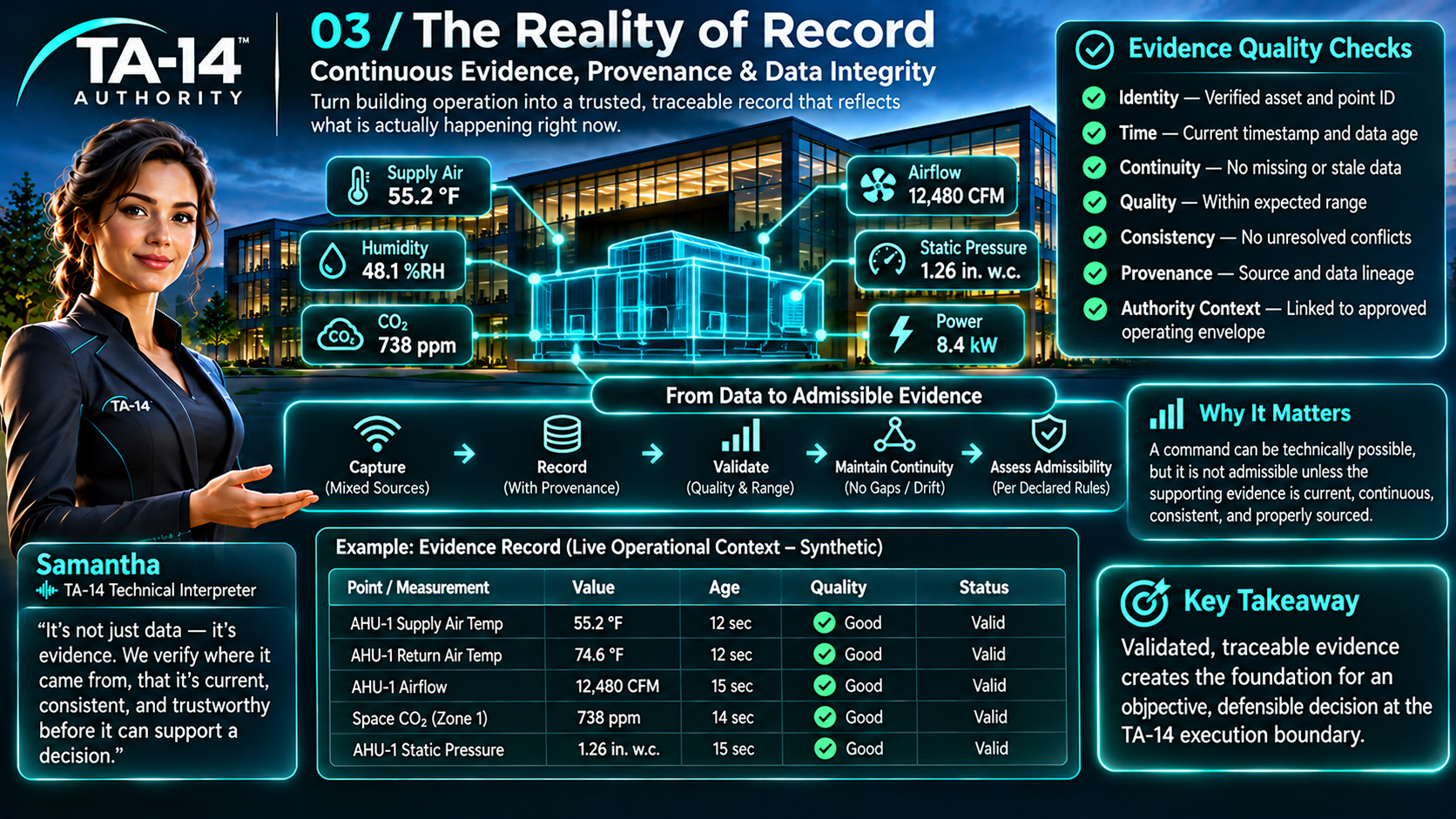
The Reality of Record
Samantha explains
A dashboard displays signals; a defensible record preserves their identities, timestamps, lineage, uncertainty and continuity. The synthetic air-handler demonstration requires two critical readings no more than 120 seconds old. If a critical point is 310 seconds old, communication can remain online while evidence is no longer sufficient for the proposed setpoint change. The correct result is HOLD, not an invented measurement or an automatic permission. A valid record must also connect to accepted requirements and expose contradictions rather than conceal them.
Narration uses the visitor's browser voice. The full explanation remains visible as text. No building equipment is controlled by this educational showroom.
SAMANTHA · CONNECTING THE LESSONS
What you just learned
A usable record must preserve identity, timestamps, provenance, uncertainty and continuity. Stale evidence can require HOLD even when a dashboard remains online.
What you'll learn next
Next, we cross the Admissibility Boundary: does this specific proposed action have sufficient evidence, applicable authority and established standing NOW?
LESSON 04 OF 08 · SAMANTHA'S TECHNICAL WALKTHROUGH
The Admissibility Boundary
Samantha explains
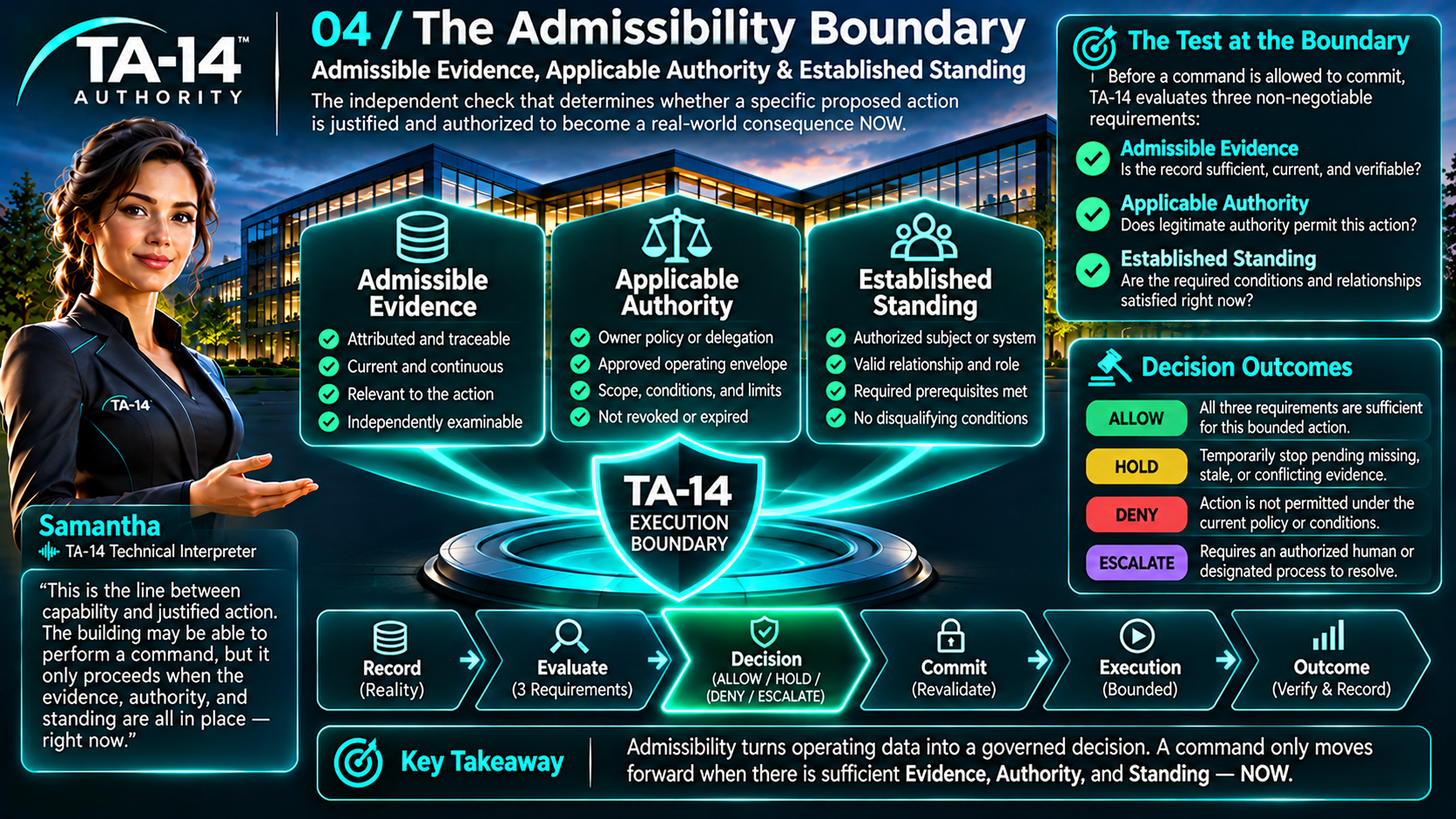
This is the independent crossing from the ability to act to legitimate authorization for a particular consequence. First: is there enough admissible, relevant, current and attributable evidence? Second: does applicable owner or delegated authority permit this action within these limits? Third: is the required standing established for this subject, equipment, site and action class? The question is evaluated NOW, against the actual proposed action. Connection is not authority. Understanding is not permission. Historical acceptance is not a blanket future grant.
Narration uses the visitor's browser voice. The full explanation remains visible as text. No building equipment is controlled by this educational showroom.
SAMANTHA · CONNECTING THE LESSONS
What you just learned
Admissible Evidence, Applicable Authority and Established Standing are separate requirements. A connected system cannot authorize itself.
What you'll learn next
Next, we see how the Decision Gate converts those requirements into a traceable ALLOW, HOLD, DENY or ESCALATE determination.
LESSON 05 OF 08 · SAMANTHA'S TECHNICAL WALKTHROUGH
The Decision Gate
Samantha explains
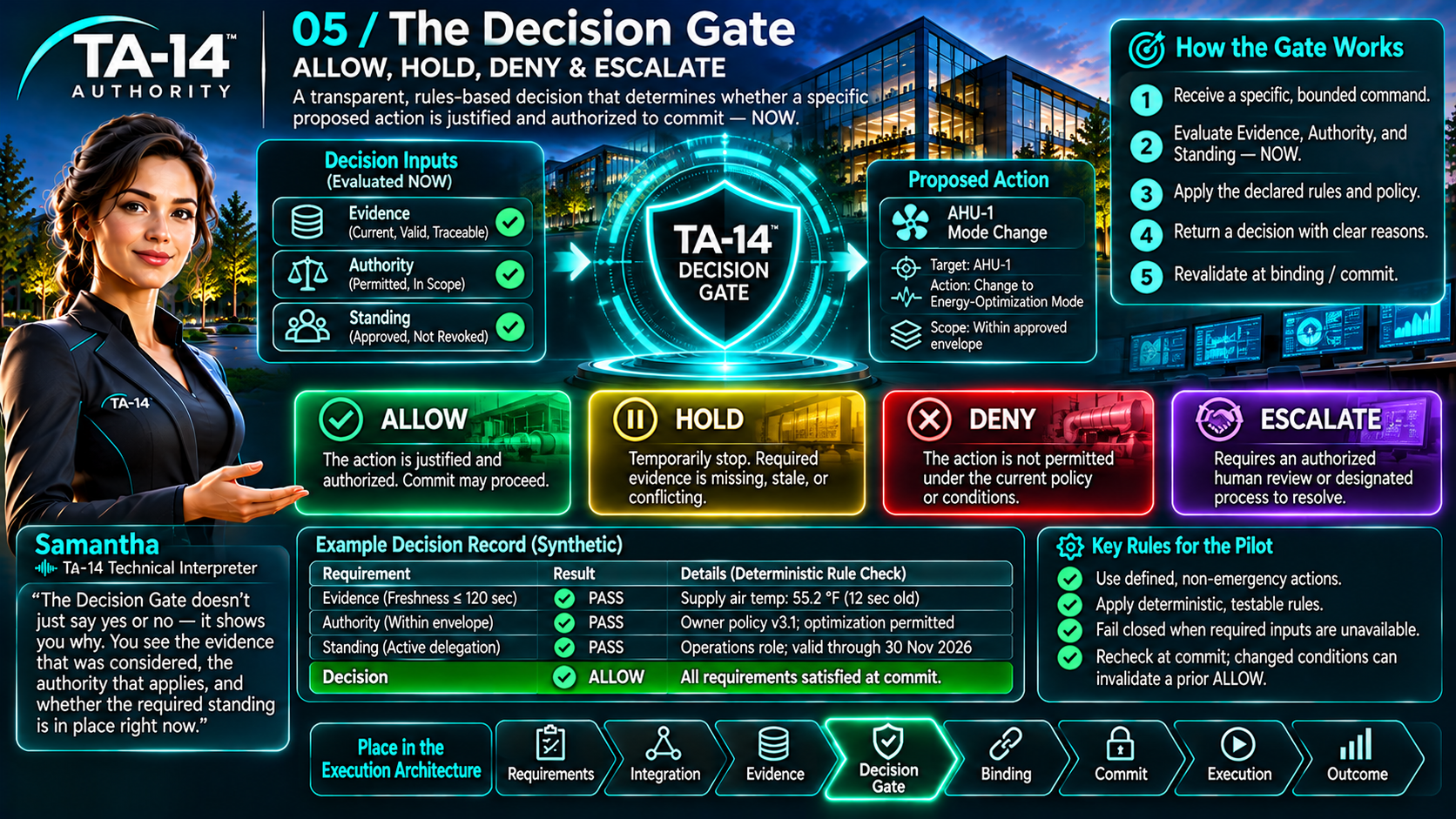
The proposed gate applies declared, deterministic rules to a specific bounded command. ALLOW means the requirements are met for that action, subject to revalidation at commit. HOLD means current evidence or another remediable prerequisite is missing, stale or contradictory. DENY means the proposal violates a declared policy constraint. ESCALATE calls for an authorized reviewer or designated process. The decision must show the exact supporting records, rule version and reasons. In this synthetic showroom, no real actuator is connected and mandatory protective controls remain outside the experimental gate.
Narration uses the visitor's browser voice. The full explanation remains visible as text. No building equipment is controlled by this educational showroom.
SAMANTHA · CONNECTING THE LESSONS
What you just learned
The gate produces an explainable determination for one bounded proposal, not permanent permission.
What you'll learn next
Next, we bind that determination to the exact equipment, command and time—and recheck it immediately before commitment.
LESSON 06 OF 08 · SAMANTHA'S TECHNICAL WALKTHROUGH
Binding and Commitment
Samantha explains
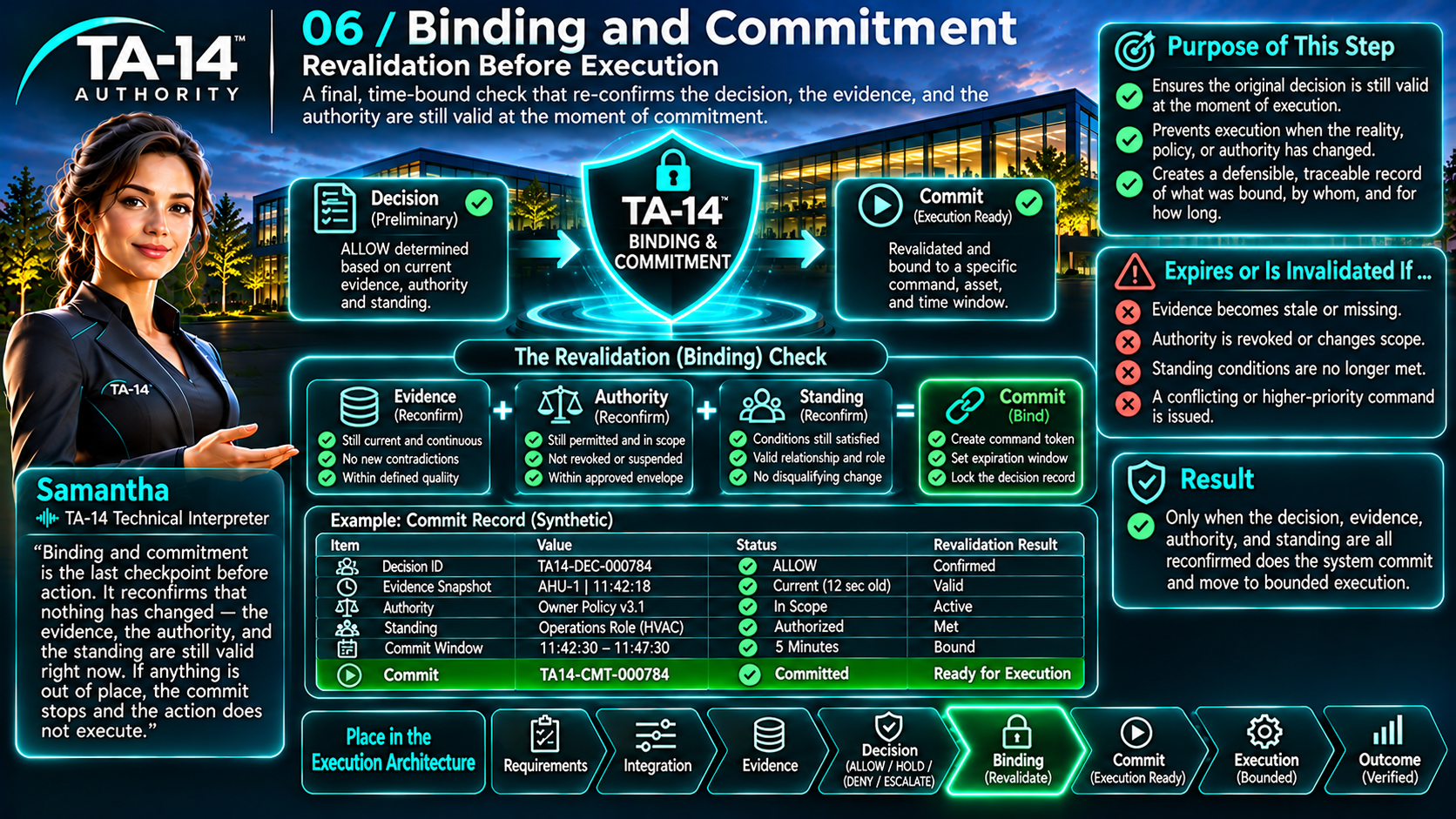
A prior ALLOW is not timeless. Binding connects the decision to an exact target asset, command, operating bounds, evidence snapshot, authority version and expiry. Before commitment, the system rechecks the conditions. If evidence becomes stale or an owner revokes a delegation, the earlier decision does not silently survive. The proposed command must be held or otherwise resolved according to the rules. This is the moment where technical capability becomes a candidate for an actual consequence, and the record must show what was bound, by whom, under which authority and when.
Narration uses the visitor's browser voice. The full explanation remains visible as text. No building equipment is controlled by this educational showroom.
SAMANTHA · CONNECTING THE LESSONS
What you just learned
Binding and commit prevent a previous ALLOW from silently surviving stale evidence, changed conditions or revoked authority.
What you'll learn next
Next, we distinguish a command that was authorized and sent from an outcome that was actually measured and verified.
LESSON 07 OF 08 · SAMANTHA'S TECHNICAL WALKTHROUGH
Execution and Verification
Samantha explains
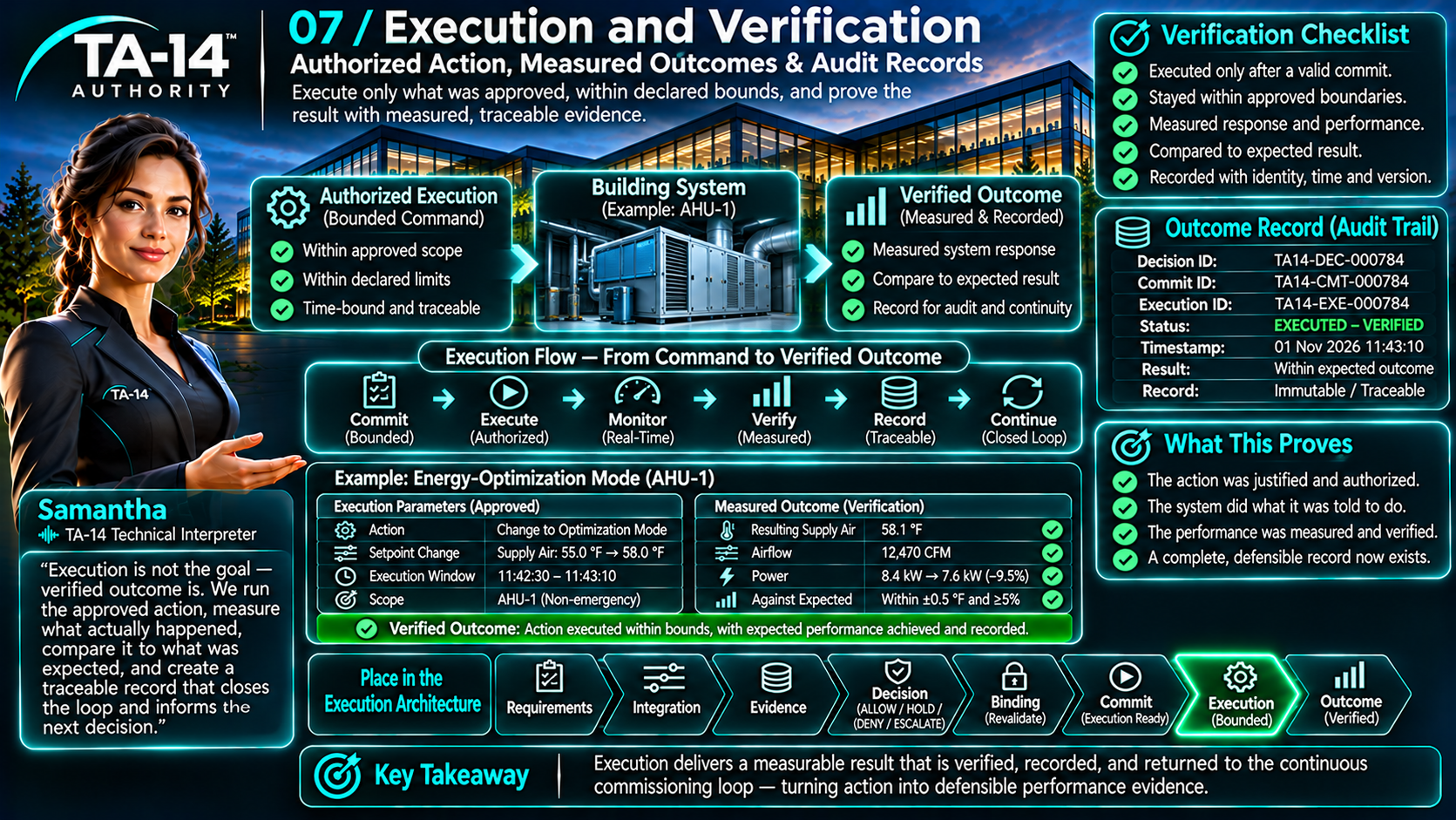
A command being issued is not proof that the expected outcome occurred. After a valid bounded commit, the demonstration records execution separately from outcome verification. Reviewers should see the target equipment, authorized scope, actual response, comparison window, deviations and audit references. If the resulting air-handler performance differs from the accepted synthetic tolerance, preserve an outcome exception. Do not silently label that action successful. Before another consequence, the new reality may require a new evidence record and decision.
Narration uses the visitor's browser voice. The full explanation remains visible as text. No building equipment is controlled by this educational showroom.
SAMANTHA · CONNECTING THE LESSONS
What you just learned
Execution records what was attempted; verification establishes what happened. A successful command is not automatically a successful outcome.
What you'll learn next
Next, we close the loop: each observed outcome becomes part of the next reality record, without automatically granting new authority.
LESSON 08 OF 08 · SAMANTHA'S TECHNICAL WALKTHROUGH
Continuous Commissioning Never Ends
Samantha explains
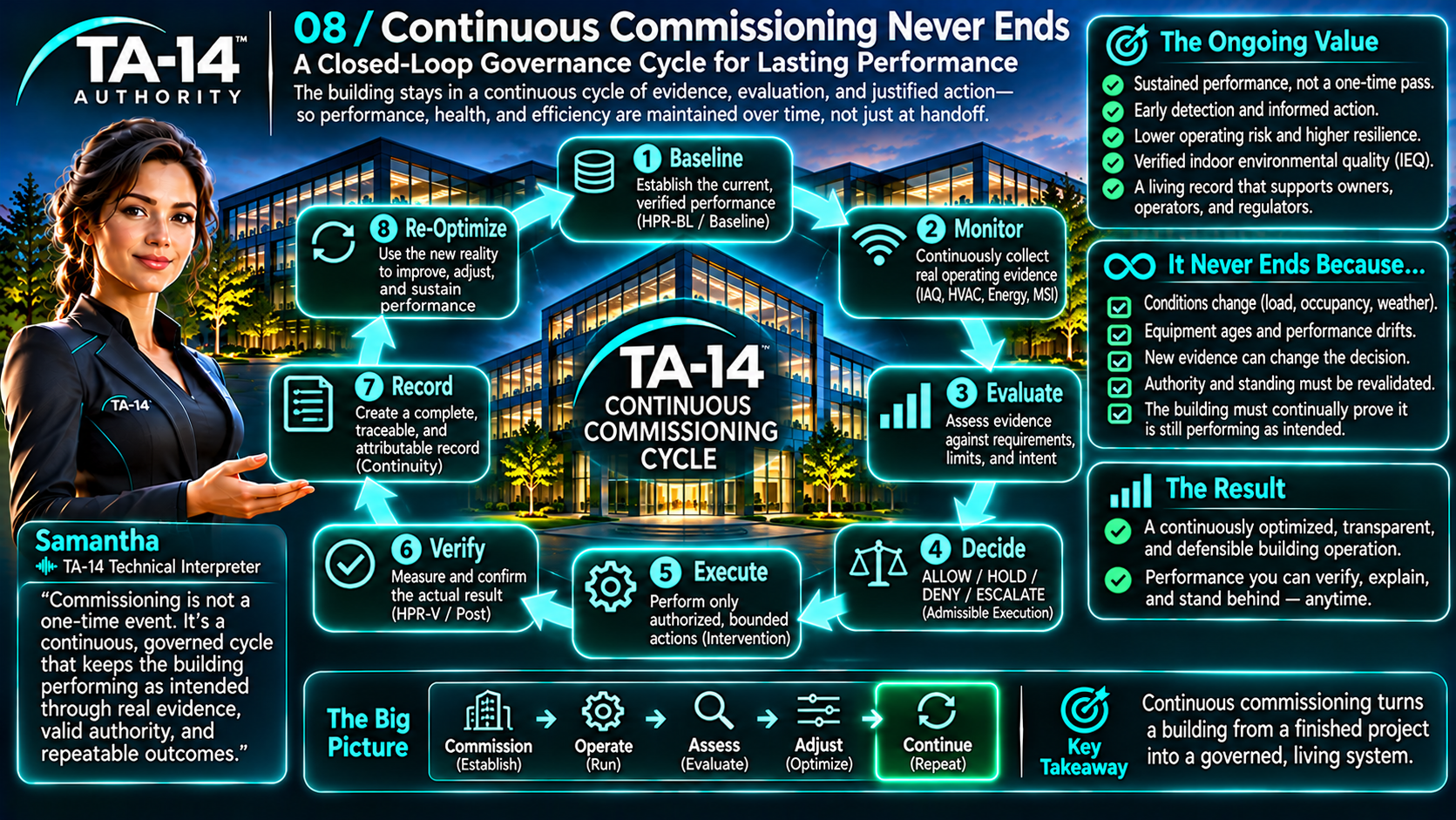
Building conditions evolve after handover. Ongoing commissioning and monitoring-based practices examine drift, corrections and performance over time. This TA-14 concept proposes a distinct check at the execution boundary. Commissioned requirements lead to current records; records support or fail a specific proposed action; binding and commit recheck authority and standing; bounded execution produces a separately measured outcome. The outcome becomes evidence for the next cycle. It does not automatically expand anyone’s authority. Every consequential decision must be justified under the conditions that actually exist NOW.
Narration uses the visitor's browser voice. The full explanation remains visible as text. No building equipment is controlled by this educational showroom.
SAMANTHA · CONNECTING THE LESSONS
What you just learned
Continuous commissioning keeps observing and investigating changing building conditions. TA-14 adds a distinct examination before each consequential action.
What you'll learn next
Next, explore the technical reference and try the interactive commissioning lab below. Change the evidence, present reality, authority and binding conditions to see why a proposed action must sometimes HOLD or DENY.
Commissioning proves a condition. Operations changes it.
A building can be correctly commissioned on Monday and face a different reality later. Sensors drift. Sequences change. Equipment is replaced. Operators intervene. Utilities degrade. A correction may clear an alarm without proving the condition stayed corrected.
WHY THIS ROOM EXISTS
The gap appears when yesterday's proof is used for today's consequence.
Continuous commissioning helps detect and investigate change. TA-14 asks the adjoining governance question immediately before consequence: does the evidence still describe reality, does authority still stand, is the exact action bound, and may execution proceed now?
Verify it. Watch it. Detect change. Re-establish standing. Act. Prove the outcome.
01 · VERIFIED
COMMISSIONED BASELINE
Requirements, functional tests, accepted configuration and baseline state are established.
EVIDENCE STATE: Commissioning record exists and describes the accepted condition.
INTERACTIVE CONTINUOUS COMMISSIONING LAB
Change the building. Watch the standing change.
Start with a commissioned condition, introduce an operational change, then re-establish what must be true before consequence can proceed.
A pressure sensor drifts after handoff
The commissioned baseline remains preserved, but the live sensor is now outside its accepted calibration condition.
WHY THIS MATTERS: A control action based on the old assumption could be technically executable while evidentially stale.
Evidence continuity survivesThe relevant record remains intact, attributable and current enough for review.
Present reality re-establishedThe live condition has been checked after the change.
Authority remains validThe actor or system still has authority for this bounded consequence.
Exact action is boundThe evidence and authority attach to this target, action, condition and moment.
TA-14 DEMONSTRATION DETERMINATION
HOLD
Execution does not proceed until continuity, present reality and exact action binding are established.
CONTINUITY · ESTABLISHED
PRESENT REALITY · NOT ESTABLISHED
AUTHORITY · STANDING
BINDING · NOT ESTABLISHED
THE CONTINUOUS COMMISSIONING SEAM
Commissioning establishes a baseline. Continuity determines whether it still matters.
Traditional commissioning can establish that a system met defined requirements at an accepted moment. Ongoing and continuous commissioning can observe drift, retest performance and identify changed conditions. TA-14 adds a separate governance question at the consequence boundary: is the evidence, authority, target and present reality still sufficient for this exact action now?
01 · COMMISSIONEstablish what was verified.
Requirements, test evidence, accepted configuration, responsible parties and baseline state become explicit.
02 · CONTINUEPreserve what changed.
Operational history, interventions, overrides, replacements, environmental drift and control changes remain reviewable.
03 · REVALIDATEResolve the present state.
Before consequence, the system determines whether the earlier basis remains current or must be narrowed, held, denied or escalated.
“What evidence survives the handoff?” is not only a commissioning question. It becomes an execution question the moment somebody intends to act because of that evidence.
A CONVERSATION WITH MARCUS MYERS · CxA, BECxP, CEM, LEED AP, ASSOC. AIA, LFA
What was verified? What changed afterward? Did the correction actually hold?
Marcus Myers connected this problem directly to ongoing commissioning: understanding what was verified, what changed afterward, and whether a correction actually held. This showroom turns that boundary into an interactive technical question. The point is not to fold commissioning into TA-14. It is to make the handoff between commissioning evidence, continuous observation, changed-condition revalidation and consequence explicit enough to examine together.
COMMISSIONING
What was required? What was tested? What passed? What was corrected? What baseline was accepted?
ONGOING / CONTINUOUS Cx
What changed? Is performance drifting? What needs investigation? Was a correction made—and did it hold?
TA-14 EXECUTION GOVERNANCE
Is evidence still continuous? Is present reality established? Does authority still stand? What exact action is bound? May consequence proceed now? What outcome was actually produced?
SEMICONDUCTOR FACILITY APPLICATION
Why complex facilities make the seam visible.
Cleanrooms, critical utilities, process systems, controls, manufacturing tools and operating teams are tightly coupled. A change in one layer can invalidate assumptions made in another. Continuous commissioning can detect and investigate that drift. TA-14 focuses on the final transition from evidence and recommendation into consequence-bearing action.
BOUNDARY
This showroom is an educational architecture demonstration. It is not ASHRAE guidance, a commissioning standard, semiconductor design guidance, certification, code compliance, safety approval, or a claim that TA-14 replaces commissioning practice. It demonstrates a possible interoperability seam between commissioning evidence and admissible execution governance.