TA-14 PUBLIC GOVERNANCE SHOWCASE · GOVERNED DEMONSTRATION CLOSED
S3DVS
Schad-Software-sichere Datenverarbeitungssysteme · Version 1.0
A registered S3DVS baseline that has now progressed through technical freeze, execution, evidence review, independent TA-14 determination, and bounded closure.
01 · REGISTERED ARCHITECTURE
Secure processing by architecture, not merely by after-the-fact policy.
The first visual introduces S3DVS as a governed processing architecture built around segregation, containment, evidence continuity, and controlled consequence.
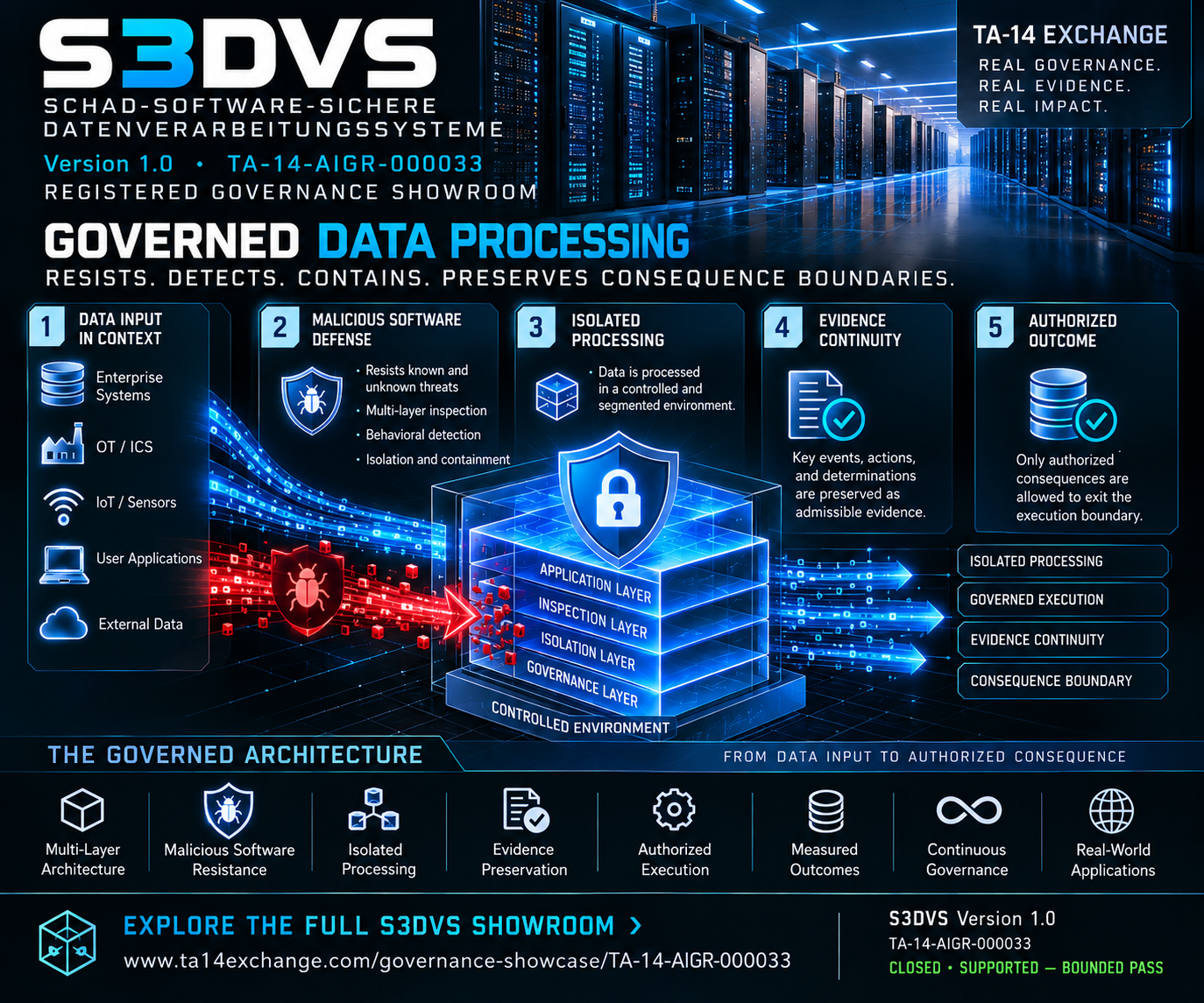
S3DVS presents a distinctive hardware-oriented approach to secure data processing. Its registered architecture separates instruction and data behavior through processor-specific access rules, explicit memory-region boundaries, and gate-level validation. The strength of the concept is architectural separation: instead of relying only on software policy after the fact, S3DVS is designed so important access distinctions are enforced by the structure of the processing environment itself. That makes the architecture especially interesting for systems where containment, evidence preservation, and trustworthy execution boundaries matter.
02 · COMPLETE GOVERNANCE RECORD
From architecture to a closed, inspectable evidence record.
The second visual brings the public story together: governed processing, examination results, preserved evidence, and the bounded outcome already earned.
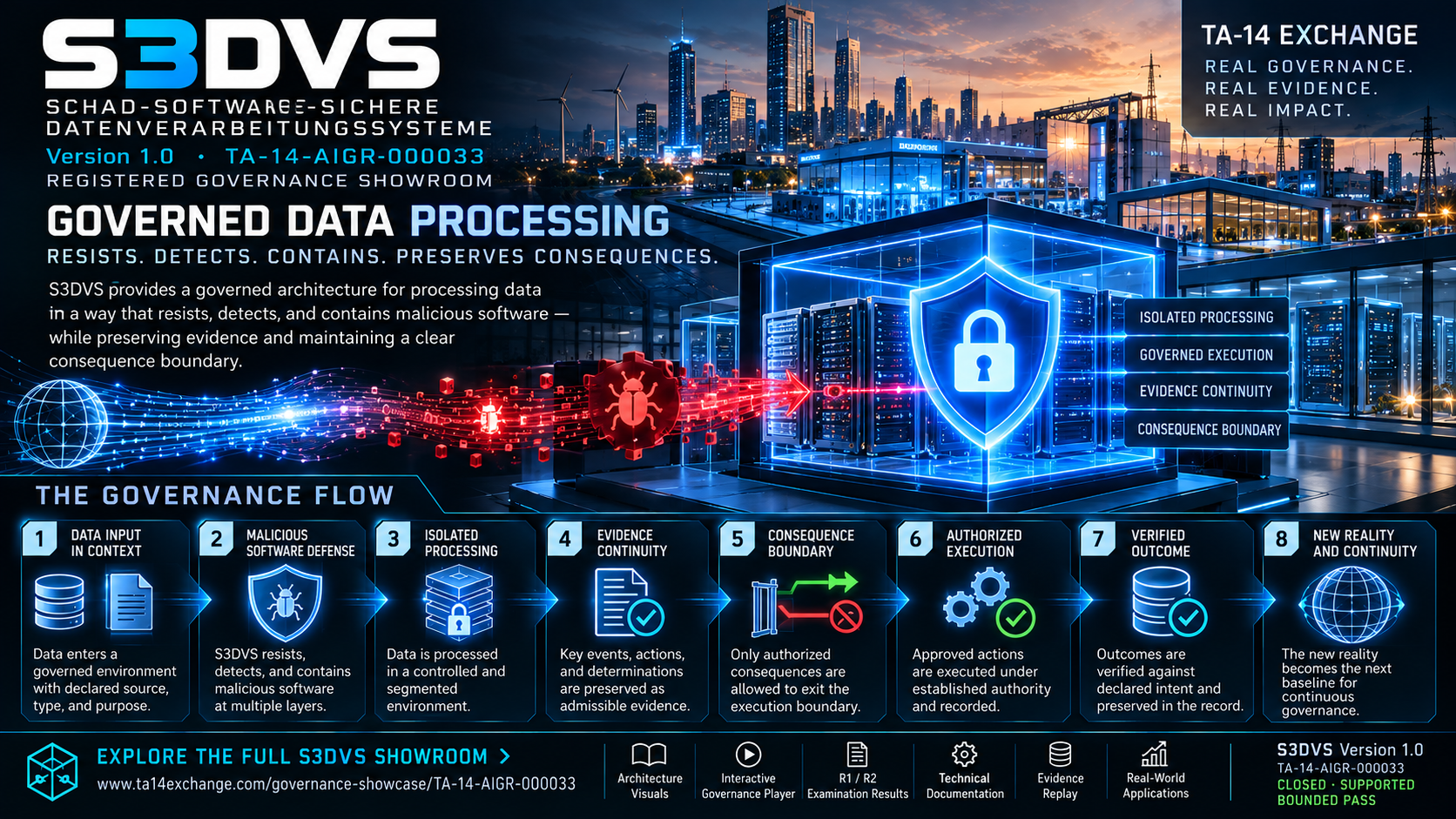
The S3DVS public record is stronger than an architecture description alone because it includes a completed governed demonstration. Protocol 10 preserved the contrasting full-overlap condition, while Protocols 1 through 9 examined the segregated condition. Across those frozen simulator configurations, the record supports the tested processor-specific restrictions and refusal behavior. The result is a closed, supported, bounded pass that gives visitors something concrete to inspect: not just what S3DVS is intended to do, but what the frozen evidence actually showed within the examined environment.
TA-14 FINAL EVIDENCE DETERMINATION
SUPPORTED — BOUNDED PASS
R1 Protocol 10 and R2 Protocols 1–9 are supported within the exact frozen simulator configurations and transactions examined. The finding belongs to the evidence boundary; it is not a universal security certification.
Registration → Technical Freeze → Execution → Evidence → Independent Determination → Closure
What makes S3DVS compelling is the combination of separation, containment, and preserved evidence. The architecture aims to keep malicious or unauthorized behavior from silently crossing important processing boundaries while maintaining an attributable record of what occurred. The TA-14 demonstration gives that idea an inspectable lifecycle from registration, to technical freeze, to execution, evidence review, independent determination, and closure. The bounded pass is not a marketing shortcut; it is a preserved result attached to a specific tested proposition.
RECORDED EXAMINATION PLAYER · FROZEN EVIDENCE REPLAY
Break the segregation. Watch the evidence boundary change.
This player reconstructs the preserved S3DVS examination. It does not generate a new finding, alter the historical determination, or convert simulator evidence into production proof.
CURRENT RECORDED CONDITION
FROZEN R2 BASELINE
Protocols 1–9 preserve differentiated processor behavior across the declared non-overlapping address regions.
What the record supports: Tested instruction/data restrictions and tested refusal at undefined address 524.
What remains outside the record: Observed simulator behavior only.
Historical replay only · frozen evidence remains unchanged.
Registered architecture claims
Registrant-declared claims remain preserved as the baseline. The bounded finding below does not silently expand them.
Explicit finding non-claims
Closure preserves the difference between what the execution showed and what was never tested.
Preserved limitations
These remain visible after closure rather than being erased by a successful bounded result.
Evidence record
The governed demonstration separates the contrasting overlap condition from the nine-protocol segregated condition.