TA-14 PUBLIC GOVERNANCE SHOWCASE · REGISTERED GOVERNANCE OBJECT
GLASS BOX
Elias Glass Box Governance Platform · EGBP v1.0.0
From black-box trust toward evidence-bound governance. EGBP is a governance and evidence architecture for making consequential AI and automated-system decisions inspectable, attributable and reviewable while keeping intelligence, authority, governance determination, execution and witnessed consequence distinct.
TA-14 REGISTRY ADMISSION
REGISTERED — NOT CERTIFIED
TA-14 found the submitted EGBP v1.0.0 record sufficiently attributable, bounded and preserved for Registry admission. Registration recognizes the governance object and its claim envelope. It does not establish independent validation, operational effectiveness, regulatory conformity, certification, legal sufficiency, safety, production readiness or fitness for execution.
01 · EGBP VISUAL TEACHING ATLAS
See inside a consequential decision.
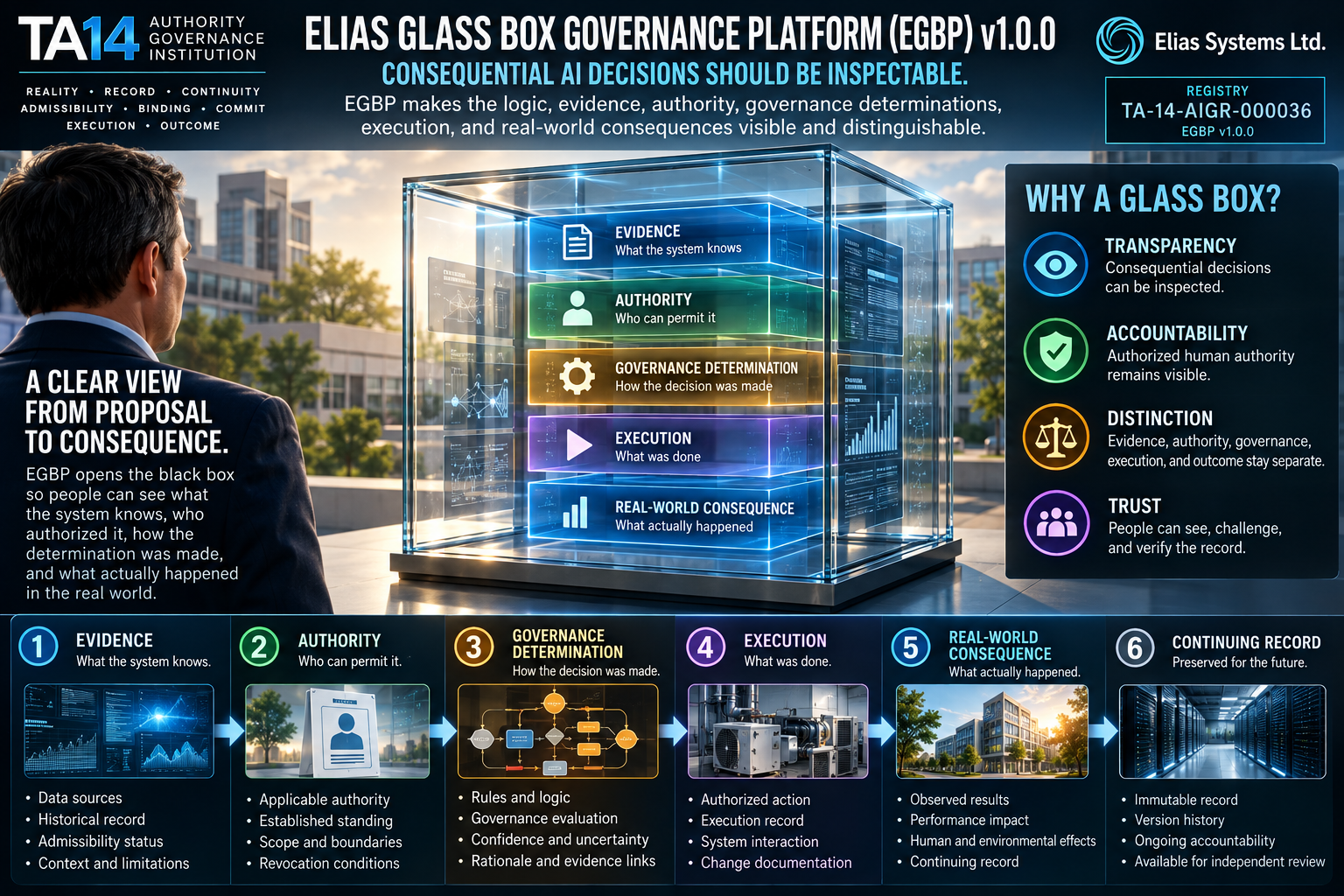
This EGBP-only illustration introduces six distinct windows into a consequential decision. It is a teaching image, not a tested runtime implementation or independent finding.
🎧 SAMANTHA · IMAGE 01 ARCHITECTURE WALKTHROUGH
Listen here, while viewing this image.
Six numbered audio lessons belong specifically to the image immediately above. Play or stop any lesson without leaving this section.
Welcome to the Elias Glass Box Governance Platform. Start with a proposed consequential decision. An AI may recommend changing a ventilation setting, approving a payment, or altering a service. EGBP invites us to inspect the decision rather than accepting the model output as permission.
Look at the evidence window. What was actually observed? Which source supplied the data? What version, scope, and transformation history belong to it? An explanation from a model is not the same thing as a preserved observation. The glass box keeps that distinction visible.
Next, inspect authority. Who may permit this action, under what rules, and within which boundaries? A model can be confident and still have no authority. EGBP is valuable because it exposes the authority basis separately from the recommendation.
Now examine the governance determination. Which rules and constraints applied? Was the proposal supported, refused, held, or escalated? The important distinction is that the governance reason is not interchangeable with the model prediction.
Move to execution and real-world consequence. A governance determination does not prove a command was issued. A command being issued does not prove the intended effect occurred. EGBP keeps execution records and witnessed outcomes distinguishable so they can be examined independently.
Finally, consider continuity. Could someone later reconstruct the decision, challenge its evidence, and see what changed? The registered EGBP claims describe attributable lineage and revalidation after material changes. This illustration teaches those claims; independent examination of EGBP remains open.
02 · EGBP GOVERNANCE TRANSPARENCY DASHBOARD
The entire glass box at a glance.
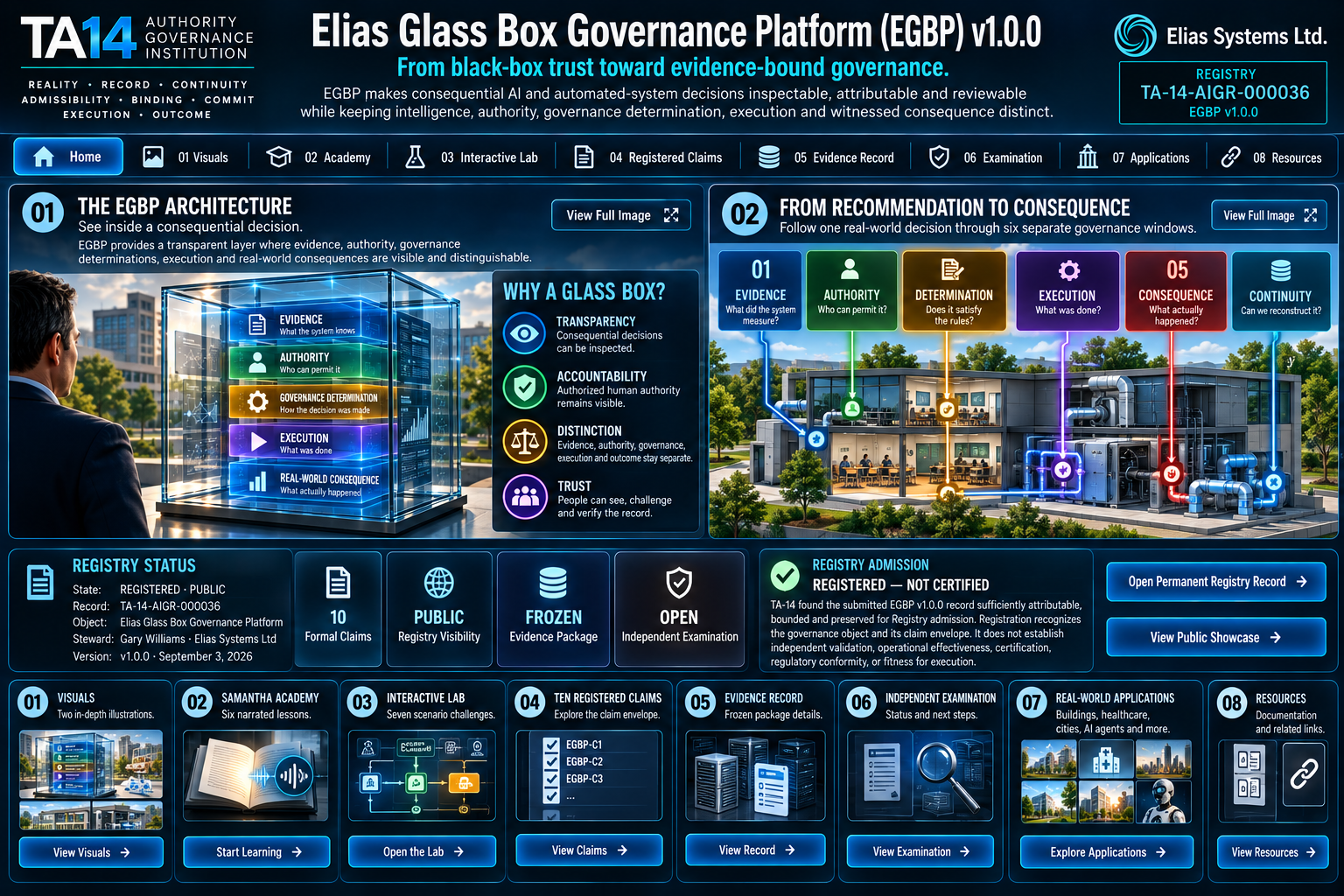
Explore how the registered architecture separates six windows of a consequential decision and connects them to the public Registry, Samantha Academy, interactive lab, frozen evidence identity and examination status. This is an illustrative teaching dashboard, not an operational system or a TA-14 examination finding.
🎧 SAMANTHA · IMAGE 02 DASHBOARD WALKTHROUGH
Listen here, while viewing this image.
Six numbered audio lessons belong specifically to the image immediately above. Play or stop any lesson without leaving this section.
Welcome to the EGBP transparency dashboard. This second image is a map of the public teaching experience. Its purpose is to connect the glass-box architecture to six inspectable windows, a permanent Registry identity, a guided academy, an interactive lab, and a frozen evidence record.
Look at the building illustration. Imagine sensors report rising carbon dioxide and an AI recommends increasing ventilation. First inspect the measurement and its provenance. Next inspect who can approve a change. Then examine the governing determination. Only after that should we distinguish the actual command from the observed airflow result.
Read the six colored checkpoints in order: evidence, authority, determination, execution, consequence, and continuity. Each answers a different question. The sequence does not imply that satisfying one checkpoint automatically satisfies the next.
The lower dashboard panels point to lessons and an interactive lab. The academy explains the registered architecture in everyday language. The lab lets you change conditions and observe how an inspectable record should avoid silently upgrading unresolved facts into authorization. These interactions are educational models, not fresh examination results.
Notice the Registry identity TA-14-AIGR-000036, the ten formal registered claims, and the frozen evidence package. Also notice the status: registered, public, not certified, and independent examination open. Registration preserves an attributable claim envelope; it does not certify operational effectiveness.
Think about healthcare, finance, buildings, and AI agents. The glass-box question remains the same: what did the system know, what authority applied, what did governance determine, what actually happened, and can the history be reconstructed? EGBP offers a promising framework for making those distinctions inspectable.
03 · SAMANTHA · IN-DEPTH GUIDED ACADEMY
Six narrated lessons. One inspectable architecture.
Select any chapter and listen at your own pace. The page never auto-scrolls. Samantha teaches the registered EGBP architecture without representing claimant claims as independently verified.
01 · THE GLASS BOX
Imagine a computer recommends changing a building ventilation system. The recommendation might be clever, but clever is not the same as authorized. EGBP makes the different parts of that decision visible, like placing them in a transparent glass box. We can ask what evidence was used, what rule applied, who had authority, what governance decided, whether anything actually happened, and what people observed afterward. That is the value of this architecture: it gives humans a way to inspect a consequential decision rather than merely trust a black box.
Narration uses your browser's speech voice; Samantha is preferred when installed.
04 · INTERACTIVE TRANSPARENCY EXPLORER
Six windows. Six different questions.
Choose a window to inspect its burden. This is an educational interpretation of the registered claim envelope.
INSPECTING · EVIDENCE
What does the system know?
Source, version, provenance, scope and uncertainty
Visibility of this window does not by itself prove the other five windows have been satisfied.
Open the glass box. Change the condition. Watch what governance may actually conclude.
This interactive model explains the registered EGBP v1.0.0 claim envelope. The frozen claims remain claimant-declared and independent examination remains OPEN.
CURRENT INSPECTABLE STATE
MODEL PRODUCES A RECOMMENDATION
A model output, confidence score, recommendation, or explanation can be preserved without being promoted into governing authority.
Registered-architecture model only · no new finding, certification, or execution standing is created here.
The inspectability boundary
EGBP separates what a system produced from what governance may legitimately conclude about it.
Ten registered claims
These are claimant-declared claims preserved by registration. They are not TA-14 findings.
Frozen integrity identity
Lineage: EGBP v1.0.0 is recorded as successor to the earlier Elias Glass Box Platform Kernel v0.2. The predecessor remains historically attributable to its own version and state.