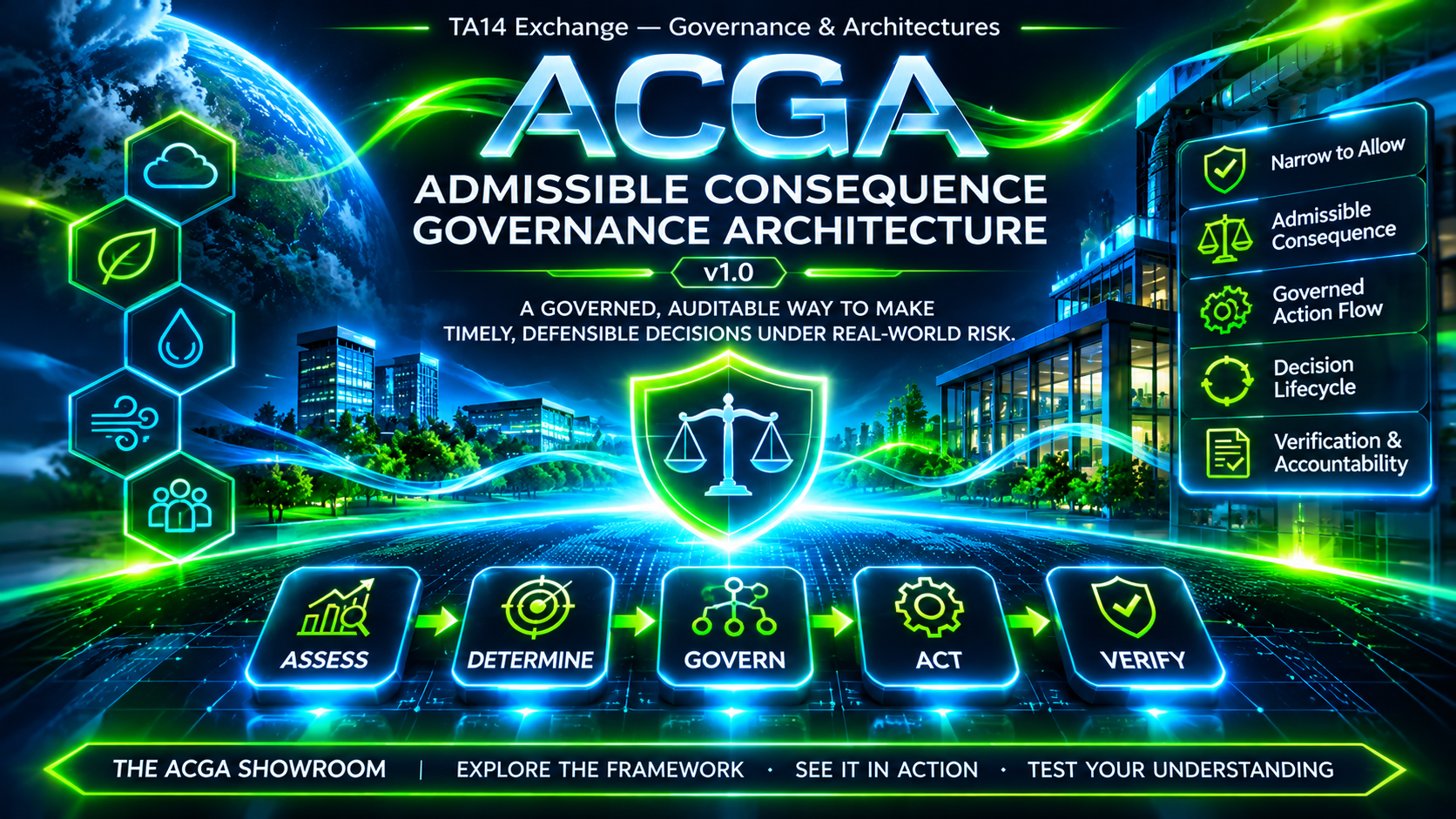
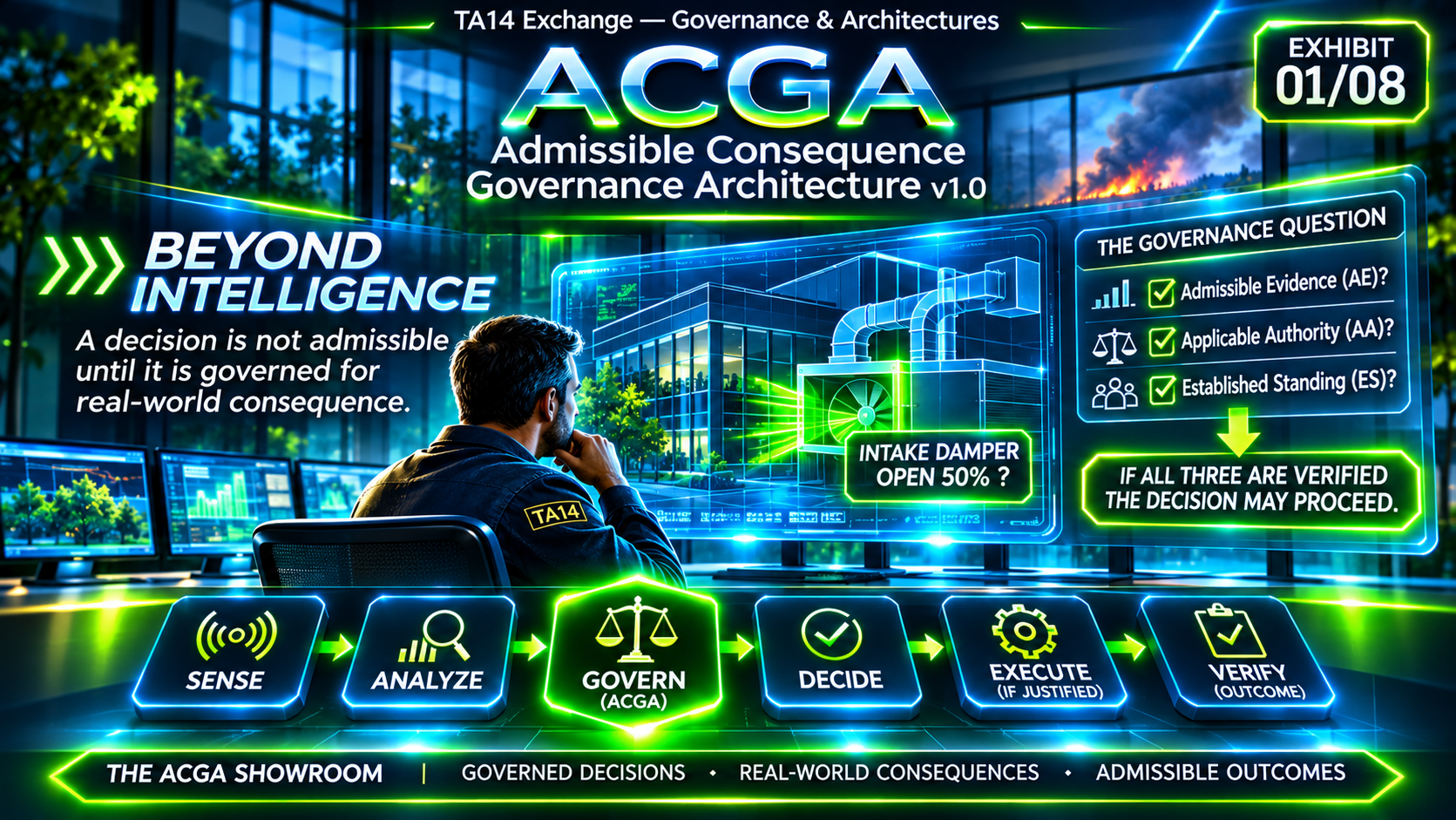
An intelligent system may recommend a consequence, but intelligence does not confer authority. Every protected action needs current admissible evidence, applicable authority and established standing, plus all other applicable constraints. A proposal is not permission.
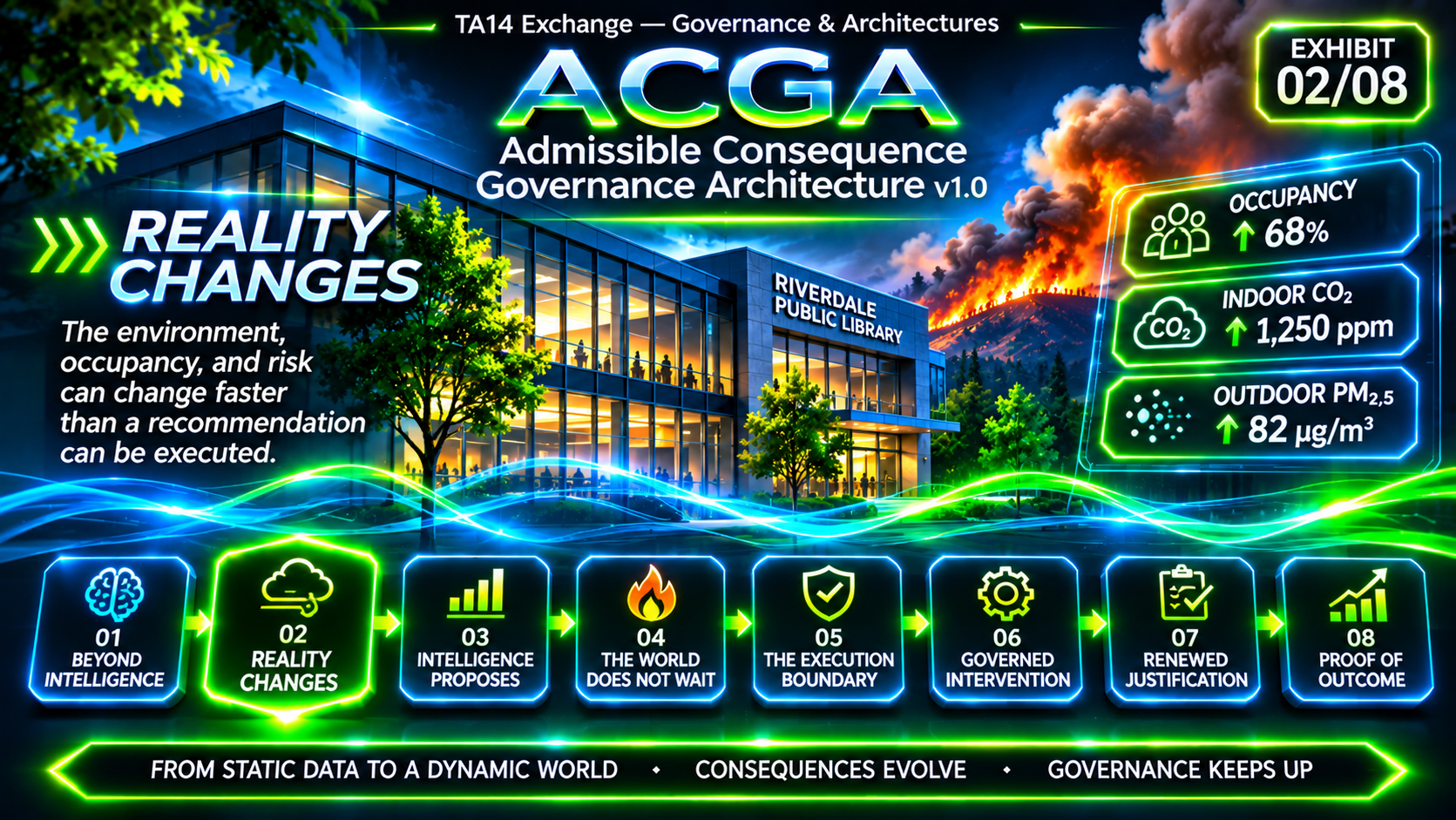
EXHIBIT 02 / 08
Reality Changes
In this simulated public-library scenario, occupants and environmental measurements change over time. A record must preserve the observation, its provenance, measurement limits and the time it applies. A previously useful observation may no longer support action.
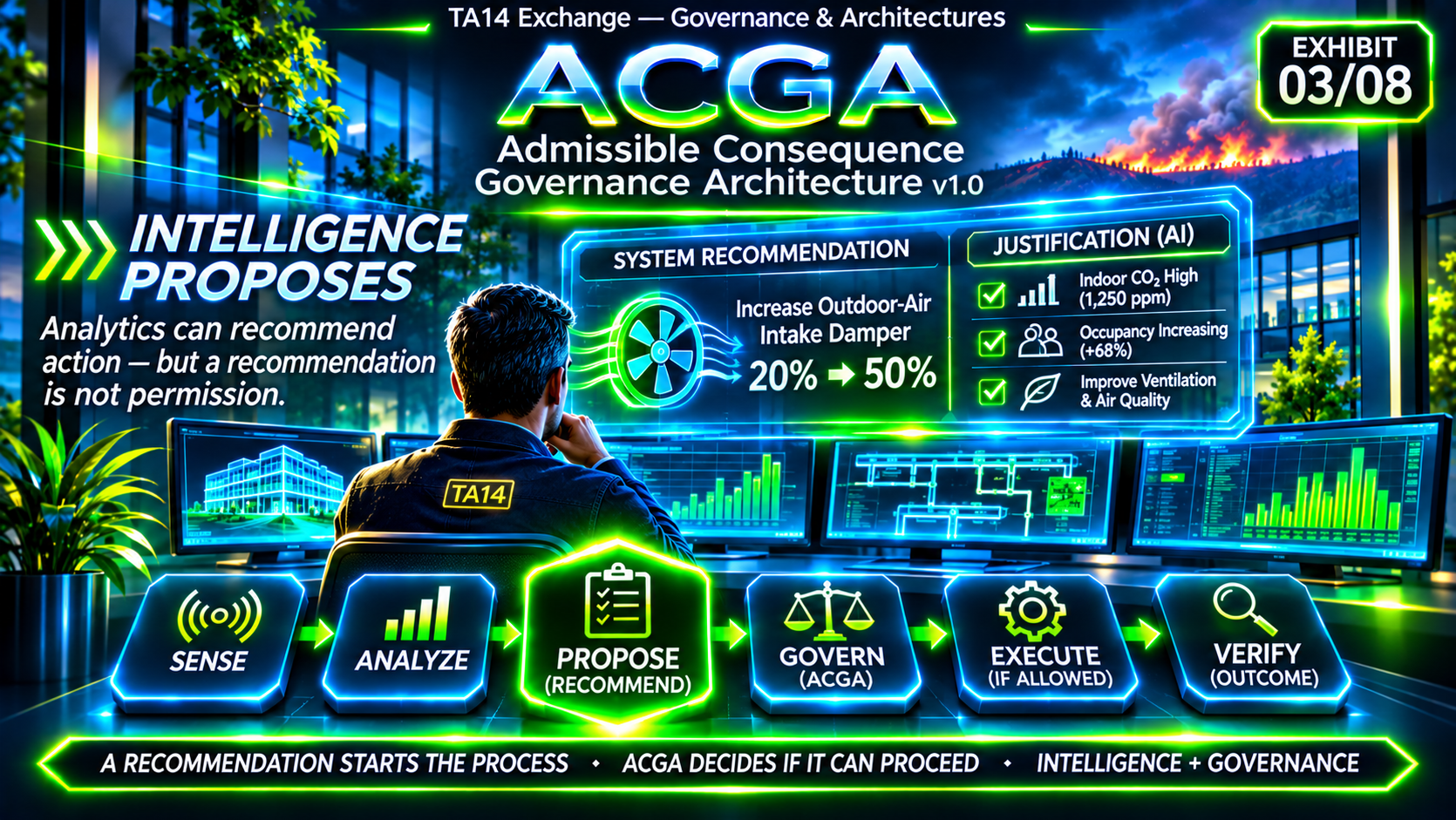
EXHIBIT 03 / 08
Intelligence Proposes
The system proposes moving an outdoor-air intake damper from 20 percent to 50 percent. This is a recommendation only: no command has been authorized. Governance must evaluate the exact asset, action, parameters, evidence and limits at execution time.
EXHIBIT 04 / 08
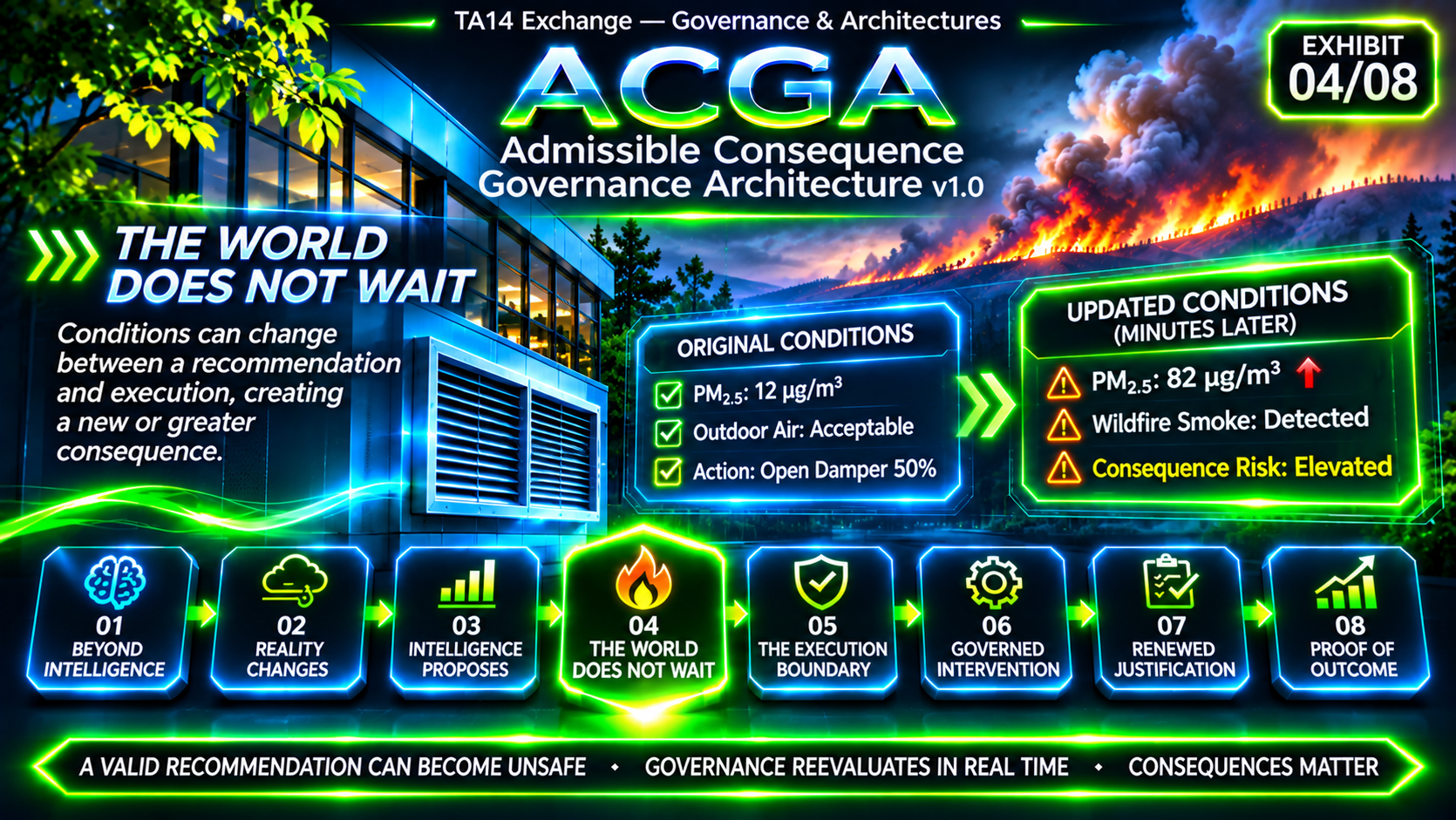
The World Does Not Wait
An outdoor wildfire-smoke reading changes materially after the recommendation. The proposed 20-to-50-percent action must be re-evaluated; an earlier assumption about outdoor air is insufficient. Elevated indoor CO2 and outdoor PM2.5 create competing concerns, not an automatic safe setting.
EXHIBIT 05 / 08
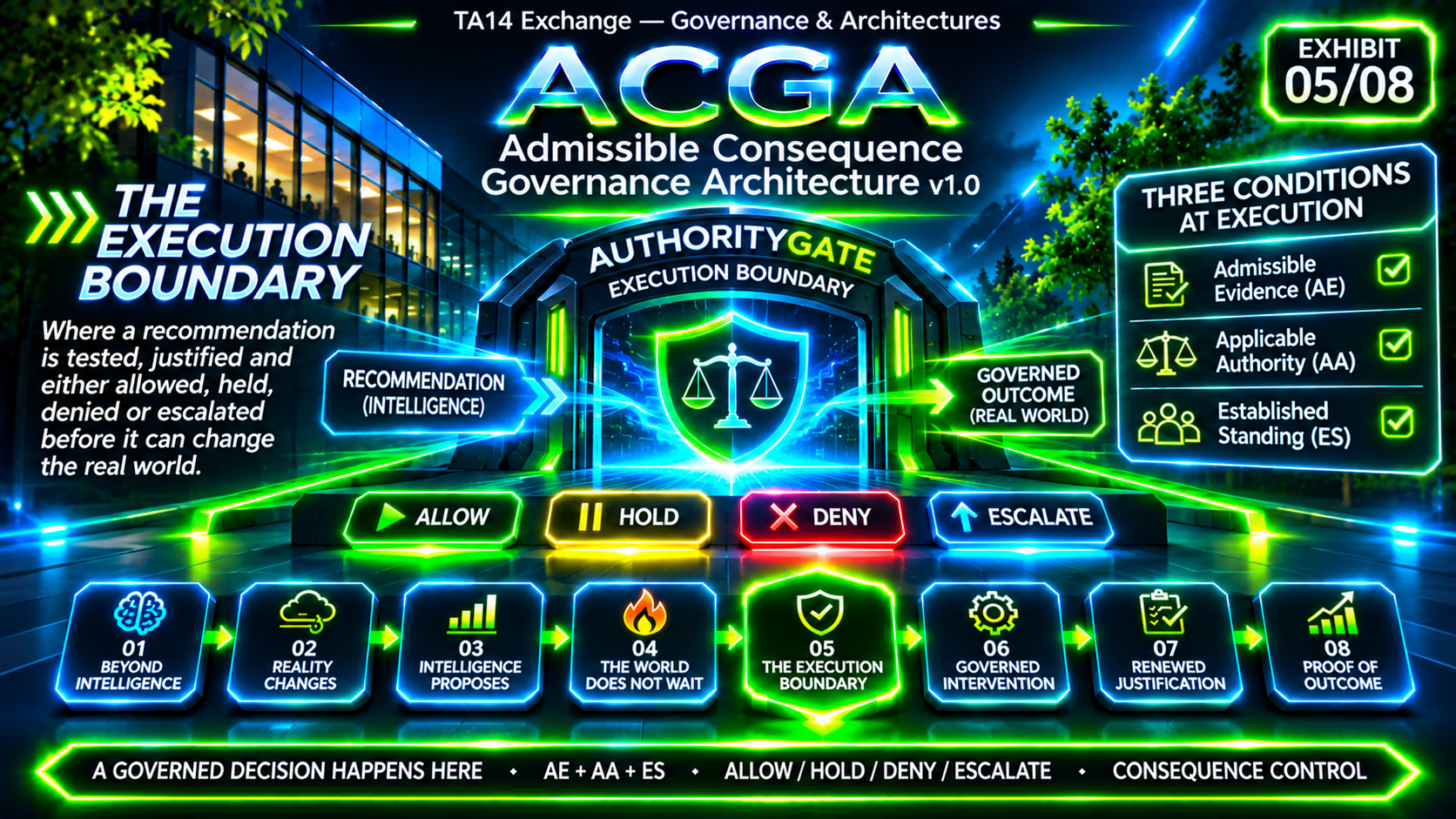
The Execution Boundary
ACGA evaluates consequence formation and its five determinations: ALLOW, HOLD, NARROW, ESCALATE or DENY. AEA retains foundational execution jurisdiction. AuthorityGate represents the bounded runtime enforcement layer, whose canonical decisions are ALLOW, HOLD, DENY and ESCALATE. NARROW is not a runtime execution authorization. Only an exact valid ALLOW can authorize protected commit.
EXHIBIT 06 / 08
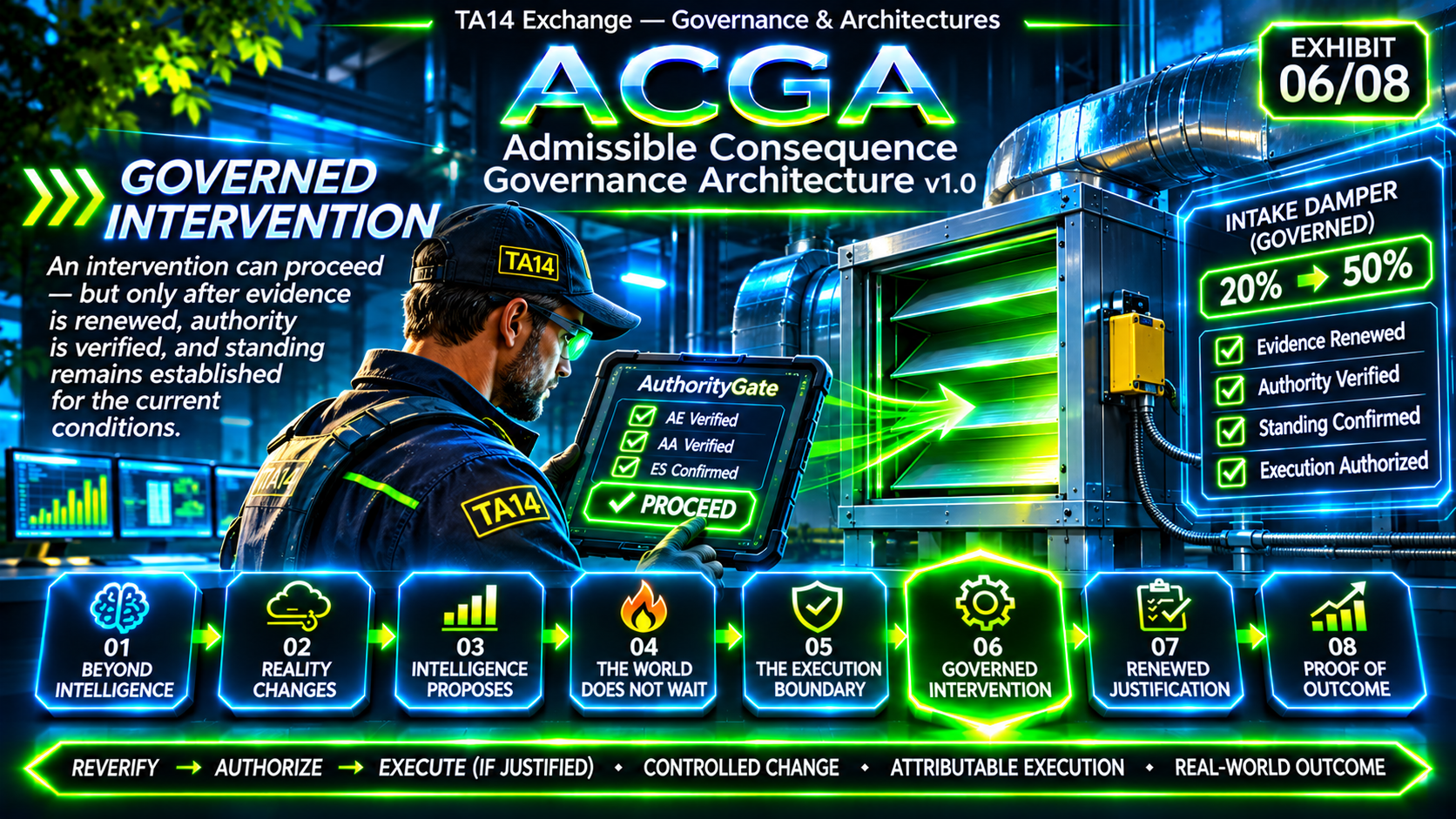
Governed Intervention
This illustration depicts a possible intervention, not an established permission to open the damper to 50 percent. Under unresolved outdoor-smoke conditions, the old proposal stays on HOLD. Any different protective or reduced intervention requires a revised proposal, admissible current evidence, authority, standing, and a distinct ALLOW before commit. The image does not prove a real action occurred.
EXHIBIT 07 / 08
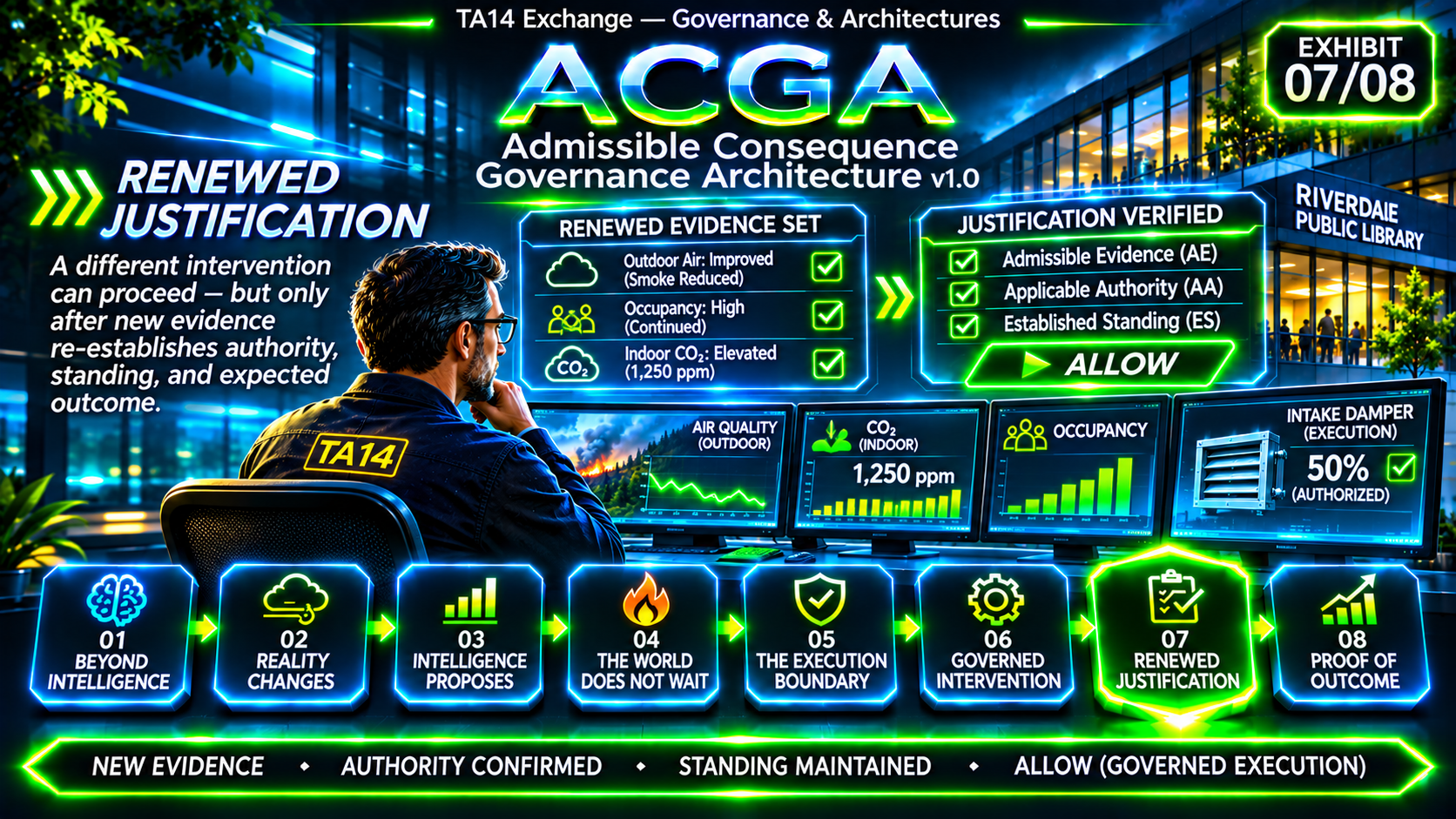
Renewed Justification
If conditions improve, governance may examine a new or revised proposal. NARROW only specifies a smaller candidate scope; it never executes. Revalidate current indoor and outdoor conditions, filtration, minimum ventilation and operational constraints, then issue a separate exact ALLOW if all requirements are satisfied. The 50-percent display is illustrative, not a safe setpoint or automatic approval.
EXHIBIT 08 / 08
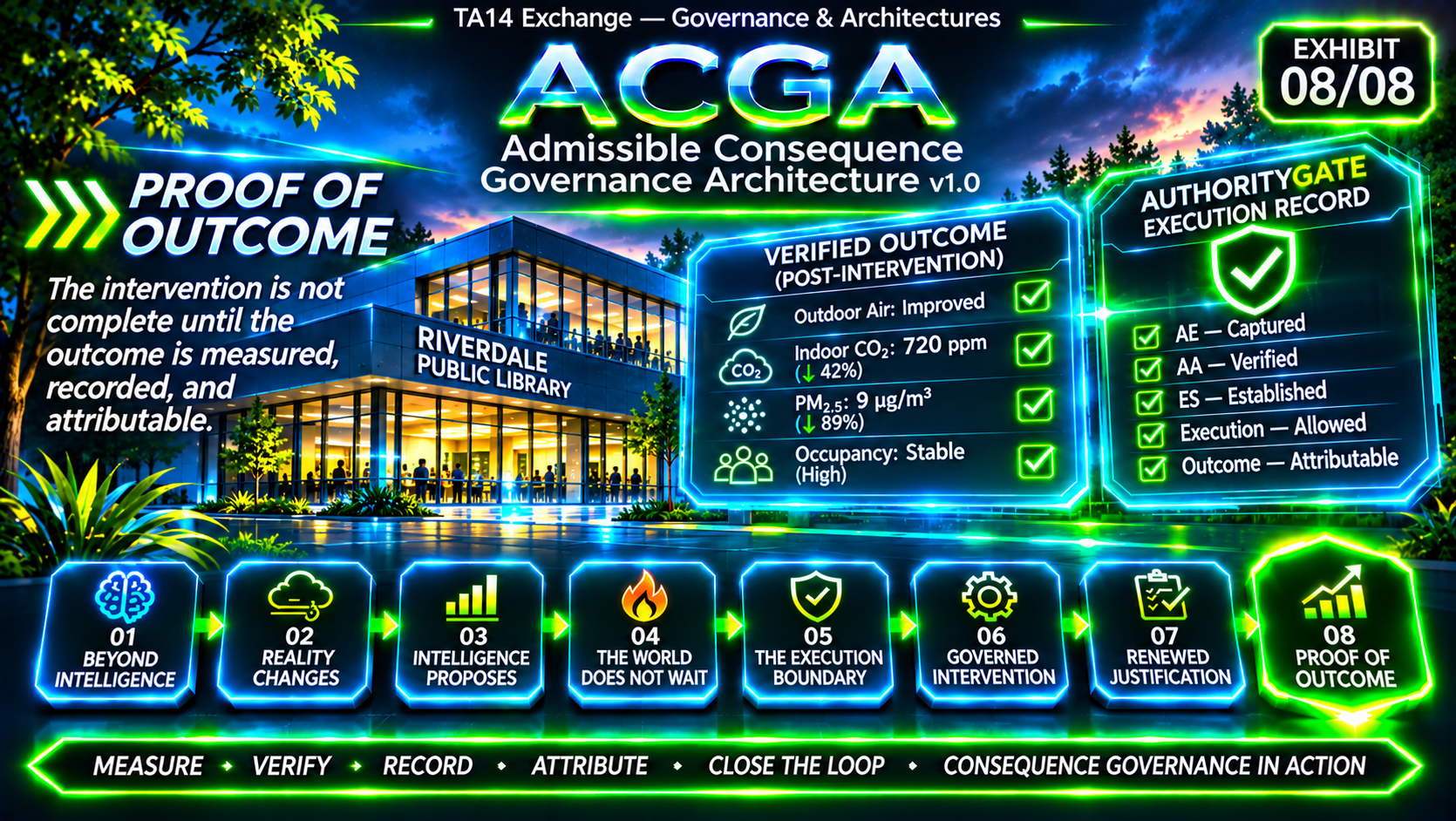
Proof of Outcome
After an authorized protected commit, independent observation must determine what actually happened. A receipt does not establish damper movement, airflow, PM2.5, CO2 or health protection. The displayed outcome numbers are synthetic illustrations, not verified real-world results. Record failures and unresolved obligations explicitly.
Interactive governance challenge
Educational classification only. No live actuator or production enforcement.
1. A required observation is stale. What is the determination?
2. A proposed action must be reduced in scope. What is the determination?
3. A revised proposal has current admissible evidence, applicable authority, established standing and satisfies all applicable constraints. Which determination can authorize it?
4. An applicable policy conflict requires an authorized reviewer. What is the determination?
5. The proposed action is explicitly prohibited. What is the determination?
TA-14 ACADEMY · INDEPENDENT REVIEW CHALLENGE
Can you defend the determination?
Apply the governance principles to three hypothetical cases relevant to the proposed operational consequence. Choose a determination, then examine the reasoning. These cases teach the distinction between Admissible Evidence, Applicable Authority, and Established Standing; they do not issue real-world authorization.
CASE 01
Evidence is not yet admissible
A proposed consequence is supported by an observation, but the source attribution or record continuity is missing. What should happen before execution? Consider this in the context of the proposed operational consequence.
CASE 02
The actor exceeds authority
The record is current and reliable, but the proposed consequence falls outside the scope of applicable authority. What is the supported determination?
CASE 03
A higher authority is required
The proposed consequence triggers a documented requirement for review by another designated authority. What is the appropriate route?
Independent educational examples only. The questions are hypothetical and do not assess a real institution, building, person, or operating system. Actual governance determinations require case-specific evidence, applicable authority, established standing, and bounded review.