From an owner-defined clean-air promise to accountable public refuge, governed execution and lifetime stewardship.
Prepared as an educational examination for Lloyd Helferty of Energime Institute / UnityNet International, and a proposed virtual discussion with Michael Bordenaro, Stephanie and Kimon Onuma. The central question is not whether a sanctuary has sophisticated technology—it is whether its promises can be examined when people depend on them.
EXPLORATORY · NOT A DEPLOYED PILOT. This is an independent educational demonstration, not an approved engineering design, building specification, public-health guarantee, certification, government endorsement, United Nations affiliation or confirmed partnership. Architectural imagery, dashboards and numerical readings are conceptual.
Does this proposed consequence have sufficient Admissible Evidence, Applicable Authority and Established Standing to become reality NOW?
TA-14 examines a specific proposed action and its consequences for people, access, air, energy, occupancy and independent emergency safeguards. Environmental Integrity Governance (EIG) frames combined environmental effects; Atmospheric Integrity Records (AIR) preserve attributable history; Admissible Execution Architecture (AEA) examines the execution boundary.
POTENTIAL INTERNATIONAL RELEVANCE · NOT AN INSTITUTIONAL CLAIM
A Canadian owner question with globally transferable lessons
The scenario begins with Canadian outreach and explores questions that can matter across countries: clean-air refuge, resilient infrastructure, inclusive access, municipal obligations, environmental evidence and accountable stewardship. These are subjects of potential relevance to multilateral and United Nations-related discussions, but no UN project, mandate, sponsorship, selection or collaboration is asserted here. Any international engagement would require separate confirmation and the participating institution’s own authority.
Follow the numbered teaching sections on the image. The page does not auto-scroll.
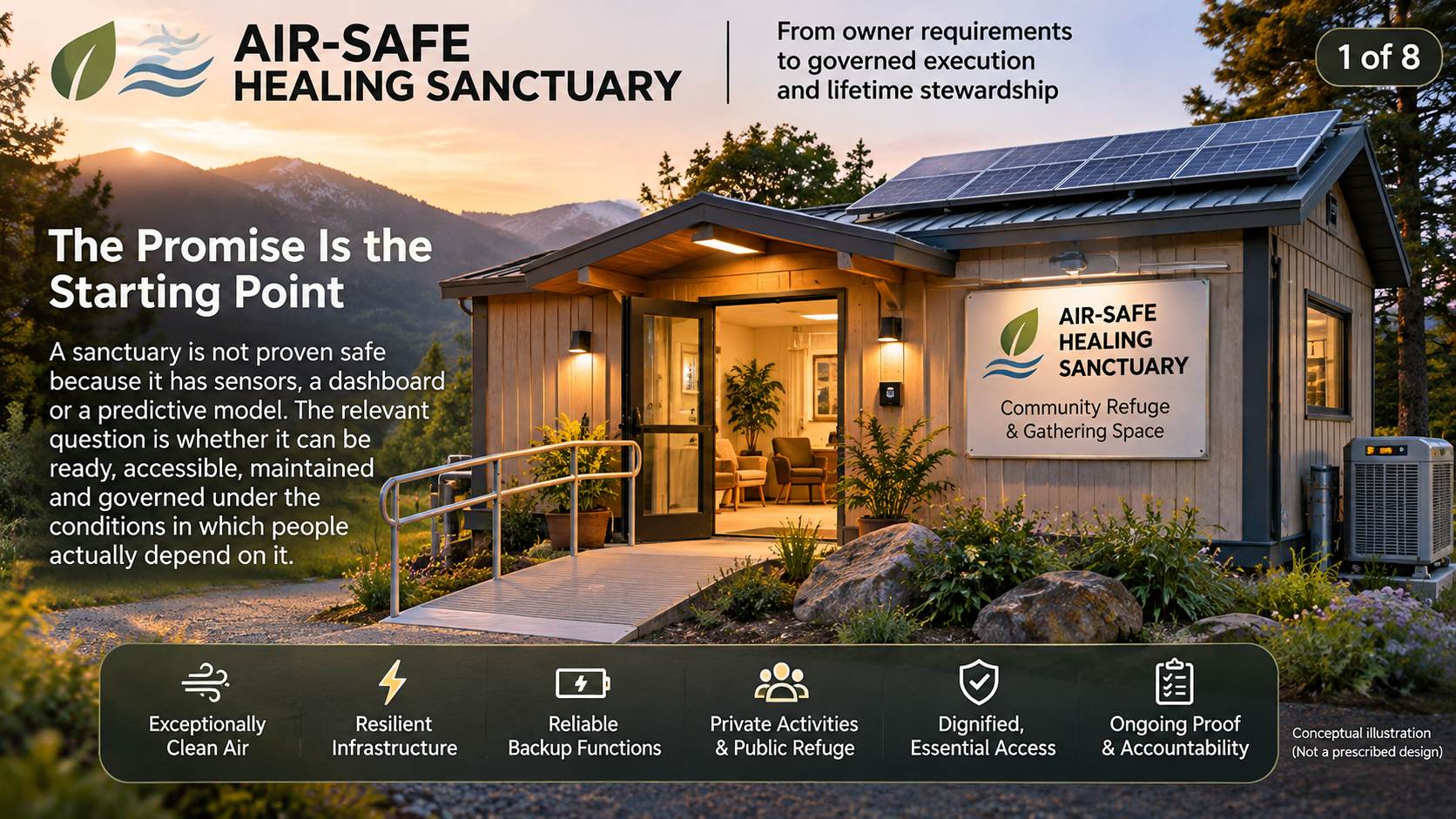
Lloyd Helferty asks what a community sanctuary must promise before technology is selected: exceptionally clean air, resilience, reliable backup functions, dignified access and proof that protection continues. This small modular building is only an illustration. No building dimensions, system configuration, acceptance criteria or validated performance have been specified.
WHAT YOU LEARNED
A beautiful building or sensor installation is not proof of sanctuary readiness.
WHAT COMES NEXT
We turn to public access without unnecessary barriers.
Follow the numbered teaching sections on the image. The page does not auto-scroll.
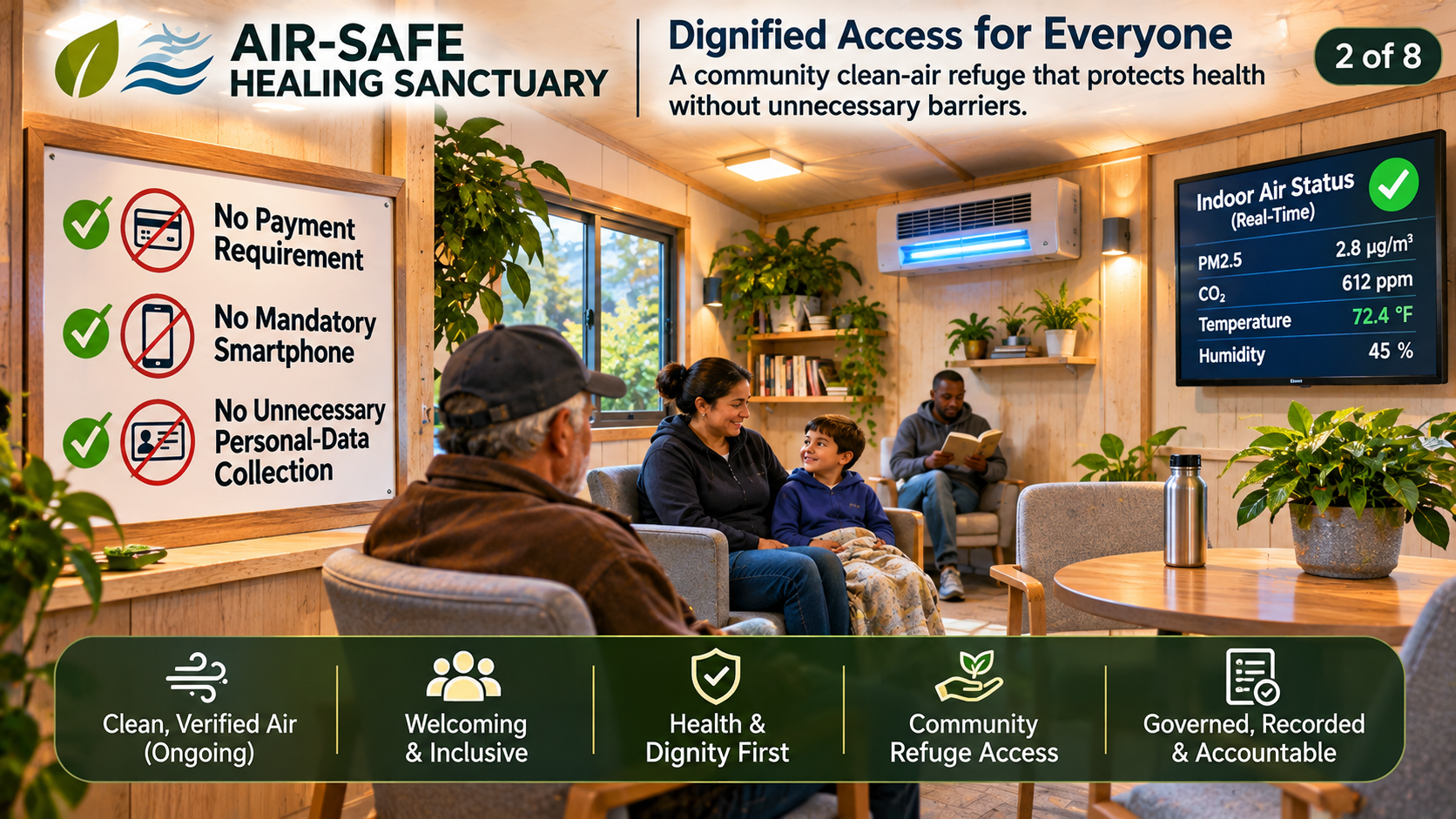
Essential refuge cannot depend on payment, ownership of a smartphone or surrendering unnecessary personal information. A facility may host private activities while carrying a distinct public obligation. The dashboard numbers in the illustration are fictional; the existence of a display would not establish actual indoor air quality or access performance.
WHAT YOU LEARNED
Access is an owner obligation to define, test and verify—not an app feature.
WHAT COMES NEXT
We ask what evidence would substantiate the environmental promise.
Follow the numbered teaching sections on the image. The page does not auto-scroll.
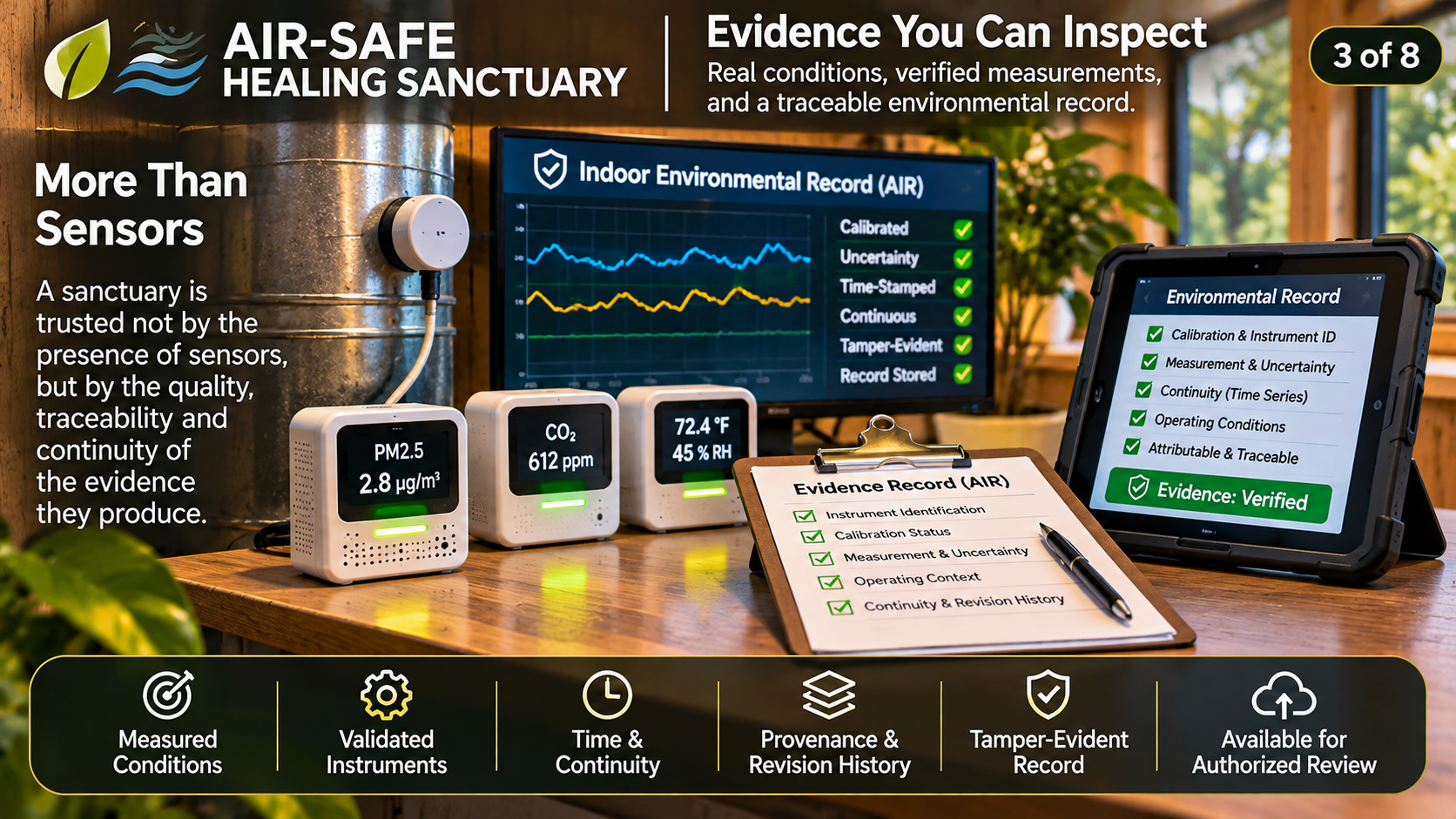
Atmospheric Integrity Records, or AIR, are intended to preserve the identity of instruments, calibration status, timestamps, units, measurement uncertainty, operating context, missing intervals, source lineage and revisions. A green checkmark on this conceptual graphic is not evidence that a real sensor was calibrated. The illustrative readings are not site measurements. Evidence must be attributable, continuous enough for its purpose and independently examinable.
WHAT YOU LEARNED
Trustworthy evidence includes its limitations, provenance and missing data.
WHAT COMES NEXT
We separate environmental observation from authority to act.
Follow the numbered teaching sections on the image. The page does not auto-scroll.
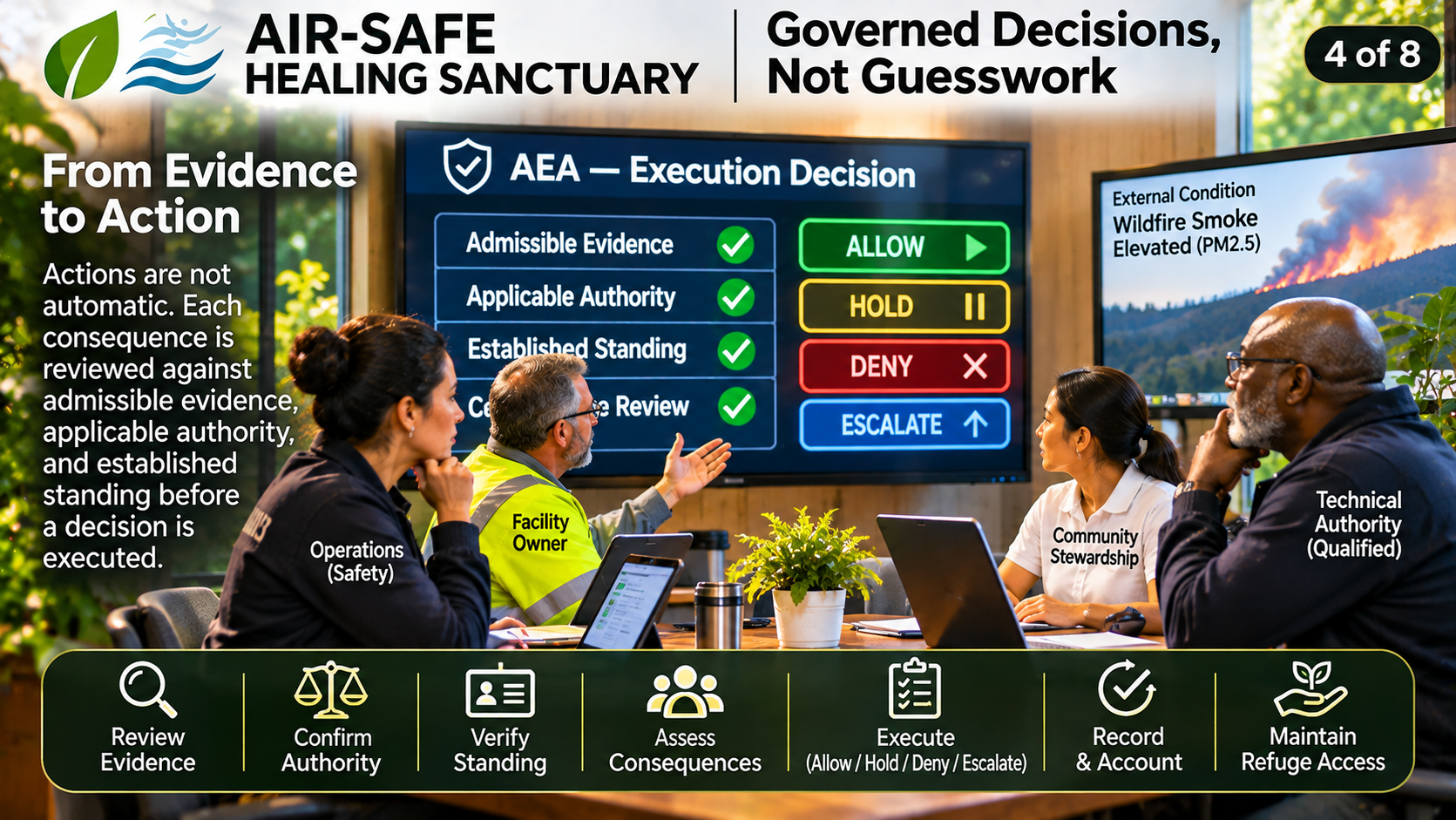
The Admissible Execution Architecture asks whether Admissible Evidence, Applicable Authority and Established Standing support a specific proposed consequence now. Technical safety professionals and community stewards carry distinct responsibilities. A sensor alert or a dashboard never inherits legal or operational authority merely because it detects a condition. ALLOW, HOLD, DENY and ESCALATE are policy outcomes for particular proposed actions, not an automatic instruction to equipment.
WHAT YOU LEARNED
Evidence, authority and the standing of the decision-maker are different requirements.
WHAT COMES NEXT
We examine a scoped HOLD that does not disable emergency functions.
Follow the numbered teaching sections on the image. The page does not auto-scroll.
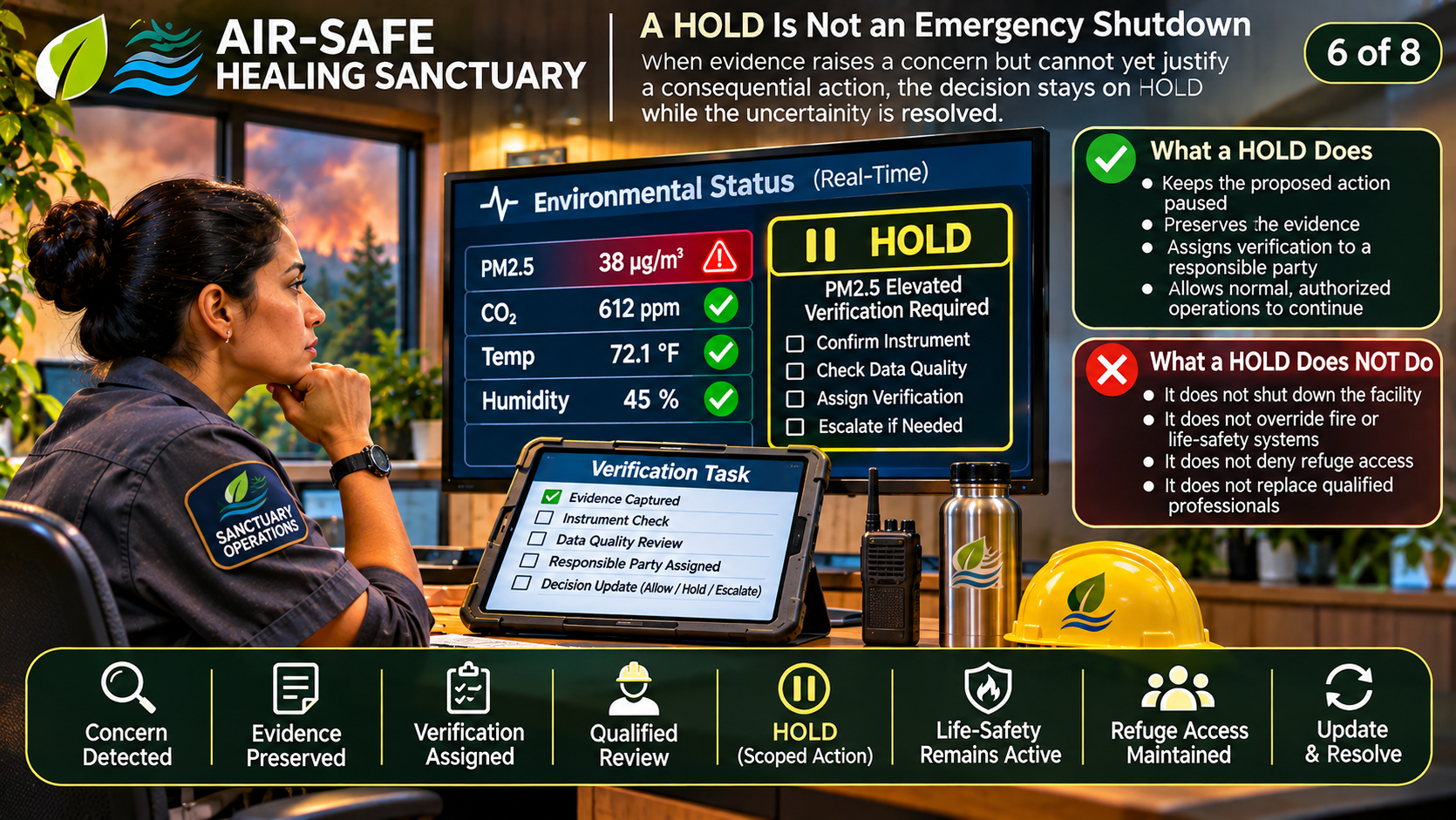
Imagine a particulate alert with unresolved instrument quality or applicability. The consequential proposal remains on HOLD while the original readings are preserved and a qualified responsible party investigates. The HOLD is scoped only to the proposed action. It is not permission to shut down life-safety systems, override emergency functions or block refuge access. A separate emergency procedure remains governed under its own authority.
WHAT YOU LEARNED
Uncertainty should trigger accountable review, not improvised control over people.
WHAT COMES NEXT
We test competing commercial and municipal obligations.
Follow the numbered teaching sections on the image. The page does not auto-scroll.
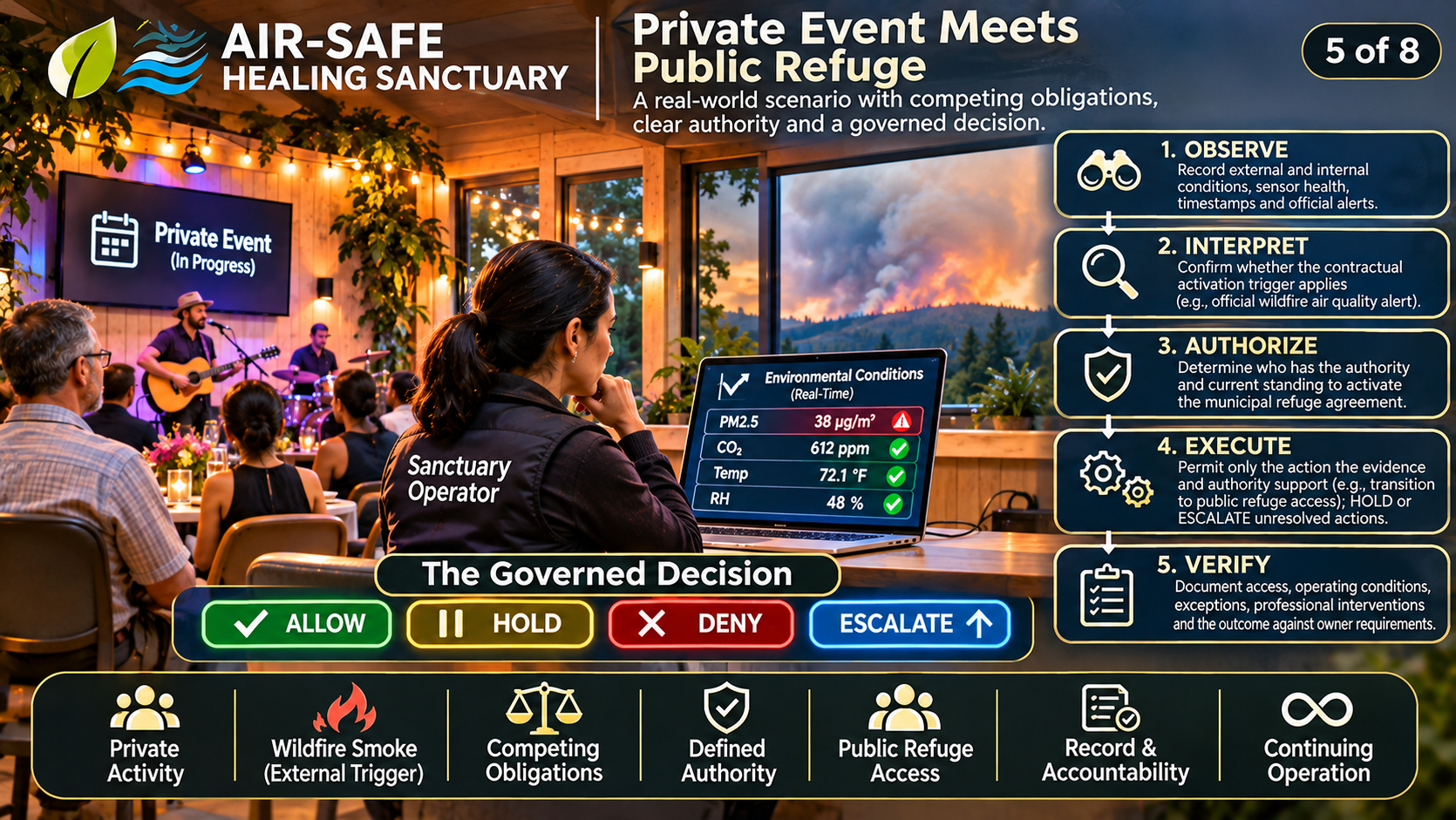
A paid community event is underway when regional wildfire smoke prompts consideration of a municipal refuge agreement. First observe and preserve conditions and official notices. Interpret the actual agreement rather than assuming a sensor alert activates it. Identify the authorized decision-maker and current standing. Execute only what that authority permits, then verify occupancy, access, facility conditions and exceptions. This illustration represents a hypothetical conflict, not an actual emergency or executed municipal decision.
WHAT YOU LEARNED
An owner’s commercial interest, public access duty and safety responsibilities must all be examined.
WHAT COMES NEXT
We follow the promises through decades of stewardship.
Follow the numbered teaching sections on the image. The page does not auto-scroll.
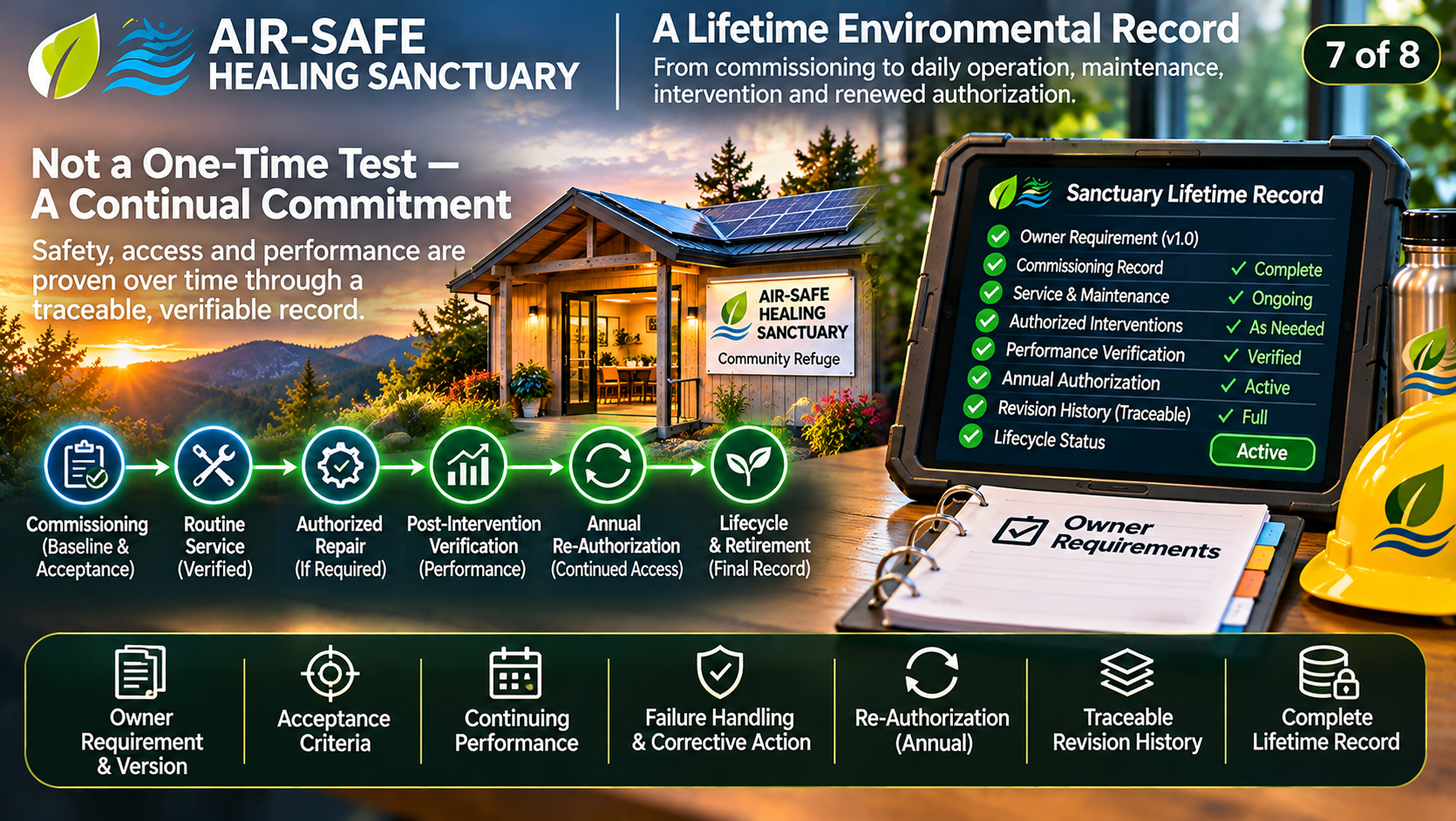
A lifetime environmental record should connect versioned owner requirements, approved acceptance criteria, commissioning evidence, instrument identity and calibration, maintenance, deficiencies, repairs, changed agreements, renewed authorization and post-intervention verification. The displayed completed statuses are illustrative—not claims about a deployed sanctuary. A preserved record makes missing obligations and drift visible; it cannot guarantee safety by itself.
WHAT YOU LEARNED
Commissioning begins the accountable record; it does not complete it.
WHAT COMES NEXT
We invite independent examination before any operational claims.
Follow the numbered teaching sections on the image. The page does not auto-scroll.
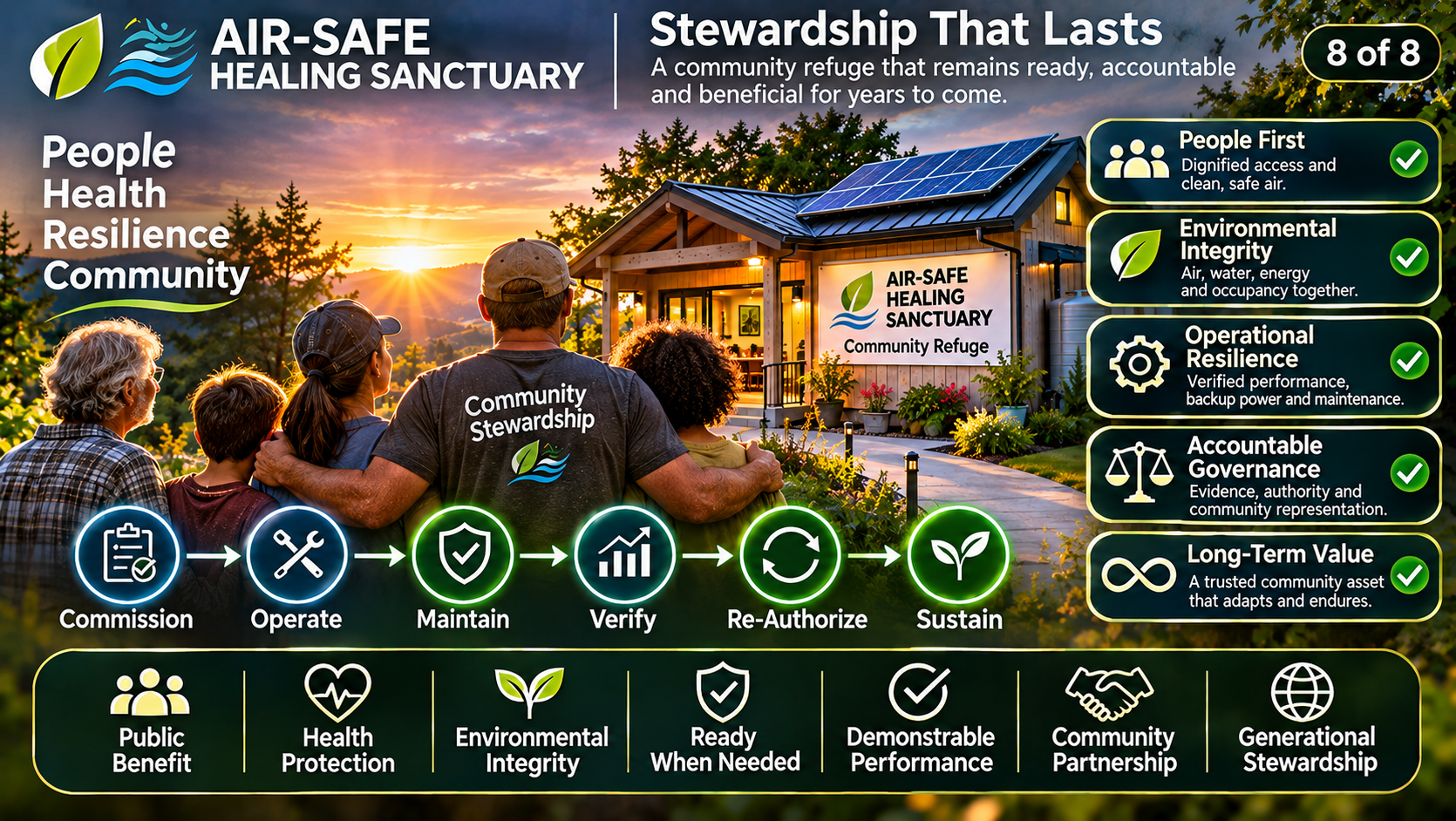
This closing illustration expresses a stewardship aspiration. It is not a deployed facility or a substitute for independent review. Our proposed virtual workshop can take one owner-defined requirement and one hypothetical decision, expose the supporting evidence, contract or rule, the person entitled to act, the bounded ALLOW, HOLD, DENY or ESCALATE determination and the resulting audit record. Reviewers should challenge unclear activation triggers, unresolved uncertainty, life-safety independence, privacy, accessibility and verification over time.
WHAT YOU LEARNED
A credible next step is an independently challengeable demonstration, not a premature certification claim.
WHAT COMES NEXT
Explore the open review questions and a potential bounded evaluation.
BOUNDED VIRTUAL EXAMINATION
One requirement. One decision. One inspectable record.
For an initial workshop, use a hypothetical private-event/public-refuge conflict and trace five steps. The example does not decide a real municipality’s legal obligations or operate a real sanctuary.
01 / Observe
Preserve dated indoor and outdoor conditions, uncertainty, source health and official notices.
02 / Interpret
Check whether the owner requirement and any real contract trigger apply.
03 / Authorize
Identify the legal or contractual authority and current actor standing.
04 / Execute
Permit only the bounded, supported consequence; otherwise HOLD, DENY or ESCALATE.
05 / Verify
Preserve what happened, access outcomes, exceptions and independently examinable follow-up.
Challenge the proposed decision
Remove instrument calibration; change a contractual trigger; revoke an operator’s standing; discover a conflict with independent fire protection; or show that post-action access was never verified. Which proposed action must be HELD, DENIED or ESCALATED? What new evidence would justify an ALLOW? A simulation can demonstrate the reasoning path, but cannot establish legal authority or certified performance at an actual site.
Questions for independent reviewers
What exact conditions activate the municipal refuge obligation—and who can validly declare activation?
How is a valid public-access requirement verified during a private event, including occupancy and accessibility?
Who owns inconclusive, conflicting, missing or stale evidence, and when does the case escalate?
Which fire, life-safety and emergency procedures remain independently authorized?
What can the public inspect without disclosing personal, security-sensitive or commercial information?
Who approves the commissioning baseline, reassessment schedule and acceptance criteria?
What would justify a next-stage evaluation?
A consenting site, a versioned owner brief, validated instruments and performance criteria, a real governing agreement, qualified engineering and accessibility review, explicit responsibility assignments, an independently observed demonstration and written scope and commercial terms. Any future pilot or international presentation would be a separately approved undertaking.
Apply the governance principles to three hypothetical cases relevant to air-quality intervention. Choose a determination, then examine the reasoning. These cases teach the distinction between Admissible Evidence, Applicable Authority, and Established Standing; they do not issue real-world authorization.
CASE 01
Evidence is not yet admissible
A proposed consequence is supported by an observation, but the source attribution or record continuity is missing. What should happen before execution? Consider this in the context of air-quality intervention.
CASE 02
The actor exceeds authority
The record is current and reliable, but the proposed consequence falls outside the scope of applicable authority. What is the supported determination?
CASE 03
A higher authority is required
The proposed consequence triggers a documented requirement for review by another designated authority. What is the appropriate route?
Independent educational examples only. The questions are hypothetical and do not assess a real institution, building, person, or operating system. Actual governance determinations require case-specific evidence, applicable authority, established standing, and bounded review.