Environmental Integrity Governance
Examines evidence, interpretations, proposed interventions and accountability.
INDEPENDENT COLLABORATION CONCEPT · ITALY
A proposed AIRsana × TA-14 teaching experience. Explore how Environmental Integrity Governance, Atmospheric Integrity Records and Admissible Execution Architecture might complement a verified AIRsana use case.
Examines evidence, interpretations, proposed interventions and accountability.
Preserves provenance, context, quality, continuity and subsequent observations.
Tests evidence, authority and standing at the commitment boundary NOW.
Eight guided lessons
Scroll through all eight full-width visual lessons. Each one includes a detailed explanation, its key lesson, and the next question to examine.
LESSON 01 / 08
A condition exists before anyone measures it. A sensor reports a bounded observation, not the entirety of a school’s air.
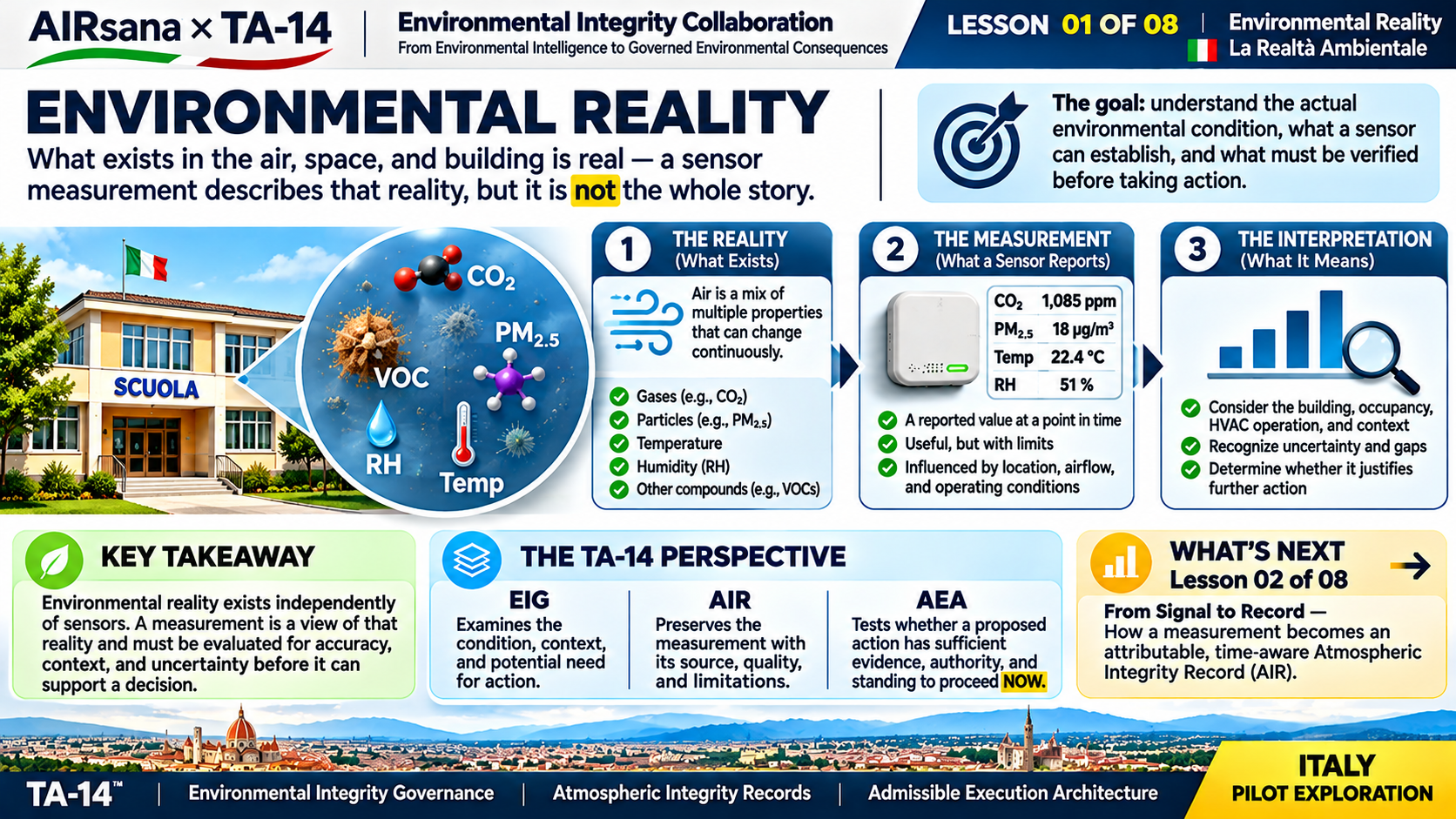
Begin with the school and the illustrated air constituents. Compare the actual environmental reality with the values displayed by the instrument. A reading depends on instrument quality, position, timing, operating state, and sampling coverage. The numbers pictured are hypothetical. Before using an observation to justify an intervention, ask what it truly establishes and what remains unknown.
Environmental reality is not identical to a reading or a dashboard score.
Next, we make the observation attributable and reconstructable.
LESSON 02 / 08
A number gains evidentiary value when its provenance, location, time, quality and context are documented.
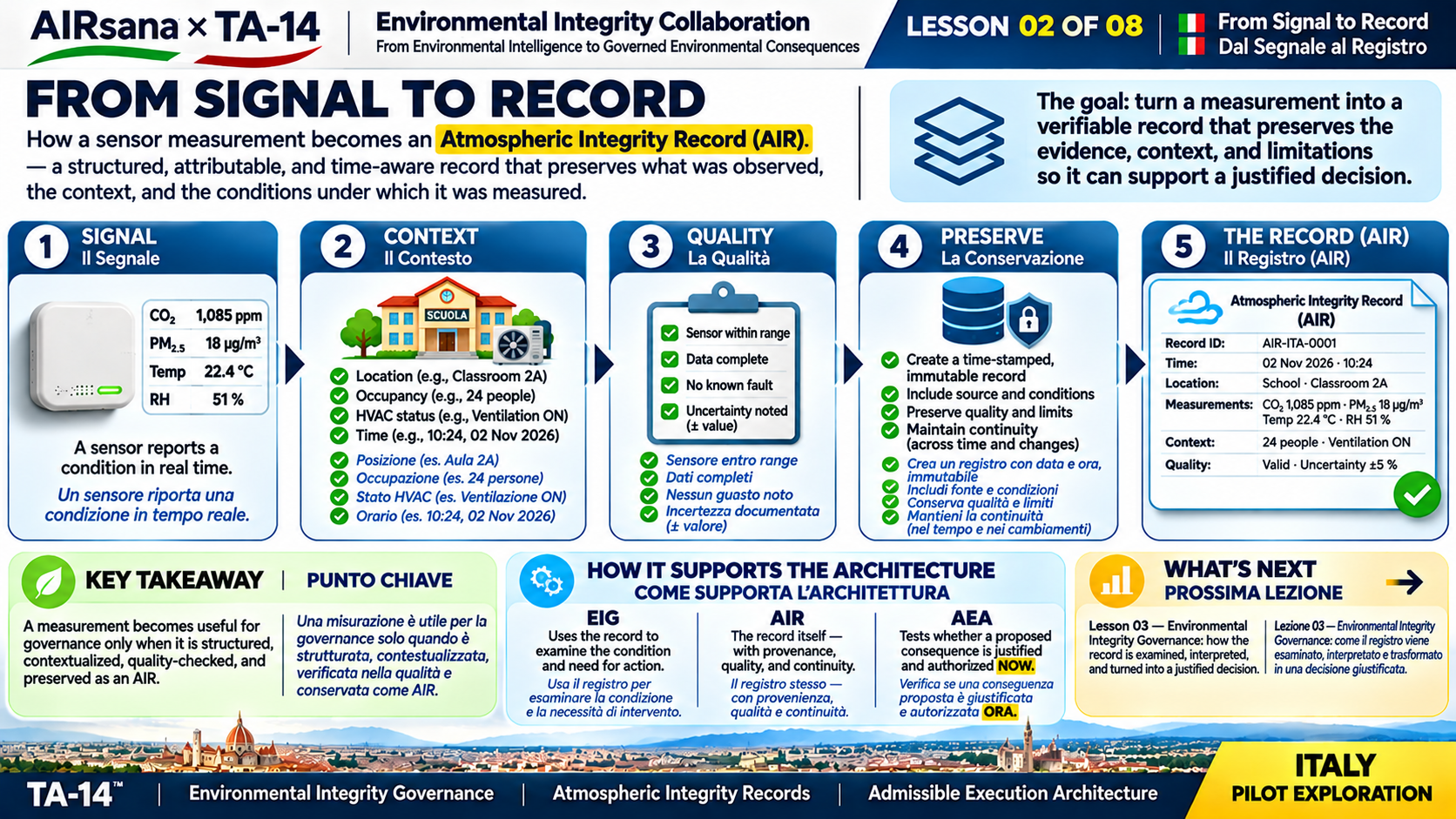
Read the image from left to right: signal, context, quality, preservation and record. An Atmospheric Integrity Record links an environmental observation to its source and conditions. It should preserve raw data, timestamps, instrument identity, calibration or verification status, relevant limitations and later corrections with provenance. An immutable-looking icon in this illustration is not proof that any operational system is immutable. A well-structured record can be examined; its admissibility must still be tested for the proposed use.
An AIR preserves evidence and limitations; the existence of a record does not itself authorize an action.
Next, examine what the preserved observation can legitimately support.
LESSON 03 / 08
EIG tests the environmental claim, evidence sufficiency and proposed response before presenting a reasoned recommendation.
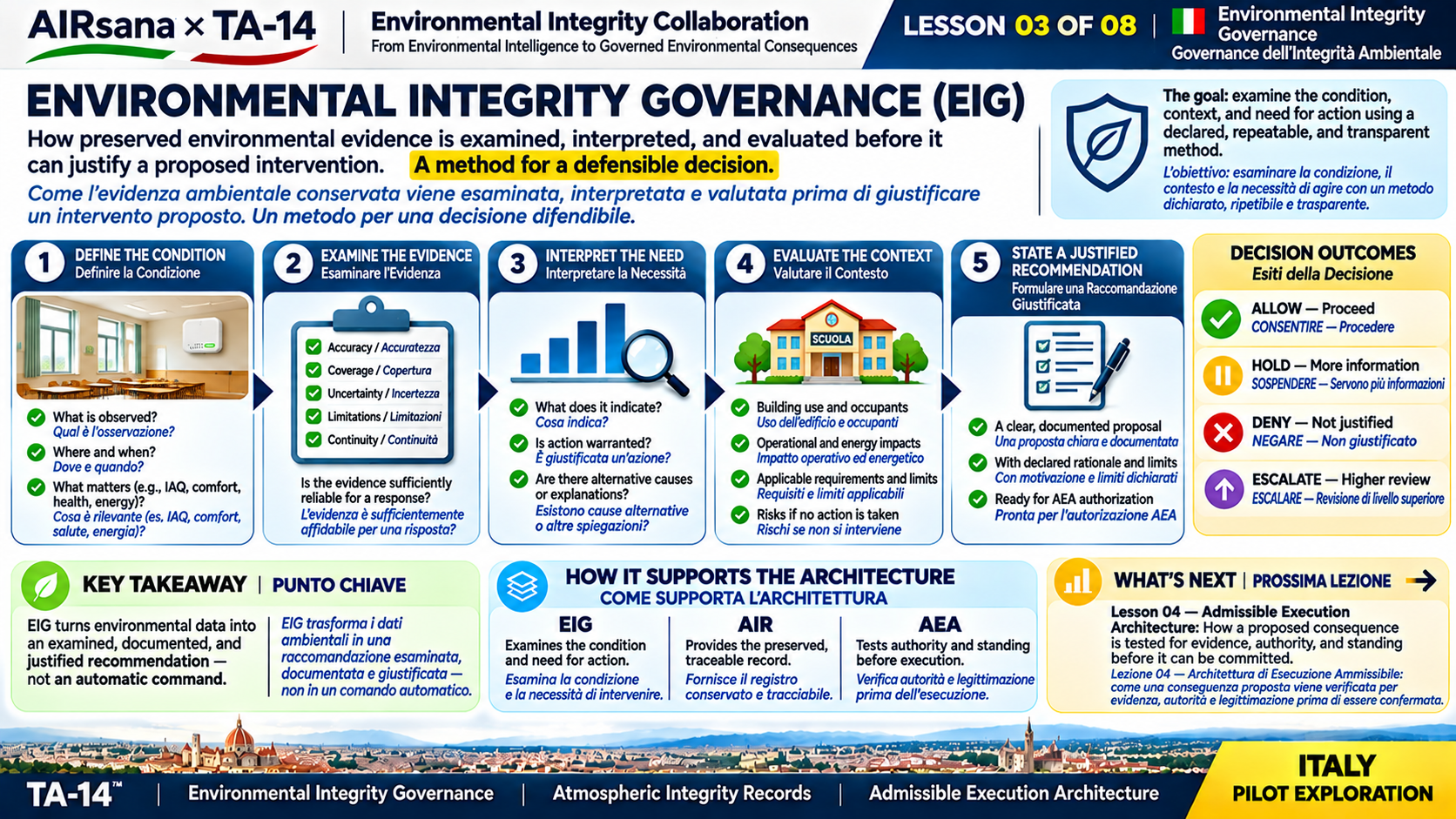
Start with the observed condition and move across evidence examination, interpretation, context and recommendation. Ask whether the sensor coverage is representative, which competing explanations exist, and whether the proposed response respects building use and occupant needs. An EIG recommendation is an examinable proposal, not a command to an HVAC controller. ALLOW, HOLD, DENY and ESCALATE are consequences of a separate bounded authority check, not automatic outputs of a green dashboard.
A defensible recommendation and permission to execute are two different questions.
Next, test the specific proposed consequence at the execution boundary.
LESSON 04 / 08
AEA tests Admissible Evidence, Applicable Authority and Established Standing at commitment NOW.
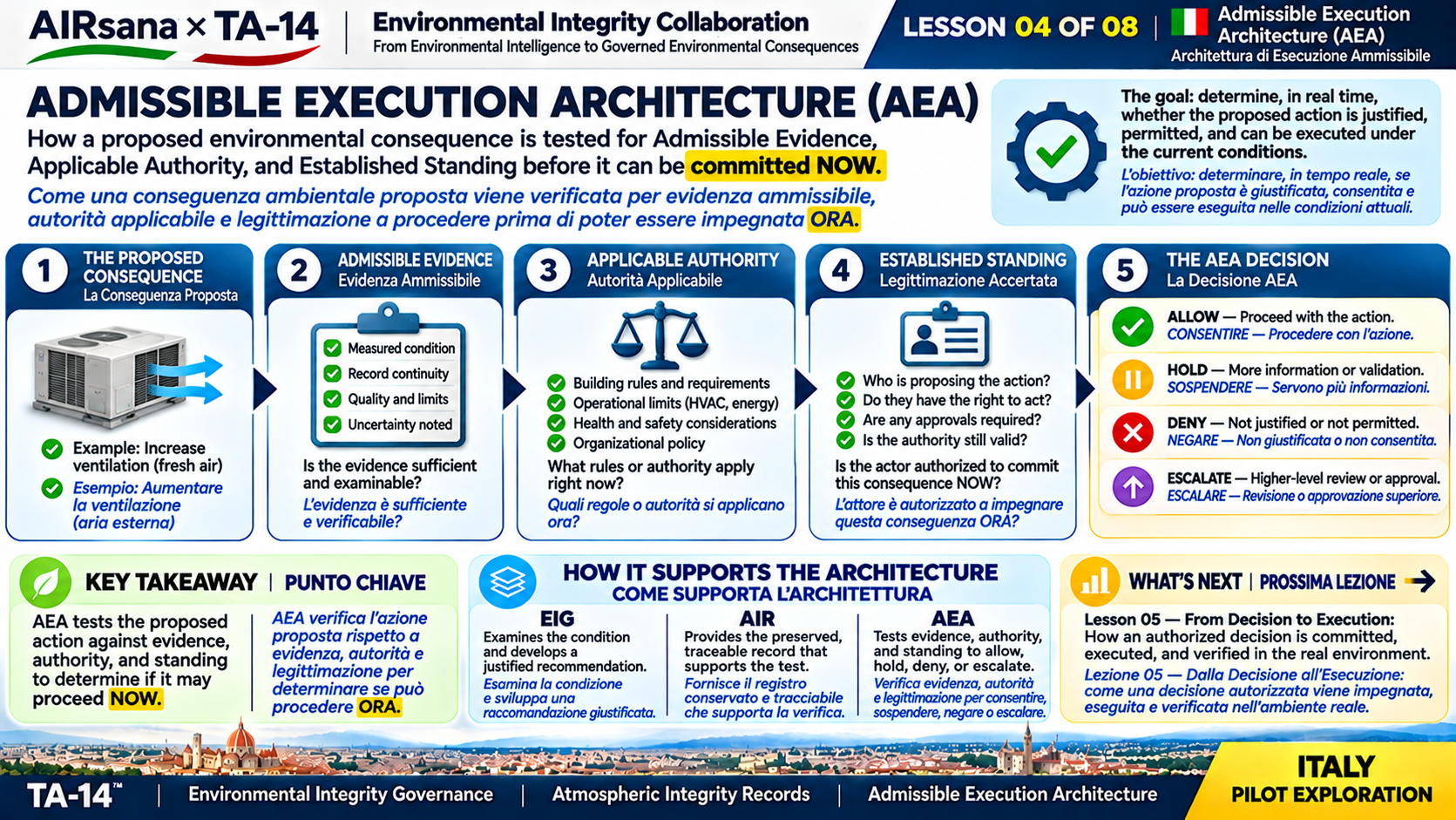
The image begins with a proposed ventilation adjustment, not an already permitted action. Examine the evidence, the controlling building rules and the specific person or system making the decision. A technically feasible action can still be unauthorized. A determination is bounded to the actor, asset, action, conditions and time. A missing requirement may lead to HOLD or ESCALATE; an established prohibition requires DENY. Only a properly established ALLOW can move toward execution, subject to revalidation when circumstances change.
Capability and recommendation do not create current execution authority.
Next, examine what an authorized intervention actually does.
LESSON 05 / 08
Authorization, commitment, actual execution and observed outcome must be recorded separately.
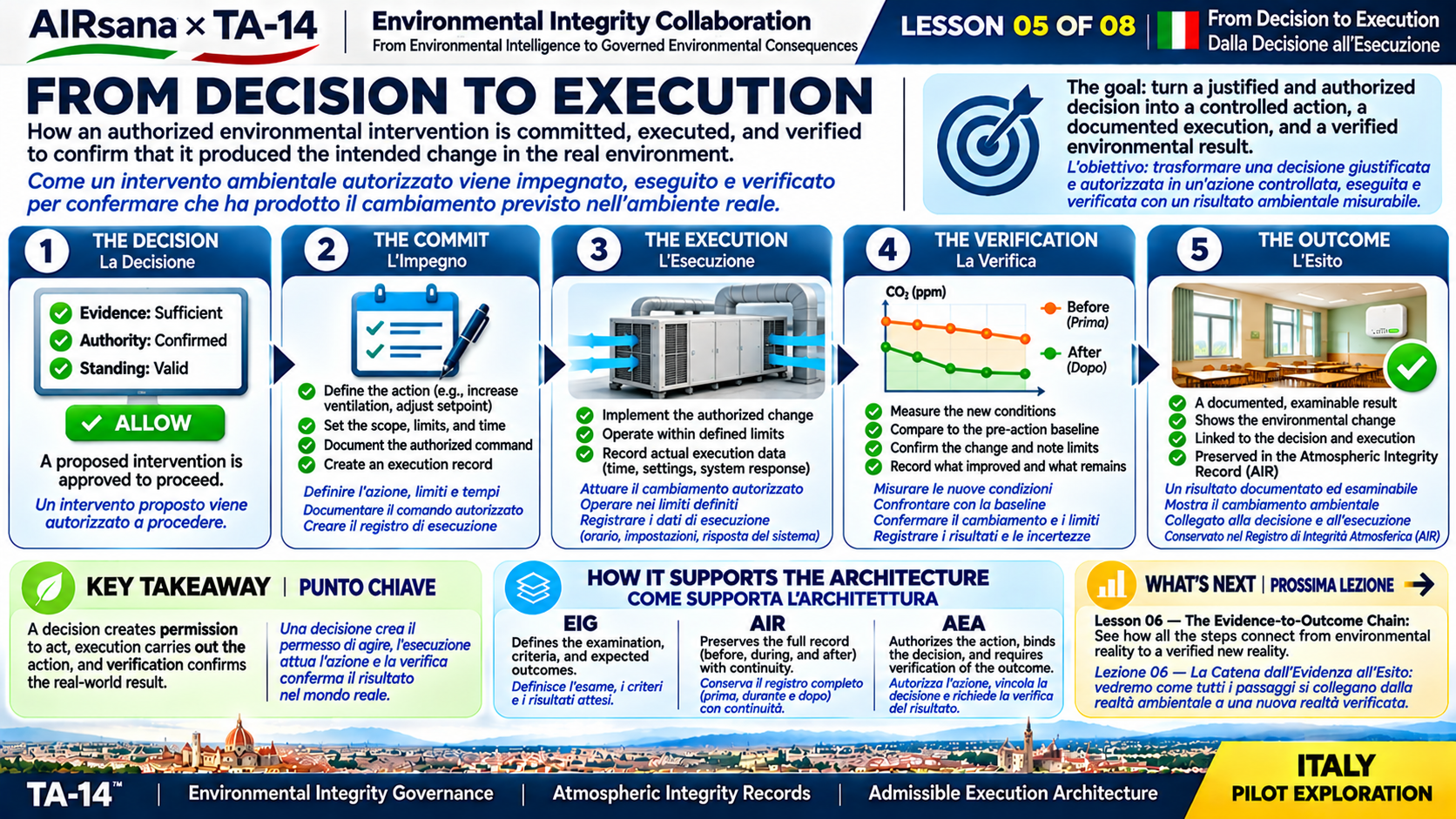
Follow the five panels: decision, commit, execution, verification and outcome. A bounded ALLOW applies to one specified action under declared conditions. The control system or technician must perform only that action, preserve actual settings and timestamps, and stop for material changes requiring revalidation. A successful command acknowledgement is not proof that the environmental objective was achieved. Observe and verify the resulting condition independently.
An approved decision, an executed command and a verified outcome are distinct records.
Next, see the complete eight-link execution evidence chain.
LESSON 06 / 08
Reality, Record, Continuity, Admissibility, Binding, Commit, Execution and Outcome form one examinable sequence.
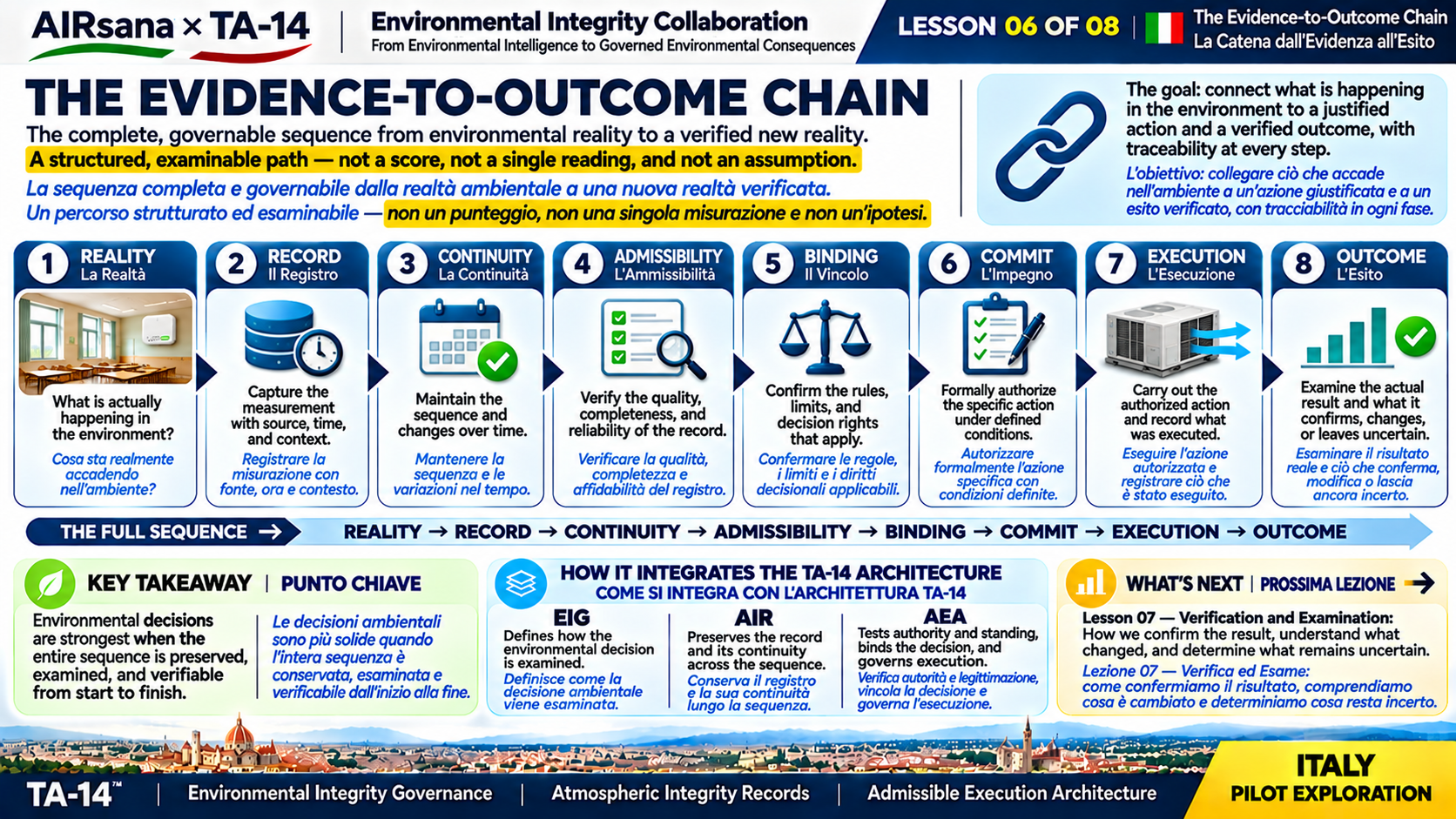
Read all eight links left to right. Reality is not the record; the record needs continuity. Continuity must be examined for admissibility. Admissibility does not by itself confer authority. Binding links a specific decision to actor, asset, action, scope and conditions. Commitment must revalidate those constraints. Execution must match the bounded authorization. The outcome must be measured, including remaining uncertainty. Each transition is a separate question.
No link can silently substitute for another; the whole chain must remain reconstructable.
Next, distinguish evidence of improvement from proof of causation.
LESSON 07 / 08
Compare an attributable baseline with comparable post-action observations, documenting uncertainty and alternative causes.
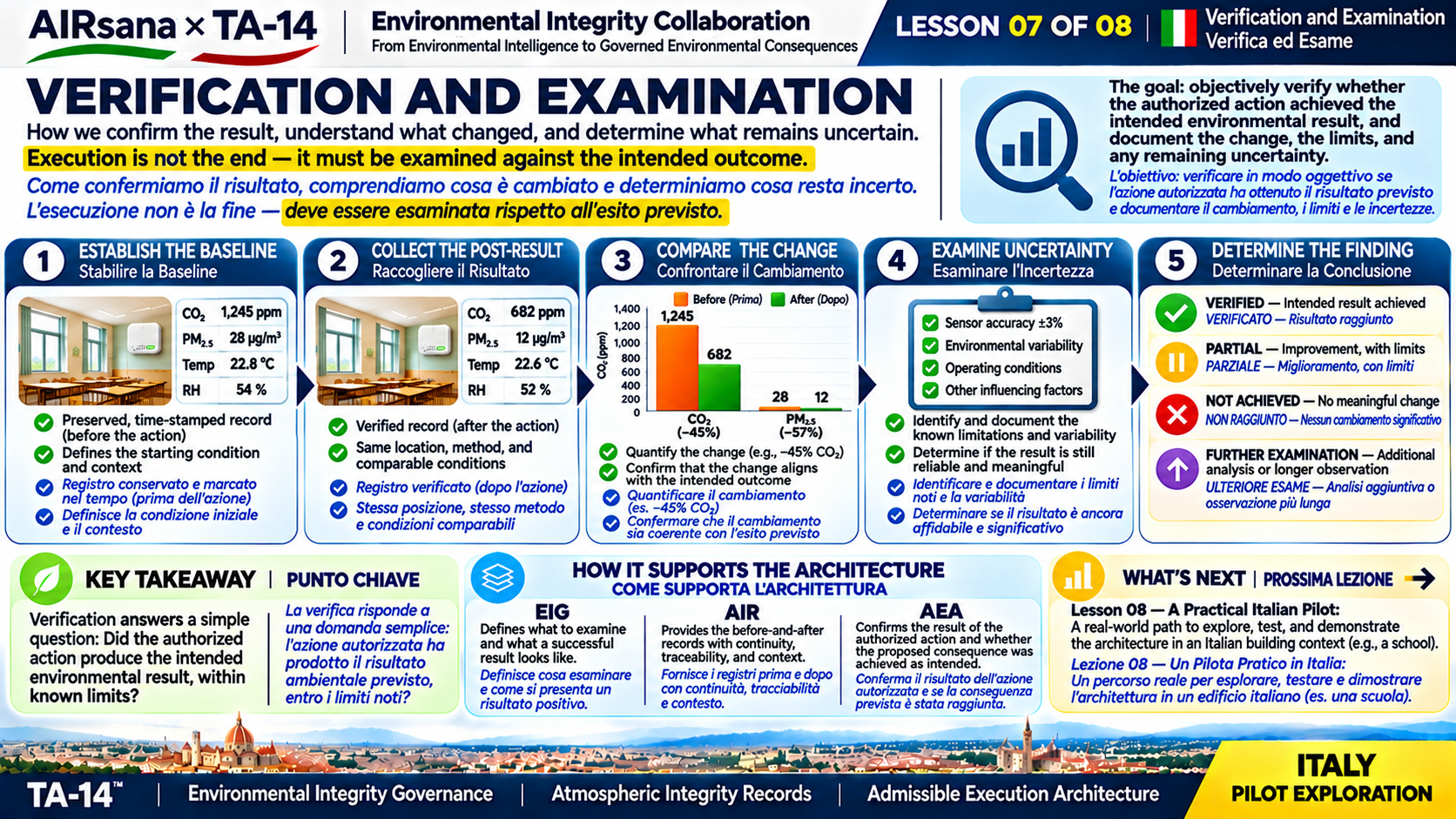
Examine the before and after classroom values, which are simulated. Even a substantial apparent decrease in carbon dioxide or particulate matter does not, by itself, establish the cause, a health benefit, or the whole building’s performance. Compare instrumentation, sampling period, occupancy, outdoor conditions and ventilation state. State whether the objective was achieved, partly achieved, not achieved, or requires further examination, with reasons and limitations.
Observed improvement is not automatically proof that the intervention caused it.
Finally, map these methods into a potential bounded Italian pilot.
LESSON 08 / 08
A proposed demonstration: agree on an AIRsana use case, evidence access, governance criteria, verification and commercial scope.
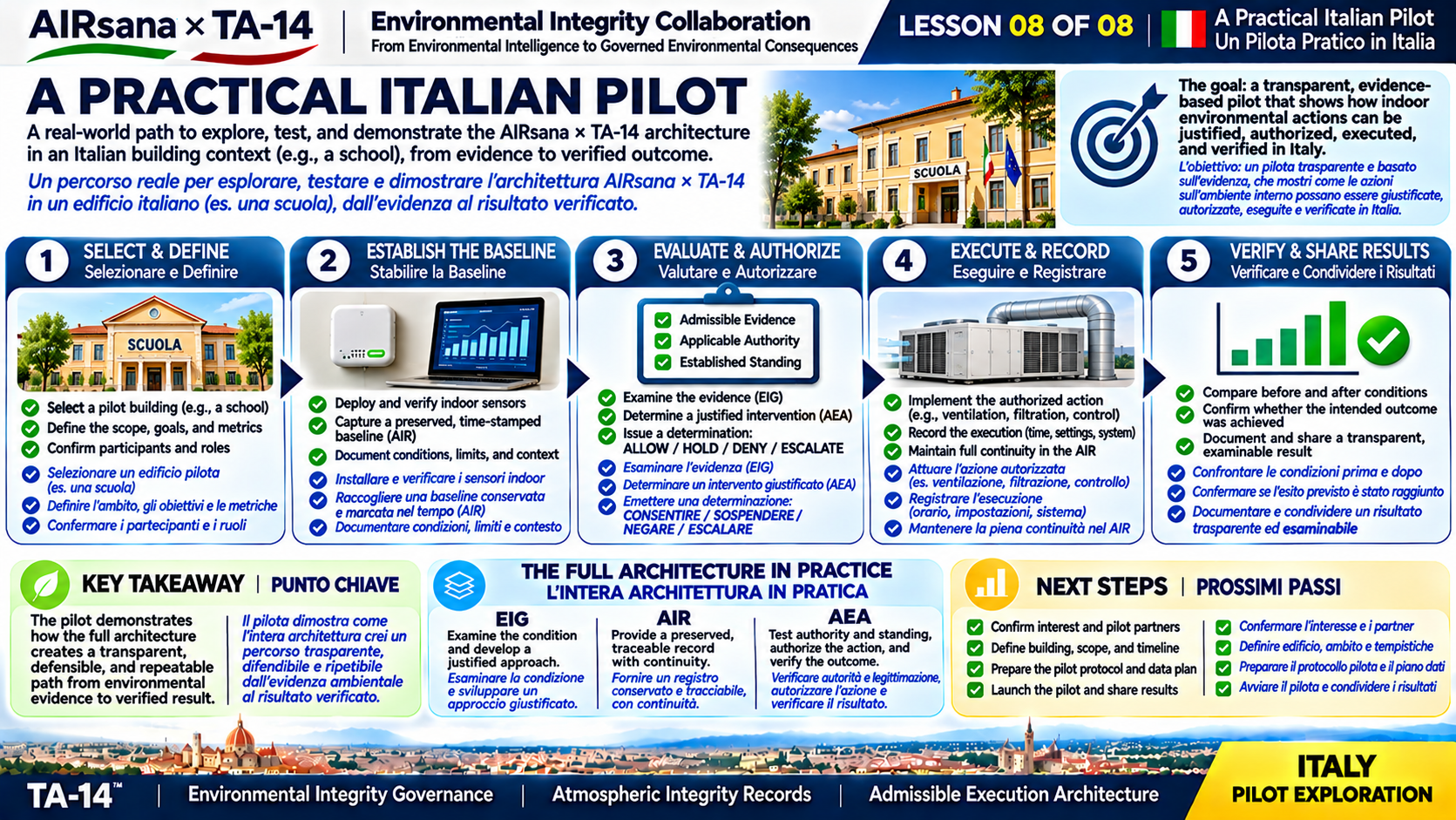
The illustrated school is a candidate scenario, not a secured customer or operating pilot. First obtain AIRsana’s approved technical descriptions and permission to use them. Agree on a specific building question, participants, data sources and privacy boundaries. Establish a baseline and explicit acceptance criteria; evaluate a proposed intervention under applicable authority; then record any authorized work and compare outcomes. After a bounded demonstration, the participants can decide whether a funded pilot is warranted. No AIRsana endorsement, integration, audit or performance guarantee is claimed.
The next step is a voluntary, narrowly scoped examination, not a preannounced partnership.
The full framework is available in the accompanying PDF.
AEA · ALLOW / HOLD / DENY / ESCALATE
Hypothetical classroom ventilation proposal. Set the examination facts below; the result is a teaching simulation, never an actual authorization.
At least one prerequisite has not been established; no execution should follow.
PROPOSED NEXT STEP · ITALY
The eight lessons describe a possible governance layer around a verified AIRsana use case. The opportunity is not to replace AIRsana’s technology or to claim that a partnership already exists. It is to examine whether environmental observations can support traceable, justified, authorized and independently examinable outcomes.
Explore an evidence pathway that preserves environmental conditions, provenance and uncertainty; distinguishes recommendations from authority; and verifies what happened after an intervention. These are potential benefits to test, not demonstrated AIRsana outcomes.
AIRsana would remain responsible for its own technology, documentation and verified technical claims. TA-14 would propose EIG, AIR and AEA methods for evidence continuity, admissibility and consequence governance. Building owners, operators and qualified professionals would retain their actual legal, technical and operational authority.
Select one consenting building or operational scenario. Agree on the question, source data, privacy and access permissions, baseline, decision rights, acceptance criteria and independent examination. Review the findings before discussing integration, scope or commercial terms.
We propose a voluntary discussion with AIRsana’s relevant representatives to identify one real use case and determine whether a bounded technical examination would be useful. No participation or endorsement is assumed.