01
REALITY
What was the building actually doing at the consequential time?
ATMOSPHERIC EVIDENCE · HVAC HISTORY · CONTINUITY · OUTCOME
When a school, apartment, workplace, insurer, attorney, court, consultant, or public agency needs to understand what happened inside a building, the question is not merely what can be measured today. The question is what condition actually existed, what changed, what intervention occurred, and what record survived.
.png&w=3840&q=75)
A building is not just a location. Its atmosphere, systems, operation, occupancy, maintenance, and timestamps can form a technical record.
Next, we test what happens when that record is missing and someone tries to reconstruct the past from a later inspection.
WHY ARIZONA · WHY NOW
The opportunity is not to invent a new need. It is to strengthen the record around needs Arizona already has: classroom temperature and air quality, HVAC deficiencies, housing cooling failures, environmental disputes, capital improvements, compliance, and later technical examination.
Arizona Building Renewal Grants expressly recognize Classroom Temperature, Classroom Air Quality, and Building Systems deficiencies. The pathway can include assessment, design, procurement, construction, and supporting documentation.
VIEW SOURCE →HOUSING / HABITABILITYArizona enforcement in 2026 has focused on failed air conditioning, extreme indoor heat, repair obligations, proof of compliance, and preservation of HVAC-related records.
VIEW SOURCE →LITIGATION / FORENSIC EVIDENCEMason v. Eastside/Wasatch shows the evidentiary problem created when later testing is asked to establish an earlier indoor condition without sufficient continuity, documentation, or chain of custody.
VIEW SOURCE →PROCUREMENT / IMPLEMENTATIONArizona already procures environmental monitoring, assessment, engineering, and technical services. TA14 enters as an evidence-integrity and consequence-governance layer, not as a replacement for licensed practice.
VIEW SOURCE →.png&w=3840&q=75)
A later test is evidence of the later condition. It does not automatically establish the earlier condition when continuity is missing.
Next, we turn that lesson into a full evidence path that preserves the building before, during, and after intervention.
THE EVIDENCE PATH
TA14 treats the building record as a chain that moves from physical reality through observation, continuity, intervention, verification, and examination. Each stage has a different job. None is allowed to silently substitute for another.
What was the building actually doing at the consequential time?
What atmospheric, mechanical, service, complaint, occupancy, and system evidence was preserved?
Can the record survive gaps in time, custody, location, system state, changed conditions, and later reconstruction?
What repair, control change, remediation, operating action, or capital improvement actually occurred?
What changed afterward, what did not change, and was the result measured rather than assumed?
What can the preserved record legitimately support now — and what remains unresolved?
.png&w=3840&q=75)
Baseline, problem, intervention, verification, and post-condition evidence should be connected rather than stored as unrelated snapshots.
Next, we examine the moment after the work: commissioning and verification.
HISTORICAL ARIZONA PRESSURE TEST
The Mason litigation illustrates the evidentiary risk: sample documentation and chain of custody were challenged, and testing years later could not reliably establish earlier mold conditions where temperature, humidity, remediation, and other intervening conditions were not known. The lesson is not that one party was right. The lesson is that a missing chronology can become decisive.
.png&w=3840&q=75)
The fact that work was performed does not establish that the intended atmospheric or mechanical outcome occurred.
Next, we preserve the entire before-during-after history so the result can survive future examination.
.png&w=3840&q=75)
A complete record preserves the sequence from baseline through intervention and post-condition instead of forcing future reconstruction.
Next, we show what that preserved history can support — and what it still cannot authorize by itself.
TA14 EVIDENCE ARCHITECTURE
AIR preserves atmospheric condition and chronology. ERI makes the preserved record understandable without silently converting observation into diagnosis, legal conclusion, or execution authority. PAIR is used only where person-centered atmospheric continuity is actually relevant.
Temperature, humidity, CO₂, particles, pressure, equipment state, occupancy context, complaints, timestamps, and other bounded observations establish what the building was doing before intervention.
Service events, control changes, failures, repairs, bypass conditions, commissioning observations, configuration changes, and material changed conditions preserve how the system moved through time.
The record identifies what was proposed, what authority applied, what work actually occurred, who performed it, when it occurred, and the scope under which it was performed.
After work is complete, the building is measured again. Improvement, non-improvement, drift, or unresolved conditions are recorded without rewriting execution as success.
ERI makes the preserved record understandable while keeping observation separate from inference, diagnosis, legal conclusion, and execution authority.
The resulting package can be replayed by owners, districts, consultants, insurers, counsel, experts, or agencies without TA14 pretending to decide the underlying legal or professional question.
.png&w=3840&q=75)
Better records can support risk reduction, dispute resolution, operations, and accountability — but evidence alone does not grant authority.
Next, we extend the record beyond one project into the full lifecycle of building decisions.
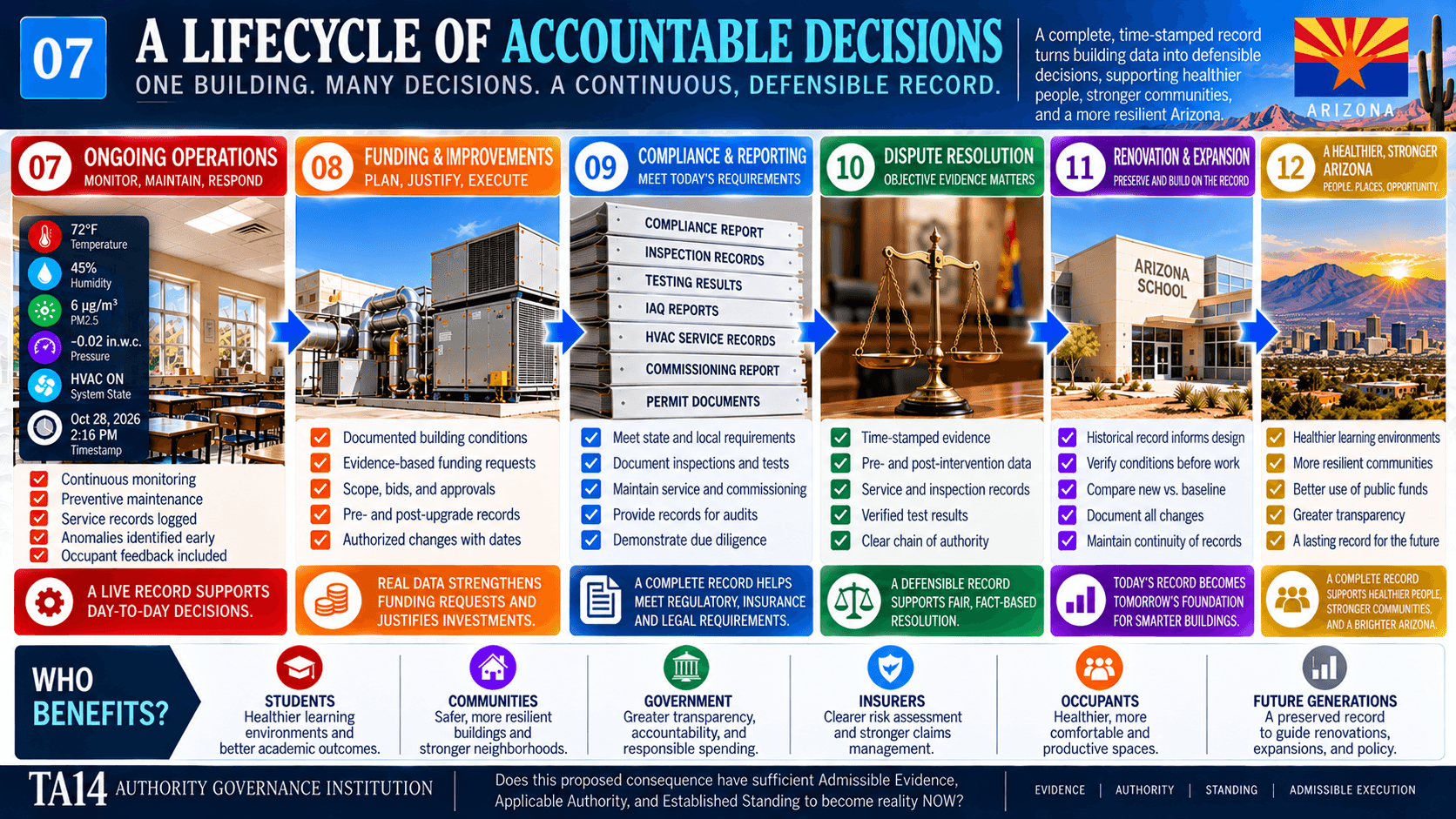
Operations, maintenance, funding, compliance, disputes, and renovation all rely on the history created by earlier decisions.
Next, we connect preserved evidence directly to funding and capital improvement decisions.
.png&w=3840&q=75)
Evidence can support prioritization, scope, funding, execution oversight, and verification of the result.
The final step is a bounded Arizona pilot: one building, one condition, one evidence problem, and a record that can be examined.
PROPOSED ARIZONA PILOT
A school HVAC or IAQ deficiency. An apartment cooling or habitability complaint. A mold or moisture evidence problem. Post-repair verification. Or a portfolio that needs defensible operating history. The pilot does not decide the case. It establishes a stronger record of reality around the consequential route.
Freeze the proposition and scope.
Establish baseline evidence and provenance.
Preserve mechanical and service chronology.
Record authority, actor, intervention, time, and scope.
Verify post-condition performance.
Produce a replayable examination package.
ARIZONA PILOT INVITATION
No endorsement is required. The useful result may be confirmation, a HOLD, a missing record, a broken continuity chain, an unresolved authority question, or a finding that the proposed method needs to change. The purpose of the pilot is to make that visible before the record is relied upon for a consequential decision.
PROPOSE AN ARIZONA PILOT →