TA-14 AUTHORITY GOVERNANCE INSTITUTION · INDEPENDENT SCIENTIFIC EVIDENCE SHOWROOM
Clean Air.
Developing Minds.
From Atmospheric Observation to Human Consequence
A guided, eight-visual examination of published research on prenatal air pollution exposure and early childhood cognition—and the critical boundary between a scientific finding and an authorized real-world decision.
Independent TA-14 educational interpretation. Not a certification, completed examination, causal determination, or endorsement by Columbia University, its researchers, or the journal. No researcher is represented as a TA-14 registrant.
1998–2016 · residential prenatal
1998–2016 · residential prenatal
1998–2020 · personal monitoring
Latest vs earliest cohort
Reported by Columbia University Mailman School of Public Health. Different pollutants, methods, and periods; do not combine percentages or interpret the cohort association as proof of policy causation.
THE DISTINCTION THIS ROOM TEACHES
Observed is not inferred.
Inferred is not authorized.
Read each numbered visual. Start narration only when you choose; scrolling remains completely under your control. The voice is selected from those installed in your browser, preferring Samantha when available.
VISUAL 01 / 08 · WHY THE QUESTION MATTERS
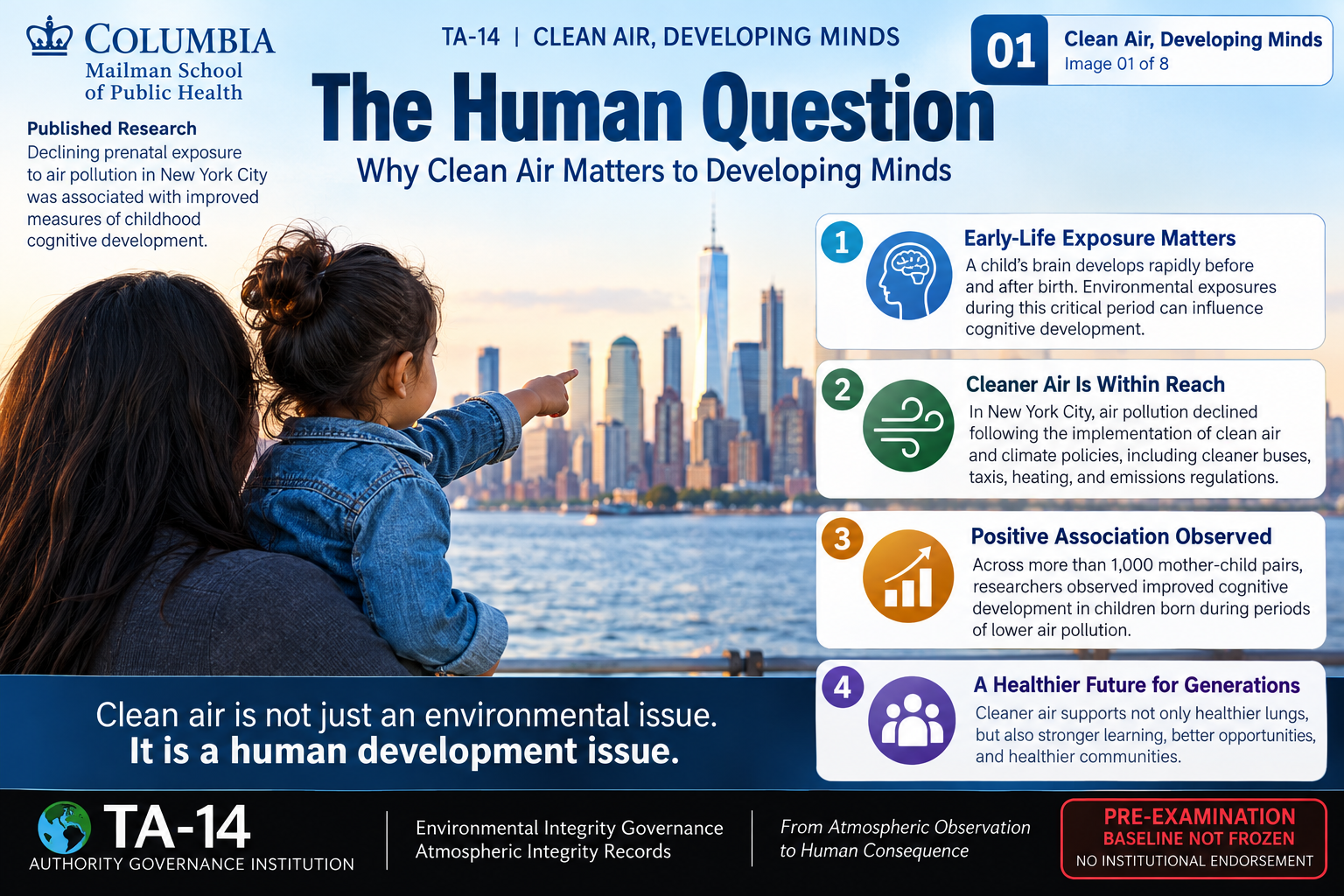
The Human Question
Children encounter environmental conditions long before they can choose or control them. This study asks whether changing prenatal pollution exposures across New York City cohorts coincide with differences in later cognitive development.
Read the full narration transcript
Visual one. Start with the human question. A developing child experiences the atmosphere that actually exists, not the atmosphere a policy promises. The Columbia University research reports associations between declining prenatal pollution exposures and improved age three cognitive scores across successive cohorts. That is an important observation. It is not yet a proof that any single clean air policy caused a particular child’s score. Our job is to preserve the distinction between what was observed, what was inferred, and what someone is authorized to do next.
VISUAL 02 / 08 · THE MEASUREMENT BOUNDARY
What Was Measured
The summary discusses PM2.5, nitrogen dioxide, and polycyclic aromatic hydrocarbons. These are not interchangeable measures: exposure estimation, personal monitoring, and observation periods differ.
.png)
Read the full narration transcript
Visual two. Examine what was measured. Fine particulate matter, nitrogen dioxide, and polycyclic aromatic hydrocarbons are different pollutant indicators. Residential prenatal concentration estimates and personal exposure measurements are different forms of evidence. Each has its own methods, time window, limitations, and uncertainty. Before we compare numbers, we must preserve their provenance. A measurement is a record of a defined thing under defined conditions. It does not automatically describe every pollutant, every neighborhood, or every child.
VISUAL 03 / 08 · THE CONTINUITY QUESTION
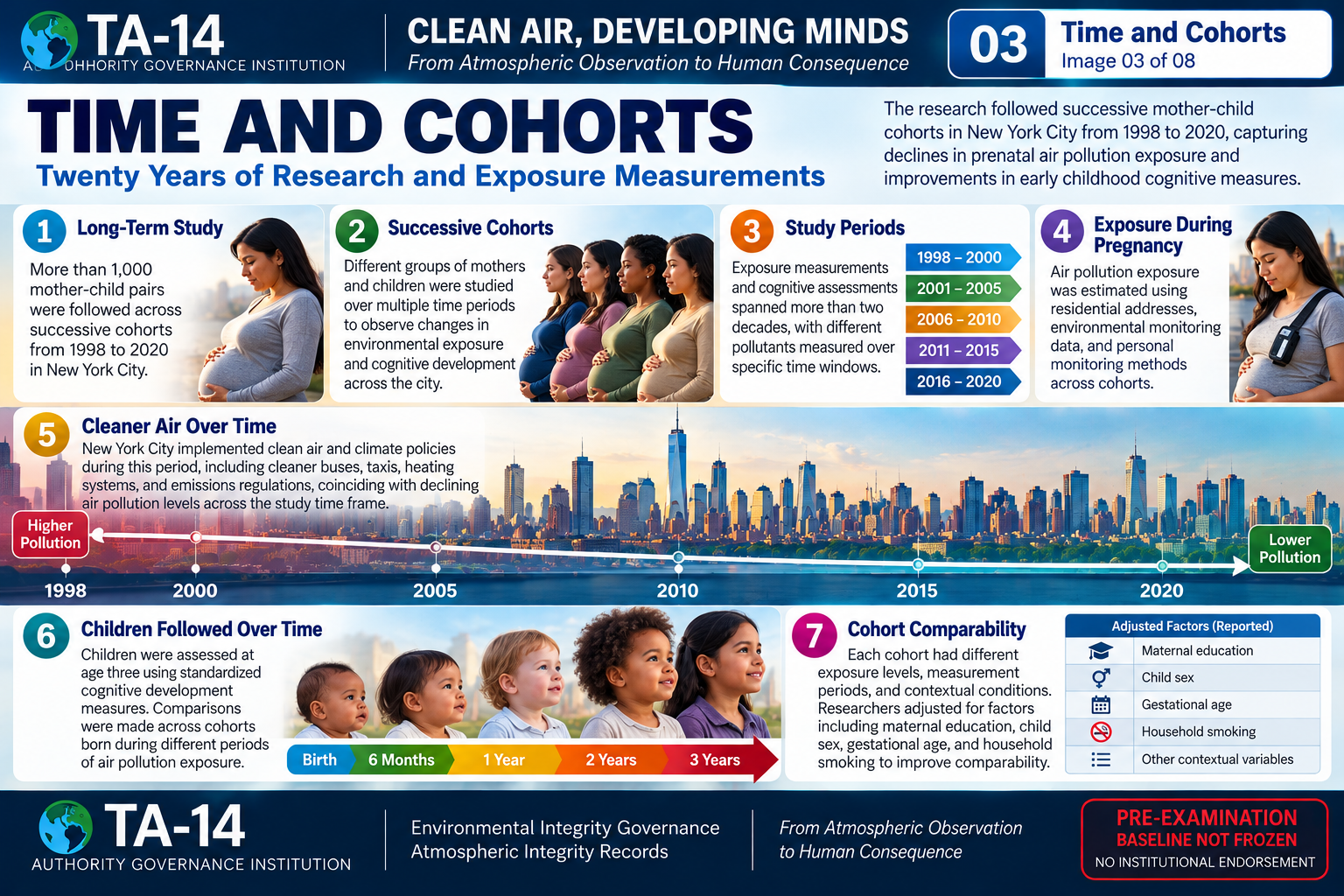
Time and Cohorts
The reported comparisons span successive cohorts and differing time windows. The integrity of the claim depends on preserving when and how exposure and developmental outcomes were assessed.
Read the full narration transcript
Visual three. Time is part of the evidence. These results compare cohorts recruited across years. PM two point five and nitrogen dioxide trends were reported over nineteen ninety eight through twenty sixteen. The personal PAH comparison extends through twenty twenty. Cohort composition, exposure estimation, developmental assessment, and statistical adjustment must remain distinguishable. Continuity means the reader can follow the record from the original observation through the published comparison without quietly substituting one time period or population for another.
VISUAL 04 / 08 · THE REPORTED FINDINGS
What the Results Show
The university summary reports declines of 32% in prenatal residential PM2.5, 30% in NO₂, and 60% in personal PAH concentrations across their respective periods; it also reports a 26% higher age-three Mental Development Index score in the later versus earliest cohort.
.png)
Read the full narration transcript
Visual four. Here are the reported findings. Residential prenatal PM two point five declined thirty two percent between nineteen ninety eight and twenty sixteen. Nitrogen dioxide declined thirty percent across that period. Personal PAH measurements declined sixty percent across the longer reported window. The later cohort had age three Mental Development Index scores twenty six percent higher than the earliest cohort. These percentages do not share one denominator, and they should never be combined into one invented effect size. The findings are associations reported across cohorts, not the result of a randomized policy experiment.
VISUAL 05 / 08 · THE CLAIM CEILING
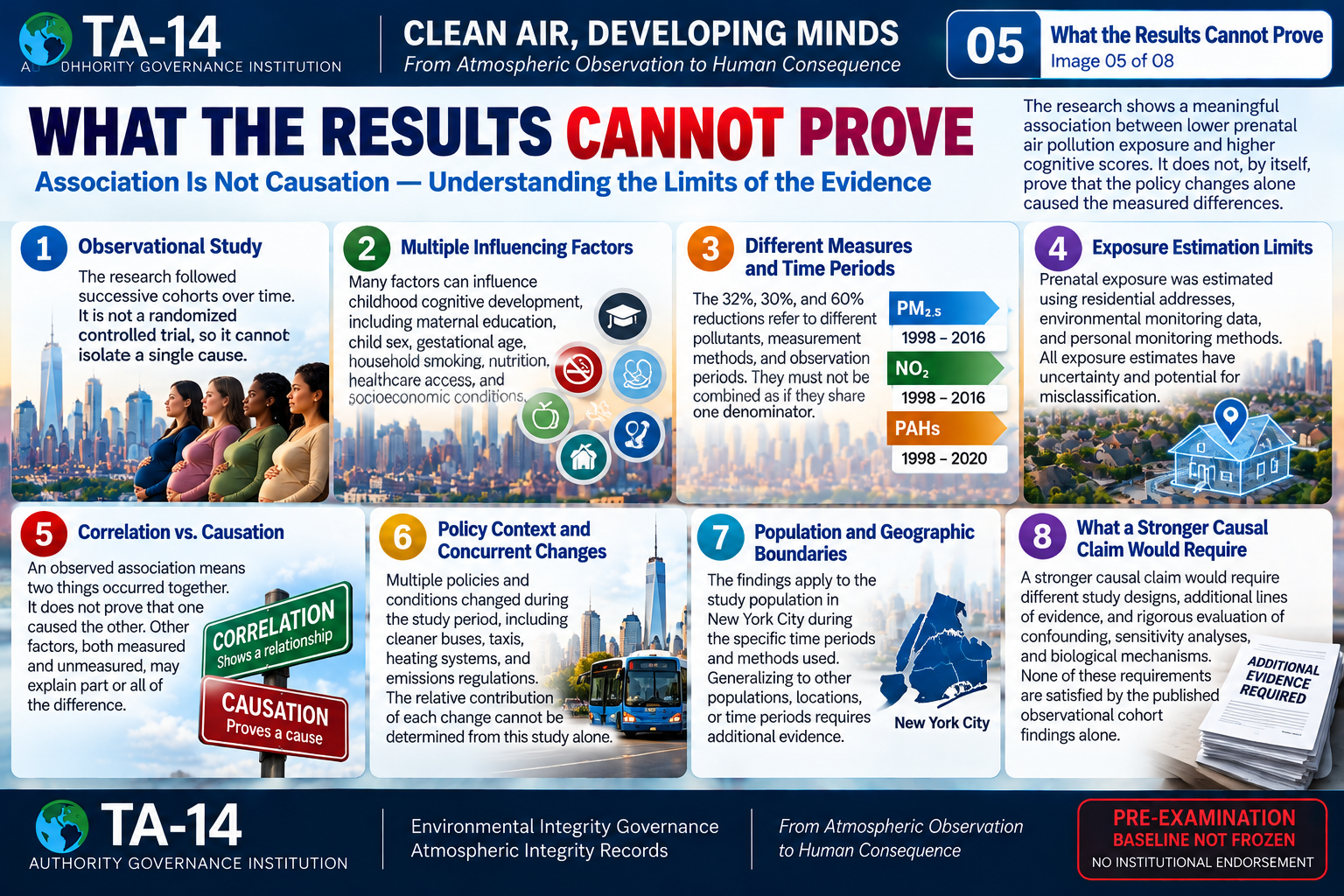
What the Results Cannot Prove
Observational association is not proof of individual causation or a quantified effect of a particular policy. Potential confounding, exposure estimation, cohort differences, and the scope of adjustment matter.
Read the full narration transcript
Visual five. The most responsible scientific communication includes what the results cannot establish. Cleaner air and improved cognitive measures occurred together across the studied cohorts. That does not prove that a specific policy produced a particular developmental gain, nor does it establish an effect for an individual child. The researchers considered adjustment variables, but observational comparisons can retain confounding and uncertainty. A useful finding becomes misleading when its claim ceiling is silently raised. Observed is not inferred. Inferred is not authorized.
VISUAL 06 / 08 · EIGHT DISTINCT ANCHORS
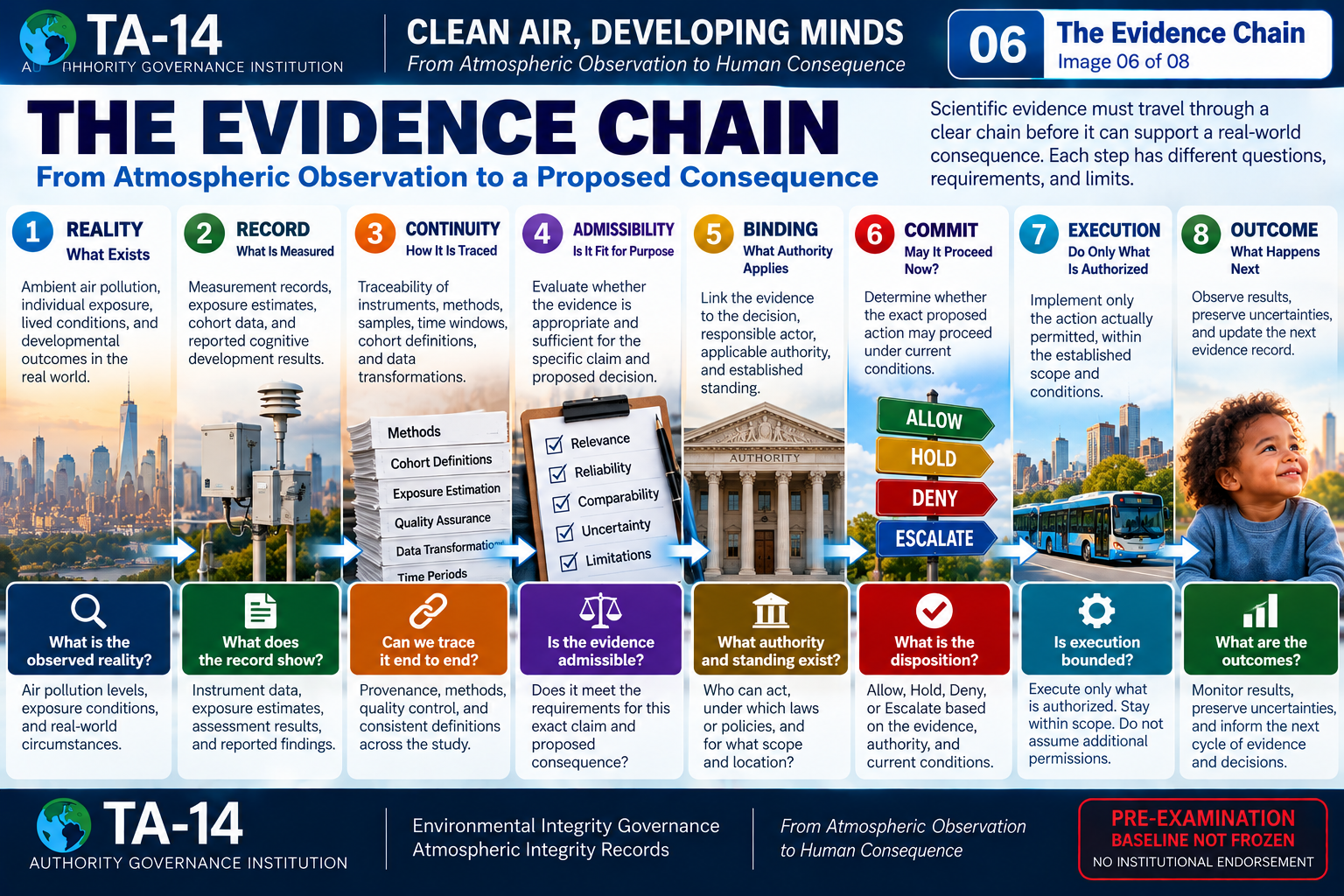
The Evidence Chain
Reality → Record → Continuity → Admissibility → Binding → Commit → Execution → Outcome. Each anchor introduces a separate question, and passing an earlier anchor does not waive the later ones.
Read the full narration transcript
Visual six. Follow all eight anchors. Reality is the actual environmental and human condition. Record is what was preserved. Continuity is whether we can trace that record through time and transformation. Admissibility asks whether the evidence fits the exact proposition. Binding asks which applicable authority, obligation, or rule attaches to the proposed action. Commit is the final decision boundary. Execution is the bounded act that actually occurs. Outcome is what changed, with a new record of reality. A scientific paper can help the evidence side of this chain. It cannot automatically cross the authority boundary for a particular school, agency, or investment.
VISUAL 07 / 08 · EVIDENCE IS NOT PERMISSION
The Authority Boundary
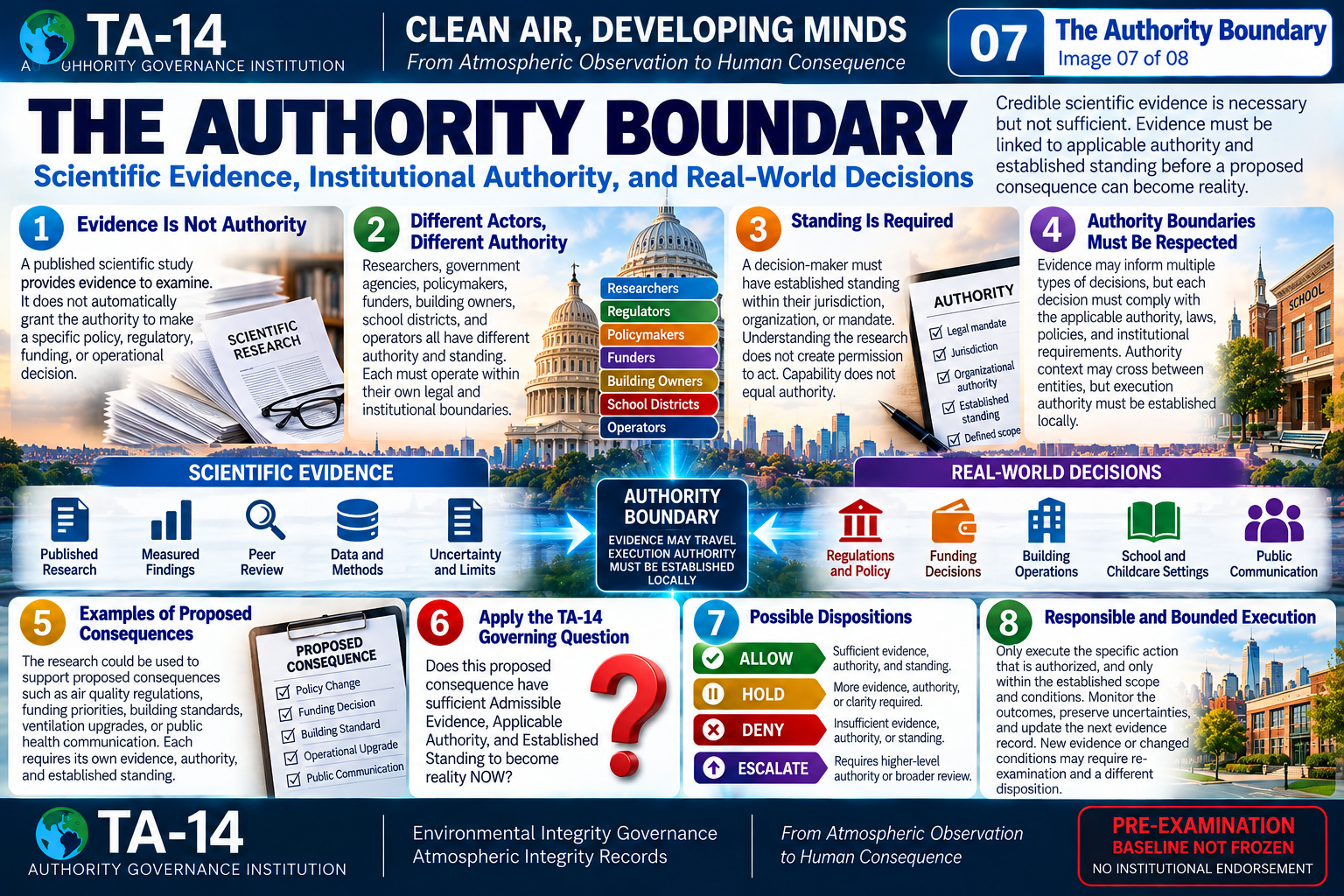
A scientific result may inform decisions, but a specific intervention still requires an identified decision-maker, applicable authority, established standing, adequate local evidence, and an authorized scope.
Read the full narration transcript
Visual seven. Here is the authority boundary. A credible publication can inform a public health discussion. It does not give TA fourteen, a school principal, a contractor, or an unrelated observer permission to order an intervention. We must identify who has standing, what rule or authorization applies, what evidence is admissible for this particular action, and whether the permission is current. Authority context can travel. Execution authority must be established where the action will occur. Capability is not authority. Understanding is not permission.
VISUAL 08 / 08 · THE CONSEQUENCE MUST BE PROVEN
From Decision to Outcome
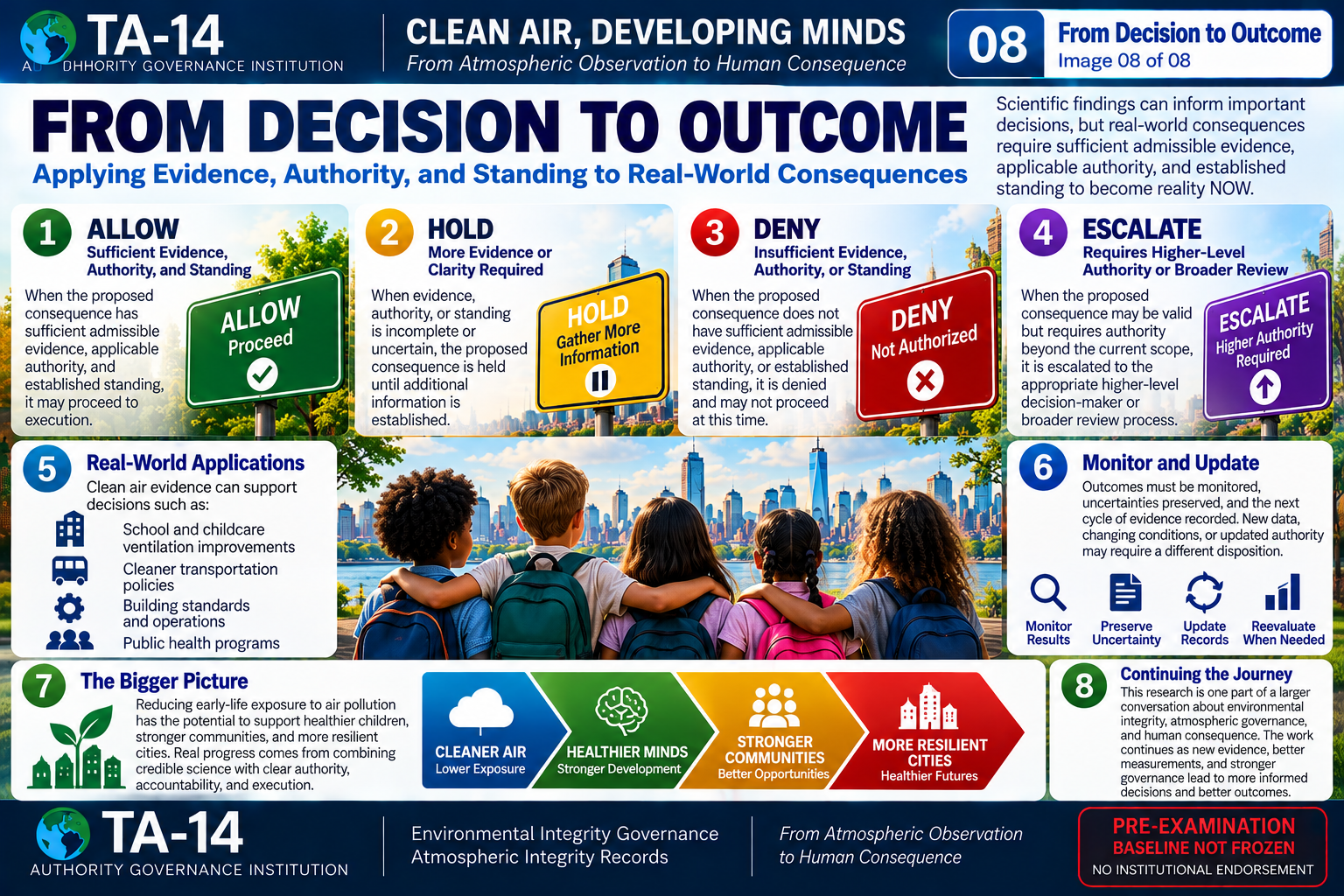
ALLOW, HOLD, DENY, and ESCALATE are illustrative dispositions, not actual findings about Columbia. Any authorized intervention must be scoped, recorded, executed, and evaluated against its own outcomes.
Read the full narration transcript
Visual eight. A decision is not the end of governance. Allow means the stated requirements for the particular proposed action have been established. Hold preserves a proposition while necessary evidence or authority is missing. Deny applies where the proposal is not permissible under the applicable conditions. Escalate refers the question to an actor with the necessary competence or authority. These are teaching examples, not a completed TA fourteen ruling on this study. After any legitimate commit, record what was actually executed, verify the outcome, preserve uncertainty, and return to the new reality.
THE TA-14 COMMIT BOUNDARY
Does this proposed consequence have sufficient Admissible Evidence, Applicable Authority, and Established Standing to become reality NOW?
Teaching scenario: A school proposes a particular ventilation investment based solely on this published cohort research. The research is available, but the school-specific conditions, approval authority, and authorized scope have not been established in the scenario.
Which disposition best preserves the boundary on the information given?
Continue with the primary evidence
This room is an independent teaching interpretation. Read the university summary and original journal article for the scientific context, methods, and limits.