CASE 01
Evidence is not yet admissible
A proposed consequence is supported by an observation, but the source attribution or record continuity is missing. What should happen before execution? Consider this in the context of air-quality intervention.
TA-14 AUTHORITY GOVERNANCE INSTITUTION · PROPOSED MUNICIPAL DEMONSTRATION
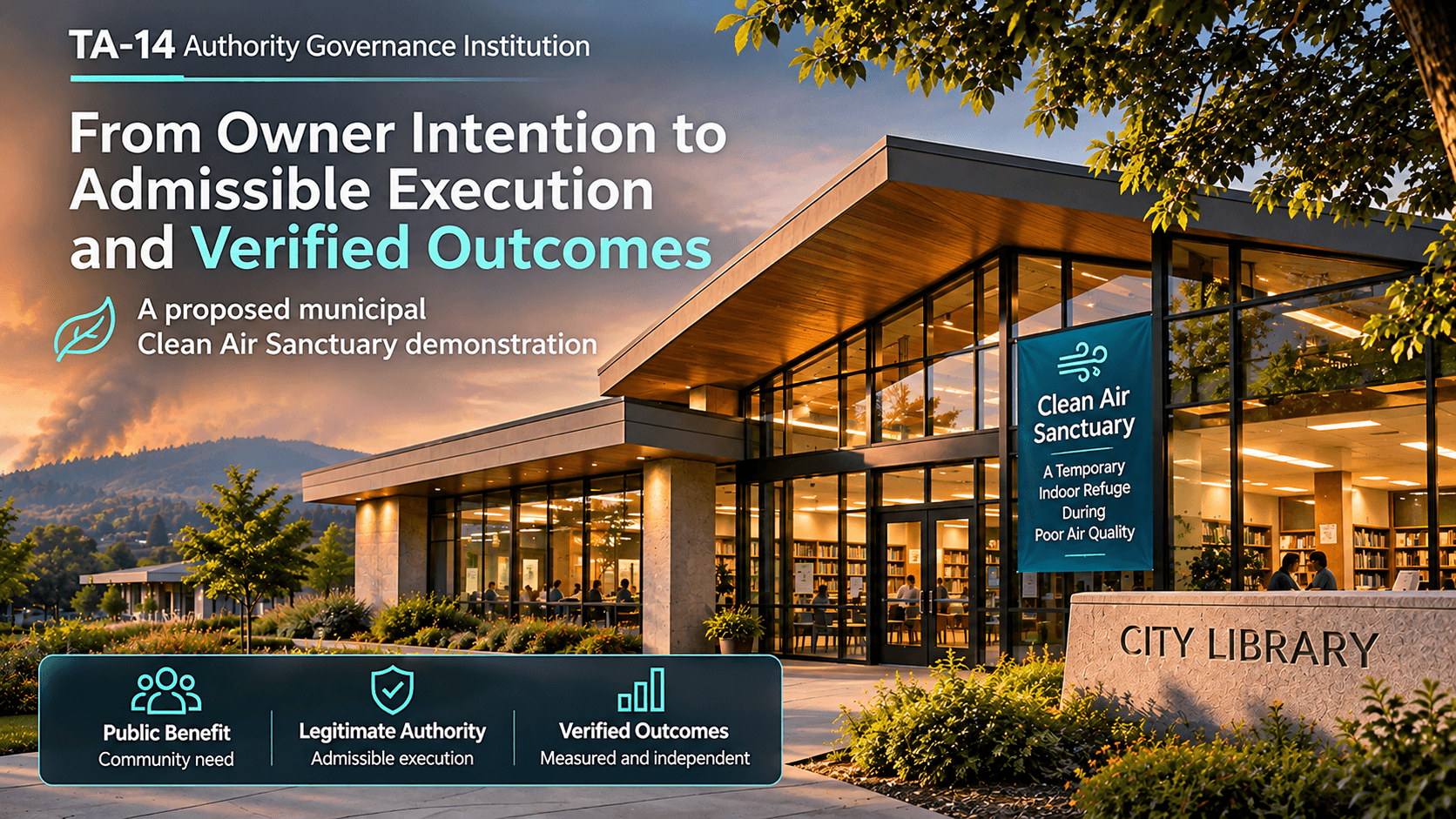
A proposed Clean Air Sanctuary demonstration connecting owner requirements, building intelligence, frontier AI, TA-14 execution governance and independently examinable public benefit.
EIGHT-IMAGE EDUCATIONAL SHOWROOM
A community need becomes an owner-defined objective, not an automatic technology purchase.
Start with the proposed municipal library refuge. Its purpose is public benefit during poor outdoor air quality. The owner must define who is served, what protection is intended, and who has authority to approve a response. The building pictured is conceptual, not an identified or approved municipal facility.
A public objective needs an accountable owner and testable acceptance criteria.
Follow that objective through the complete responsibility chain.
INTERACTIVE GOVERNANCE EXAMINATION · HYPOTHETICAL
Assume the proposed action is discretionary, the calibration is mandatory under the owner-approved policy, and emergency/life-safety systems remain independently governed.
INDEPENDENT REVIEW CHALLENGE
This public teaching room invites technical critique. It is not a solicitation claiming approved partner roles, a signed municipal agreement, an awarded grant, or validated performance. The prospectus contains preliminary budget assumptions and decision gates for prospective reviewers.
DOWNLOAD THE FULL PROSPECTUS →TA-14 ACADEMY · INDEPENDENT REVIEW CHALLENGE
Apply the governance principles to three hypothetical cases relevant to air-quality intervention. Choose a determination, then examine the reasoning. These cases teach the distinction between Admissible Evidence, Applicable Authority, and Established Standing; they do not issue real-world authorization.
CASE 01
A proposed consequence is supported by an observation, but the source attribution or record continuity is missing. What should happen before execution? Consider this in the context of air-quality intervention.
CASE 02
The record is current and reliable, but the proposed consequence falls outside the scope of applicable authority. What is the supported determination?
CASE 03
The proposed consequence triggers a documented requirement for review by another designated authority. What is the appropriate route?
Independent educational examples only. The questions are hypothetical and do not assess a real institution, building, person, or operating system. Actual governance determinations require case-specific evidence, applicable authority, established standing, and bounded review.