What is happening?
CO₂, particulate matter, temperature, humidity, VOCs, pressure, ventilation rates and other conditions can be observed continuously.
🇭🇷 CROATIA · EDIAQI INDOOR AIR QUALITY CONFERENCE · ZAGREB · 29 SEP 2026
A public companion surface to Greggory Don Butler's seven-minute EDIAQI presentation on continuous monitoring, indoor air quality and the consequence boundary.
INDEPENDENT TA-14 CONFERENCE SURFACE · NOT AN EDIAQI ENDORSEMENT · OPEN FOR CORRECTION
01 · START WHERE IAQ STARTS
Indoor air quality has become increasingly capable of observing reality. We can measure CO₂, particulate matter, temperature, humidity, VOCs, pressure and ventilation. We can trend those measurements continuously, establish thresholds, generate alarms and use analytics or AI to interpret what they mean.
02 · CONTINUOUS MONITORING
Air changes continuously. Occupancy changes. Outdoor conditions change. Equipment performance changes. Filtration changes. Pressure relationships change. Building use changes. A single inspection or commissioning event cannot establish every present condition.
CO₂, particulate matter, temperature, humidity, VOCs, pressure, ventilation rates and other conditions can be observed continuously.
Engineering, analytics and AI can interpret those observations, identify risk and propose technically intelligent responses.
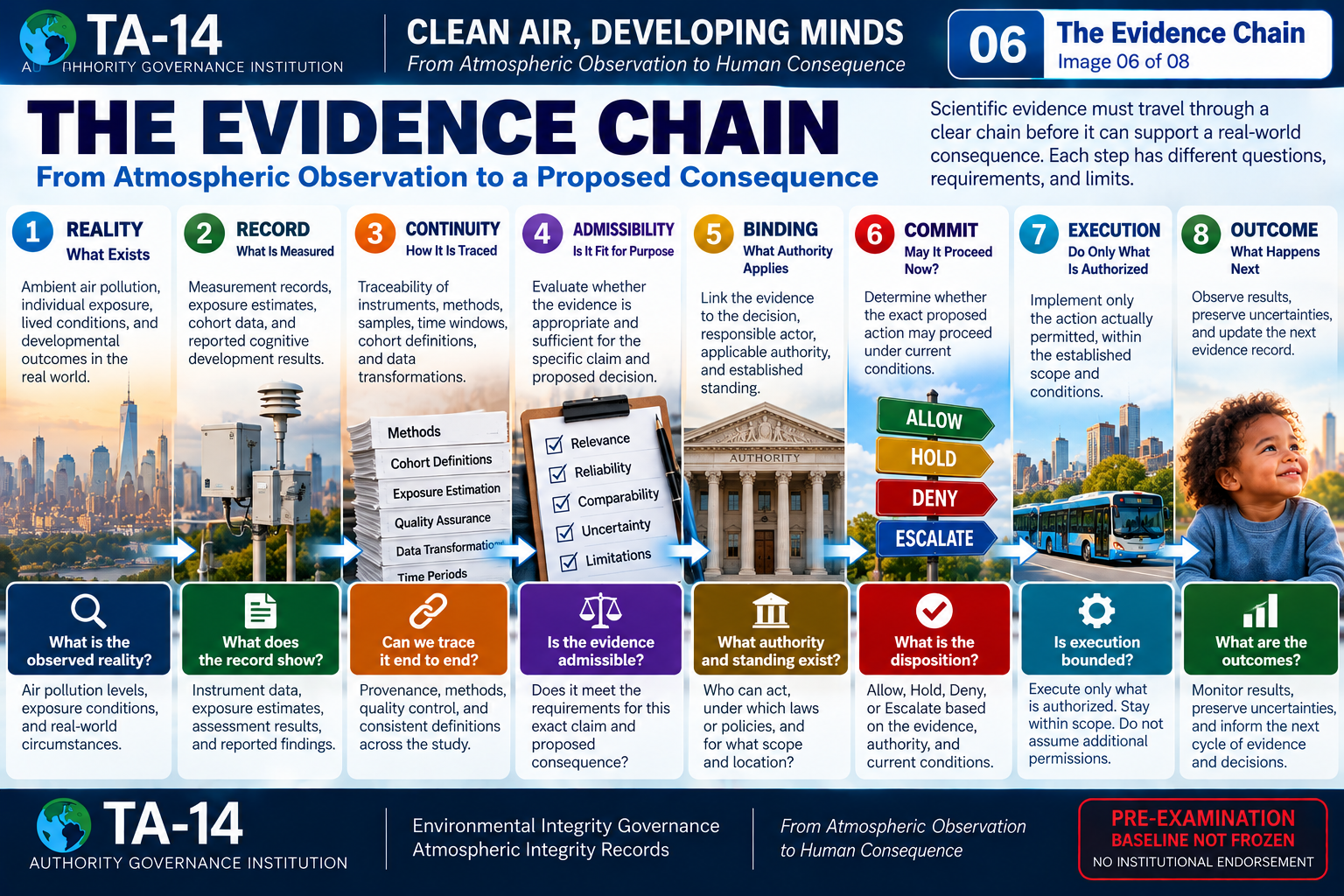
Before a proposed response becomes physical consequence, evidence, authority and present standing still have to be established.
03 · THE CLASSROOM
A classroom sensor reports elevated CO₂. The measurement may be perfectly accurate. Analytics may correctly determine that ventilation should increase. An AI system may even calculate exactly how much additional outdoor air is required.
But may this system actually change the building right now?
Measurement and authority are not the same thing. Technical intelligence and permission are not the same thing. This is the boundary TA-14 examines.
04 · THE WORD IS NOW
A measurement taken yesterday may be true. A commissioning report from six months ago may be valid. A sensor may have been calibrated. A control sequence may have been approved. The building may have been operating correctly an hour ago. The question at the moment of consequence is whether the evidence, authority and standing necessary for this particular action still exist.
05 · THE CHAIN IS ALLOWED TO STOP
The evidence, authority and standing required for this consequence are established now.
The system knows enough to know it does not yet know enough to act.
The proposed consequence is prohibited or cannot be justified.
Human or higher authority is required before consequence.
06 · WILDFIRE TEST
Particulate matter rises dramatically inside a school. Opening outdoor-air dampers appears to be the obvious response. But outdoor monitoring simultaneously shows wildfire smoke.
The indoor measurement can be correct. The outdoor measurement can be correct. The control logic can be correct. The equipment can be functioning correctly.
And increasing outdoor air can still be the wrong consequence.
The question is not simply: “Is the data true?”
It is: “Is this evidence sufficient for this consequence, under these conditions, at this moment?”
07 · AUTHORITY
A sensor does not have authority because it measured something. An AI does not acquire authority because its recommendation is intelligent. A building-management system does not acquire unlimited authority because it can move a damper, start a fan, change a setpoint, unlock a door or shut down equipment.
08 · CONNECTED BUILDINGS
A sensor manufacturer may provide evidence. An analytics company may interpret it. AI may recommend an action. A building owner may establish policy. A controls contractor may provide execution capability. A government or regulator may establish requirements. These systems need to communicate—but communication does not automatically transfer execution authority.
Evidence may travel. Credentials may travel. Authority context may travel. A determination may travel.
Execution authority must still be established where the consequence will occur.
09 · THE FINISH LINE
Not afterward in an audit. Not because somebody trusted the software. Not because an AI was confident. Not simply because the equipment could do it. At the actual boundary of execution.
The most important measurement is not simply what the building knows.
It is whether what the building does next is justified.
10 · PRESENTATION RECORD · 29 SEP 2026
Greggory Don Butler delivered the remote oral presentation to the EDIAQI Indoor Air Quality Conference in Zagreb using this public showroom as the live presentation surface. The screen was shared in Microsoft Teams and the showroom was scrolled in sequence with the spoken presentation so the visual record and oral argument remained aligned.
The full seven-minute presentation was delivered remotely on 29 September 2026.
The public page itself served as the visual presentation surface while the argument was delivered and scrolled in sequence.
No audience questions were raised during the allotted question period. This records the event as it occurred; it does not infer why no questions were asked.
THE RECORD REMAINS OPEN
Questions, corrections, technical challenges, equivalent mechanisms and examination requests may be added below this preserved presentation record as they arise.
11 · INDEPENDENT CONFERENCE DOCUMENT · 8 OCT 2026
On 8 October 2026, the EDIAQI conference organizers sent Greggory Don Butler an official Certificate of Presentation recognizing delivery of an oral presentation at the EDIAQI Indoor Air Quality Conference, Zagreb, Croatia, on 29 September 2026.
EDIAQI · DOCUMENTED PRESENTATION RECOGNITION
Greggory Don Butler
TA-14 Authority / Transparent Air, United States
For delivering an oral presentation at the
EDIAQI Indoor Air Quality Conference
Zagreb, Croatia · 29 September 2026
Mario Lovrić · EDIAQI Scientific Coordinator
Transcribed details from the issued certificate; this panel is not a reproduction of the signed original PDF.
The original PDF, titled “Greggory Don Butler.pdf”, is retained as the source document. This public panel records its verified wording; the original PDF is not yet hosted here for download.
12 · POST-CONFERENCE TEACHING GALLERY · ADDED 8 OCT 2026
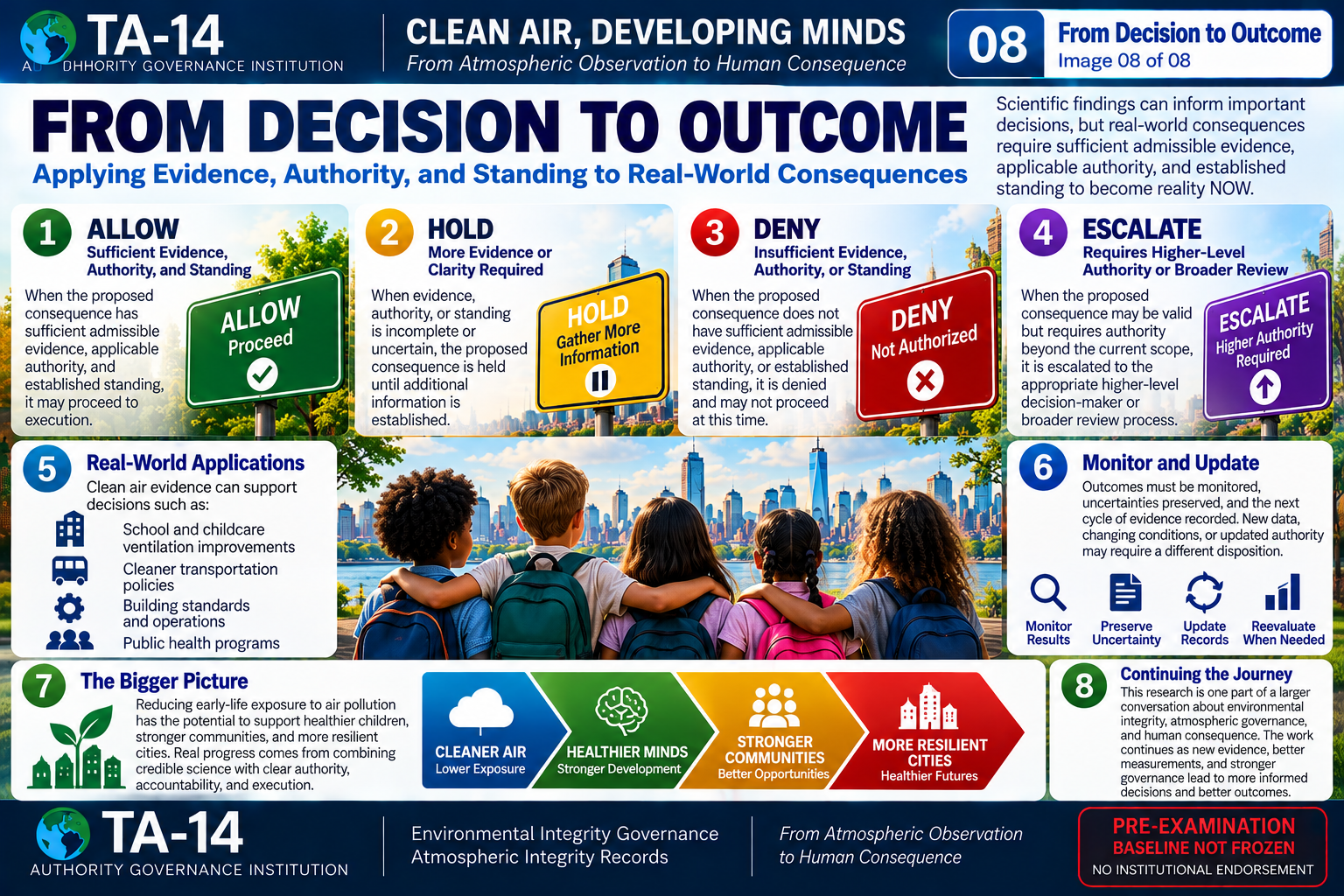
This gallery was added after the September 29 presentation. It extends the teaching record without altering the original presentation or suggesting EDIAQI endorsement. Read each numbered image, then the explanation and transition before continuing to the next.
TEACHING IMAGE 01 / 08
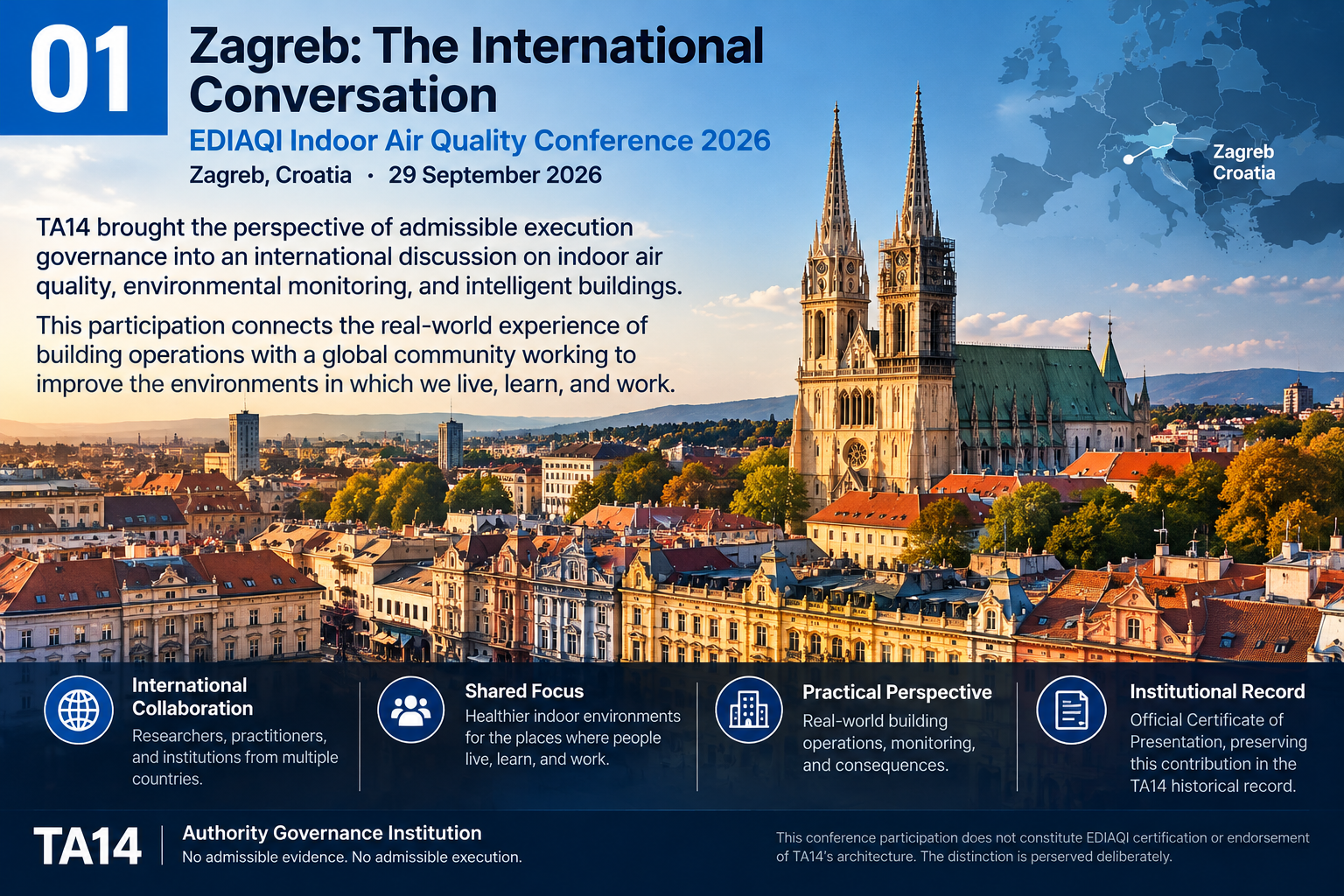
WHAT THIS IMAGE TEACHES
This opening image locates the September 2026 EDIAQI presentation in Zagreb. It records participation in an international indoor-air-quality discussion, not conference approval of TA14.
COMING NEXT
Next, we move from the conference setting into the building itself: what can instruments actually observe?
TEACHING IMAGE 02 / 08
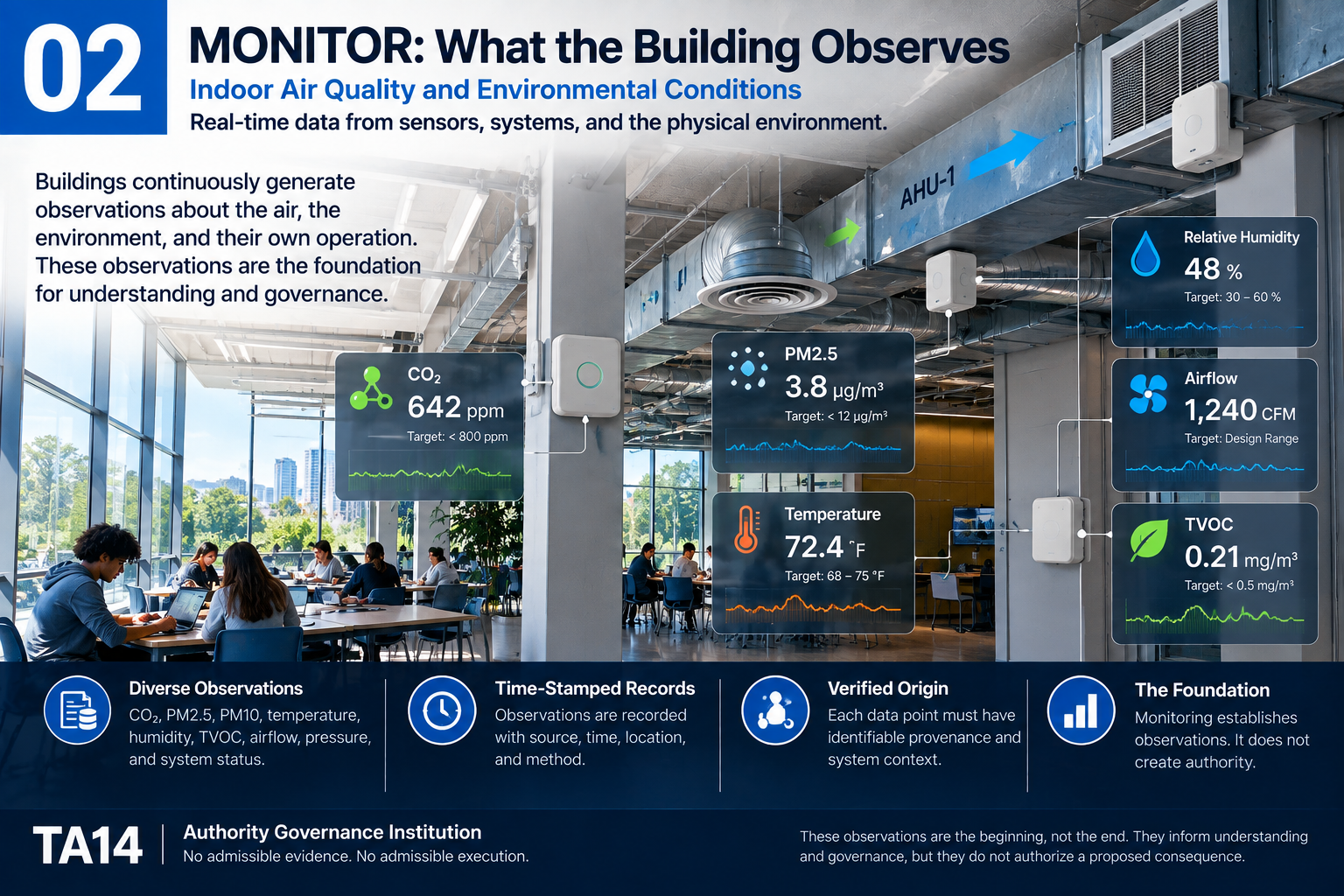
WHAT THIS IMAGE TEACHES
Sensors can capture CO₂, particulate matter, temperature, humidity and equipment conditions. Each observation needs an identifiable source, time, place and method. Monitoring creates a record; it does not confer permission.
COMING NEXT
But a reading is not an interpretation. The next image explains how evidence becomes a proposed response.
TEACHING IMAGE 03 / 08
WHAT THIS IMAGE TEACHES
Trends, occupancy, outdoor conditions, system state and uncertainty shape the meaning of measurements. Human or AI interpretation can support a recommendation, but an intelligent recommendation remains a proposal.
COMING NEXT
A proposal can affect the physical world. The next image asks who may authorize that consequence.
TEACHING IMAGE 04 / 08
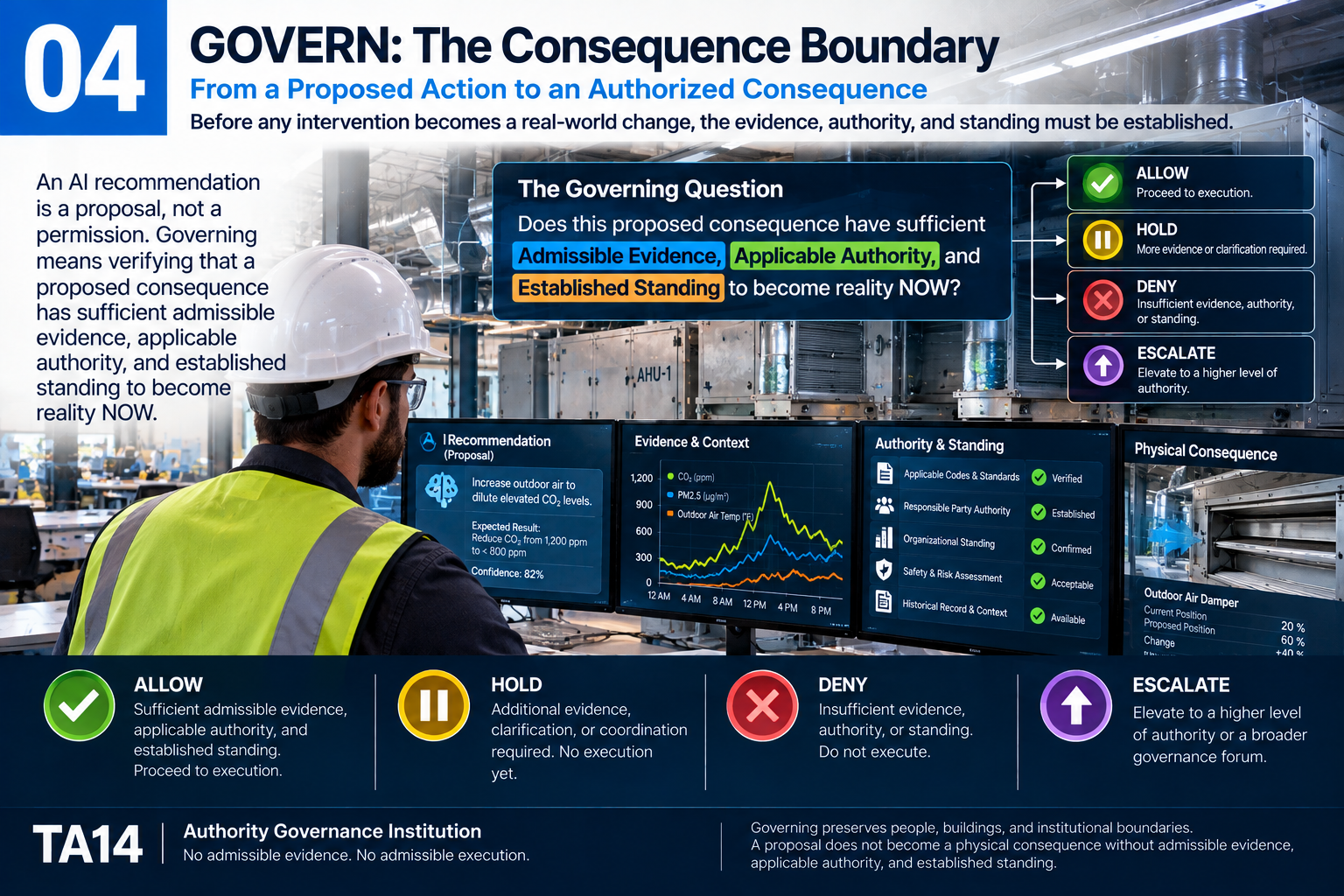
WHAT THIS IMAGE TEACHES
The governing question is whether the proposed consequence has sufficient Admissible Evidence, Applicable Authority, and Established Standing to become reality NOW. Capability is not authority; understanding is not permission.
COMING NEXT
The next image shows what happens when a proposed intervention crosses into equipment and occupied spaces.
TEACHING IMAGE 05 / 08
WHAT THIS IMAGE TEACHES
Ventilation commands change dampers, fans, airflows, comfort, exposure, energy use and maintenance demands. Even a technically sound proposal can create unintended consequences when real-world conditions change.
COMING NEXT
Because actions carry risk, governance needs more than a yes-or-no assumption. The next image explains the available dispositions.
TEACHING IMAGE 06 / 08
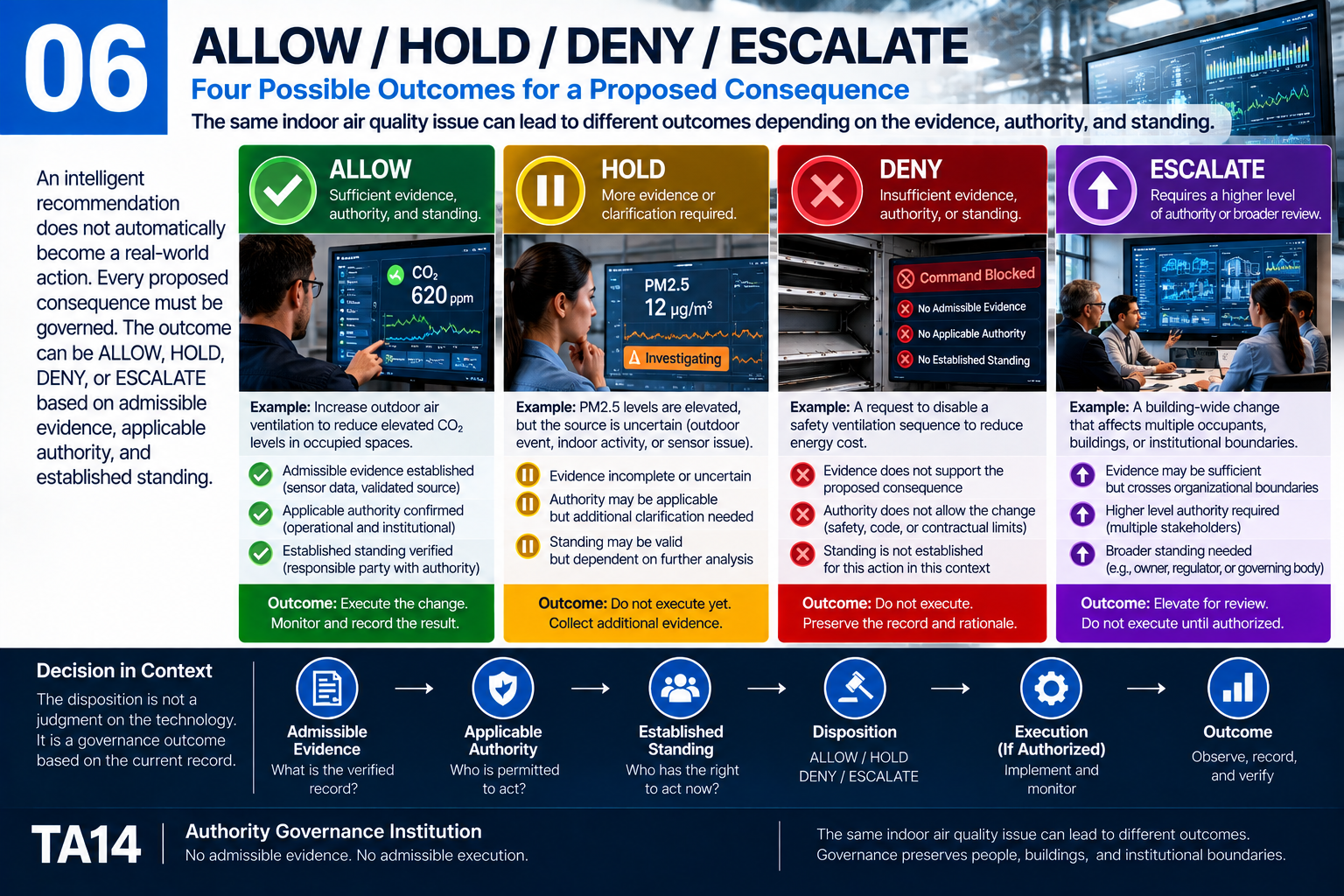
WHAT THIS IMAGE TEACHES
ALLOW permits execution within established bounds. HOLD preserves the proposal while evidence or authority is incomplete. DENY rejects an impermissible action. ESCALATE refers the matter to the appropriate authority. HOLD, DENY and ESCALATE do not themselves authorize execution.
COMING NEXT
An ALLOW is not the end of accountability. The next image shows why outcomes must be measured after execution.
TEACHING IMAGE 07 / 08
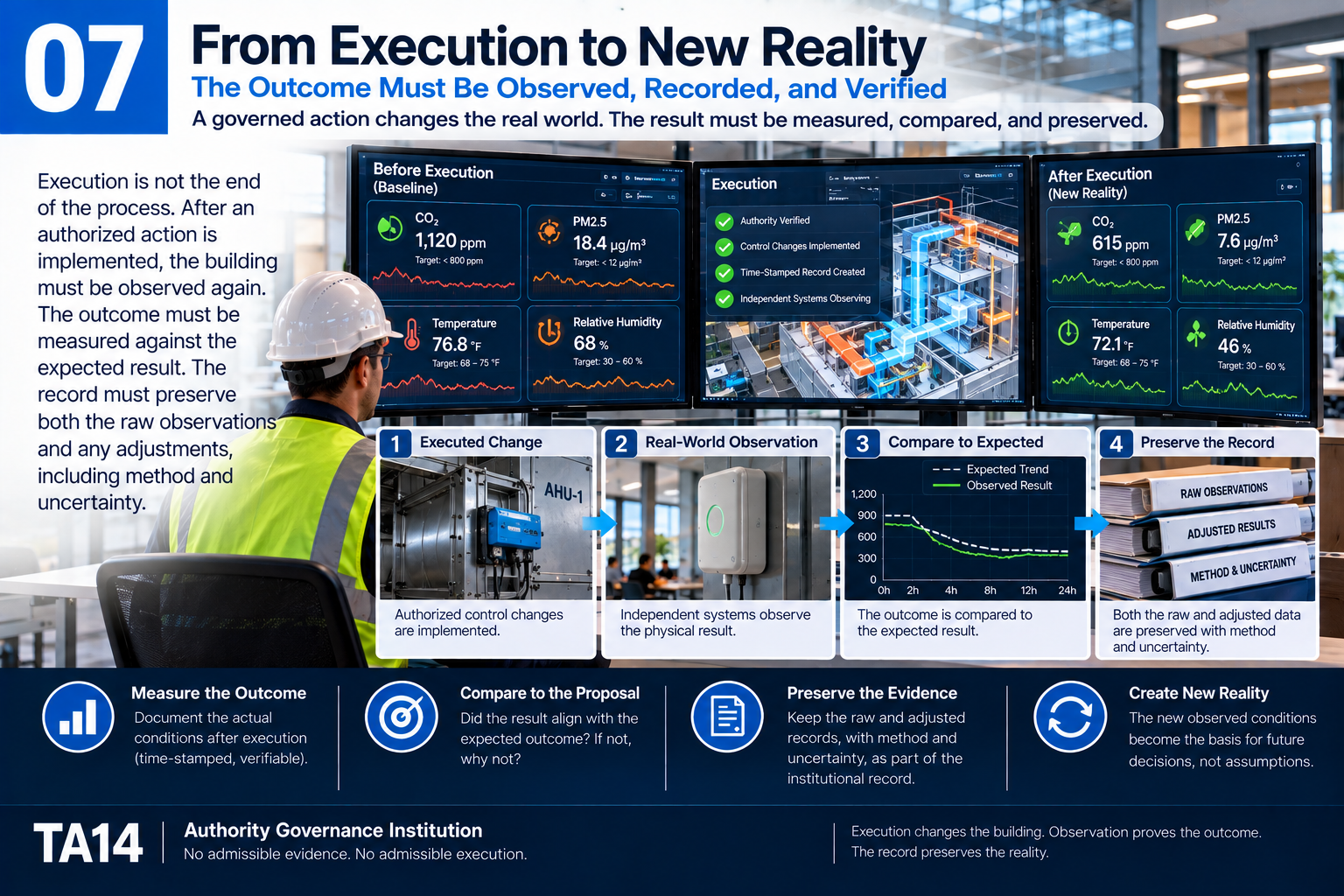
WHAT THIS IMAGE TEACHES
After an authorized change, observe the building again. Compare actual results with the proposed outcome. Preserve raw observations separately from any adjusted results, including the adjustment method and uncertainty. Observed is not inferred; inferred is not authorized.
COMING NEXT
Finally, we return to the international question: where else must this evidence-to-authority boundary be respected?
TEACHING IMAGE 08 / 08
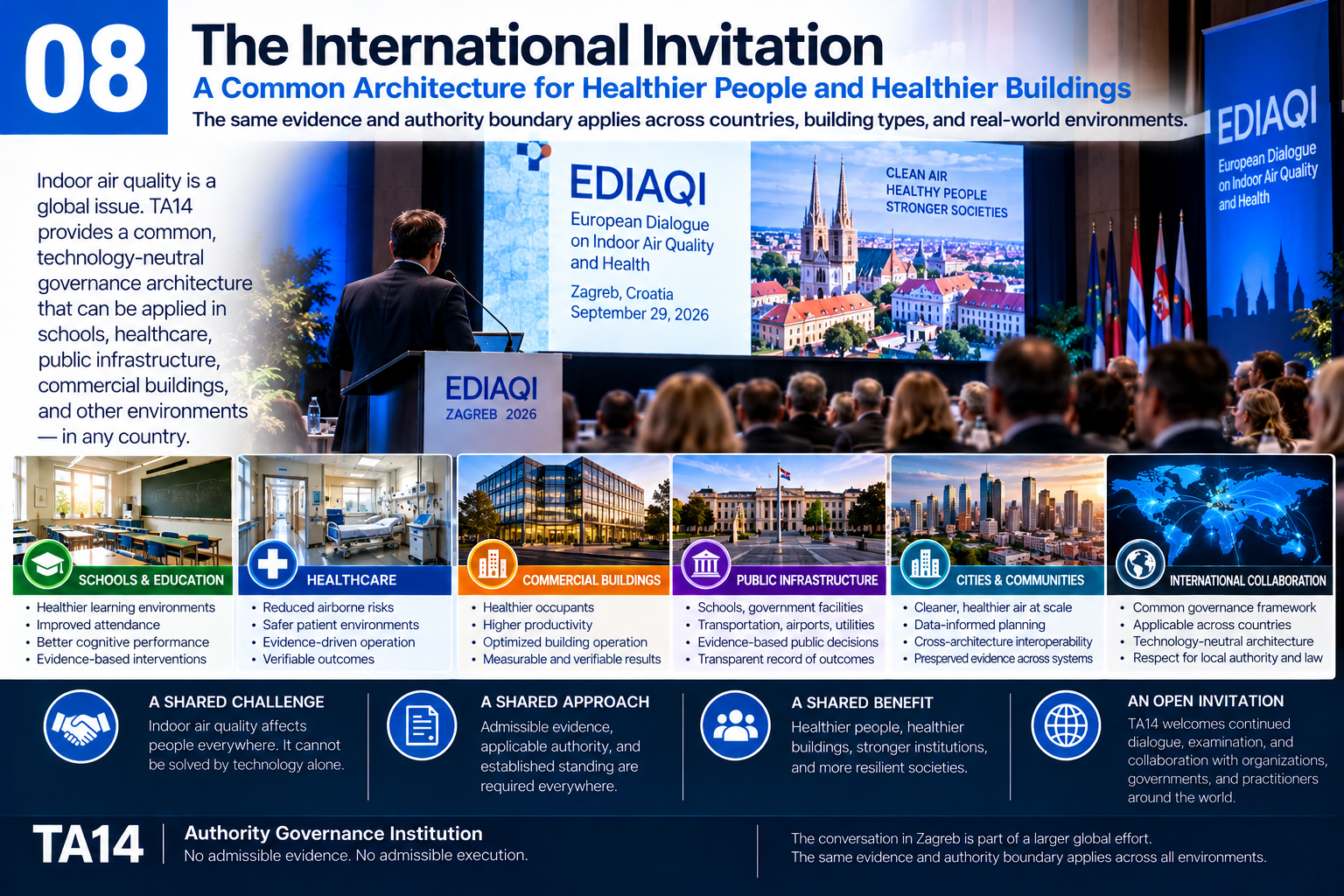
WHAT THIS IMAGE TEACHES
Schools, hospitals, offices, public infrastructure and communities all face consequences from environmental decisions. TA14 offers an independent governance question for examination across contexts, while each jurisdiction and responsible entity retains its own applicable authority.
CLOSING NOTE
The eight-image teaching sequence ends here. The historical conference presentation and certificate above remain preserved separately.
Gallery provenance: TA14 educational illustrations added after the conference. Their illustrative measurements and scenes are not presented as measured conditions from the EDIAQI venue or as conference-issued material. Audio narration is not yet included in this version.