TA-14 AUTHORITY GOVERNANCE INSTITUTION · INDEPENDENT PUBLIC TECHNICAL SHOWROOM
Energy-to-Environment
Coupling
The building consumed the energy. What did the people receive?
An eight-image guided examination connecting electrical input, mechanical performance, atmospheric outcome, human occupancy and evidence continuity. Based on the February 2026 architecture; expanded October 2026. Independent and vendor-neutral.
EDUCATIONAL EXAMINATION — All illustrated measurements, costs, drift indicators, equipment states, and ALLOW / HOLD / DENY / ESCALATE decisions are hypothetical. No actual school finding, individual health outcome, regulatory certification or execution authorization is claimed.
↓ Download Technical Reference v2 (PDF)The governing question
Does this proposed consequence have sufficient Admissible Evidence, Applicable Authority, and Established Standing to become reality NOW?
Reality → Record → Continuity → Admissibility → Binding → Commit → Execution → Outcome
IMAGE 01 / 08
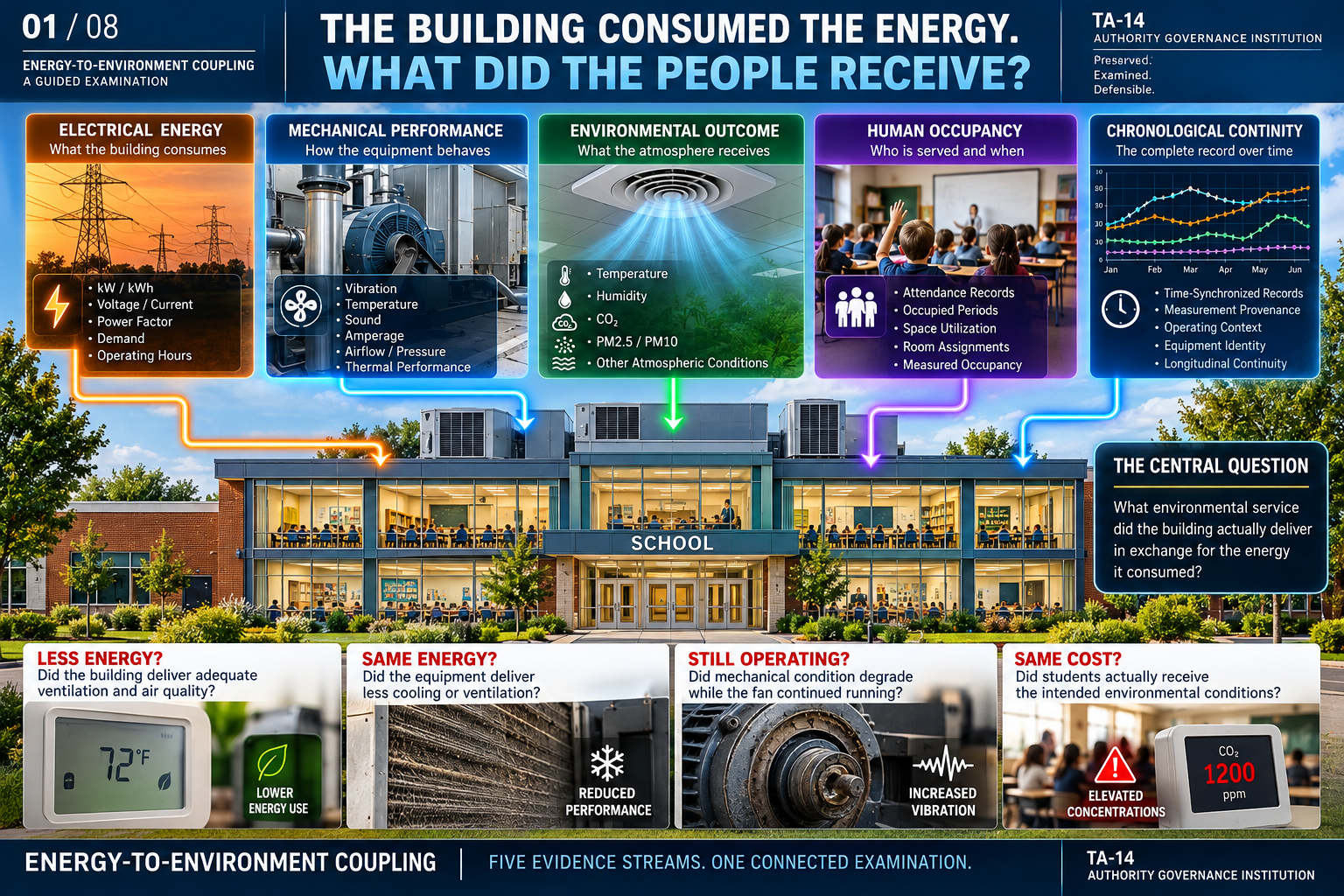
The building consumed the energy. What did people receive?
Samantha · Narration 01
Energy alone is incomplete. A building can consume less while failing to deliver ventilation, cooling or clean air. We examine energy, equipment, atmospheric outcome, occupancy and time. What we learned: electricity consumption does not establish environmental service. Next: the five streams.
Audio uses an available browser voice (Samantha where installed). Scroll naturally; no forced chapter advancement.
WHAT WE LEARNED · IMAGE 01
Electricity consumption alone cannot establish whether a building delivered the intended environmental service.
COMING NEXT · IMAGE 02
Five evidence streams
The five streams that must be connected: energy, mechanical performance, atmospheric outcome, human occupancy and chronological continuity.
IMAGE 02 / 08
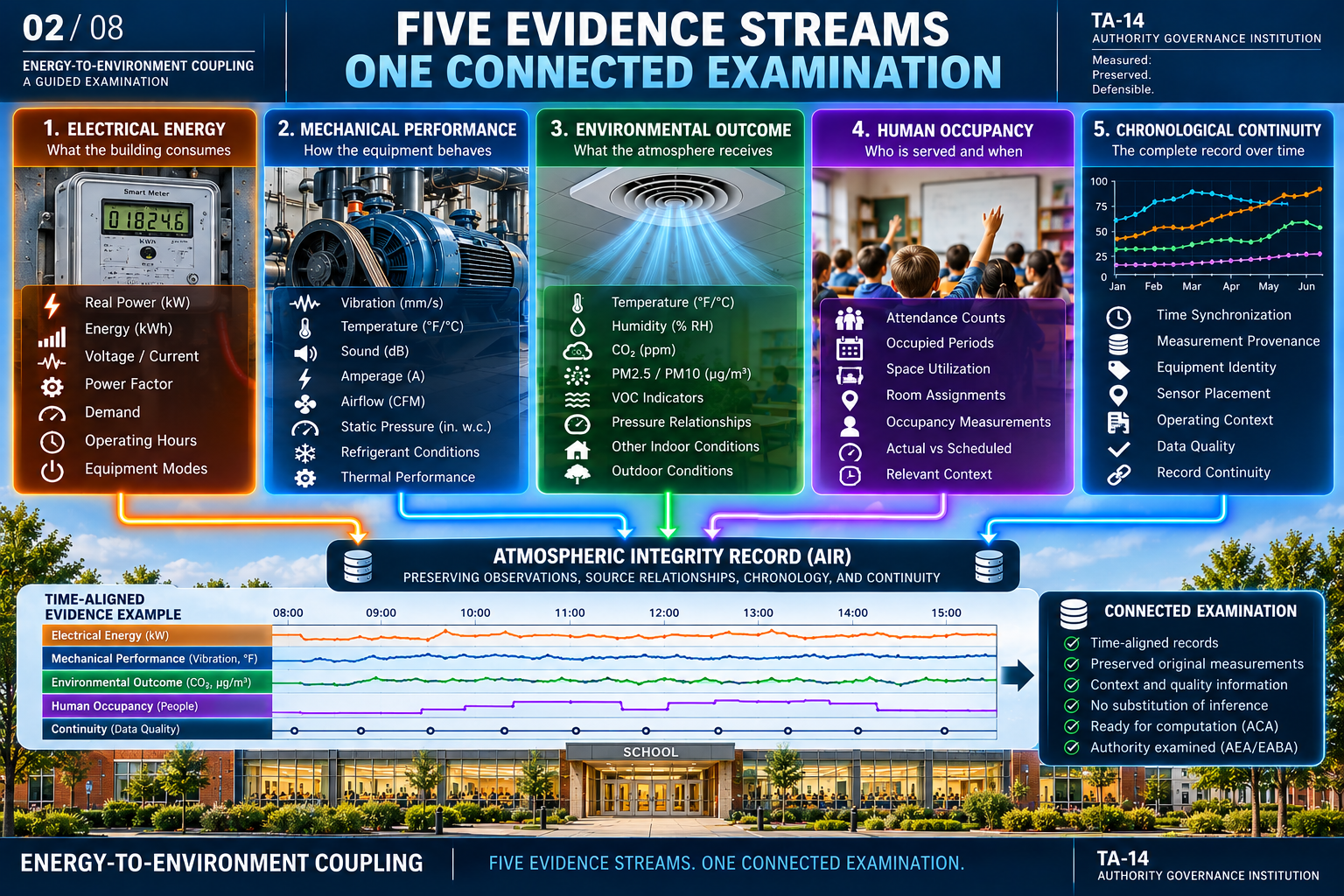
Five evidence streams
Samantha · Narration 02
Electrical energy is recorded in kilowatts and kilowatt-hours. Mechanical condition includes vibration, heat, sound, amperage and airflow. The atmosphere is measured through temperature, humidity, carbon dioxide and particulate observations. Occupancy provides human context; continuity connects the timeline. Attendance does not prove individual exposure. What we learned: five independent streams need meaningful links. Next: how AIR preserves them.
Audio uses an available browser voice (Samantha where installed). Scroll naturally; no forced chapter advancement.
WHAT WE LEARNED · IMAGE 02
Each stream provides distinct evidence. A defensible conclusion requires trustworthy relationships among all five, not merely a combined dashboard.
COMING NEXT · IMAGE 03
Inside the atmospheric integrity record
How an Atmospheric Integrity Record preserves source observations, timestamps, context and provenance without overwriting raw measurements.
IMAGE 03 / 08
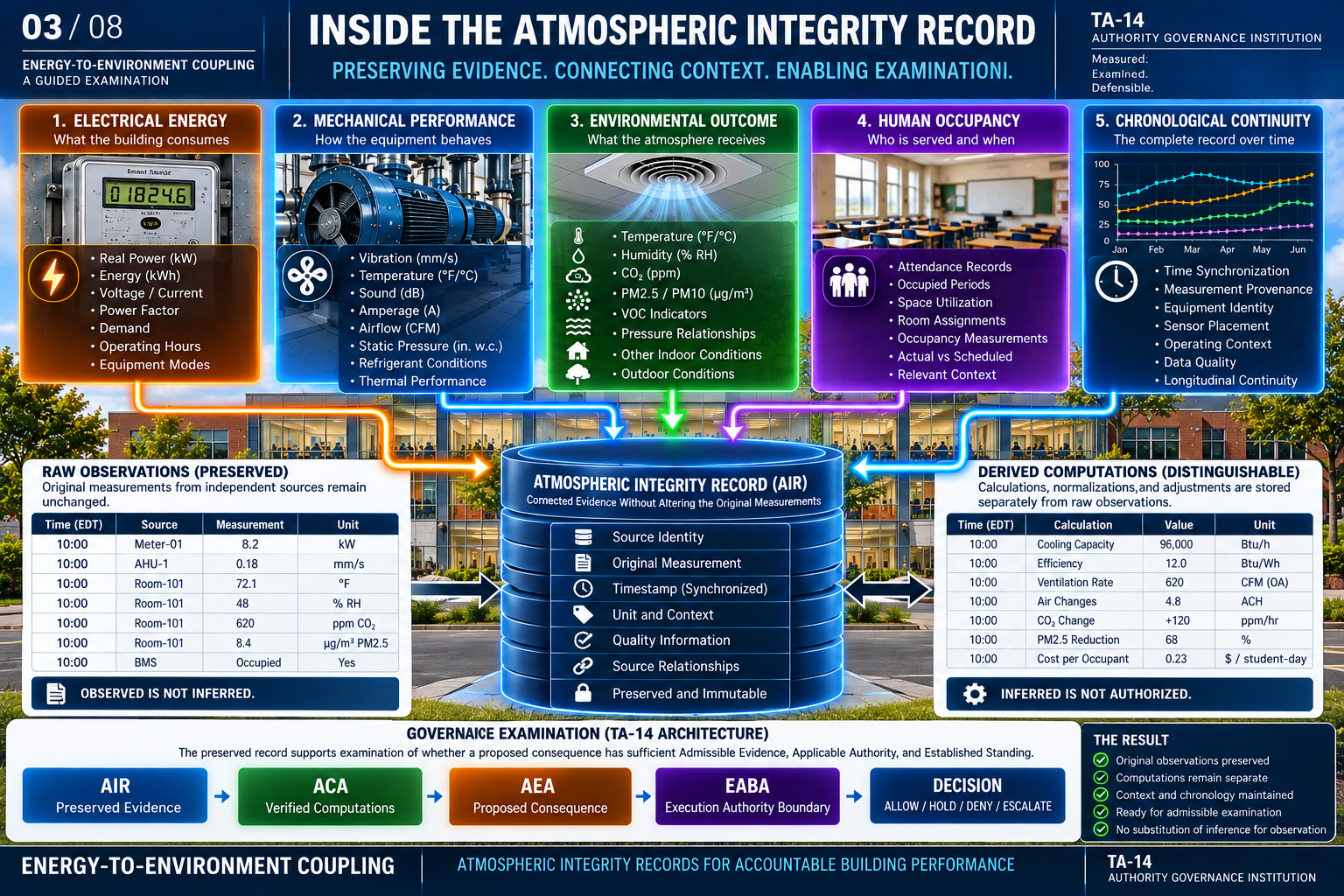
Inside the atmospheric integrity record
Samantha · Narration 03
An Atmospheric Integrity Record preserves original observations, their units, timestamps, source identities, context and quality. Derived cooling efficiency, cost calculations and adjusted values remain separate from originals. Interpretation cannot rewrite the record. What we learned: observed is not inferred; inferred is not authorized. Next: mechanical drift.
Audio uses an available browser voice (Samantha where installed). Scroll naturally; no forced chapter advancement.
WHAT WE LEARNED · IMAGE 03
Raw observations and derived calculations must remain distinguishable. AIR preserves the record; computation and interpretation are separate examinations.
COMING NEXT · IMAGE 04
Mechanical drift
How to identify mechanical drift using changes in airflow, vibration, heat, sound and electrical behavior without assuming the cause.
IMAGE 04 / 08
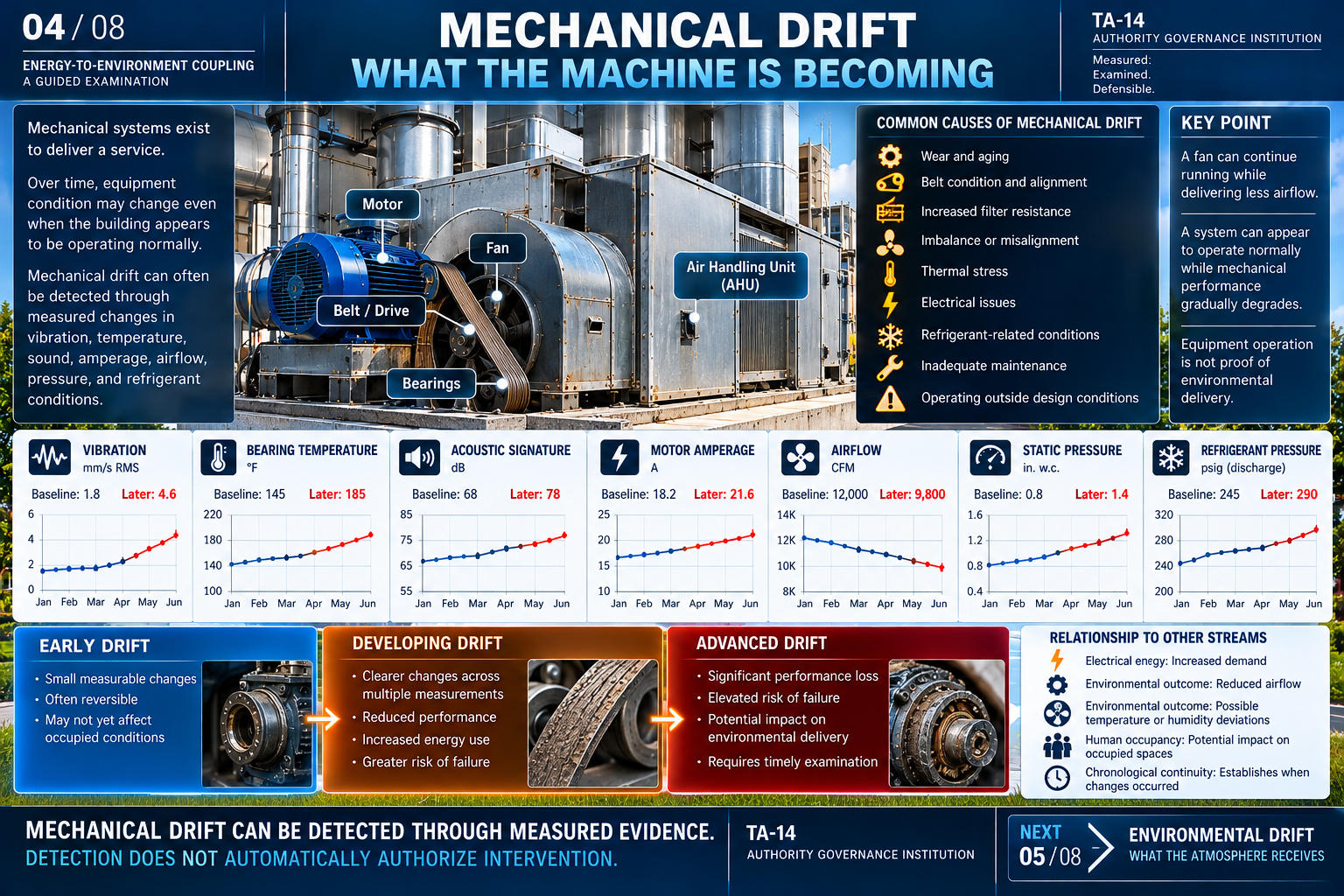
Mechanical drift
Samantha · Narration 04
Machinery can keep running while its condition changes. This hypothetical illustration shows vibration, bearing heat and amperage rising while airflow falls from 12 thousand to 9 thousand 800 cubic feet per minute. Those observations support investigation, not an automatic diagnosis or replacement. What we learned: a running fan may be degrading. Next: environmental drift.
Audio uses an available browser voice (Samantha where installed). Scroll naturally; no forced chapter advancement.
WHAT WE LEARNED · IMAGE 04
A machine may continue running while its delivery changes. Falling airflow and changing equipment signals warrant investigation but do not prove a particular failure.
COMING NEXT · IMAGE 05
Environmental drift
How to examine what the occupied atmosphere actually receives through independently measured indoor environmental conditions.
IMAGE 05 / 08
Environmental drift
Samantha · Narration 05
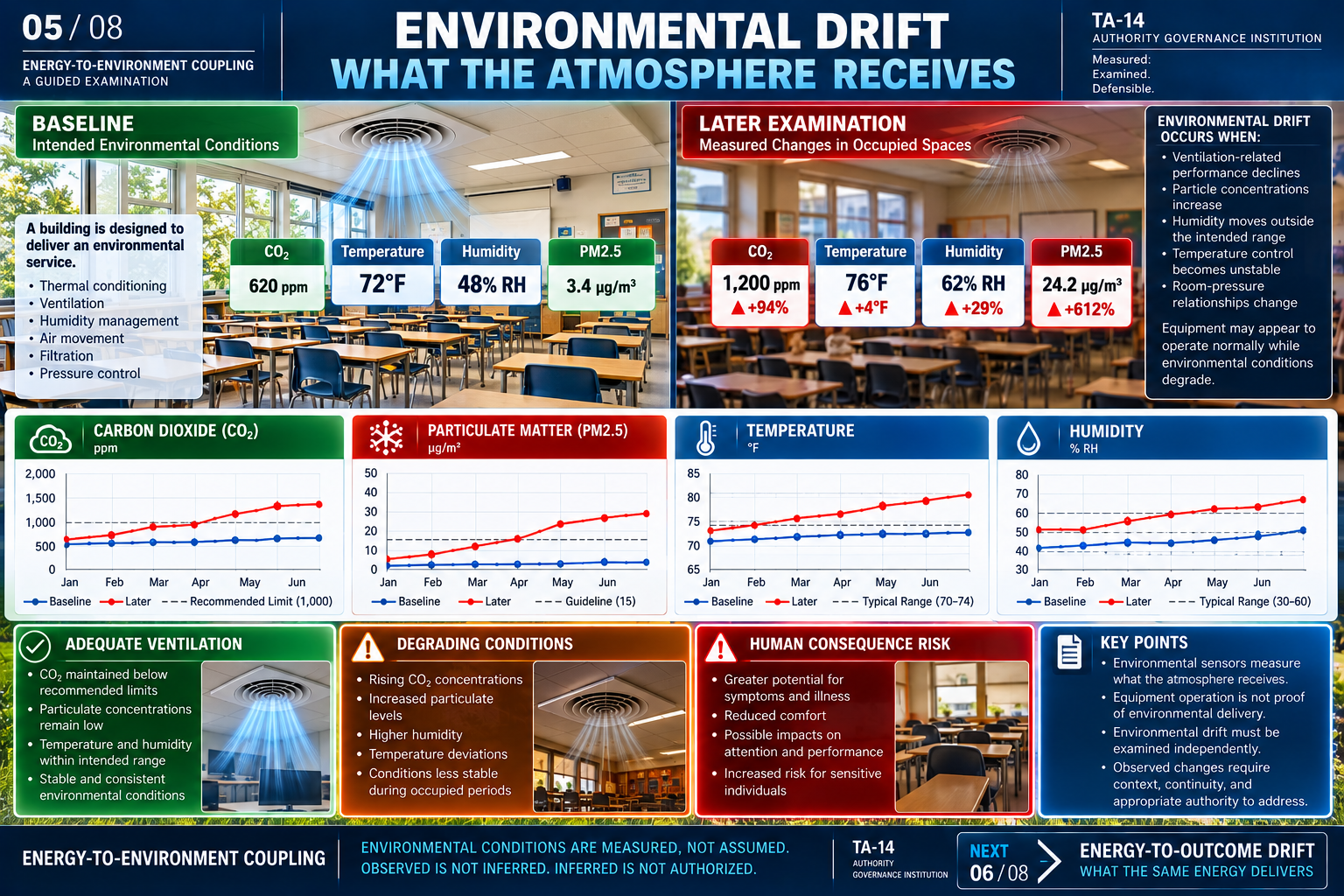
A hypothetical occupied classroom changes from 72 to 76 degrees Fahrenheit, humidity from 48 to 62 percent, carbon dioxide from 620 to 1200 parts per million, and fine particles from 3.4 to 24.2 micrograms per cubic meter. These readings need occupancy, outdoor conditions and sensor context before explaining cause. What we learned: atmosphere must be independently measured. Next: energy-to-outcome drift.
Audio uses an available browser voice (Samantha where installed). Scroll naturally; no forced chapter advancement.
WHAT WE LEARNED · IMAGE 05
Changes in CO₂, particles, temperature and humidity are environmental observations. They require occupancy and outdoor context before a causal explanation is supported.
COMING NEXT · IMAGE 06
Energy-to-outcome drift
How unchanged electrical input can coincide with reduced cooling output, efficiency and environmental service.
IMAGE 06 / 08
Energy-to-outcome drift
Samantha · Narration 06
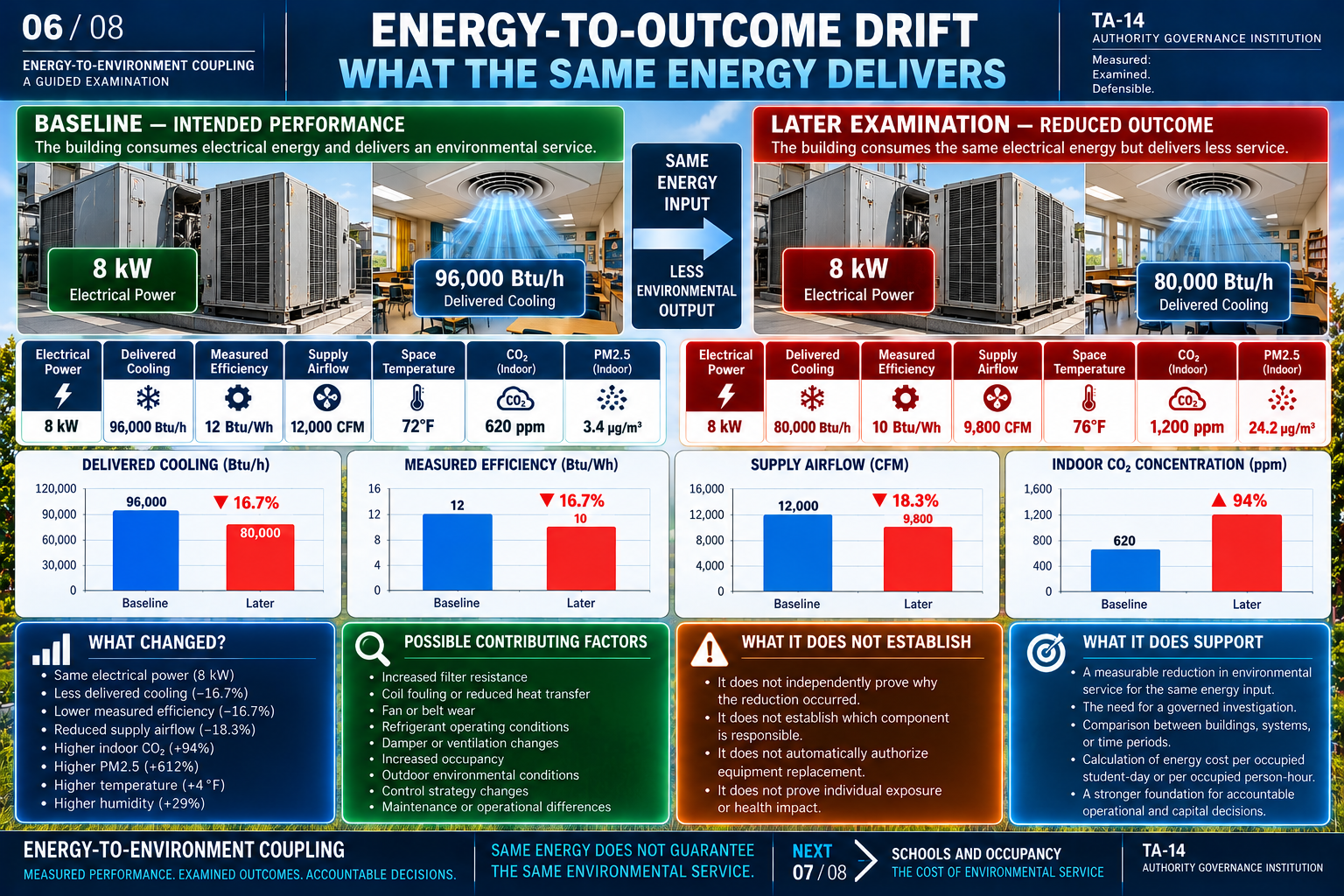
An illustrative cooling system consumes 8 kilowatts at two operating points. Cooling delivery declines from 96 thousand to 80 thousand British thermal units per hour. Efficiency falls from 12 to 10 British thermal units per watt-hour. Equal electrical power does not mean equal environmental service, and kilowatt-hours are needed to calculate actual energy cost. What we learned: distinguish power, energy, thermal output and environmental conditions. Next: schools.
Audio uses an available browser voice (Samantha where installed). Scroll naturally; no forced chapter advancement.
WHAT WE LEARNED · IMAGE 06
Power is not energy; delivered cooling is not electrical input. The illustrative decline from 12 to 10 Btu/Wh requires a bounded, reproducible comparison.
COMING NEXT · IMAGE 07
Schools and occupancy
How to connect building energy cost with school attendance and occupancy without mistaking a cost proxy for proof of health protection.
IMAGE 07 / 08
Schools and occupancy
Samantha · Narration 07
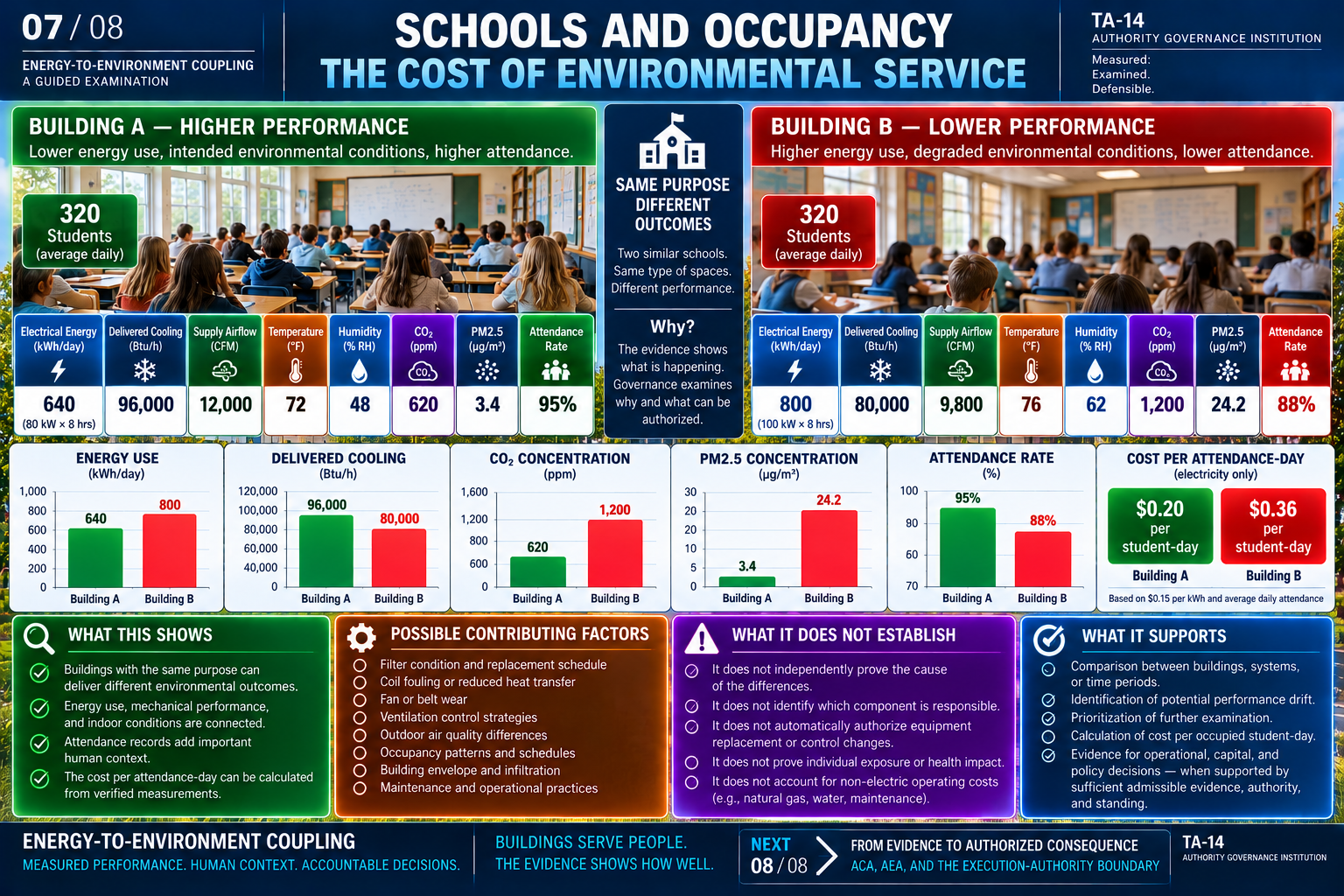
Two hypothetical schools may serve similar purposes yet incur different energy costs, environmental conditions and attendance. Electricity cost per attended student-day can be calculated from attributable cost and attendance counts. It does not prove individual protection, causation or fair building comparison without occupancy, weather, service and measurement context. What we learned: human service and economics can be examined without overclaiming. Next: authorized consequence.
Audio uses an available browser voice (Samantha where installed). Scroll naturally; no forced chapter advancement.
WHAT WE LEARNED · IMAGE 07
Electricity cost per attended student-day can be calculated, but fair comparisons need normalized operating conditions and independently verified environmental service. Attendance is not individual exposure.
COMING NEXT · IMAGE 08
From evidence to authorized consequence
How AIR, ACA, AEA and EABA separate evidence and proposed actions from locally authorized execution.
IMAGE 08 / 08
From evidence to authorized consequence
Samantha · Narration 08
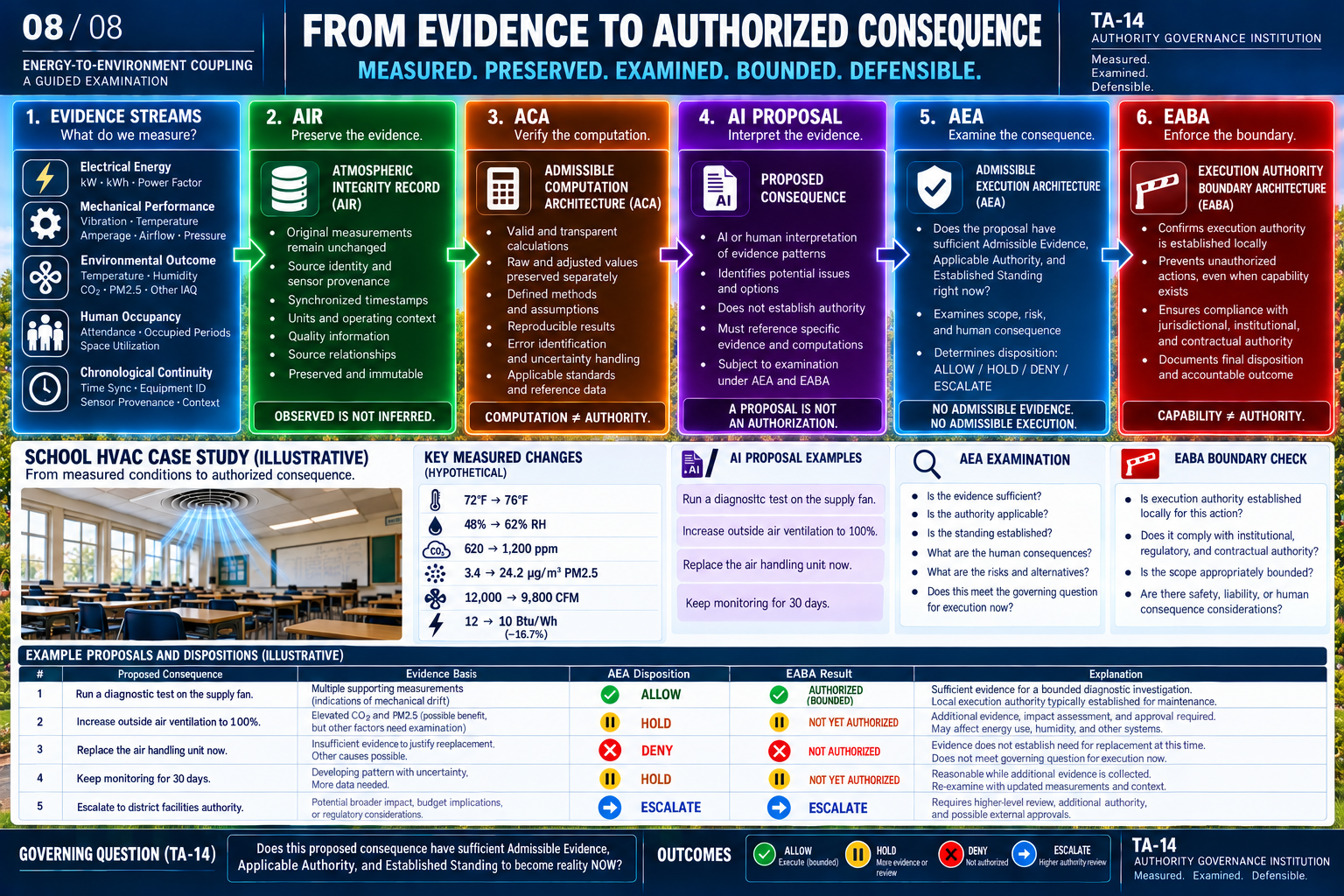
The AIR preserves. ACA examines computations. AI or human analysis proposes a response. AEA examines admissible evidence, applicable authority and established standing. EABA checks local execution boundaries. A bounded diagnostic may be allowed; uncertain control changes held; unsupported replacement denied; broader decisions escalated. Illustrative dispositions are not real authorizations. The building consumed the energy, the equipment performed the work, the atmosphere received the result and people experienced the conditions. No admissible evidence. No admissible execution.
Audio uses an available browser voice (Samantha where installed). Scroll naturally; no forced chapter advancement.
WHAT WE LEARNED · IMAGE 08
Evidence does not grant authority. A bounded diagnostic, a held control change, a denied replacement and an escalated institutional decision represent distinct illustrative governance dispositions.
EXAMINATION COMPLETE
From evidence to accountable consequence
The examination is complete: return to the technical reference and test any proposed consequence against evidence, applicable authority, established standing and local execution boundaries.
Technical reference & independent examination
The 12-page expanded reference addresses measurement boundaries, kilowatt versus kilowatt-hour distinctions, delivered Btuh, three forms of drift, AIR continuity, occupancy economics, comparison limits and authority boundaries. Original February 2026 foundation remains separately preserved.
Download TA-14 Energy-to-Environment Coupling Technical Reference v2 (PDF) ↗Technical observations and documented challenges are welcome. No proposed physical consequence is automatically authorized by any illustration, model or calculation.
Send a technical observation ↗