Founded November 26, 2026. The founding charter remains a draft pending formal adoption. Level 5 is a TA-14 proposed classification, not an adopted industry standard. Lessons and challenges are educational demonstrations, not operational authorizations or certification.
FOUNDATIONAL DOCTRINE
Autonomous capability does not independently constitute permission.
Intelligence is not authority. A forecast is not proof of current permission. Before a consequential act becomes binding on reality, examine Admissible Evidence, Applicable Authority and Established Standing at the execution boundary.
01 · ADMISSIBLE EVIDENCE
02 · APPLICABLE AUTHORITY
03 · ESTABLISHED STANDING
EIGHT EXHIBITS · EIGHT GOVERNANCE CHALLENGES
Walk the boundary from capability to consequence.
EXHIBIT 01 OF 08
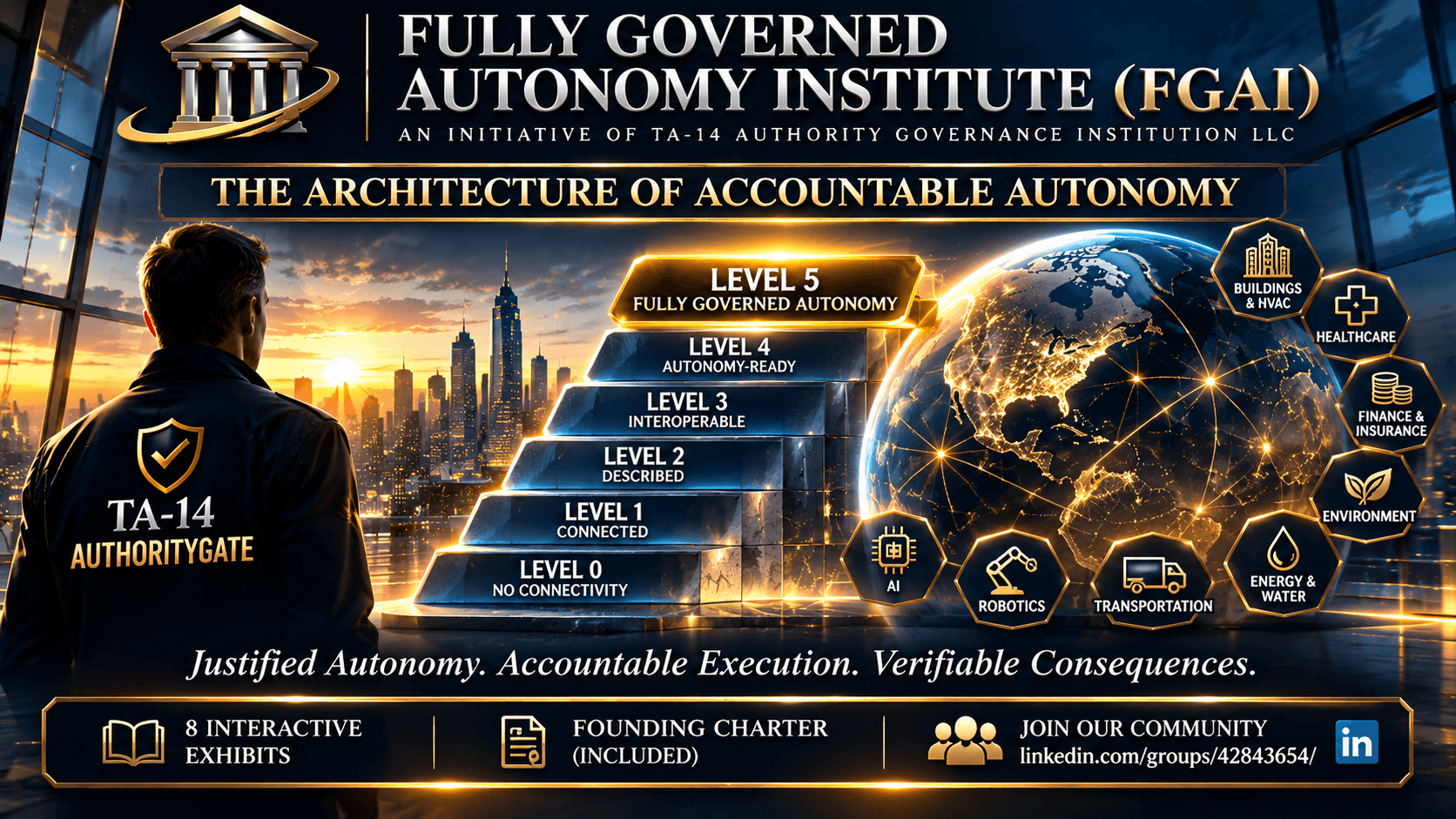
The Birth of FGAI
Learning objective: Distinguish autonomous capability from justified execution.
AUTONOMOUS CAPABILITY IS NOT PERMISSION.
SAMANTHA · EXHIBIT 01 NARRATION
Founded as an initiative of TA-14 Authority Governance Institution LLC, FGAI advances Justified Autonomy, Consequence Governance and Institutional Accountability. The founding charter dated November 26, 2026 remains a draft pending adoption.
Browser-based narration selects the Samantha voice when available; otherwise an available English voice is used.
INTERACTIVE GOVERNANCE CHALLENGE
A building operator installs an autonomous controller. Does installation alone authorize every action the controller can propose?
EXHIBIT 02 OF 08
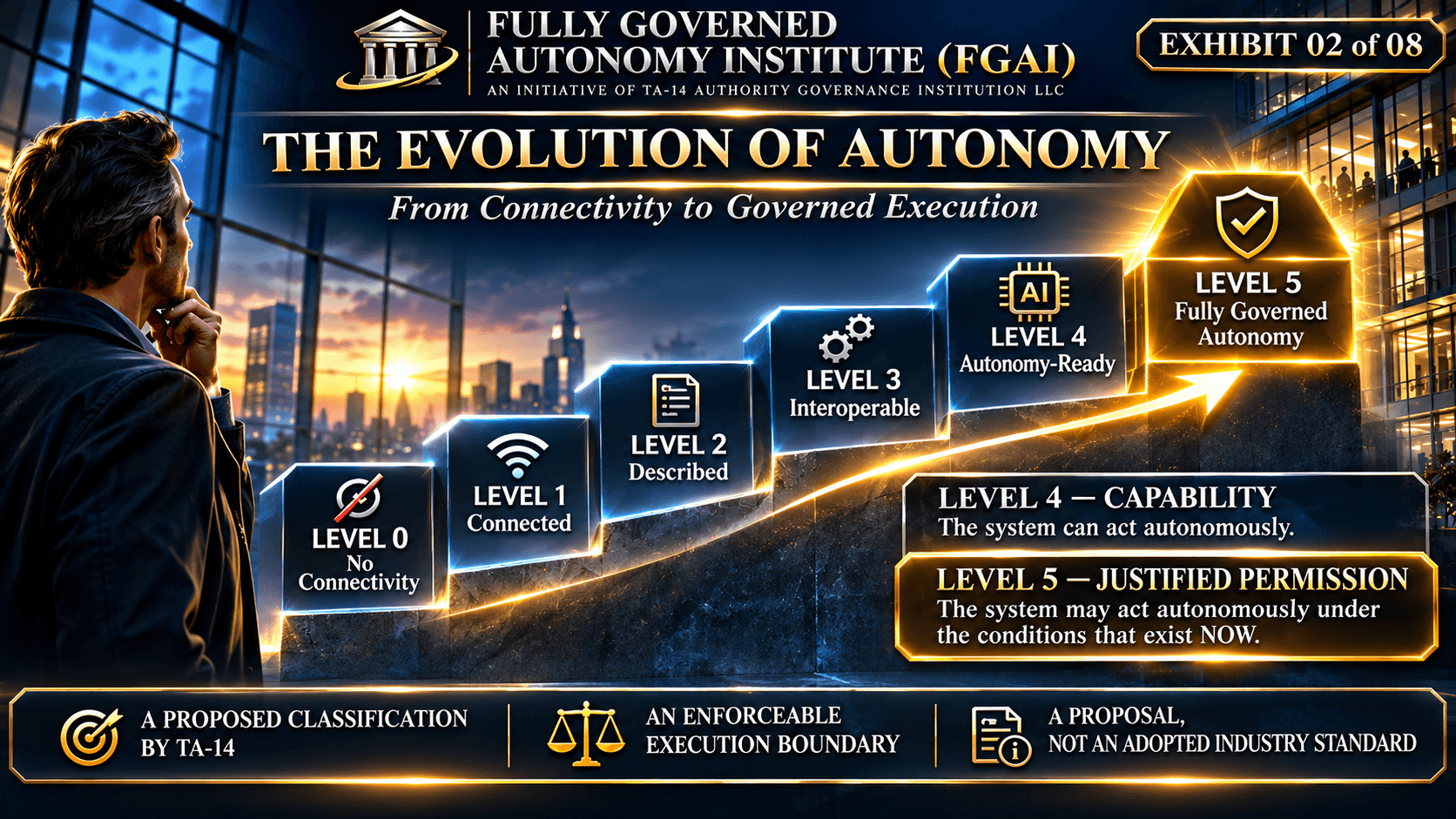
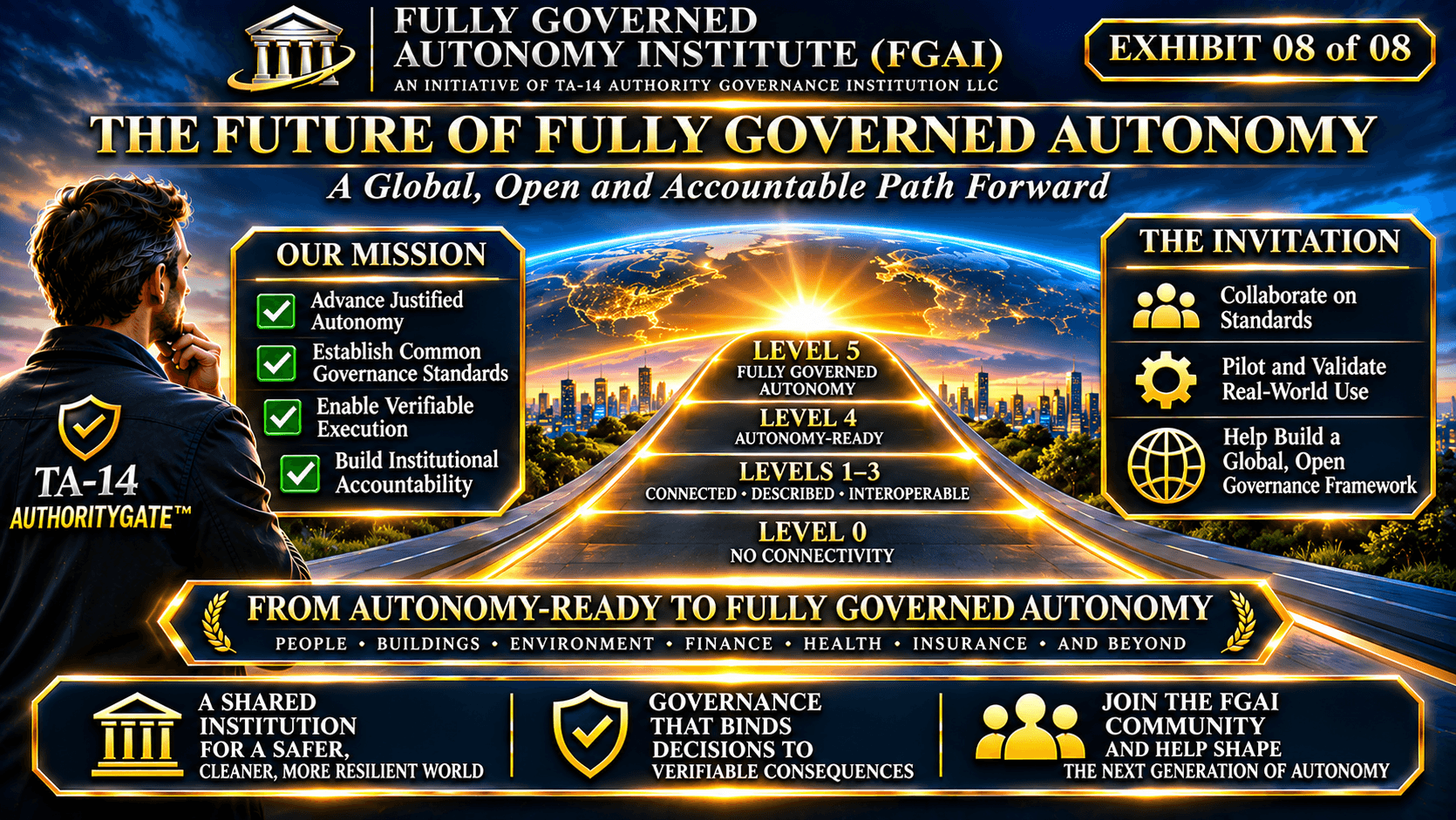
The Evolution of Autonomy
Learning objective: Understand the proposed distinction between Level 4 and Level 5.
LEVEL 4: CAN ACT. LEVEL 5: MAY ACT, IF JUSTIFIED NOW.
SAMANTHA · EXHIBIT 02 NARRATION
Level zero: No Connectivity. Level one: Connected. Level two: Described. Level three: Interoperable. Level four: Autonomy-Ready. Level five: Fully Governed Autonomy. Level five is TA-14’s proposal, not an adopted industry standard. It adds an enforceable execution boundary rather than merely more automation.
Browser-based narration selects the Samantha voice when available; otherwise an available English voice is used.
INTERACTIVE GOVERNANCE CHALLENGE
An interoperable system can autonomously adjust ventilation. Is it necessarily Level 5?
EXHIBIT 03 OF 08
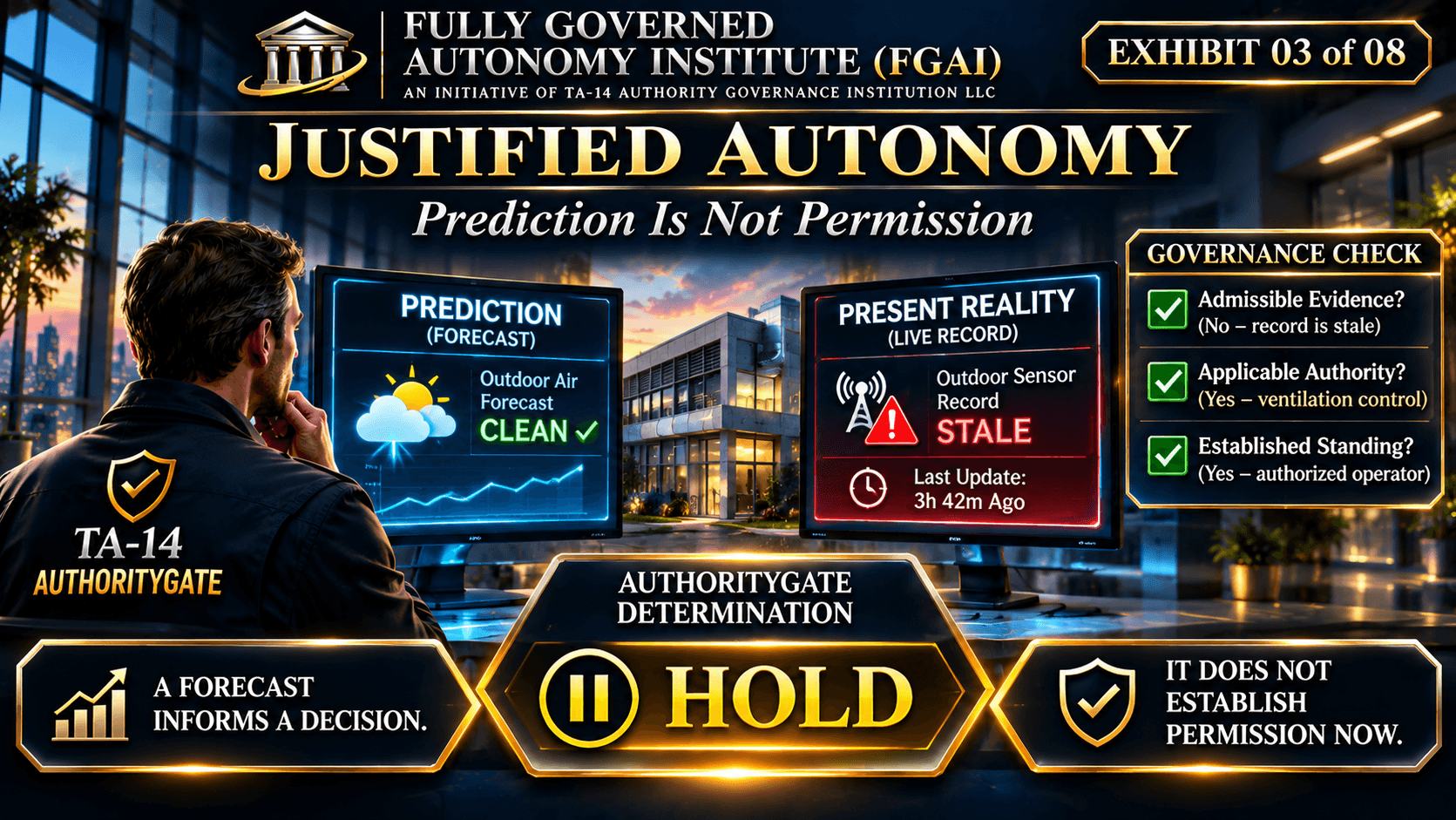
Justified Autonomy
Learning objective: Separate prediction from present justification.
Illustration clarification: the green check alongside stale evidence is a graphic error. A stale outdoor sensor record is not admissible current evidence; the correct instructional disposition is HOLD. The challenge and narration below govern the teaching case.
PREDICTION IS NOT PERMISSION.
SAMANTHA · EXHIBIT 03 NARRATION
Prediction can inform a decision but cannot independently establish permission now. Evidence must remain admissible, authority applicable and standing established when execution occurs. A forecast is not proof that these conditions currently hold.
Browser-based narration selects the Samantha voice when available; otherwise an available English voice is used.
INTERACTIVE GOVERNANCE CHALLENGE
A forecast predicts clean outdoor air, but the current outdoor sensor record is stale. Should the automated damper open on that forecast alone?
EXHIBIT 04 OF 08
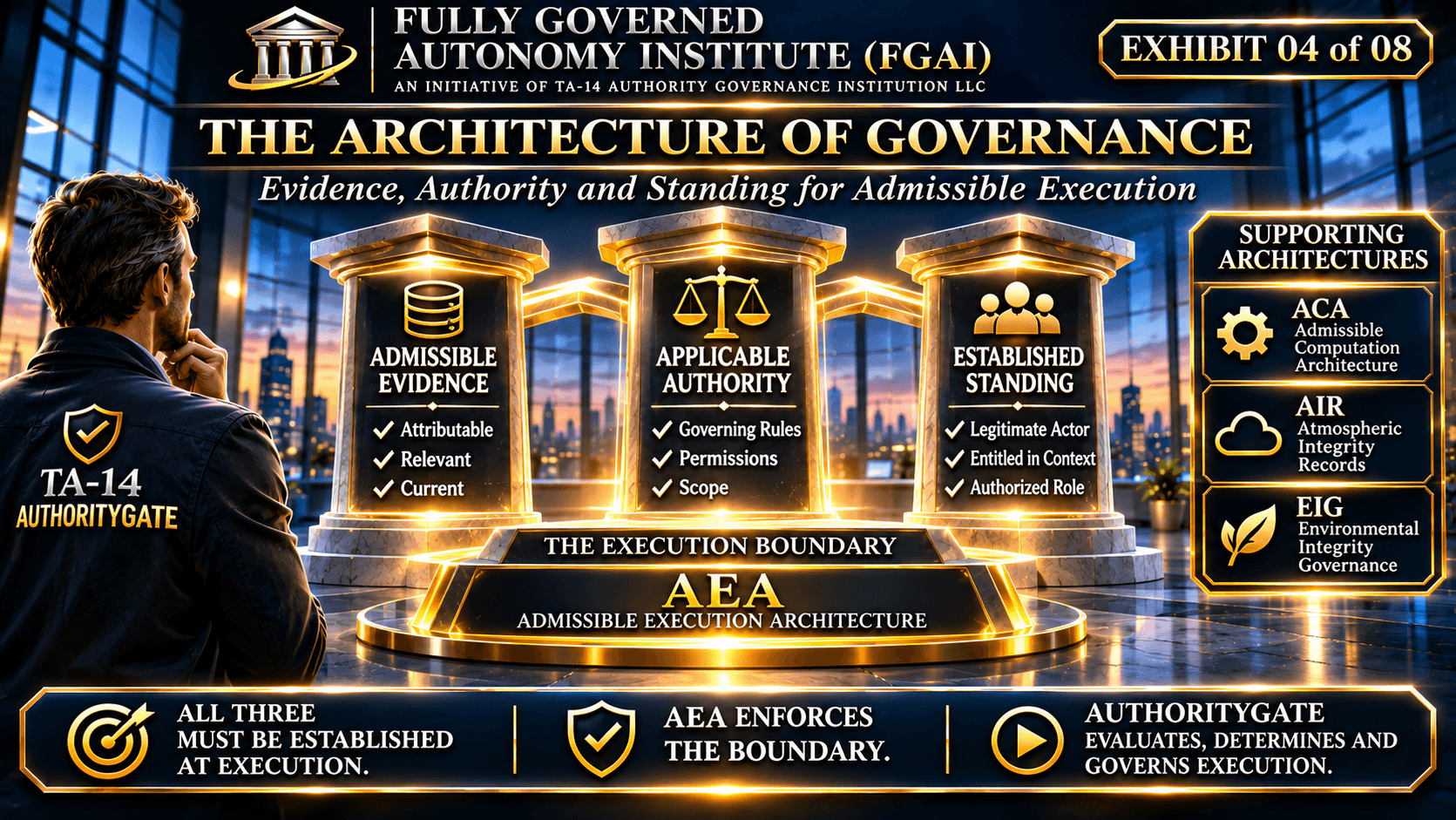
The Architecture of Governance
Learning objective: Identify the three prerequisites for admissible execution.
ADMISSIBLE EVIDENCE · APPLICABLE AUTHORITY · ESTABLISHED STANDING.
SAMANTHA · EXHIBIT 04 NARRATION
Admissible Evidence concerns attributable, relevant and sufficiently current evidence. Applicable Authority concerns the governing rules and permissions for the action. Established Standing concerns whether the actor is entitled to exercise that authority in context. Admissible Execution Architecture provides the execution boundary; Admissible Computation Architecture, Atmospheric Integrity Records and Environmental Integrity Governance contribute computation, atmospheric evidence and environmental consequence governance respectively.
Browser-based narration selects the Samantha voice when available; otherwise an available English voice is used.
INTERACTIVE GOVERNANCE CHALLENGE
A valid sensor reading supports a command, but the requesting actor has no established standing. Is the evidence enough?
EXHIBIT 05 OF 08
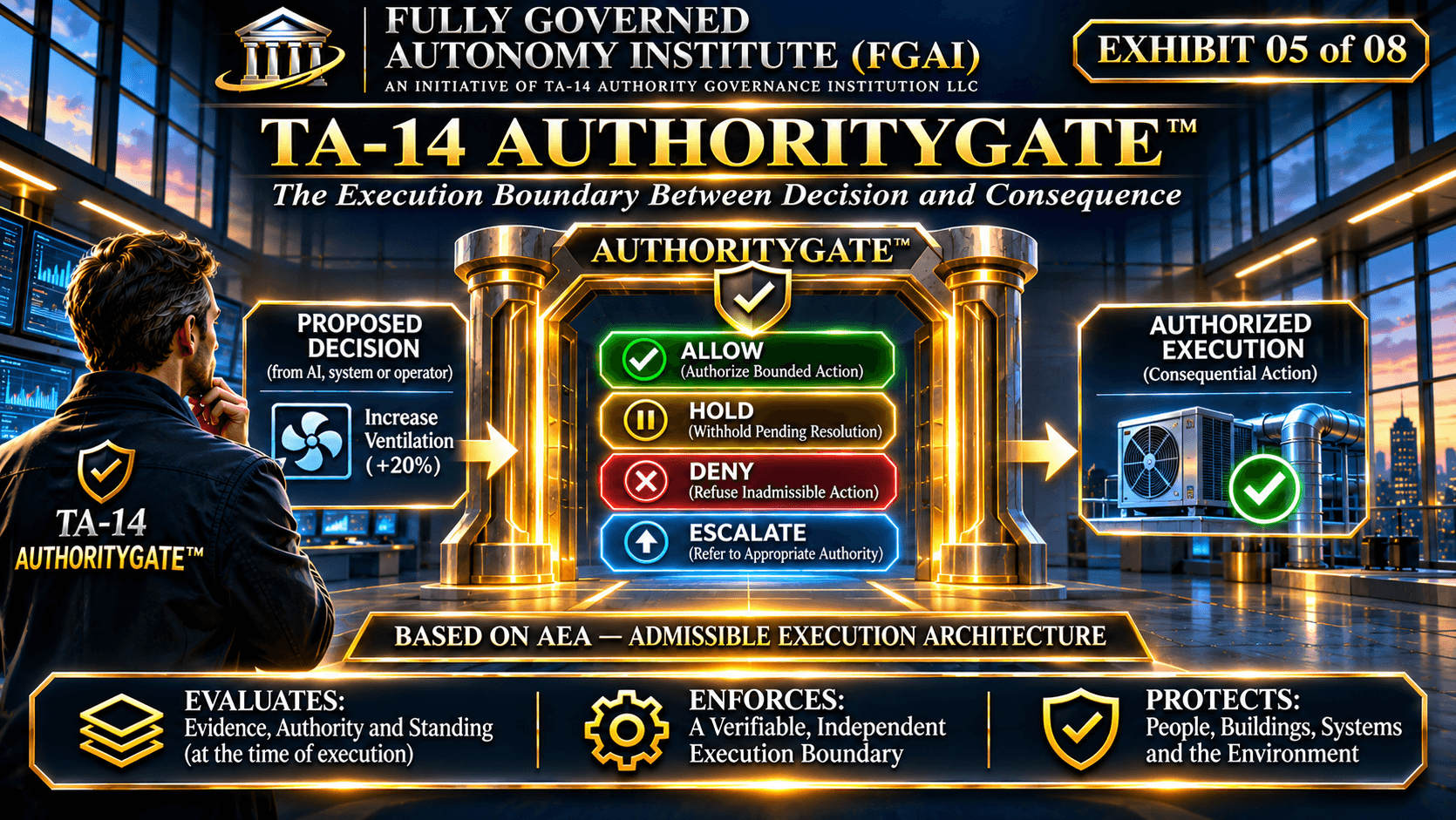
TA-14 AuthorityGate
Learning objective: Distinguish a proposed decision from authorized execution.
ALLOW · HOLD · DENY · ESCALATE.
SAMANTHA · EXHIBIT 05 NARRATION
AuthorityGate is TA-14’s execution-governance software based on Admissible Execution Architecture. Its canonical dispositions are ALLOW, HOLD, DENY and ESCALATE. ALLOW authorizes a bounded action when prerequisites are satisfied; HOLD withholds pending resolution; DENY refuses an inadmissible action; ESCALATE refers a matter to appropriate authority without granting execution permission. This is an architectural explanation, not a claim of independently verified production readiness.
Browser-based narration selects the Samantha voice when available; otherwise an available English voice is used.
INTERACTIVE GOVERNANCE CHALLENGE
A command was authorized earlier, but its authority is revoked before execution. What should happen?
EXHIBIT 06 OF 08
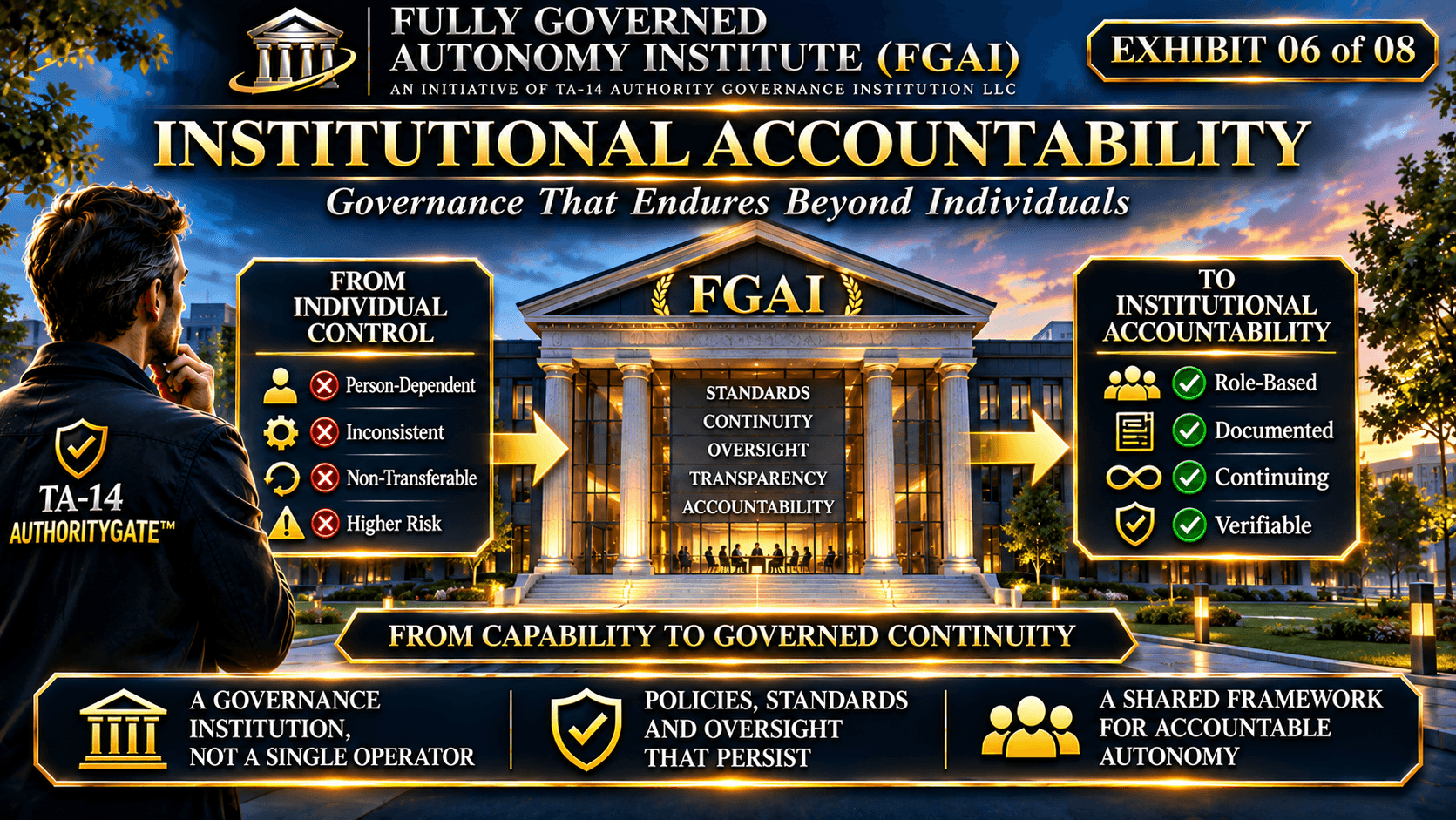
Institutional Accountability
Learning objective: Make governance attributable beyond individual leadership.
GOVERNANCE MUST OUTLAST ANY ONE OPERATOR.
SAMANTHA · EXHIBIT 06 NARRATION
Accountability requires identifiable authority, documented decisions, auditable evidence and verifiable outcomes. Institutional continuity requires that policies, responsibilities and records survive leadership changes. A founder’s personal approval cannot substitute for a durable governance process.
Browser-based narration selects the Samantha voice when available; otherwise an available English voice is used.
INTERACTIVE GOVERNANCE CHALLENGE
A founder leaves and a successor cannot locate the basis for an automated decision. Is accountability established?
EXHIBIT 07 OF 08
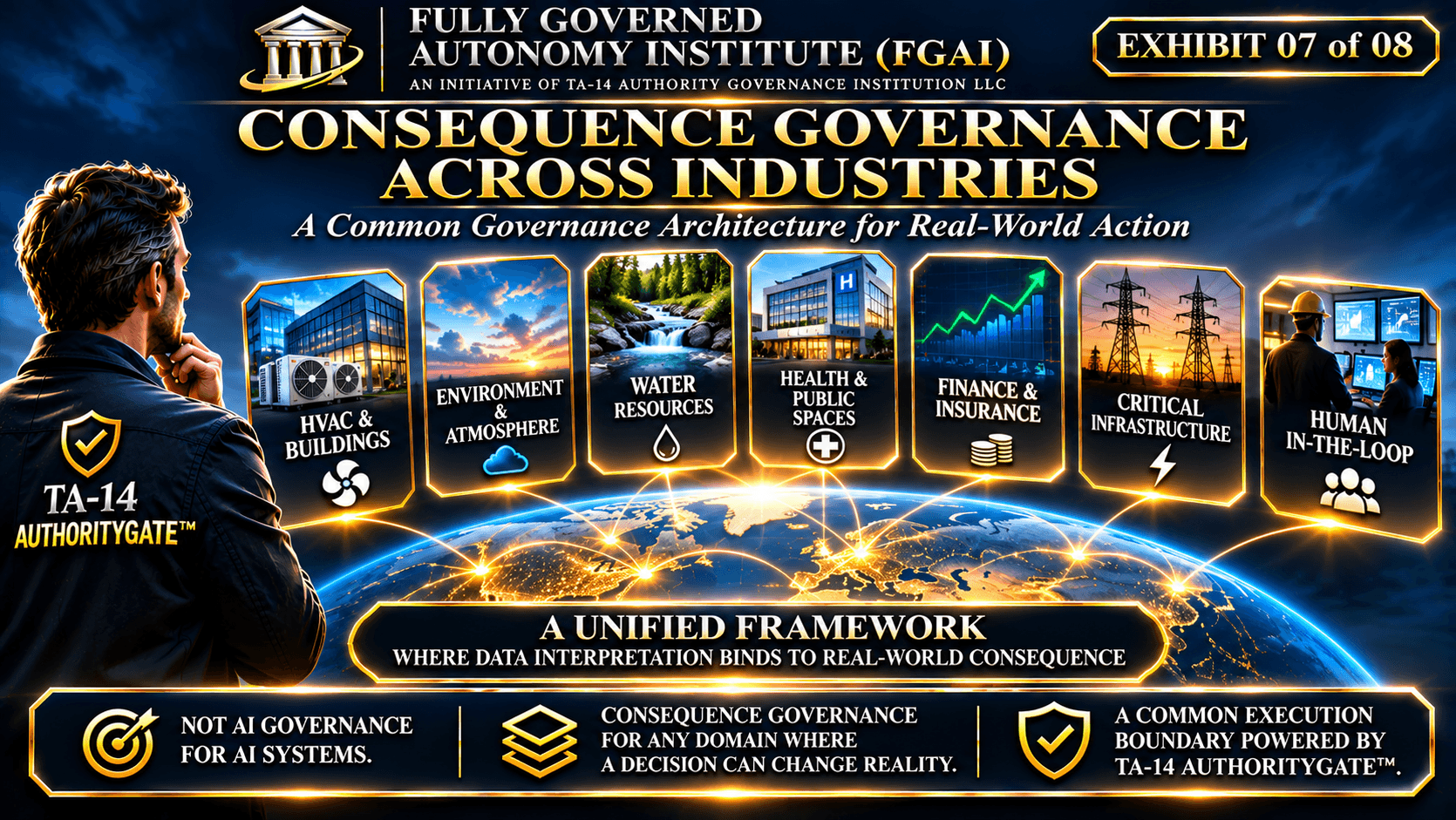
Consequence Governance Across Industries
Learning objective: Recognize the common execution boundary across domains.
CONSEQUENCE GOVERNANCE EXTENDS BEYOND AI GOVERNANCE.
SAMANTHA · EXHIBIT 07 NARRATION
Consequence governance applies wherever interpretation of data becomes a binding action: buildings, healthcare, finance, insurance, robotics, transport, energy, water and human decisions. Domain-specific laws and safety requirements remain controlling. Atmospheric Integrity Records can support atmospheric evidence; Environmental Integrity Governance addresses environmental trade-offs without treating energy savings alone as proof of acceptable outcomes.
Browser-based narration selects the Samantha voice when available; otherwise an available English voice is used.
INTERACTIVE GOVERNANCE CHALLENGE
A controller saves energy by reducing ventilation, but indoor air evidence indicates a possible harmful consequence. Is energy optimization sufficient justification?
EXHIBIT 08 OF 08
The Future of Fully Governed Autonomy
Learning objective: Connect justification, accountability and verification.
JUSTIFICATION BEFORE EXECUTION. VERIFICATION AFTER CONSEQUENCE.
SAMANTHA · EXHIBIT 08 NARRATION
FGAI invites independent examination, education and interdisciplinary collaboration. Demonstrated capabilities must be distinguished from proposals and independently verified capabilities. Participation is not certification, accreditation or execution authority. The founding commitment is justification before execution, accountability through governance and verification after consequence.
Browser-based narration selects the Samantha voice when available; otherwise an available English voice is used.
INTERACTIVE GOVERNANCE CHALLENGE
A participant claims FGAI membership certifies a product as fully governed. Is the claim supported?
TA-14 ACADEMY · INDEPENDENT REVIEW CHALLENGE
Can you defend the determination?
Apply the governance principles to three hypothetical cases relevant to the proposed operational consequence. Choose a determination, then examine the reasoning. These cases teach the distinction between Admissible Evidence, Applicable Authority, and Established Standing; they do not issue real-world authorization.
CASE 01
Evidence is not yet admissible
A proposed consequence is supported by an observation, but the source attribution or record continuity is missing. What should happen before execution? Consider this in the context of the proposed operational consequence.
CASE 02
The actor exceeds authority
The record is current and reliable, but the proposed consequence falls outside the scope of applicable authority. What is the supported determination?
CASE 03
A higher authority is required
The proposed consequence triggers a documented requirement for review by another designated authority. What is the appropriate route?
Independent educational examples only. The questions are hypothetical and do not assess a real institution, building, person, or operating system. Actual governance determinations require case-specific evidence, applicable authority, established standing, and bounded review.