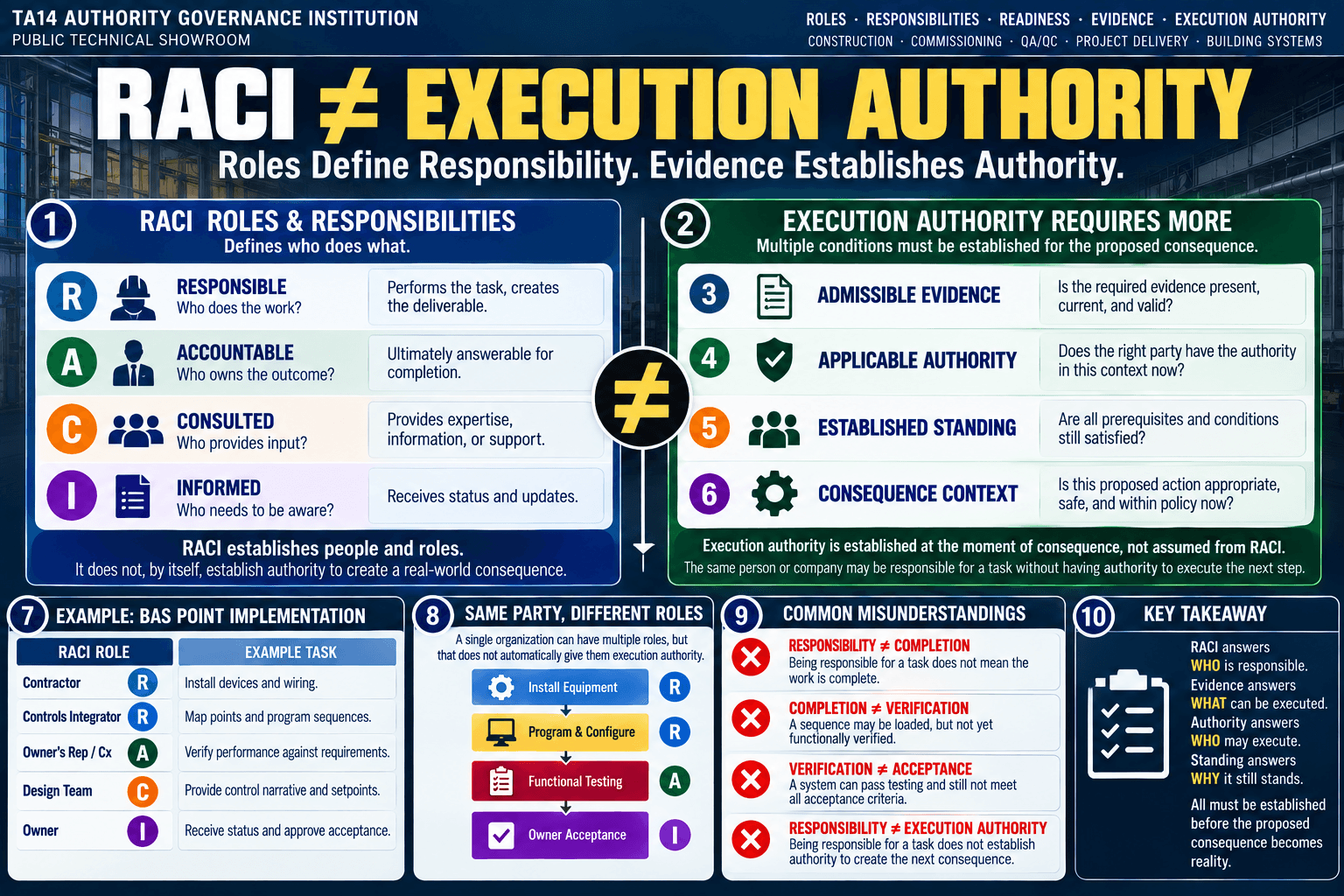
RACI can identify who owns a task. Commissioning can define readiness and acceptance. But when one scope hands reality to another, a separate question appears: what must actually be established before the next consequence is allowed to occur?
Responsibility identifies an owner. It does not manufacture readiness or execution authority.
01 · THE PROJECT DELIVERY PROBLEM
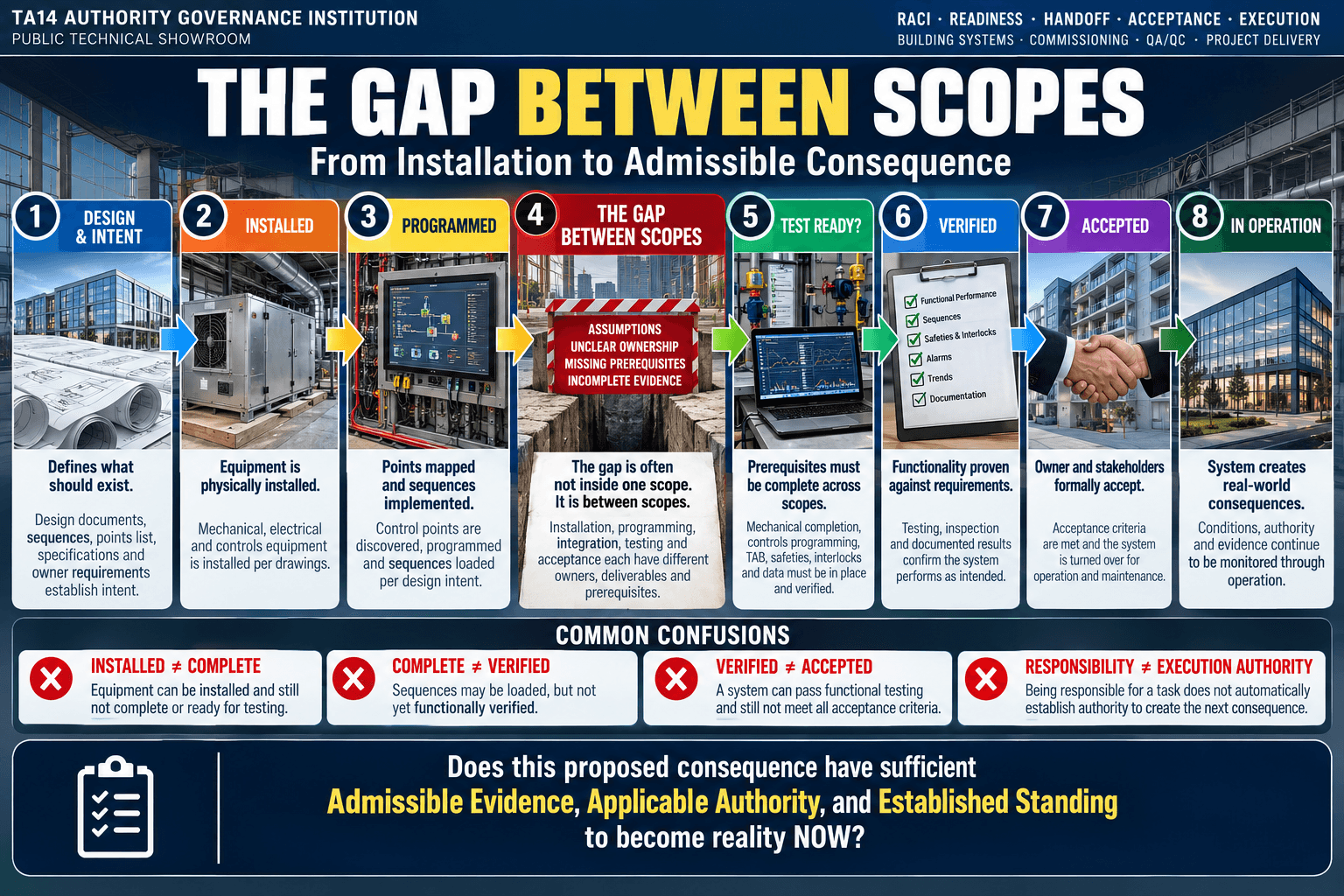
THE FAILURE OFTEN LIVES BETWEEN “DONE” STATES.
01
INSTALLED
Physical work exists. That does not establish completion.
02
PROGRAMMED
Logic exists. That does not establish integration or readiness.
03
TEST READY
Prerequisites are claimed complete. The claim still needs evidence.
04
ACCEPTED
The authorized acceptance path has been satisfied for the defined scope.
A person or organization can be responsible for a task without having unlimited authority to create every downstream consequence. Scope, evidence, prerequisites, acceptance criteria, current standing, and applicable authority still govern the boundary.
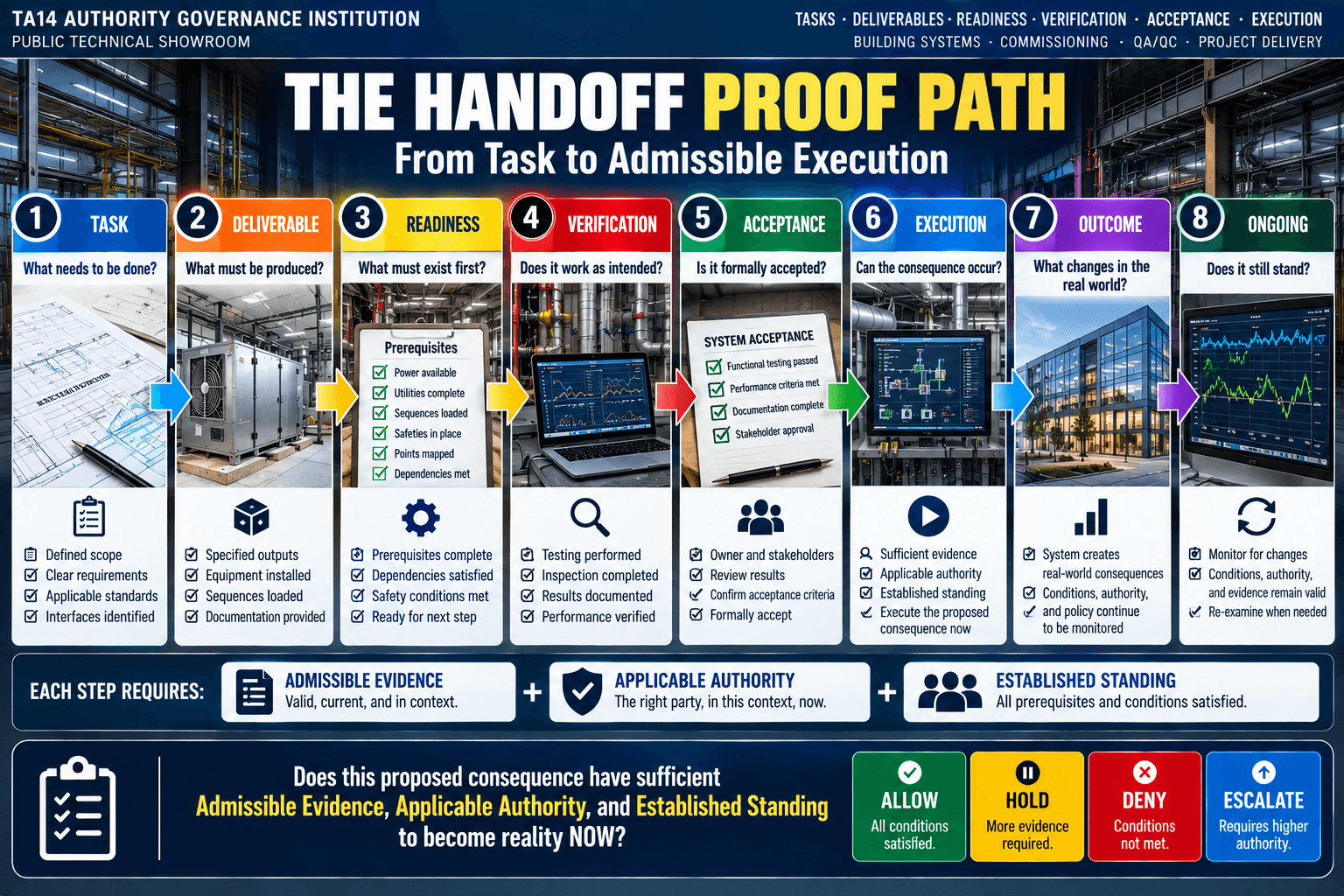
A handoff is not a sentence in a meeting. It is a proposed transition in reality.
04 · WORKED COMMISSIONING EXAMPLE
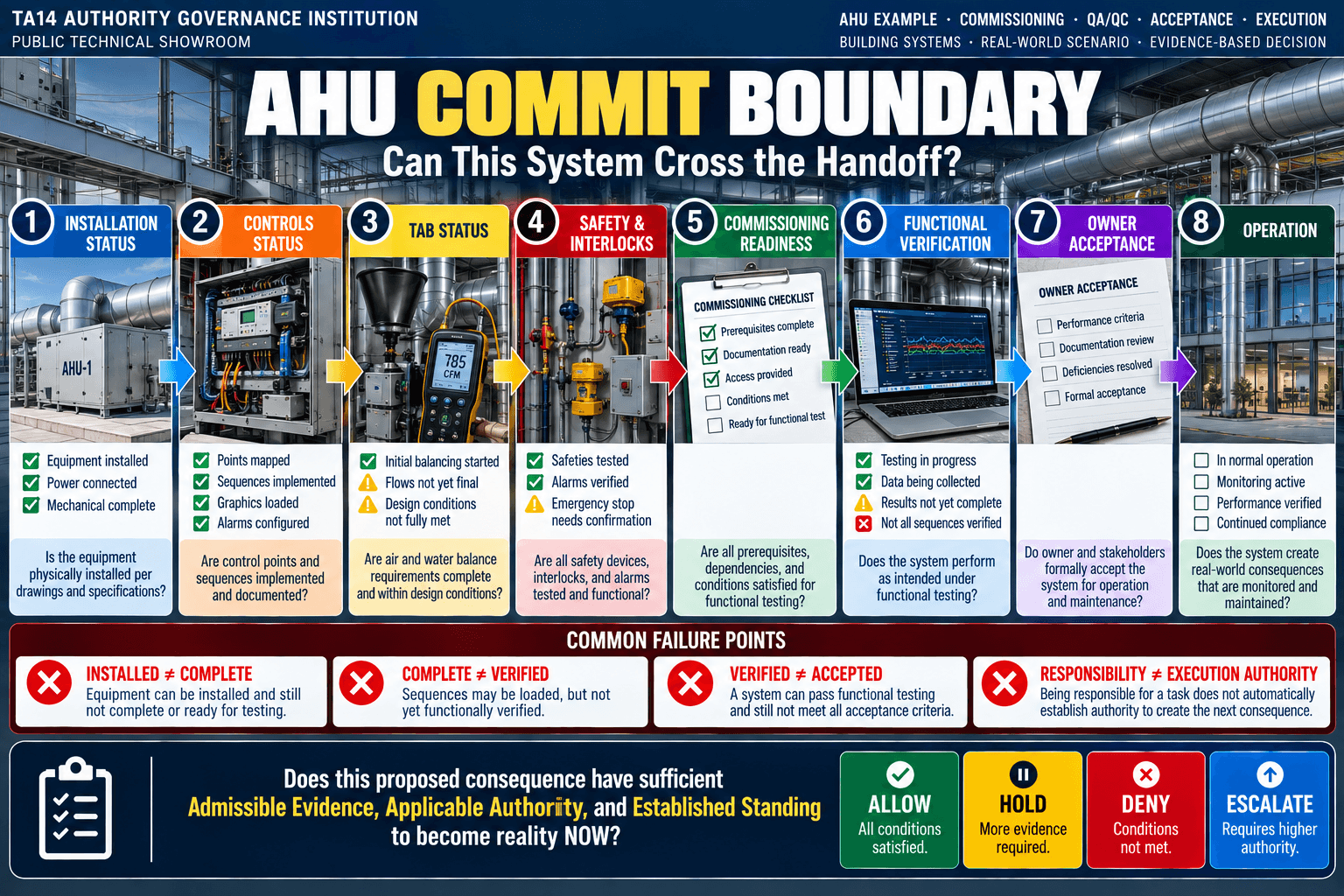
THE AHU IS “READY.” PROVE IT.
The mechanical contractor reports installation complete. Controls reports programming complete. Functional testing is scheduled. Before testing or turnover crosses the boundary, examine what actually stands.
01 · INSTALLATION
Equipment, sensors, actuators, safeties, wiring, access, labeling and required physical work are complete for the declared test scope.
02 · CONTROLS
Points, sequences, alarms, safeties and commanded states are mapped to the actual installed system.
03 · TAB / PREREQUISITES
Required balancing, flows, pressures, calibration or other prerequisites are established where applicable to the proposed test.
04 · EVIDENCE
The claims above are supported by identifiable, current records rather than assumption or verbal status alone.
05 · AUTHORITY
The actor initiating testing, overrides, commands or acceptance is authorized for that exact consequence and scope.
06 · ACCEPTANCE / OUTCOME
The applicable acceptance criteria are evaluated, exceptions are preserved, and the observed outcome becomes the next record.
05 · LIVE HANDOFF LAB
CHANGE THE PROJECT STATE. WATCH THE BOUNDARY MOVE.
CURRENT HANDOFF DISPOSITION
ESCALATE
A readiness or acceptance decision remains unresolved. Route the boundary to the applicable accountable or acceptance path.
06 · THE COMMIT BOUNDARY
BEFORE “READY” BECOMES REALITY.
At the handoff, the project is no longer asking only who owns the next task. It is asking whether this specific transition has sufficient grounds to cross from claim into consequence.
Does this proposed consequence have sufficient Admissible Evidence, Applicable Authority, and Established Standing to become reality NOW?
Replace “I thought they were doing that” with a preserved transition record.
LESS PREMATURE TESTING
Do not schedule consequence ahead of established prerequisites.
CLEARER EXCEPTIONS
A HOLD identifies what is missing without pretending the entire project failed.
BETTER ACCOUNTABILITY
Preserve who proposed, verified, accepted, authorized and executed each transition.
ORIGIN / ATTRIBUTION / NON-ENDORSEMENT. This independent TA14 technical examination was prompted by a public commissioning discussion by Marcus Myers emphasizing RACI, roles and responsibilities, readiness gates, acceptance criteria, handoffs, and the observation that project gaps often occur between scopes. Marcus Myers did not commission, approve, or endorse this TA14 examination unless separately stated. RACI, commissioning, contractual requirements, professional standards, project specifications, codes, and applicable authority remain distinct and controlling within their proper domains.