EXHIBIT 01 / 08
The Asset
Establish one asset and its authorized operating envelope.
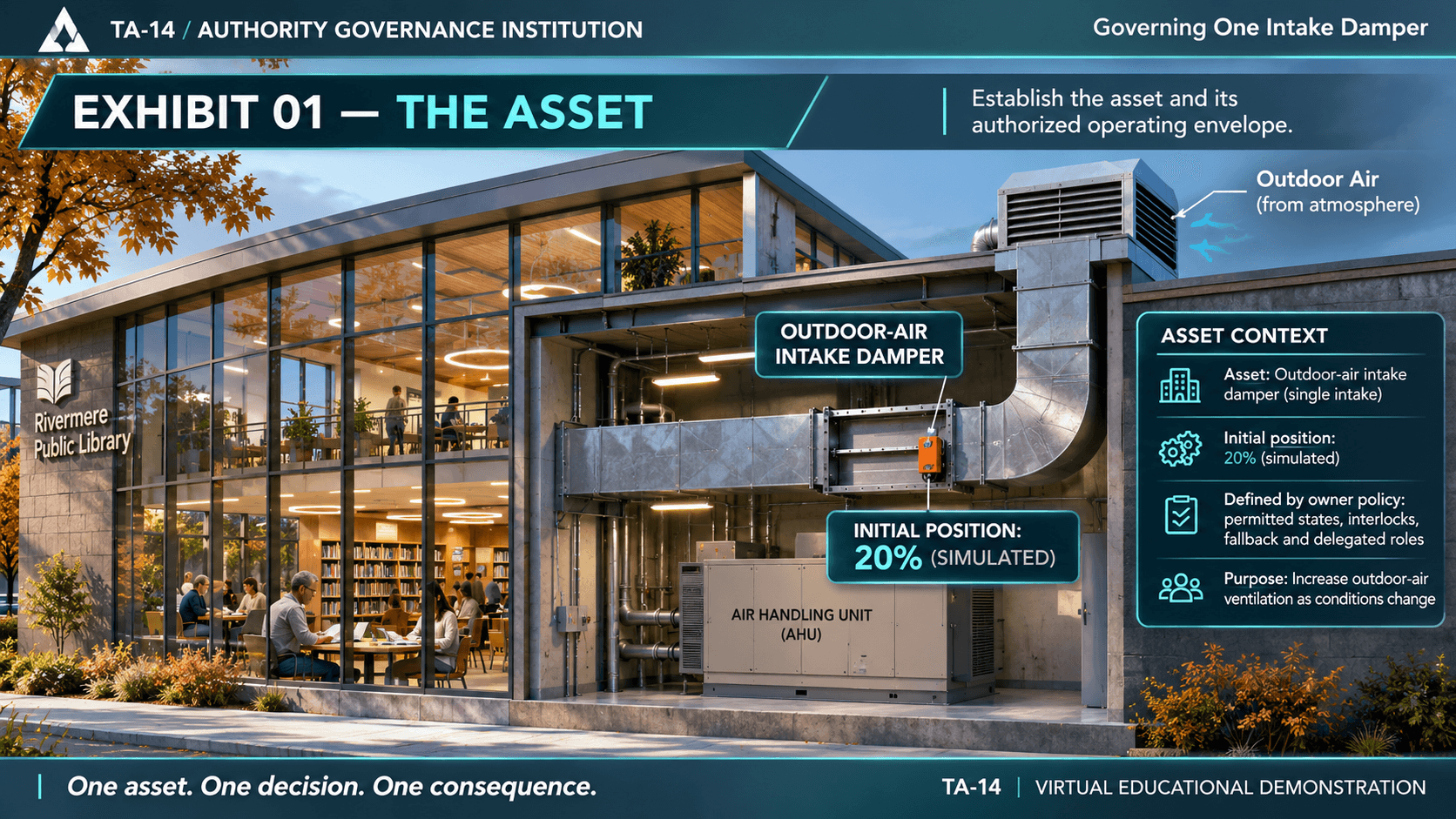
Examination lesson: Before an action can be governed, the asset, applicable policy, and authorized actors must be identified.
ONE ASSET · ONE DECISION · ONE CONSEQUENCE
An eight-exhibit examination of the distance between a building intelligence recommendation and permission to change physical reality.
Virtual educational demonstration, not a deployed control system. The library, numerical readings, decisions and pictured outcomes are simulated. No operational safety, field measurement, partner endorsement, certification, or independently tested software enforcement is asserted. Qualified engineering and owner approval are mandatory for any real implementation.
EXHIBIT 01 / 08
Establish one asset and its authorized operating envelope.
Examination lesson: Before an action can be governed, the asset, applicable policy, and authorized actors must be identified.
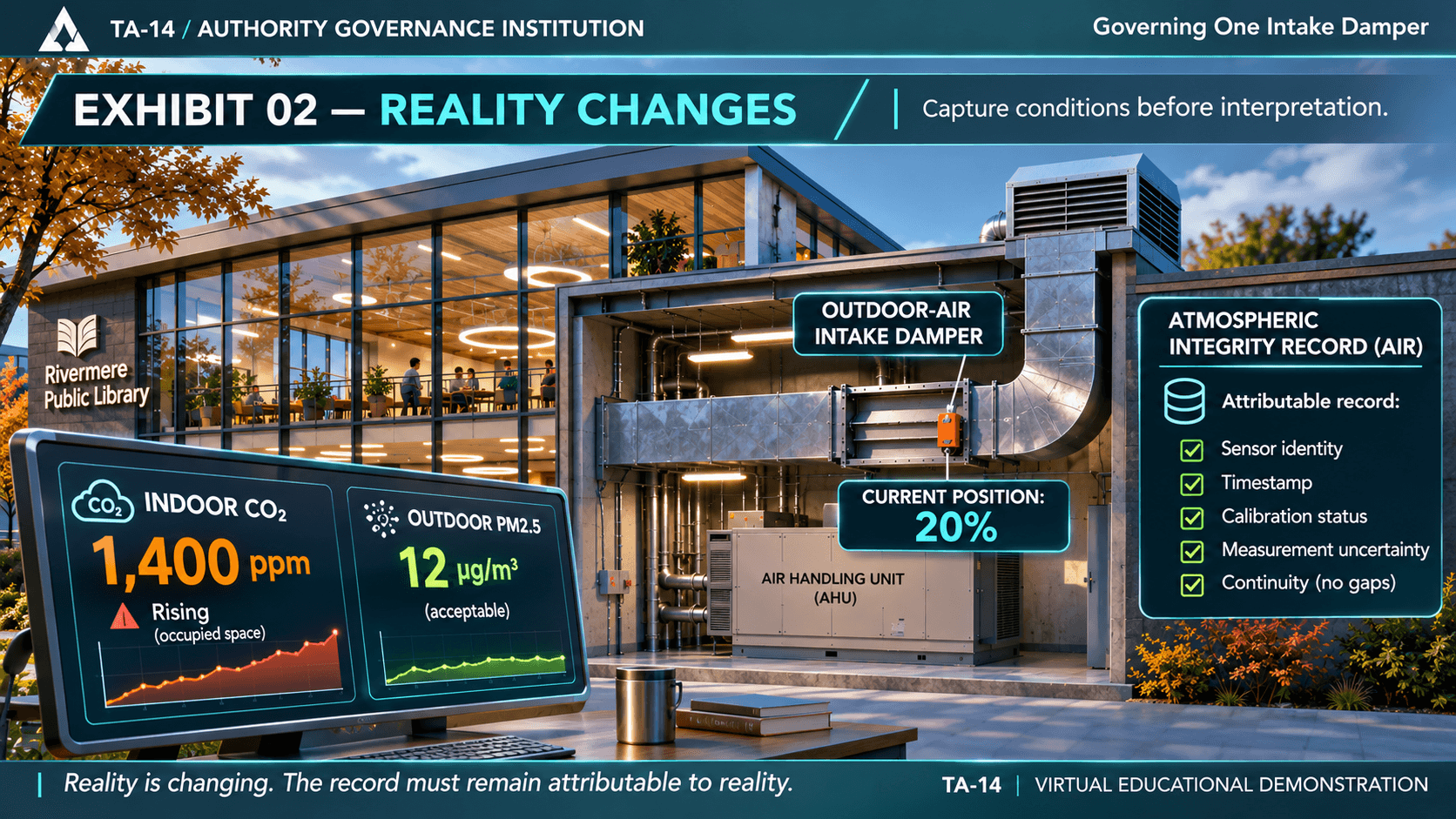
EXHIBIT 02 / 08
Capture conditions before interpretation.
Examination lesson: A reading without provenance and continuity cannot automatically become admissible evidence.
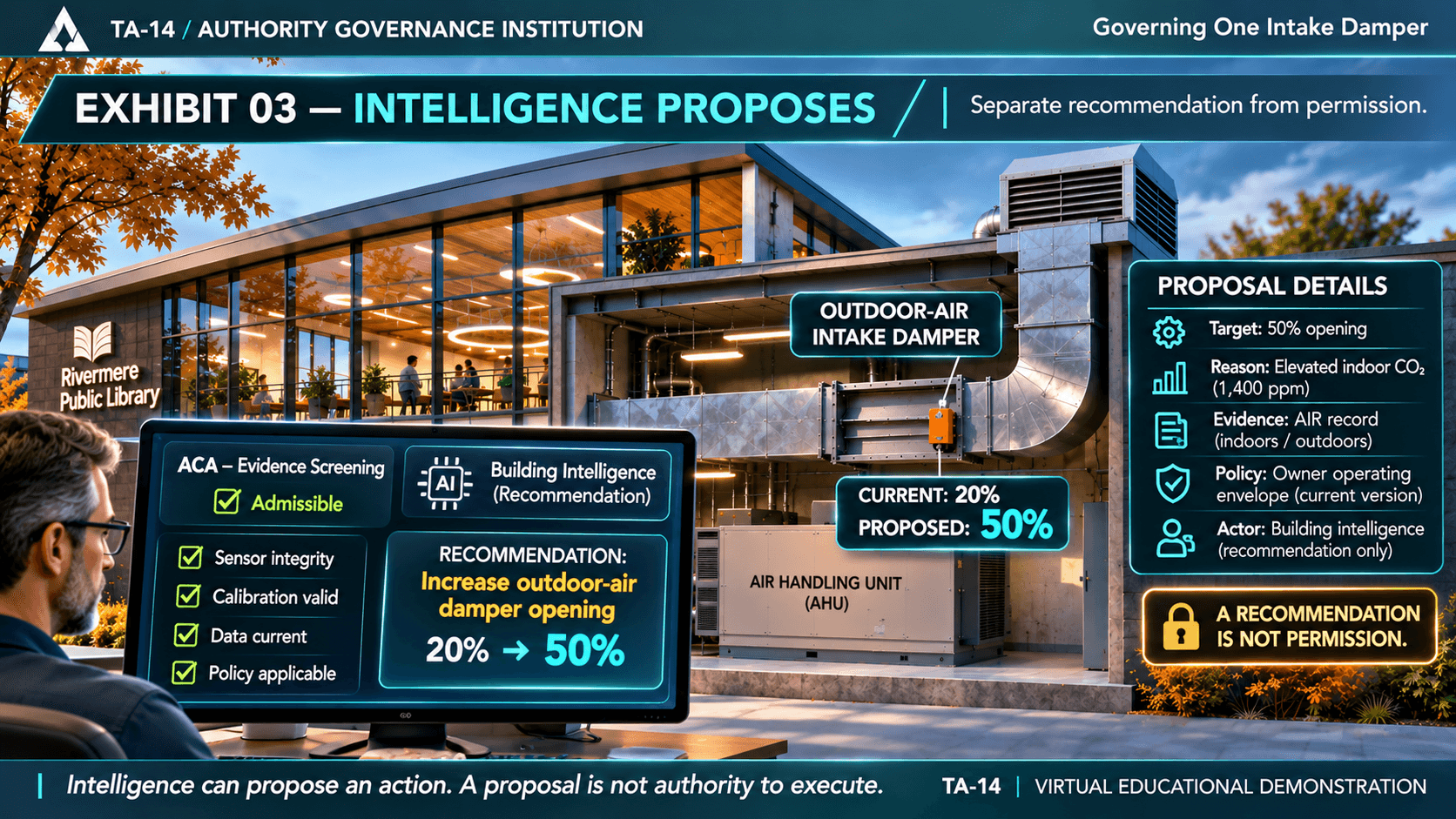
EXHIBIT 03 / 08
A recommendation is not execution permission.
Examination lesson: Intelligence may propose a consequential action. It must not authorize itself.
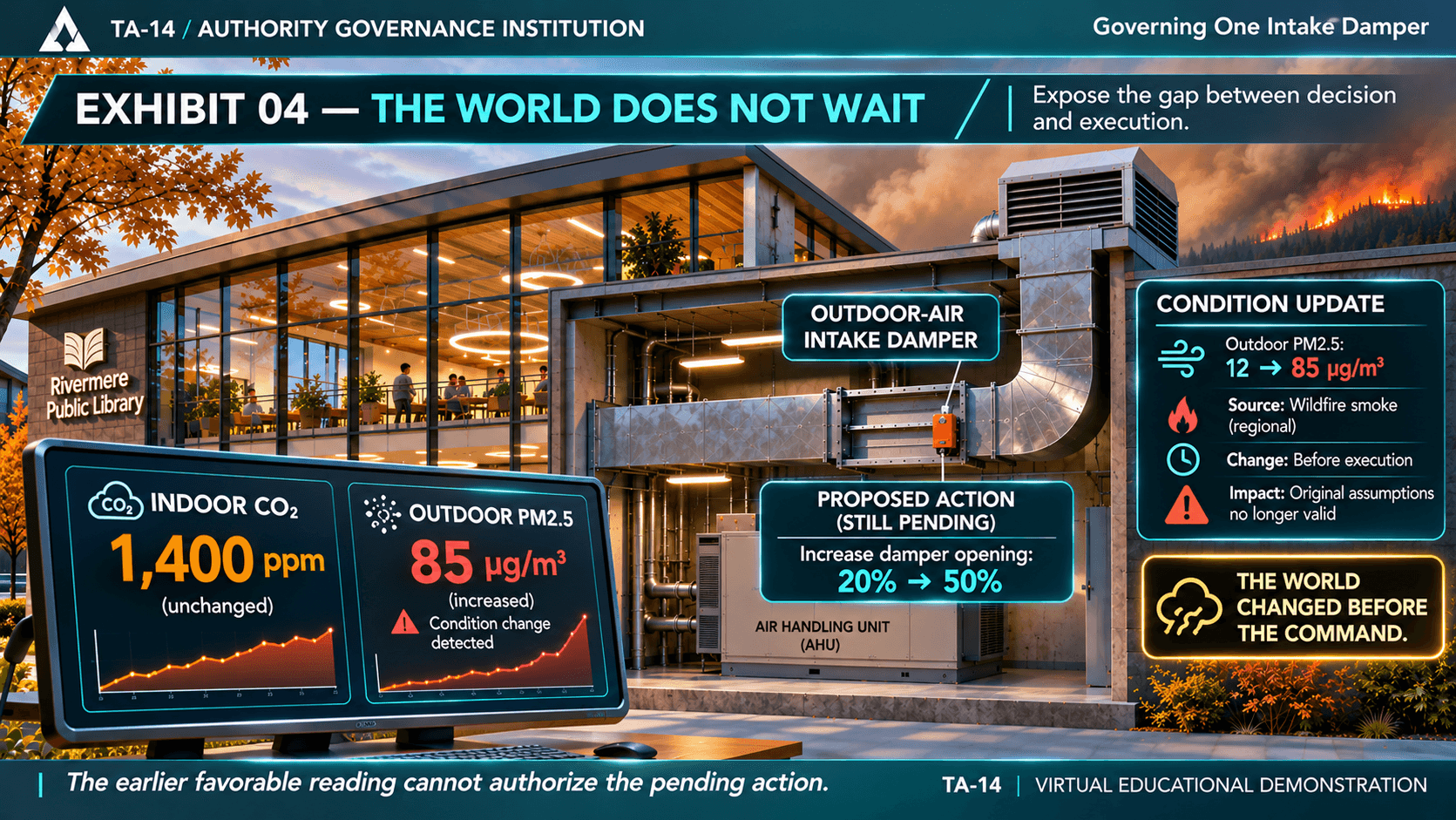
EXHIBIT 04 / 08
Reality can change before the command reaches the asset.
Examination lesson: The proposal must be checked against current conditions at the moment of consequence.
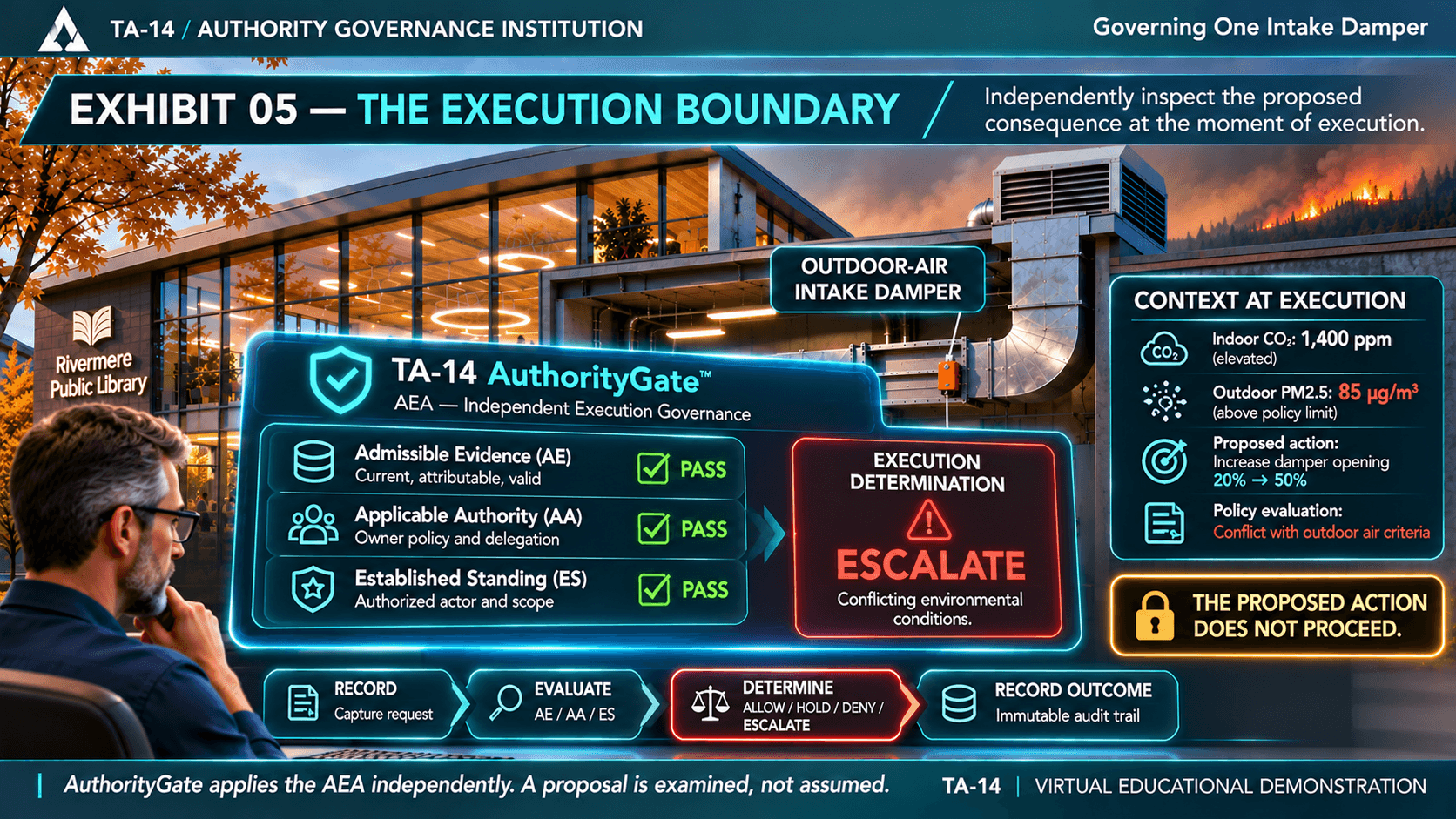
EXHIBIT 05 / 08
Independent examination at the point of consequence.
Examination lesson: A passing evidence check is not enough when an applicable operating constraint conflicts.
EXHIBIT 06 / 08
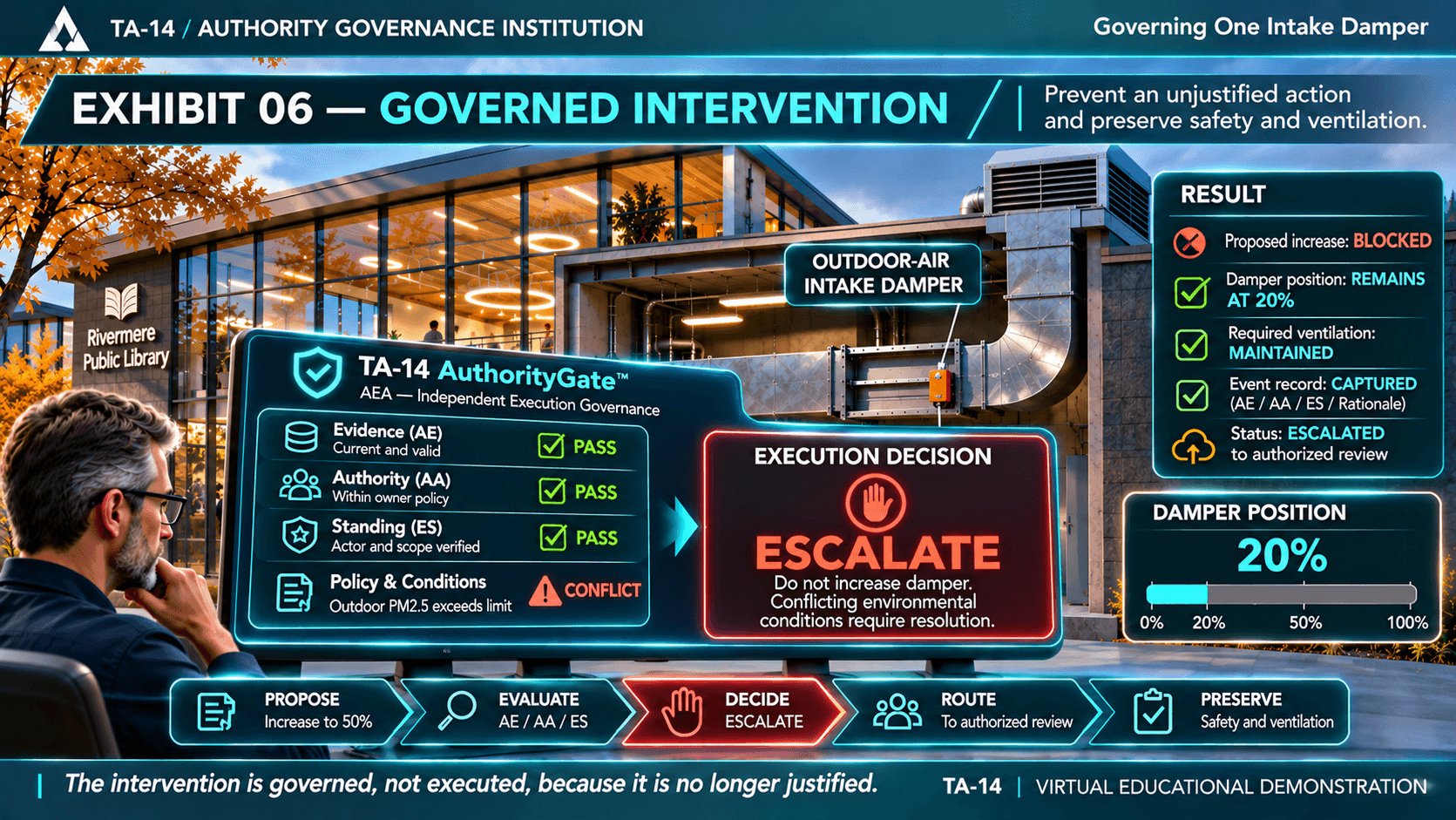
Refuse the unjustified increase without defeating safety.
Examination lesson: Restraint can be a governed outcome; it is not a waiver of ventilation or life-safety duties.
EXHIBIT 07 / 08
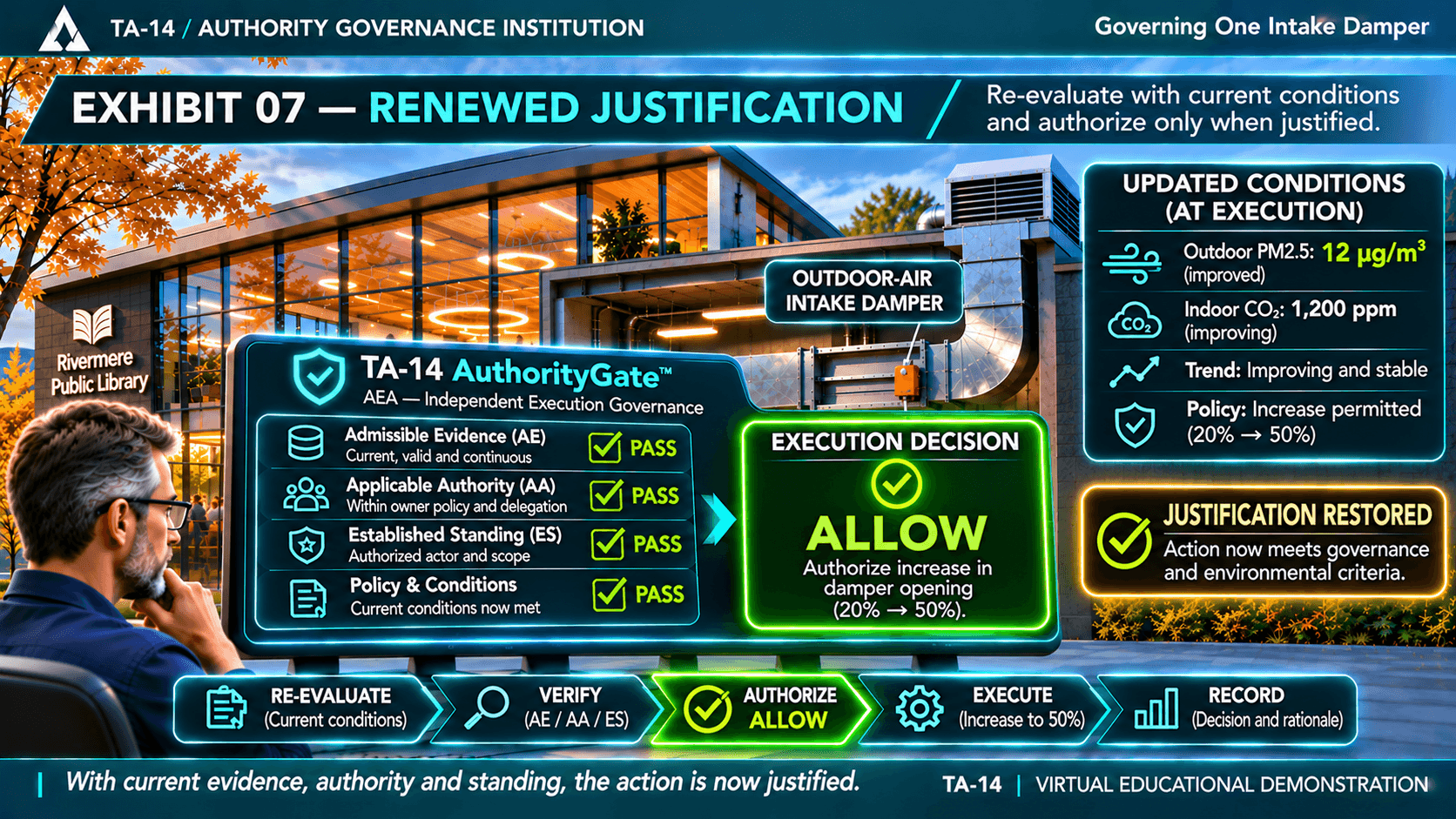
A new action requires fresh evidence and permission.
Artwork note: the scene illustrates an improving indoor CO₂ trend. The examination scenario requires a fresh admissibility check; do not read the pictured CO₂ change as a measured physical outcome before the new opening.
Examination lesson: Approval is action-specific and time-specific. Changed conditions require a new examination.
EXHIBIT 08 / 08
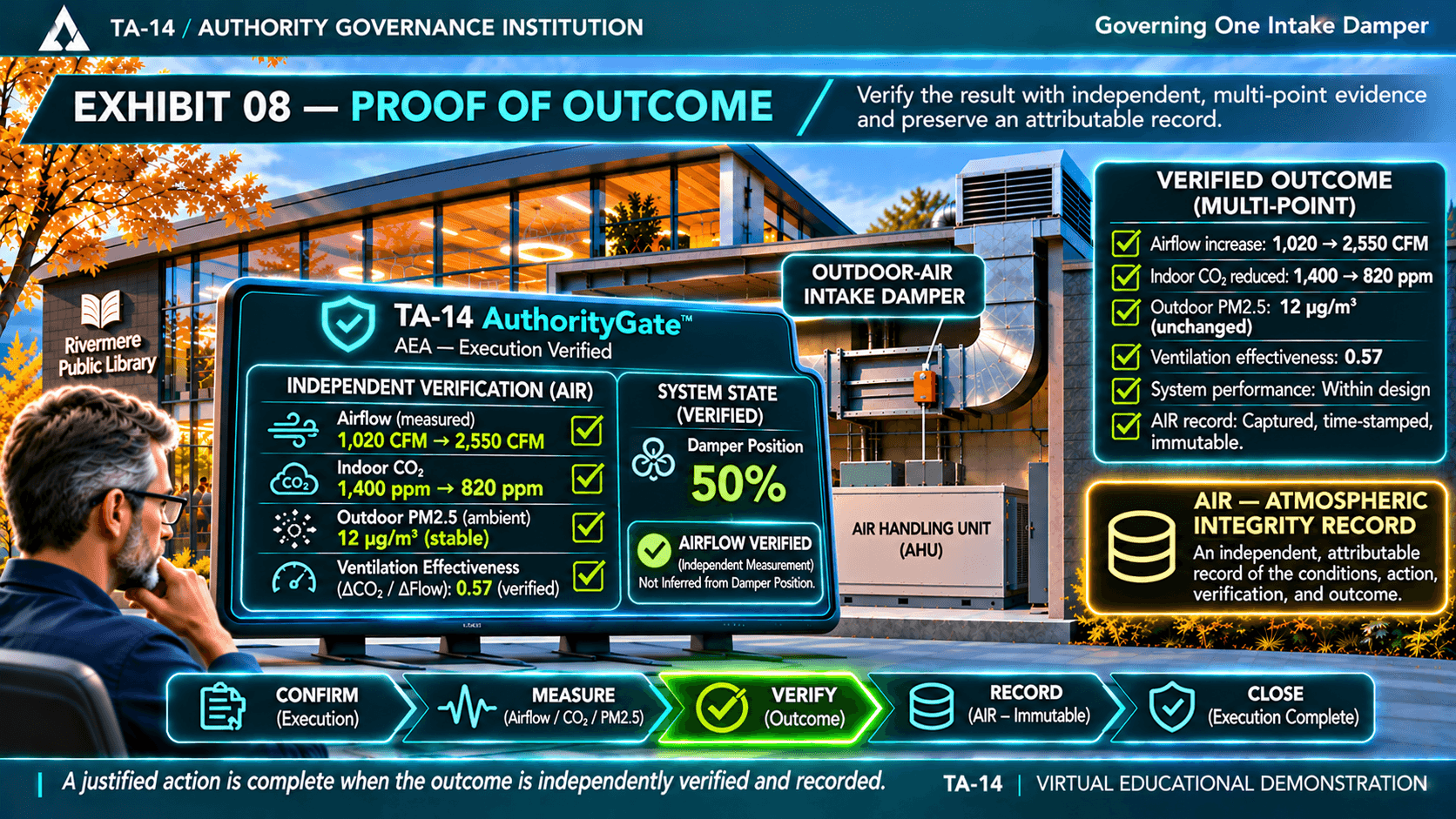
Distinguish a command from a verified environmental result.
Artwork note: displayed airflow and CO₂ values and the pictured ventilation-effectiveness calculation are illustrative, not validated measurements or an established engineering formula. Only a qualified, independently reviewed measurement protocol can support a real outcome claim.
Examination lesson: Authorization, movement, airflow, and environmental outcome are four distinct claims.
INTERACTIVE EXAMINATION · SYNTHETIC CONDITIONS ONLY
The hypothetical building intelligence proposes increasing one intake damper from 20% to 50% because of elevated indoor CO₂. Adjust the inputs to see how illustrative evidence, authority, standing, and outdoor conditions change the proposed decision. These rules are teaching fixtures, not building-control setpoints.
INTELLIGENCE PROPOSAL
Increase damper opening: 20% → 50%
INDEPENDENT EXECUTION DETERMINATION
ESCALATEOutdoor environmental conditions conflict with the scenario policy. No discretionary increase; obtain authorized review.
The CO₂ trigger of 1,000 ppm and PM2.5 comparison of 35 µg/m³ are arbitrary educational fixture values, not ventilation requirements, health standards or operational limits. A real control sequence must preserve mandatory ventilation, engineered fail-safe behavior and independent life-safety functions.
The nine expected outcomes below are proposed tests from the companion PDF. They are not reported software test results. Independent examiners must use frozen fixtures, explicit policy precedence, event timestamps, authorization scope, actuator isolation and replay prevention.
Examination Edition 1.0 includes the eight exhibit descriptions, the full proposed governance chain, acceptance-test matrix and minimum independent review record. It is for technical discussion with Michael Bordenaro and Lloyd Helferty and does not imply their endorsement.
Download 12-page examination PDF →TA-14 ACADEMY · INDEPENDENT REVIEW CHALLENGE
Apply the governance principles to three hypothetical cases relevant to the proposed operational consequence. Choose a determination, then examine the reasoning. These cases teach the distinction between Admissible Evidence, Applicable Authority, and Established Standing; they do not issue real-world authorization.
CASE 01
A proposed consequence is supported by an observation, but the source attribution or record continuity is missing. What should happen before execution? Consider this in the context of the proposed operational consequence.
CASE 02
The record is current and reliable, but the proposed consequence falls outside the scope of applicable authority. What is the supported determination?
CASE 03
The proposed consequence triggers a documented requirement for review by another designated authority. What is the appropriate route?
Independent educational examples only. The questions are hypothetical and do not assess a real institution, building, person, or operating system. Actual governance determinations require case-specific evidence, applicable authority, established standing, and bounded review.