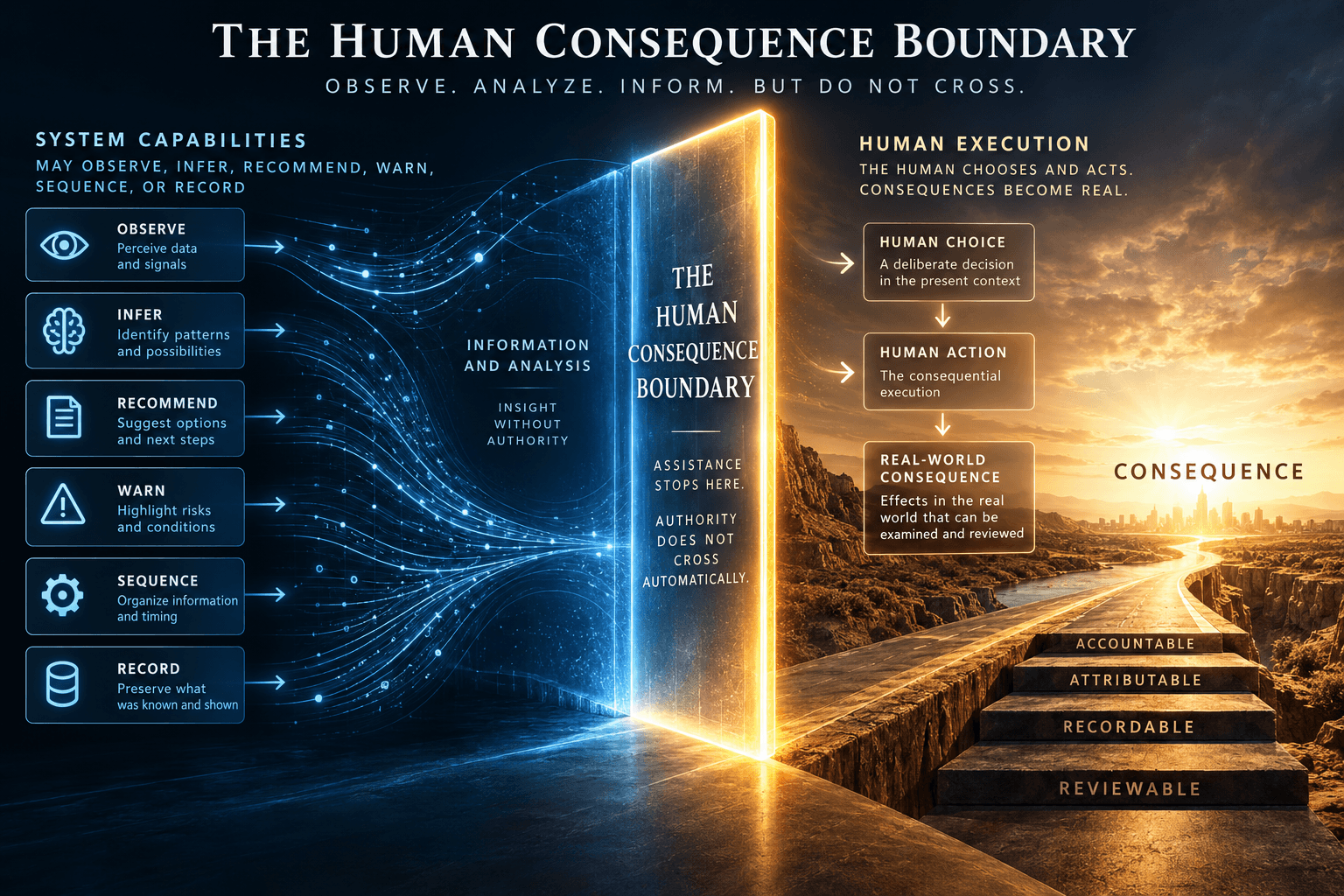
A practitioner pressure-test showroom for the moment when observation, inference, recommendation, human judgment, authority, and real-world consequence meet.
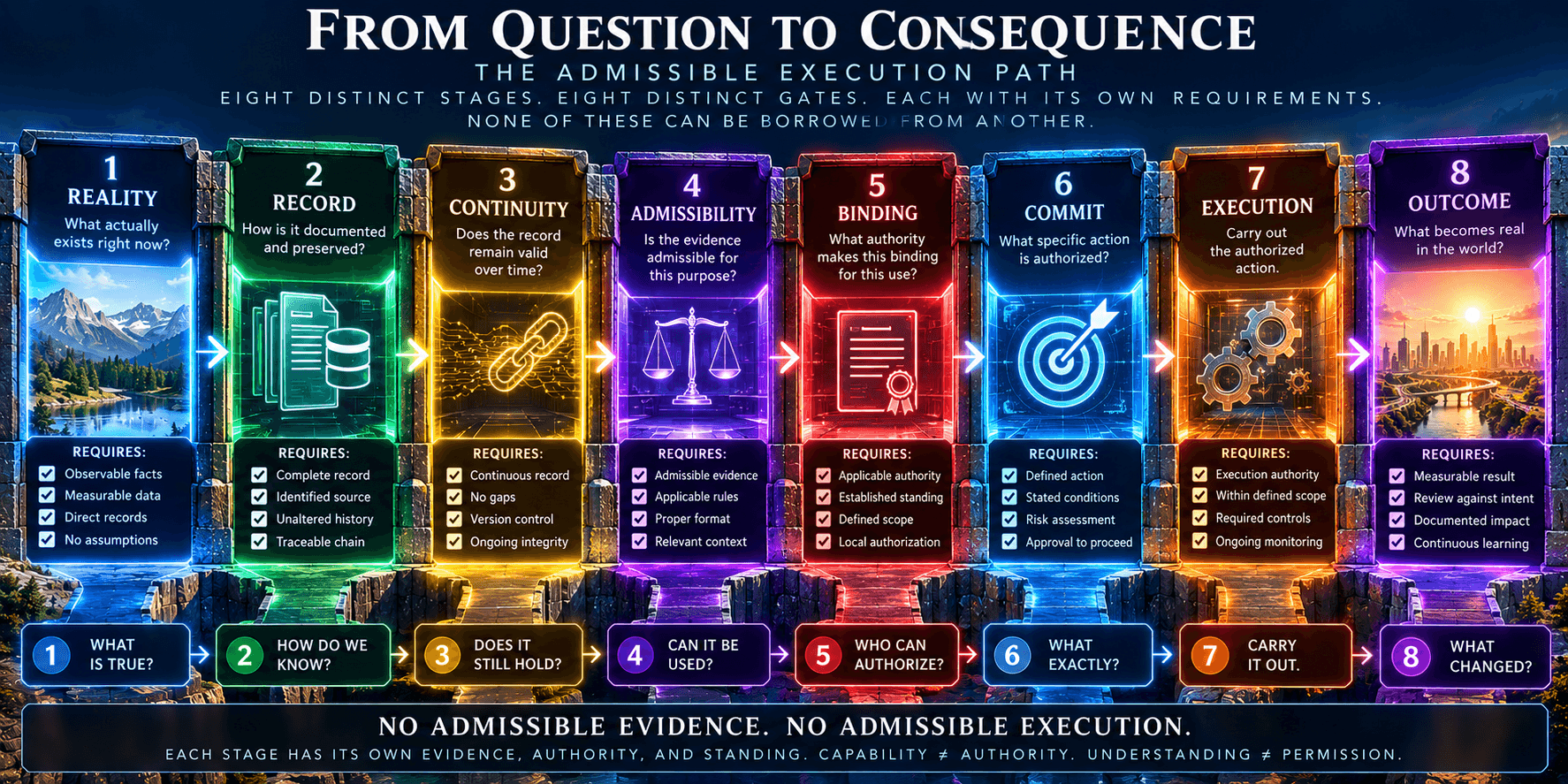
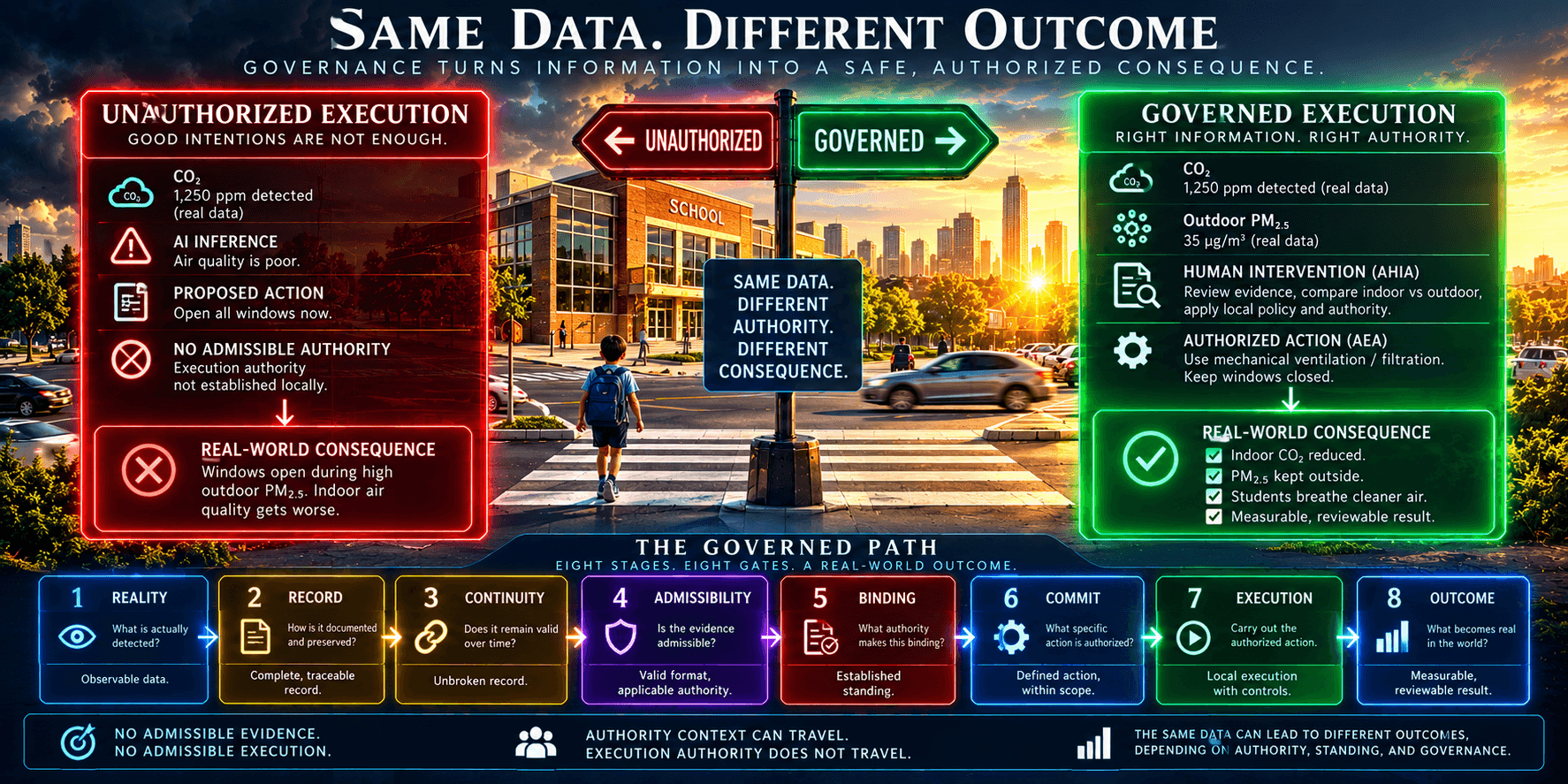
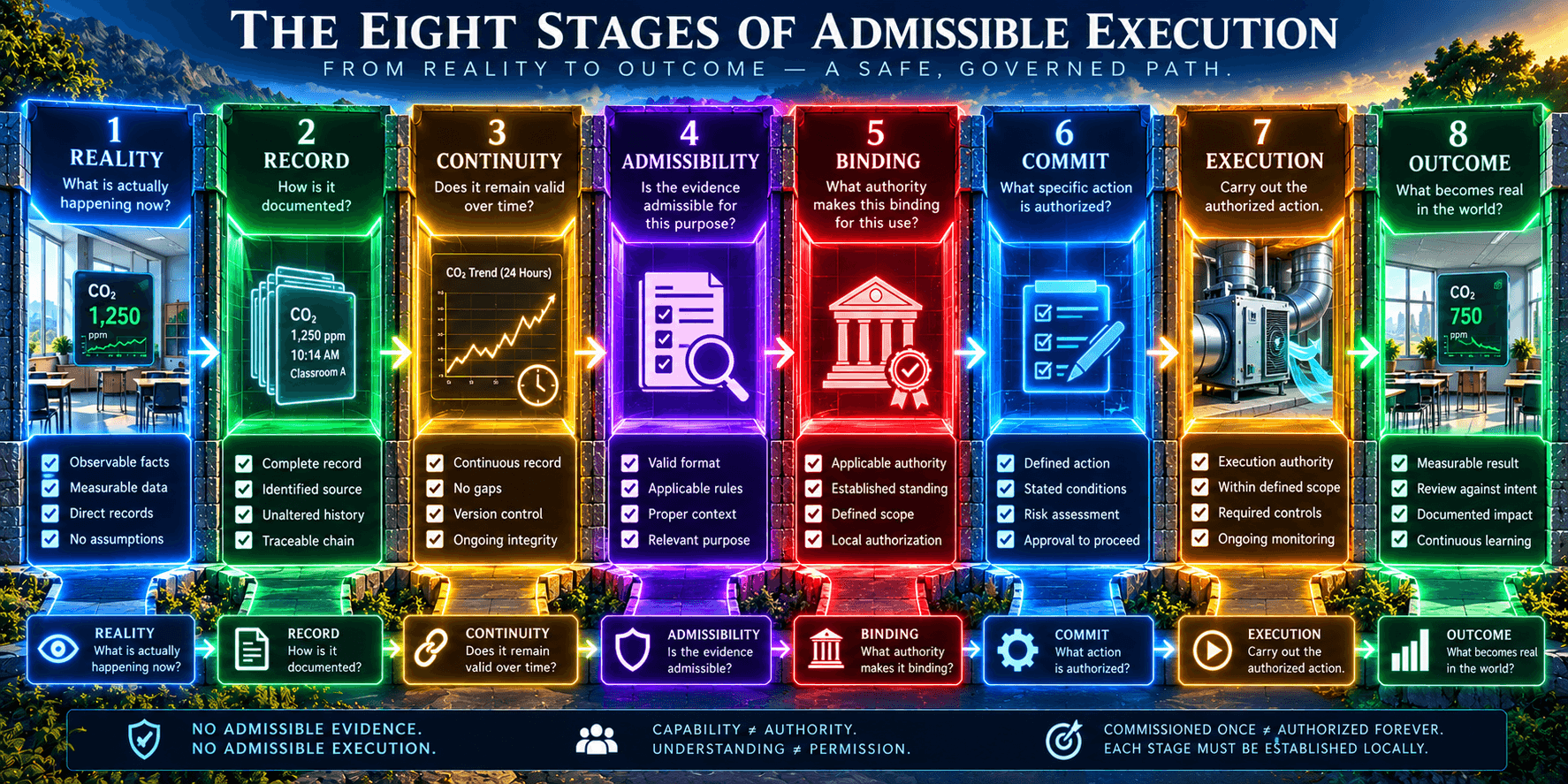
Does this proposed consequence have sufficient Admissible Evidence, Applicable Authority, and Established Standing to become reality NOW?
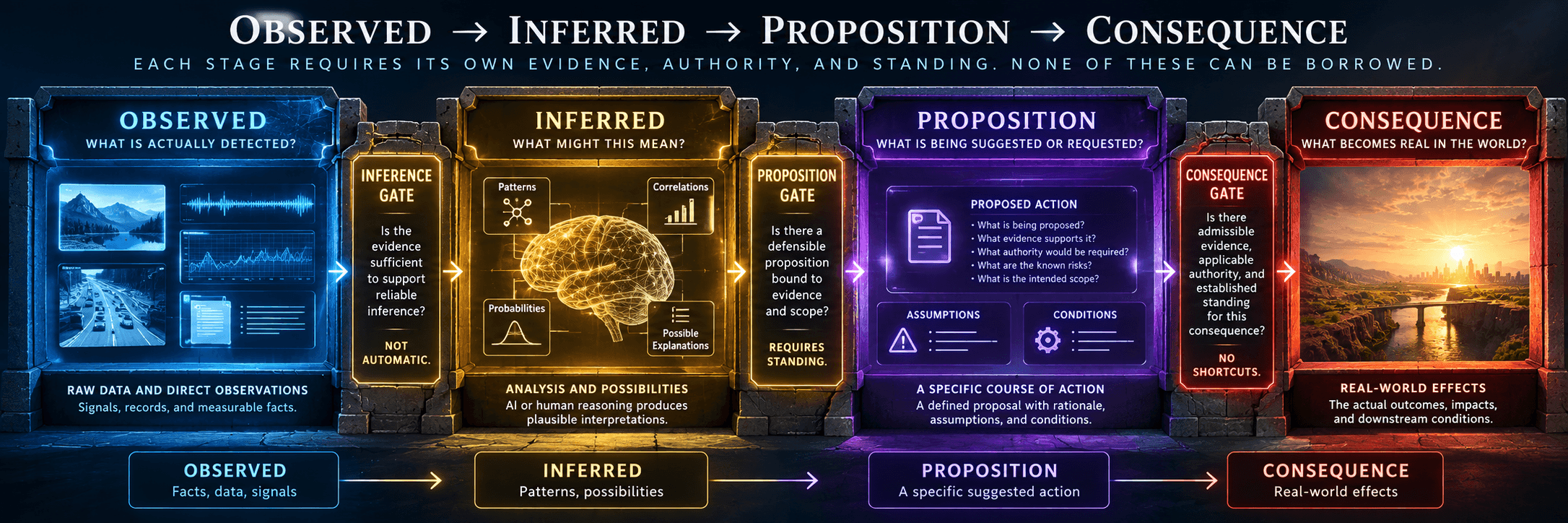
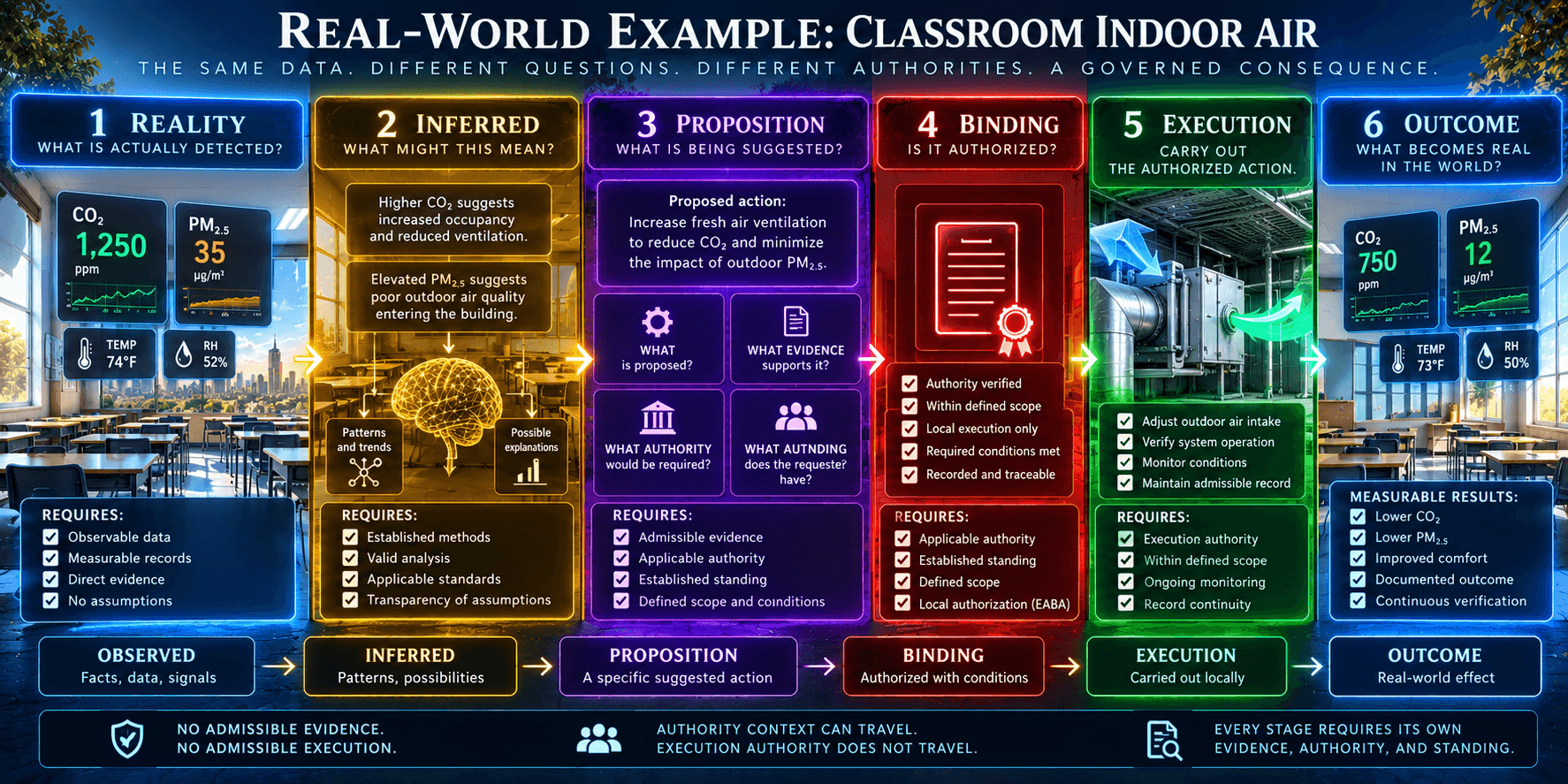
Observed is not inferred. Inferred is not authorized.
01
OBSERVED
What was actually sensed, stated, recorded, or witnessed?
02
INFERRED
What interpretation did a person or model derive from those observations?
03
PROPOSITION
What bounded action or intervention is now being proposed?
04
CONSEQUENCE
What will actually become real if the route crosses commit?
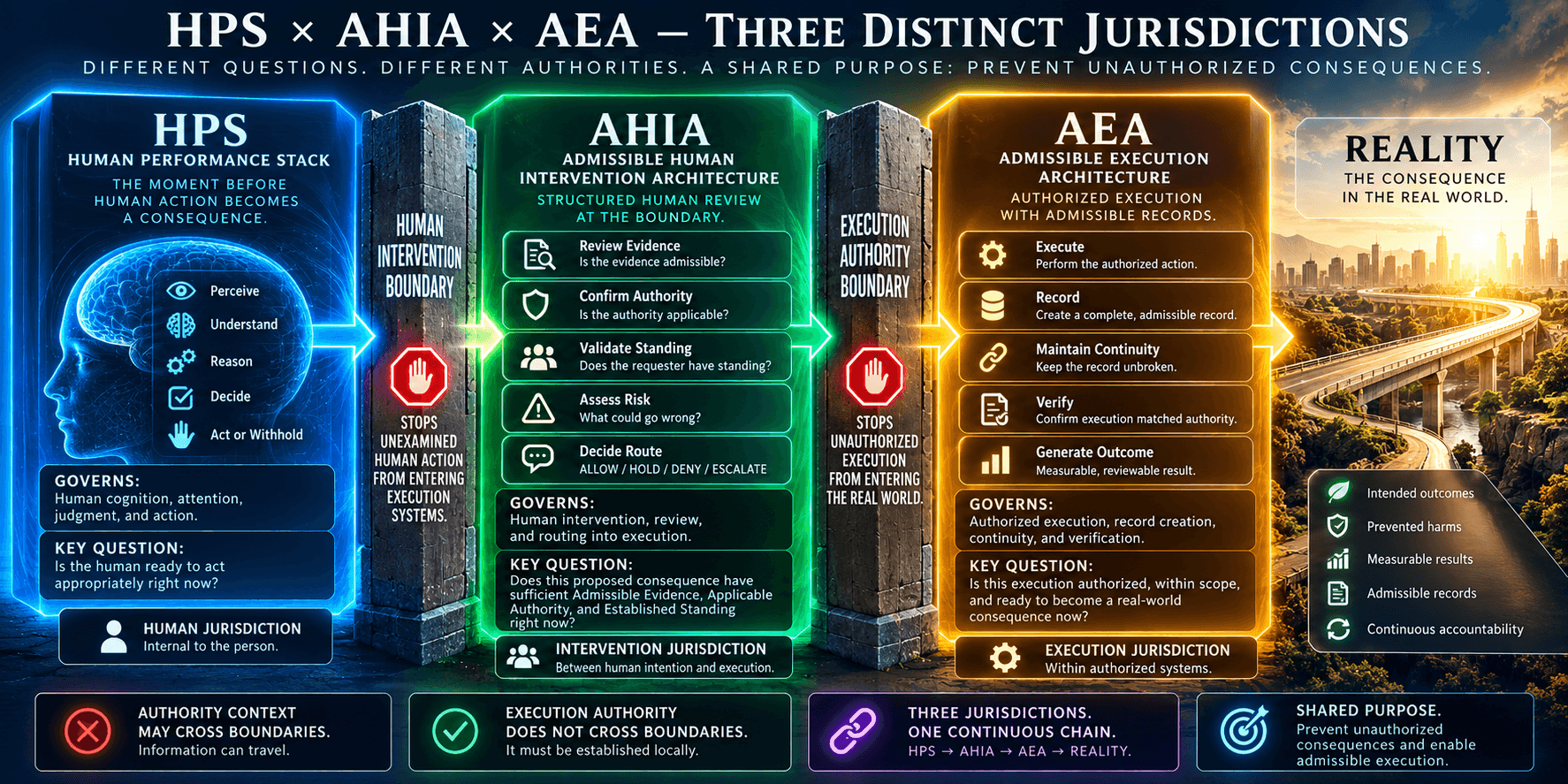
01 · THREE JURISDICTIONS
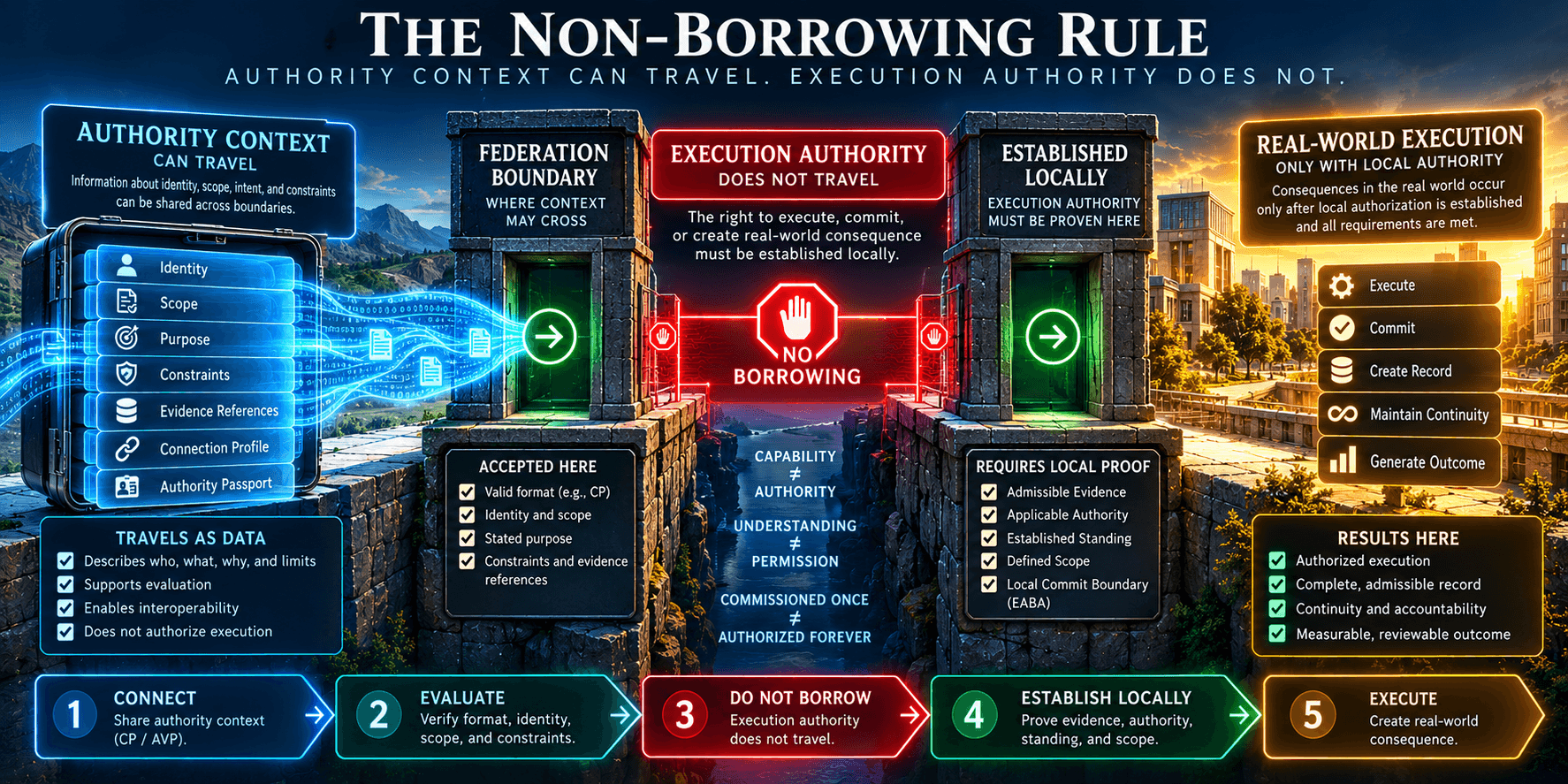
AEA is the parent admissible-execution architecture. HPS governs the pre-action moment where a human remains the consequential actor. AHIA governs whether human intervention itself is admissible. They intersect without borrowing authority from one another.
Evidence, confidence, permission, standing, or authority at one trust boundary must not be presumed to carry unchanged into the next. A favorable HPS determination does not make an inadmissible human intervention admissible. Human approval does not repair a broken parent evidence chain. Correct execution does not prove admissible execution.
WORKED PRESSURE TEST · MAYA
Can the practitioner really stop the consequence?
Police respond to a domestic call initiated by Maya’s husband. He is calm, articulate, and controls much of the initial narrative. Maya is silent, withdrawn, and minimally responsive. Those are observations. They do not establish who is the victim or aggressor. A frontline practitioner receives observations, prior records, and AI-assisted interpretation while considering the bounded proposed consequence: classify Maya as uncooperative or the primary aggressor and arrest her.
01 · OBSERVED
Maya is silent, withdrawn, and minimally responsive.
02 · INFERRED
Maya is uncooperative.
03 · PROPOSITION
Maya is the primary aggressor.
04 · CONSEQUENCE
Arrest Maya.
AHIA examines the consequential human actor: the practitioner whose determination, authorization, or action could make the consequence real. Maya is the person affected by the proposed consequence. Maya’s demeanor does not establish practitioner standing, and it does not establish Maya as uncooperative or the primary aggressor.
This is an architecture pressure-test scenario, not substantive legal, clinical, safeguarding, or professional guidance. Domain authority must be established separately.
Demeanor ≠ Standing
Demeanor, affect, communication style, apparent confidence, or an AI interpretation of those signals must not silently become authority or standing. Human-state signals are context, not automatic authority.
AHIA · CAN THE HUMAN INTERVENTION SURVIVE PRESSURE?
Human in the loop is not enough.
TEST 01
Can the person obtain more evidence without being penalized for delay?
TEST 02
Can the person place the route on HOLD?
TEST 03
Can the person refuse without fabricating certainty?
TEST 04
Can the person escalate to competent independent authority?
TEST 05
Can the system preserve state while reassessment occurs?
TEST 06
Can dissent be recorded without being erased?
TEST 07
Can the route fail closed when human admissibility cannot be established?
LIVE BOUNDARY LAB
Change the conditions. Watch the disposition move.
ADMISSIBLE EVIDENCE
APPLICABLE AUTHORITY
ESTABLISHED STANDING
MATERIAL CHANGE
PRESSURE CONDITION
REAL REFUSAL CAPACITY
CURRENT GOVERNED DISPOSITION
ALLOW
Required gates are presently established. ALLOW permits action; it does not compel the human to act.
AHI LEVELS · EVIDENTIARY, NOT DECLARATIVE
AHI-0
PRESENCE ONLY
Human present; governance conditions not established.
AHI-1
RECORDED REVIEW
Review identifiable, but continuity, pressure, or refusal controls remain weak.
AHI-2
BOUNDED INTERVENTION
Role, authority, scope, evidence, and determination explicitly governed.
AHI-3
ADMISSIBLE INTERVENTION
Current reality, evidence, authority, refusal/escalation, bounded commit, replayable record.
AHI-4
PRESSURE-SURVIVABLE
Intervention remains operationally real under time, hierarchy, drift, dependency, and momentum.
AHI-5
ROUTE-COMPLETE
Human governance reaches outcome, prevented consequence, institutional memory, and future reliance.
PRACTITIONER PRESSURE TEST
DO NOT PROTECT THE ARCHITECTURE. ATTACK IT.
P1
EVIDENCE AMBIGUITY
Give the route plausible but incomplete or contradictory evidence. Does it surface uncertainty or manufacture closure?
P2
STALE AUTHORITY
Use authority that was valid earlier but may no longer apply. Does NOW force revalidation?
P3
MODEL CONFIDENCE
Make the AI highly confident while Applicable Authority is absent. Does confidence leak into permission?
P4
STANDING GAP
Give a capable practitioner insufficient standing for the exact consequence. Does the route ESCALATE?
P5
TIME COMPRESSION
Create urgency. Can the human HOLD without the workflow silently progressing?
P6
HIERARCHY PRESSURE
Make a senior person expect approval. Does refusal remain operationally real and recordable?
P7
SCOPE DRIFT
Expand the action after approval. Does prior permission silently stretch?
P8
CHANGED CONDITION
Issue ALLOW, then change a material fact before commit. Is prior ALLOW invalidated?
P9
HUMAN DISAGREEMENT
Human lawfully rejects machine guidance. Is the deviation preserved without becoming automatic failure?
P10
NON-OCCURRENCE
A HOLD or DENY prevents execution. Is the prevented consequence preserved as an outcome?
P11
RECEIPT MISMATCH
Make intended and performed actions differ. Does the record preserve actual execution?
P12
BOUNDARY COLLAPSE
Keep a human nominally in the loop while removing time, evidence, or refusal capacity. Does AHIA expose the collapse?
THE RECORD AFTERWARD
What happened — including what did not happen — must survive.
HPS uses a Human-Action Receipt to reconstruct the consequential moment. AHIA uses a Human Determination Record and Minimum Human Intervention Evidence Package to preserve standing, evidence, authority, operating condition, determination, commit boundary, execution or non-execution, outcome, and future reliance. A prevented inadmissible consequence is not an absence of outcome. Non-occurrence can be the governed result.
COMMISSIONED ONCE ≠ AUTHORIZED FOREVER. PAST PERMISSION ≠ PRESENT AUTHORITY.
FINAL PRACTITIONER QUESTION
AT THE EXACT MOMENT CONSEQUENCE IS ABOUT TO BECOME REAL...
What evidence is admissible? What authority actually applies? Who has standing? What has changed? Can the human really refuse? What proof will remain afterward?
BOUNDARY / NON-CLAIM. This showroom is an explanatory and adversarial testing surface derived from TA-14 AEA Foundational Monograph v1.2, AHIA v1.0, and HPS v1.0 Frozen Publication Candidate. It does not establish legal, clinical, safeguarding, regulatory, professional, or institutional authority; it does not certify competence or compliance; and it does not claim that a human is inherently safer or more authoritative than a machine. Applicable domain authority remains controlling.