TA14 AUTHORITY GOVERNANCE INSTITUTION · INDEPENDENT TECHNICAL PRE-EXAMINATION
Intelligent Infrastructure:
From Edge Attestation to Authorized Physical Consequence
An eight-image technical examination of federated authority context, local execution boundaries, autonomous mobility, and the distinction between permission and physical consequence.
INDEPENDENT EDUCATIONAL DEMONSTRATION · BASELINE NOT FROZEN · NO FORMAL DISPOSITION. All scenarios, records, identities and timestamps are hypothetical. No affiliation, participation, technical integration, approval or endorsement by Jeffrey DeCoux, Autonomy Institute, or other entities is claimed.
↓ DOWNLOAD TECHNICAL GOVERNANCE REFERENCE v2.0 (PDF)THE GOVERNING QUESTION
Does this proposed consequence have sufficient Admissible Evidence, Applicable Authority, and Established Standing to become reality NOW?
Edge attestation may establish a defined claim about a system. Corridor permission establishes a separate bounded claim. AFA carries context across entities. EABA examines the proposed action at its local execution boundary. Independent vehicle safety controls remain responsible for physical behavior.
IMAGE 01 / 08
The Intelligent District
Shared infrastructure creates overlapping jurisdictions, not a single universal authorization.

Follow the numbered teaching sections on the image. The page does not auto-scroll.
Section one: the intelligent district. People, autonomous ground systems, infrastructure operators, and air mobility share physical space. Their technical capabilities and permissions are not identical. We must ask who governs each particular movement and at what location and time.
IMAGE 02 / 08
Edge Attestation
An attested property is evidence within a defined scheme, not blanket permission to act.
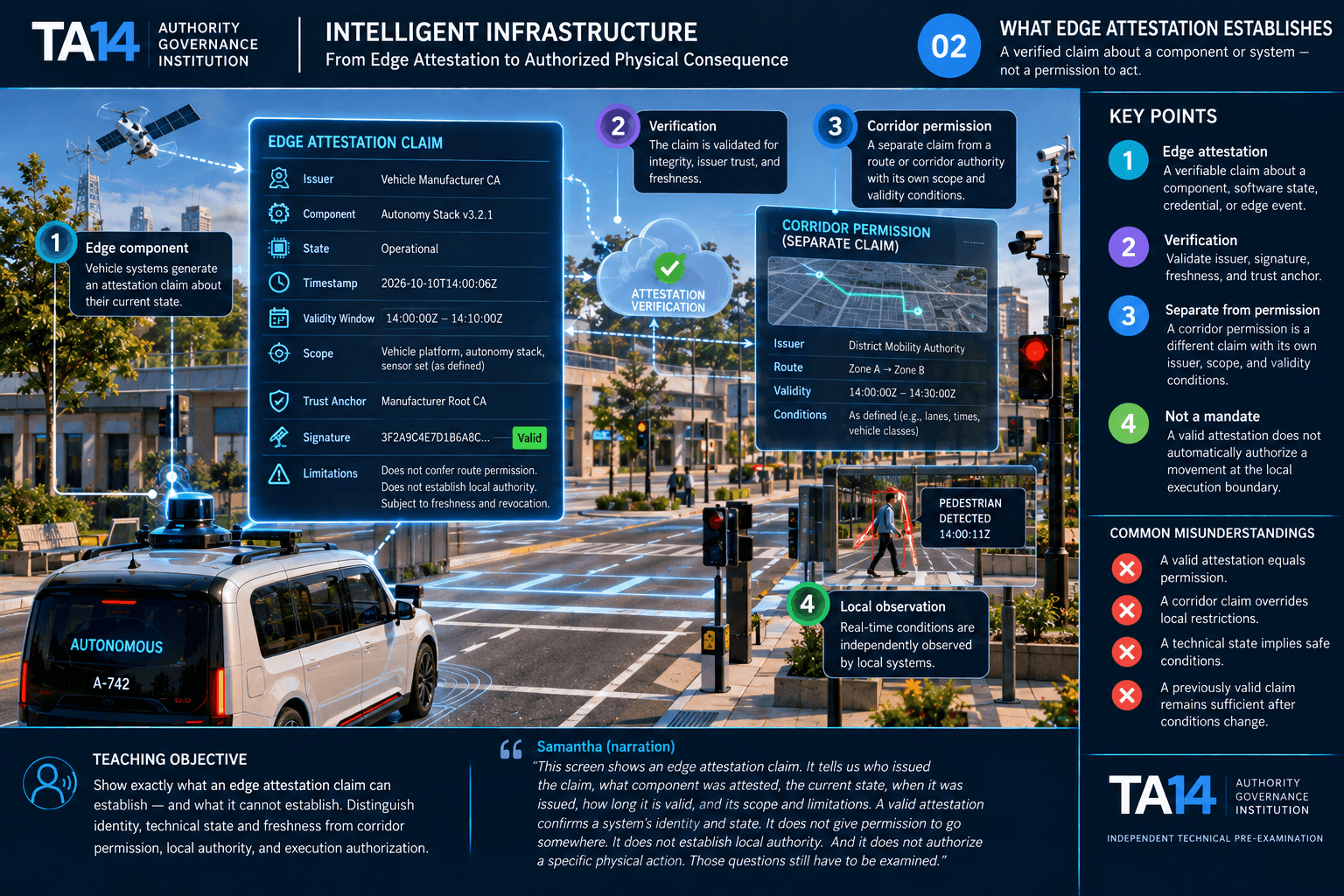
Follow the numbered teaching sections on the image. The page does not auto-scroll.
Section two: edge attestation. A signed attestation may provide verifiable claims concerning component identity, software state, issuer, timestamp, scope and trust anchor. Its precise meaning depends on the actual attestation scheme. A valid claim does not itself confer corridor permission, local authority, or authorization to execute.
IMAGE 03 / 08
Federated Authority Context
Authority context can cross entities; permission for execution must be established locally.
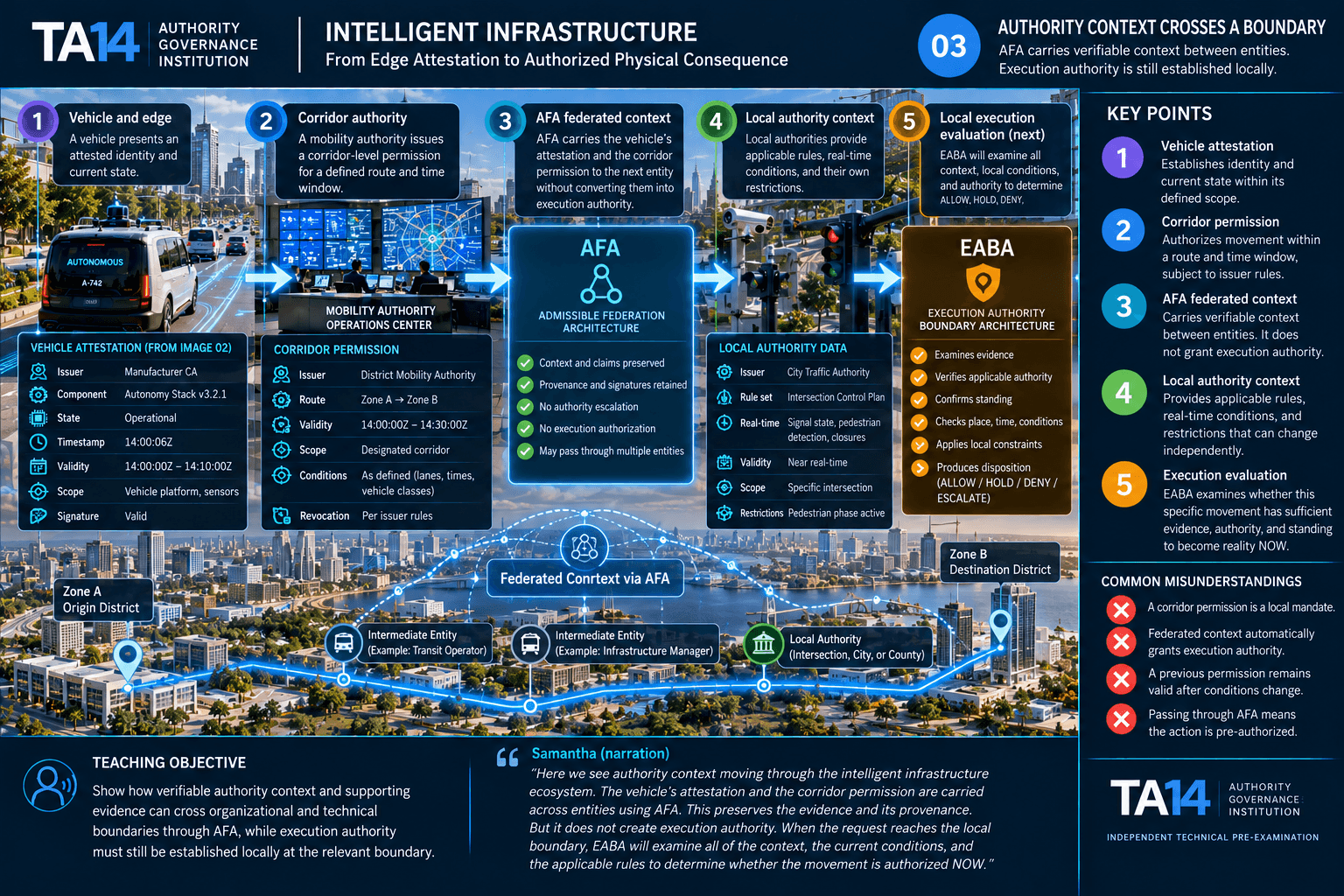
Follow the numbered teaching sections on the image. The page does not auto-scroll.
Section three: federated context. AFA permits evidence and authority context to travel across multiple entities while preserving provenance and limits. A corridor permission issued upstream does not automatically become a mandate for a local crossing. Execution authority must be established at the relevant local boundary.
IMAGE 04 / 08
Conditions Change Before Action
A pedestrian and a local restriction change the decision conditions after corridor permission.
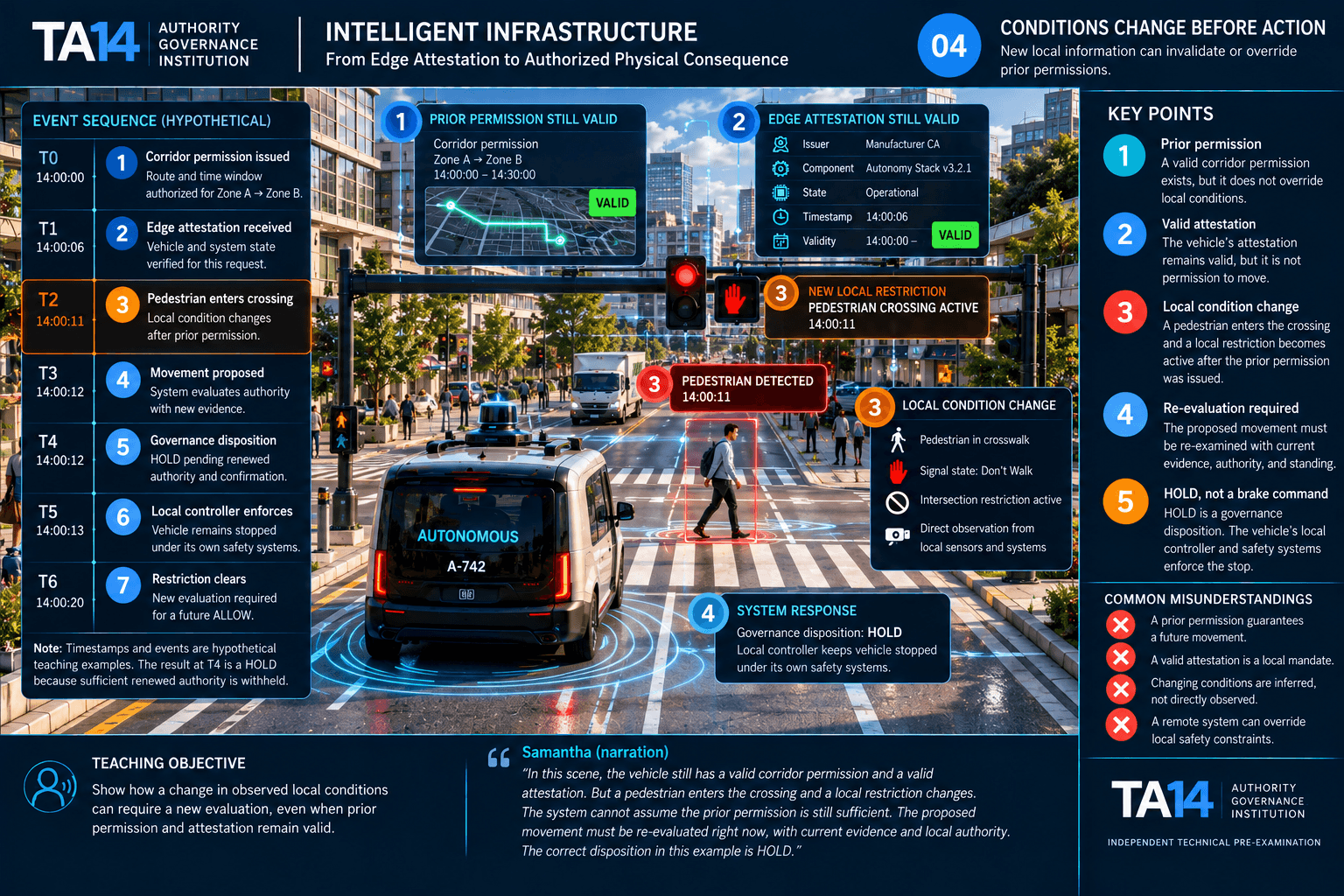
Follow the numbered teaching sections on the image. The page does not auto-scroll.
Section four: conditions change. At fourteen hundred hours the route was permitted. At fourteen hundred and eleven seconds a pedestrian enters and a local restriction becomes active. Even when the attestation and corridor claim remain valid, the proposed crossing needs to be re-evaluated against current observations and locally applicable authority.
IMAGE 05 / 08
The Local Execution Boundary
Evidence, authority, standing and current conditions must bind to the exact action.
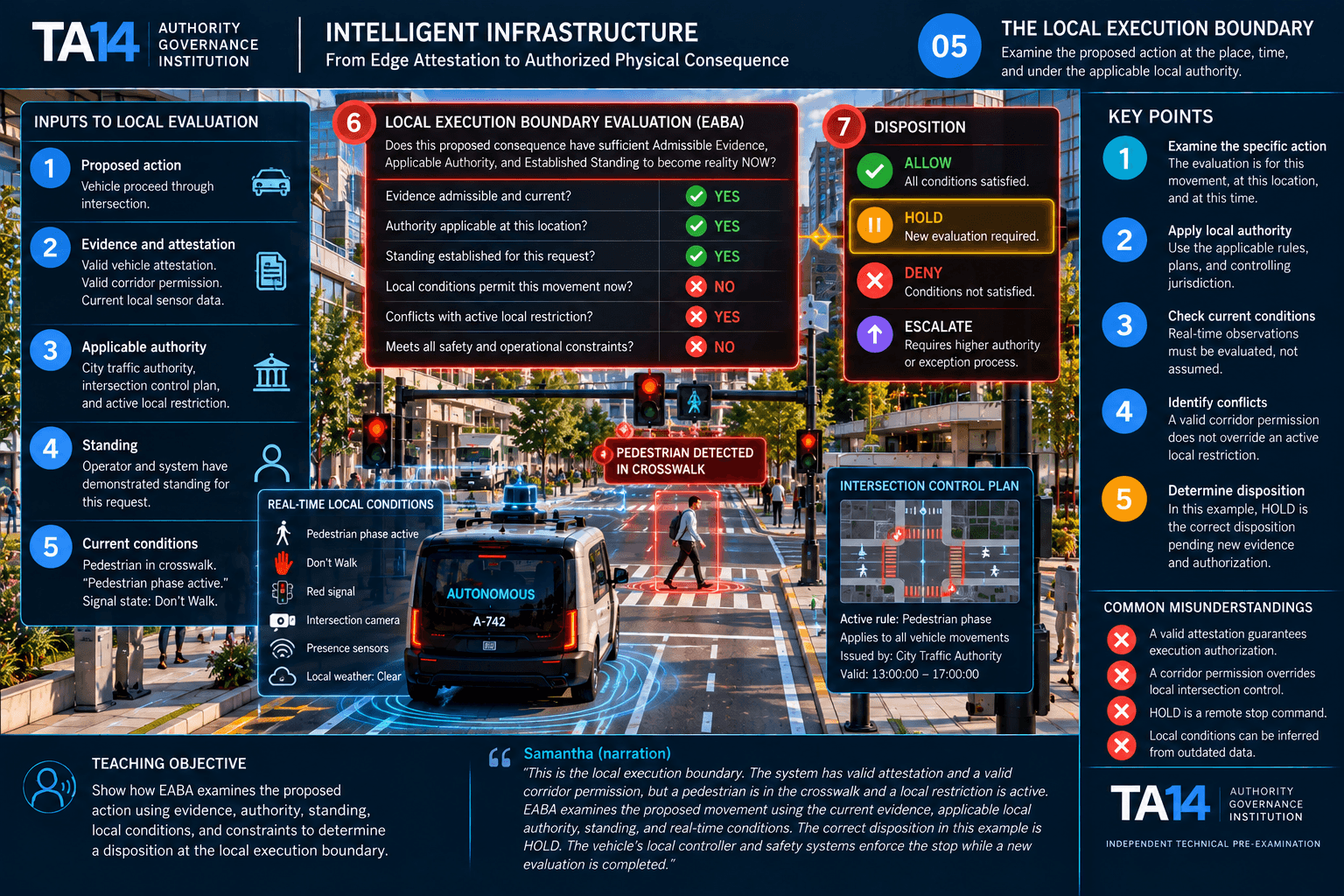
Follow the numbered teaching sections on the image. The page does not auto-scroll.
Section five: the local execution boundary. EABA asks whether this precise movement, at this crossing, at this moment, has sufficient admissible evidence, applicable authority, and established standing to become reality now. A current local restriction and unresolved conflict prevent assuming that earlier permission remains sufficient.
IMAGE 06 / 08
Decision and Disposition
HOLD is an auditable governance disposition, not a physical actuation command.
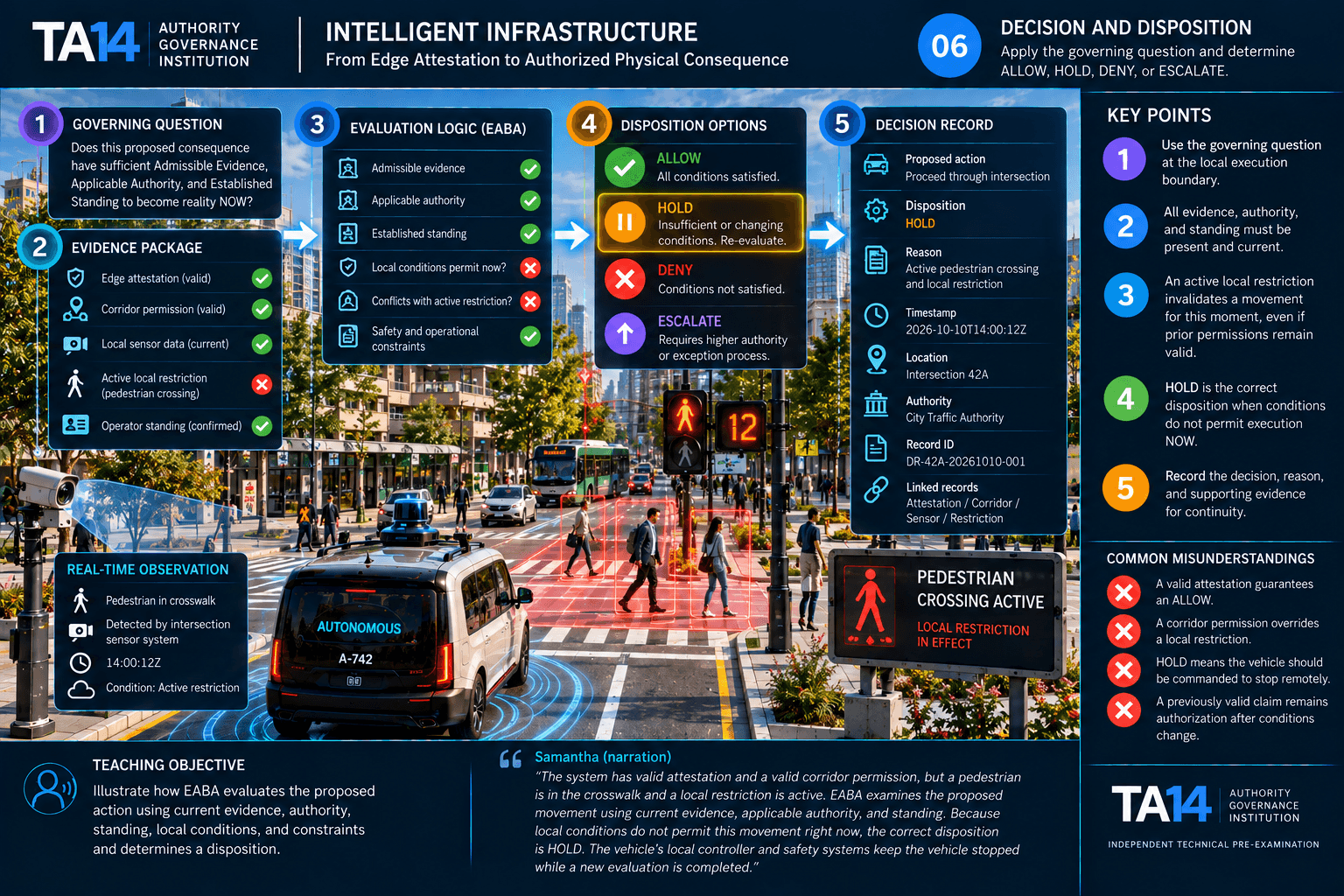
Follow the numbered teaching sections on the image. The page does not auto-scroll.
Section six: decision and disposition. The available options are ALLOW, HOLD, DENY, and ESCALATE. In this hypothetical, HOLD is recorded because renewed authority is insufficient while the crossing restriction is active. The decision record preserves the evidence, reason, issuer, timestamps, limitations and conditions for re-evaluation.
IMAGE 07 / 08
Local Safety Enforcement
Independent vehicle controls remain responsible for physical safety.
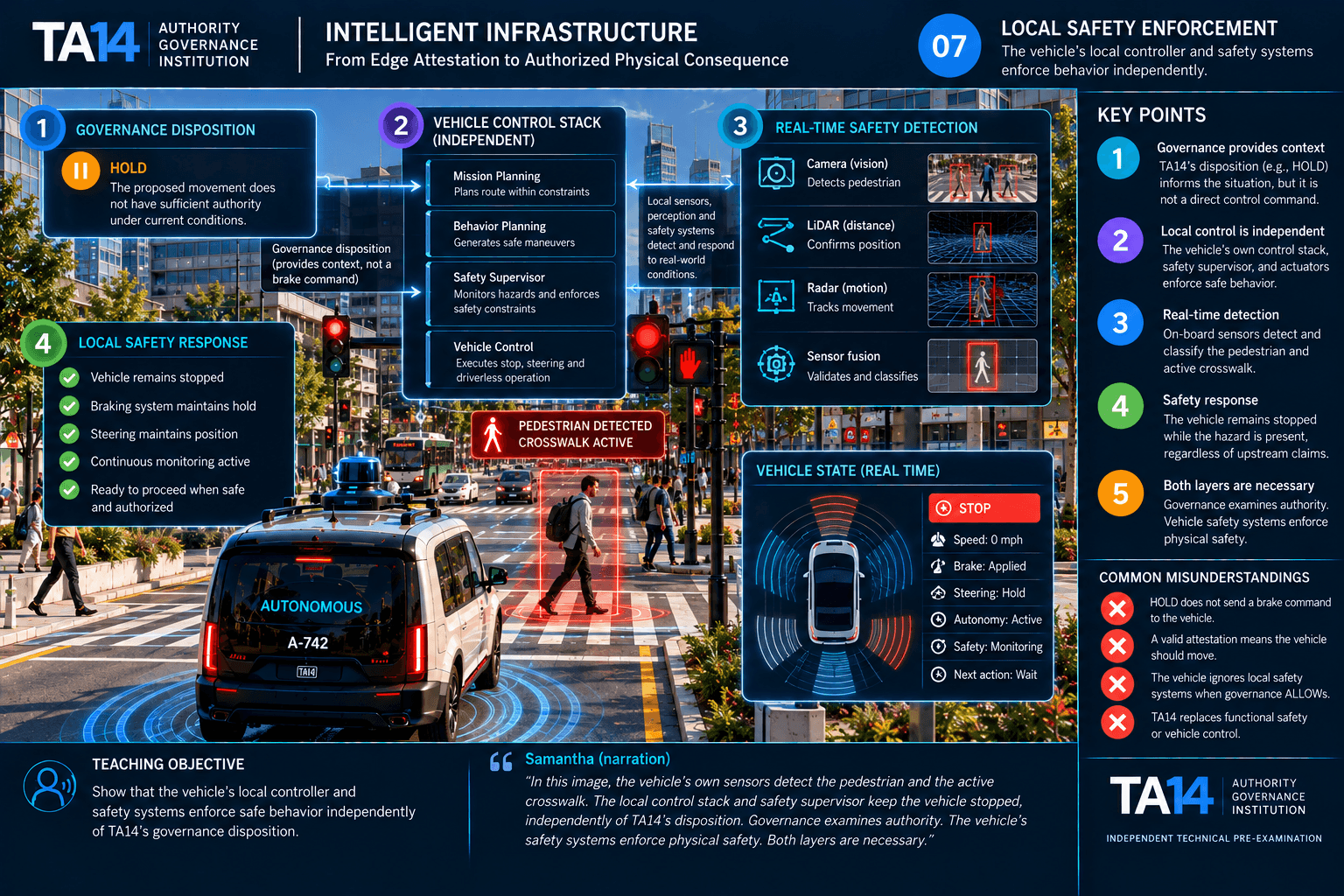
Follow the numbered teaching sections on the image. The page does not auto-scroll.
Section seven: physical safety remains local. TA14 describes a governance disposition, not a braking command. The vehicle controller and safety systems independently manage sensing, obstacle avoidance and safe motion. A governance ALLOW must never bypass a safety interlock; a HOLD does not replace the vehicle's independent duty to behave safely.
IMAGE 08 / 08
Observed Outcome and Continuity
Prove what happened from independently observed evidence, not merely from a log.
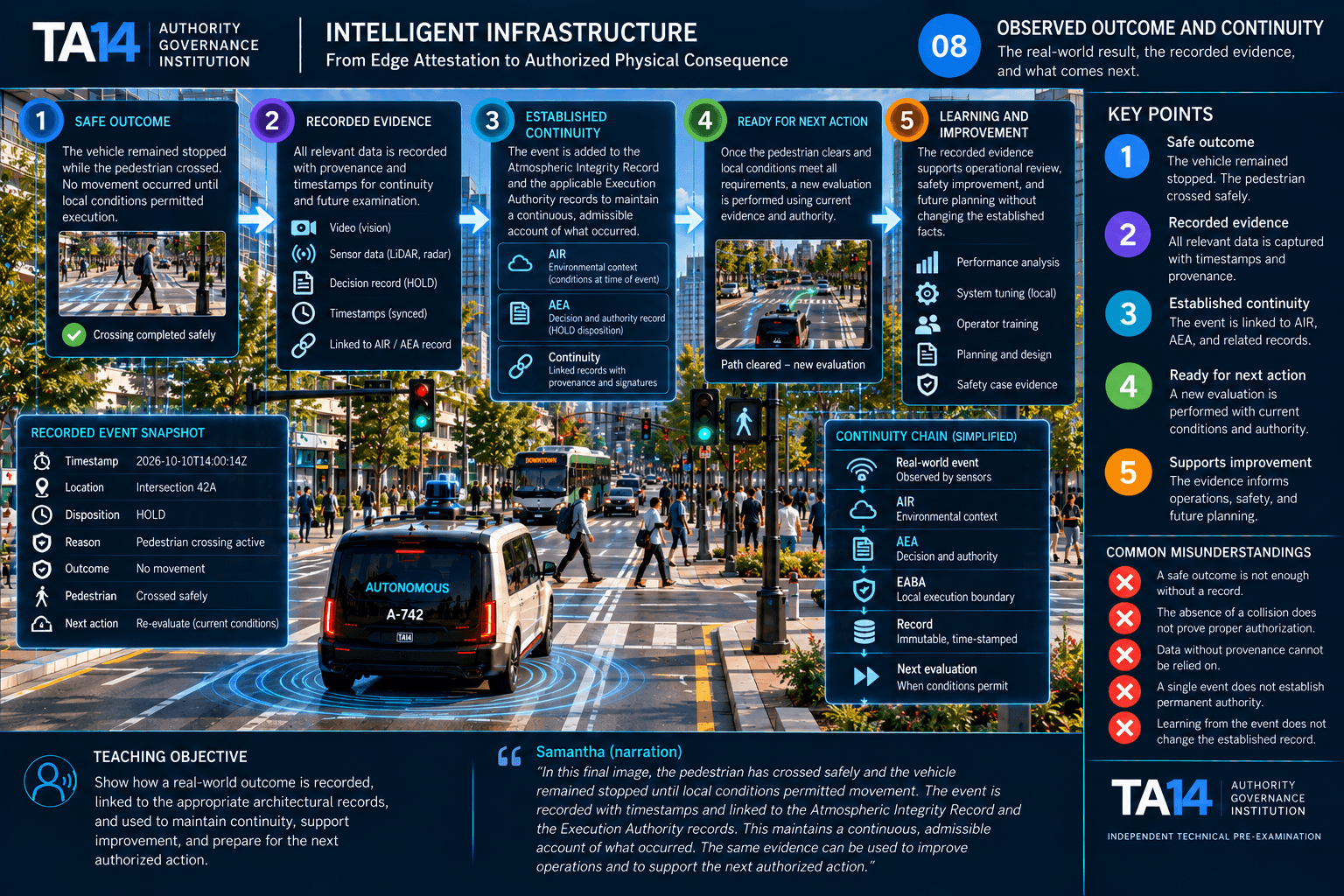
Follow the numbered teaching sections on the image. The page does not auto-scroll.
Section eight: observed outcome. Preserve the request, the decision, the controller acknowledgement, and independent observations of what physically occurred. A command or log is not proof of physical outcome. Preserve raw observations separately from interpretations. Future movement requires a fresh bounded evaluation, not an automatic restoration of permission.