Is the supporting record sufficient, attributable, continuous, relevant, and independently examinable for this particular consequence?
TA-14 AUTHORITY · EIGHT-LESSON INTERACTIVE SHOWROOM
Justified Autonomy.
An autonomous system can be capable of acting without having sufficient grounds to act. Discover the execution boundary between intelligent capability and legitimate consequence.
Does legitimate authority permit this precise action, within the specified scope, conditions and limitations?
Are the necessary conditions and relationships actually satisfied in the present reality—NOW?
STEP INTO THE ARCHITECTURE
Eight images. Eight lessons. One consequential question.
Choose any lesson, review its teaching image, then listen to Samantha explain the reasoning. Start Samantha's guided tour for continuous narration across all eight lessons, or choose any lesson and control playback yourself. Audio never starts without a click.
SAMANTHA · COMPLETE EIGHT-LESSON TOUR
Let Samantha guide you.
One click starts at lesson one. Samantha explains each teaching image and advances to the next lesson when narration finishes. Pause, resume, or stop whenever you want.
Samantha must be available on this device to begin the guided tour.
LESSON 01 / 08 · THE CENTRAL QUESTION
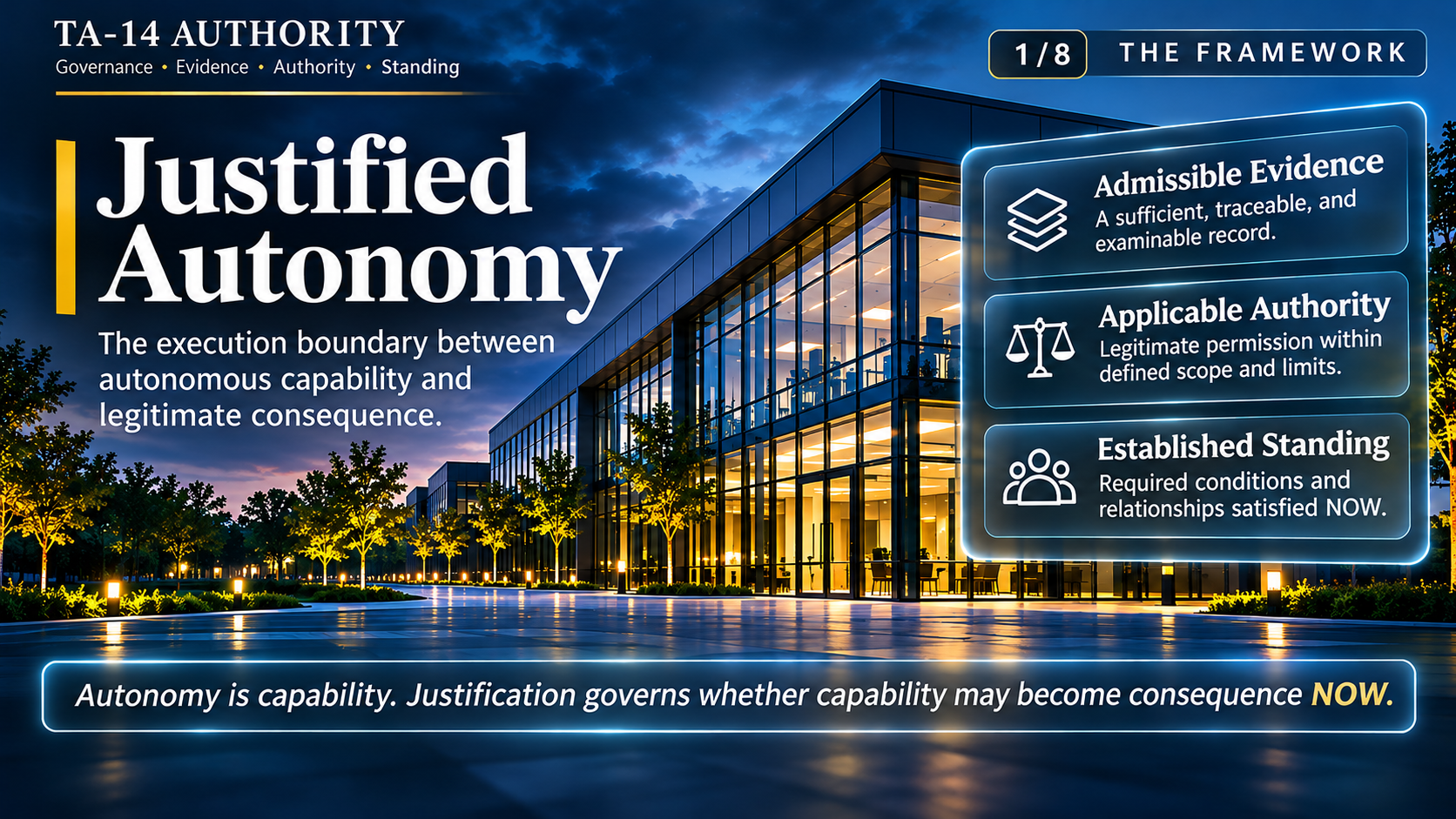
Justified Autonomy: The Framework
THE LESSON TO REMEMBER
Autonomy establishes capability. Justification governs whether a proposed consequence may become reality NOW.
WHY IT MATTERS
A system may know what to do and have the technical capacity to do it while lacking the grounds or authority to execute. Independent justification concerns the particular action, not an unrestricted approval of the system.
ASK YOURSELF
What must be established before a consequential autonomous action is committed?
SAMANTHA · GUIDED LESSON NARRATION
Checking voices installed on this device…
Voice safeguard: the guided tour and lesson player select a named English Samantha voice only. Browser operating systems supply the voice; if Samantha is missing, the site will not silently fall back to a male or unspecified voice. Install or enable Samantha in your device speech settings to use narration.
Read the complete narration transcript
Lesson one. Justified Autonomy. Today, a machine can observe, recommend and act. That is capability, not automatic permission. TA-14 Authority asks one governing question. Does this proposed consequence have sufficient Admissible Evidence, Applicable Authority, and Established Standing to become reality NOW? This examination is specific to the action. It must remain valid at binding and at the moment of execution commitment. Our example is educational, not proof of a deployed system. In the next lesson, notice why intelligence and legitimate authority are different things.
1 of 8
INTERACTIVE EXAMINATION · THE MOMENT REALITY CHANGES
A building can receive ALLOW—and still be stopped.
Run the same educational case shown in lesson five. The controller proposes increasing outside-air intake to address elevated indoor particulate readings. This is a simulation, not a live building connection.
Proposed consequence
Increase outside-air intake within the delegated operating envelope.
- Evidence: preserved baseline and calibrated readings
- Authority: controller delegation is active and in scope
- Standing: initial outdoor and equipment conditions support action
ALLOW · INITIAL
Conditions at initial examination
All three requirements support the specific proposal at the time of the initial examination. Nothing has been physically executed yet.
INITIAL EXAMINATION · NOT YET COMMITTED
A bounded ALLOW remains subject to revalidation before commitment.
This demonstration evaluates a declared hypothetical scenario only. It does not actuate equipment or demonstrate a production integration.
AUTHORITY JOURNEY · FOUR SCENARIOS
Can you make the correct governance determination?
Review the declared evidence, authority and standing. Choose the disposition that follows from each hypothetical case. All answers explain the reason—not just the result.
SCENARIO 1 OF 4
All three requirements are established
The baseline is preserved, delegated authority covers the specified ventilation adjustment, and current equipment and outdoor conditions support it. The proposed action is within scope at commit.
Your score: 0 / 0 answered correctly
PRIMARY TECHNICAL REFERENCE · VERSION 3.0
Justified Autonomy — Institutional Technical PublicationEleven-page architectural exploration by Greggory Don Butler. Covers the three requirements, eight-link chain, commitment revalidation, changed-reality scenario, and the limits of what a demonstration can establish.
OPEN TECHNICAL PUBLICATION (PDF) ↗