LISA GREENFIELD · CENTER FOR GREEN SCHOOLS · U.S. GREEN BUILDING COUNCIL

Healthy air.Brighter futures.

Lisa Greenfield’s career connects education, advocacy, indoor air quality, facilities practice, and the people who live with the consequences of the indoor environment every day.

EDUCATORINDOOR AIR QUALITYHEALTHY SCHOOLSCHANGE CATALYSTPUBLIC PROFILE

THE THROUGH-LINE

Start with people. Make the invisible environment visible. Then prove what changed.

Nearly two decades in public schools and federally funded early-childhood programs gave Lisa a human starting point for indoor air quality: students, teachers, staff, families, and the learning environment itself. Her work has since expanded across education, filtration, indoor air quality, advisory work, and the Center for Green Schools.

THE CAREER · FOUR CONNECTED CHAPTERS

From the classroom to the national conversation about healthy schools.

The thread connecting Lisa’s work is education: first through direct experience with children and school communities, then through helping adults understand the environmental conditions that shape learning. These chapters are thematic, not a claim of exact employment chronology.

01

THE EDUCATOR

Lisa’s foundation is in PK–12 education, including special education, early intervention, Head Start and Early Head Start. That experience shaped a practical understanding of the children, educators and families affected by school conditions.
02

THE AIR QUALITY SPECIALIST

Her work expanded from education into filtration and indoor environmental quality. She earned the Certified Air Filtration Specialist credential through the National Air Filtration Association and has worked to translate technical knowledge for nontechnical audiences.

03

THE CONNECTOR

Through speaking, training, advisory work and industry engagement, Lisa helps connect the people who understand air systems with the people responsible for schools and those who occupy them.

04

THE SCHOOL ADVOCATE

As Midwest Regional Program Manager at the Center for Green Schools, she supports school districts developing practical, energy-efficient indoor air quality plans and building the relationships needed to put them into practice.

🎧 SAMANTHA · LISA’S CAREER · FROM EDUCATOR TO HEALTHY-SCHOOLS ADVOCATEListen while you study this section · free-scroll remains enabled
EDUCATION & PROFESSIONAL EXPERIENCE

Drake University graduate · Certified Air Filtration Specialist (CAFS) · Nearly two decades of PK–12 public-school and federally funded early-childhood experience · Speaker and educator on school indoor air quality · Midwest Regional Program Manager, Center for Green Schools.

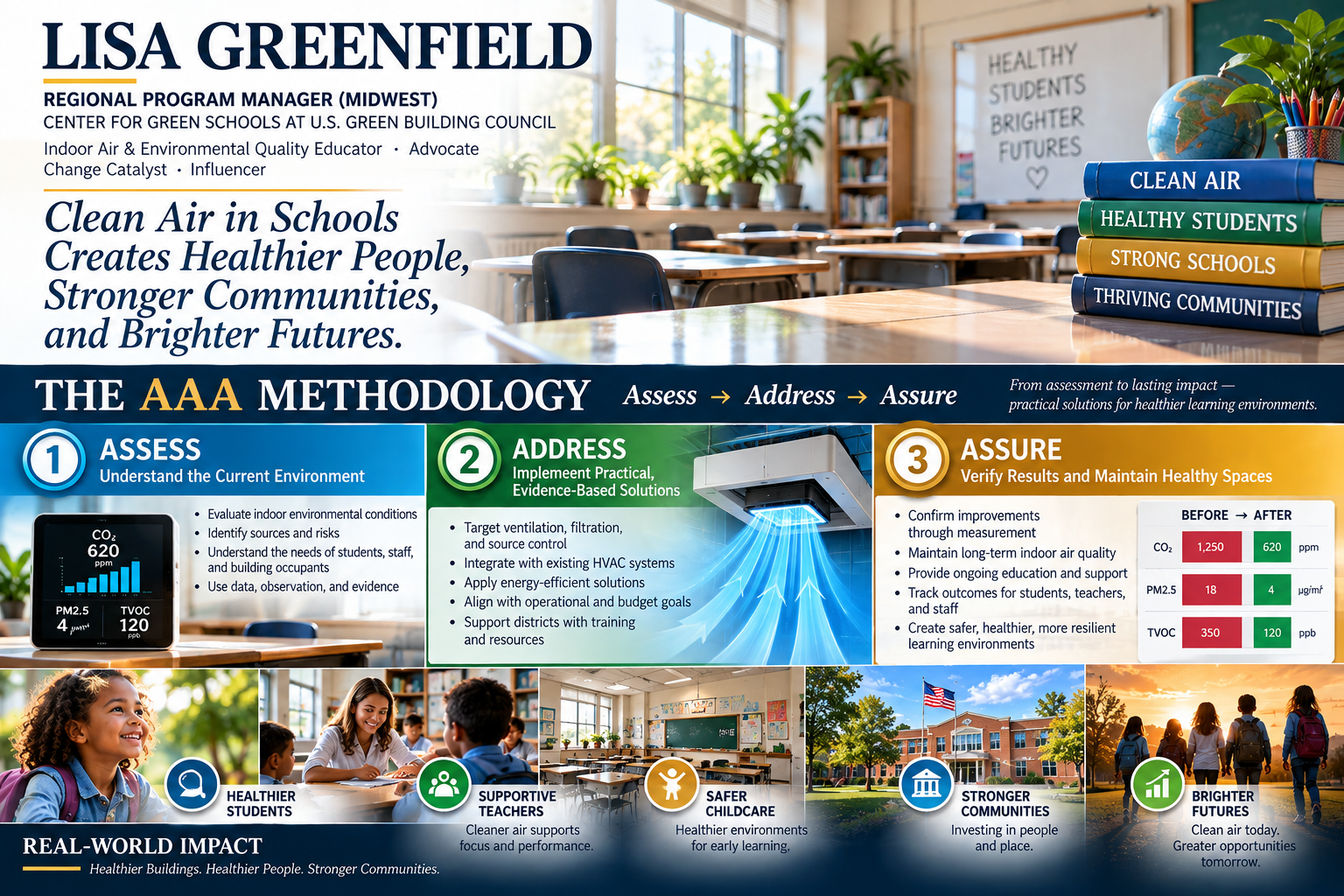
LISA GREENFIELD’S AAA METHODOLOGY

Assess. Address. Assure.

The framework is intentionally practical: understand the current environment, implement evidence-based solutions, and verify results so healthier conditions are not merely assumed.

01

ASSESS

Understand the current environment. Define the occupied spaces, questions, measurement method, equipment condition, timing, uncertainty, and the needs of students, staff, and building occupants.

02

ADDRESS

Turn evidence into practical action. Ventilation, filtration, source control, maintenance, moisture management, operational changes, training, and resources each need an owner, scope, and reason.

03

ASSURE

Verify what changed. Preserve the before condition, intervention, after condition, method, dates, limitations, and whether the intended result was actually achieved and sustained.

Clean Air in Schools — Lisa Greenfield AAA methodology teaching visual

Teaching visual · Lisa’s AAA framework shown as a practical school indoor-air journey.

🎧 SAMANTHA · IMAGE 01 · ASSESS → ADDRESS → ASSUREListen while you study this section · free-scroll remains enabled

THE HUMAN MISSION

Healthy schools are not an equipment problem alone.

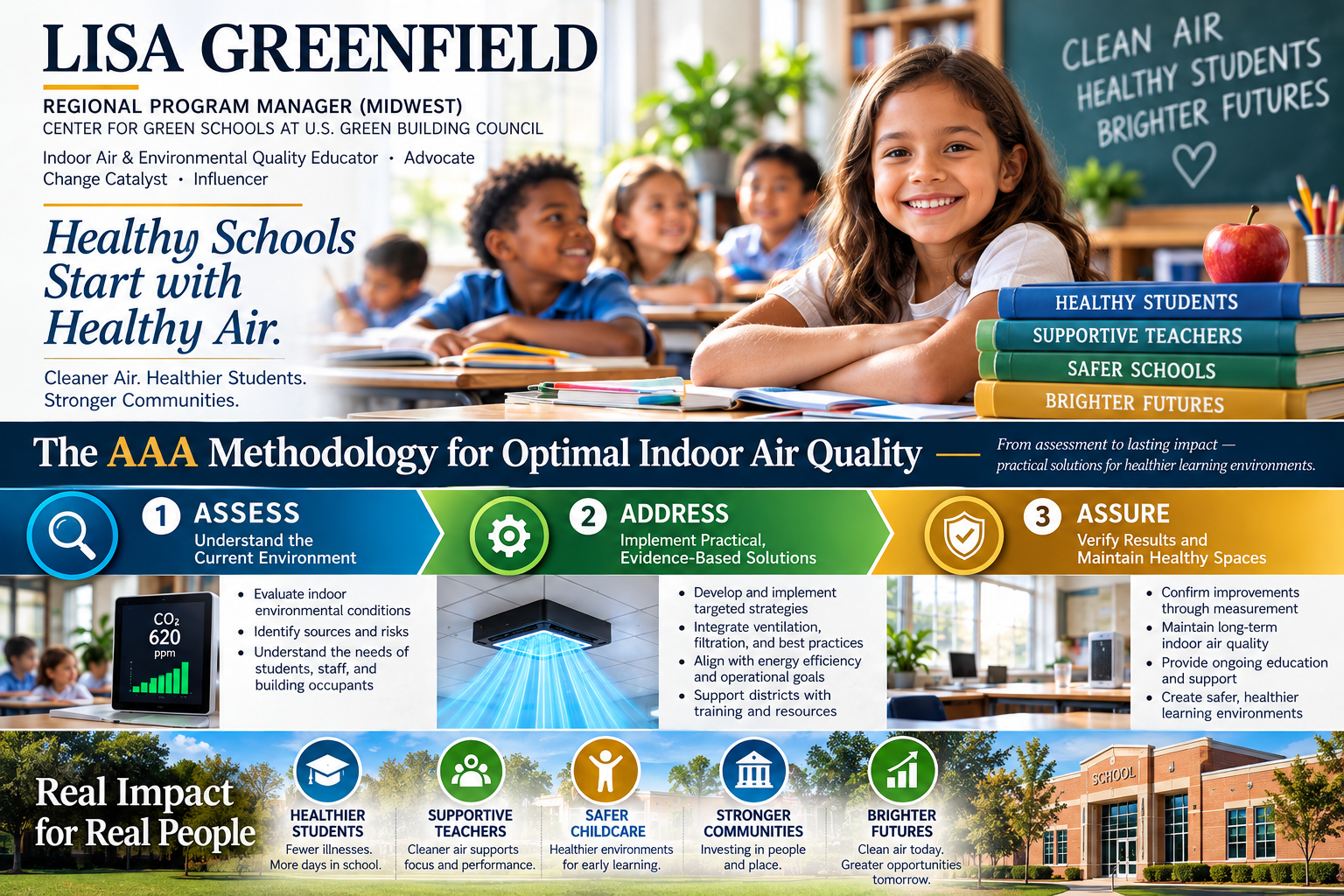
They are a people, operations, education, evidence, maintenance, and accountability problem. Better ventilation or filtration matters because people occupy the building — and because the result should be demonstrable after the intervention, not simply promised beforehand.

Healthy Schools Start with Healthy Air teaching visual

Teaching visual · healthier students, supported teachers, safer childcare, stronger communities, and brighter futures.

🎧 SAMANTHA · IMAGE 02 · HEALTHY AIR → HUMAN IMPACTListen while you study this section · free-scroll remains enabled

WHO BENEFITS FROM THE WORK

One school building. Many lives.

Indoor air quality is not a single-department responsibility. Lisa’s school-centered approach helps bring the needs of people and the realities of buildings into the same conversation.

🎧 SAMANTHA · WHO BENEFITS · ONE SCHOOL, MANY LIVESListen while you study this section · free-scroll remains enabled

STUDENTS

Air quality can affect respiratory health, comfort, concentration and attendance. Children cannot choose the condition of the classrooms they enter.

EDUCATORS

Teachers and staff spend long workdays in school buildings. Their health, comfort and ability to work matter alongside student outcomes.

FACILITIES TEAMS

Maintenance staff and facility leaders need usable guidance, budgets, training and ongoing support—not just new equipment.

SCHOOL LEADERS

District leaders must balance health, educational priorities, building constraints, energy use and long-term stewardship.

FAMILIES

Parents and caregivers depend on schools to communicate clearly about environmental conditions and improvement efforts.

COMMUNITIES

School buildings are public infrastructure. Their condition influences health, opportunity and confidence beyond the classroom.

FROM AWARENESS TO ACTION

What can a school district do next?

🎧 SAMANTHA · FROM AWARENESS TO ACTIONListen while you study this section · free-scroll remains enabled
01 · START WITH A PLAN

Bring facilities, health, finance, sustainability and school leadership together around an indoor air quality management plan.

02 · BUILD KNOWLEDGE

Use accessible training, fact sheets and technical assistance to understand ventilation, filtration, pollutants, moisture and maintenance.

03 · IMPROVE WITH PURPOSE

Identify practical opportunities, establish priorities, make improvements and revisit conditions to understand their effects.

The Center for Green Schools offers a School IAQ Management Plan Toolkit, free educational resources, and a School Air Quality Fellowship to help school staff move from interest to implementation. These are institutional programs Lisa helps advance, not projects attributed to her individually.

THE ADVOCATE

The children at the center of every decision.

Lisa describes herself as an advocate and champion for those without a voice, especially children. That perspective matters because environmental decisions are often made through budgets, work orders, standards, equipment choices, maintenance practices, and institutional processes far removed from the people who experience the result.

🎧 SAMANTHA · THE ADVOCATE · CHILDREN AT THE CENTERListen while you study this section · free-scroll remains enabled
Healthy air is about more than equipment. It is about the child learning, the educator teaching, the staff member maintaining the building, and the family trusting the school each morning.

EXPLORE LISA’S WORK

Read, watch, learn, and bring healthier air into more schools.

Independent public-profile showroom assembled from Lisa Greenfield’s public professional record and public institutional materials to celebrate and teach from her career in education, indoor air quality, healthy schools, and advocacy. Lisa’s AAA methodology — Assess, Address, Assure — remains her work. This page is not an official biography and does not imply endorsement by Lisa Greenfield, the Center for Green Schools, or the U.S. Green Building Council. Open for correction.

THE WORK CONTINUES

Every child deserves a place to learn where the air supports their future.

Assess the environment. Address what needs attention. Assure that improvement continues. Behind each step are real people—and a career dedicated to helping them thrive.

🎧 SAMANTHA · THE WORK CONTINUESListen while you study this section · free-scroll remains enabled