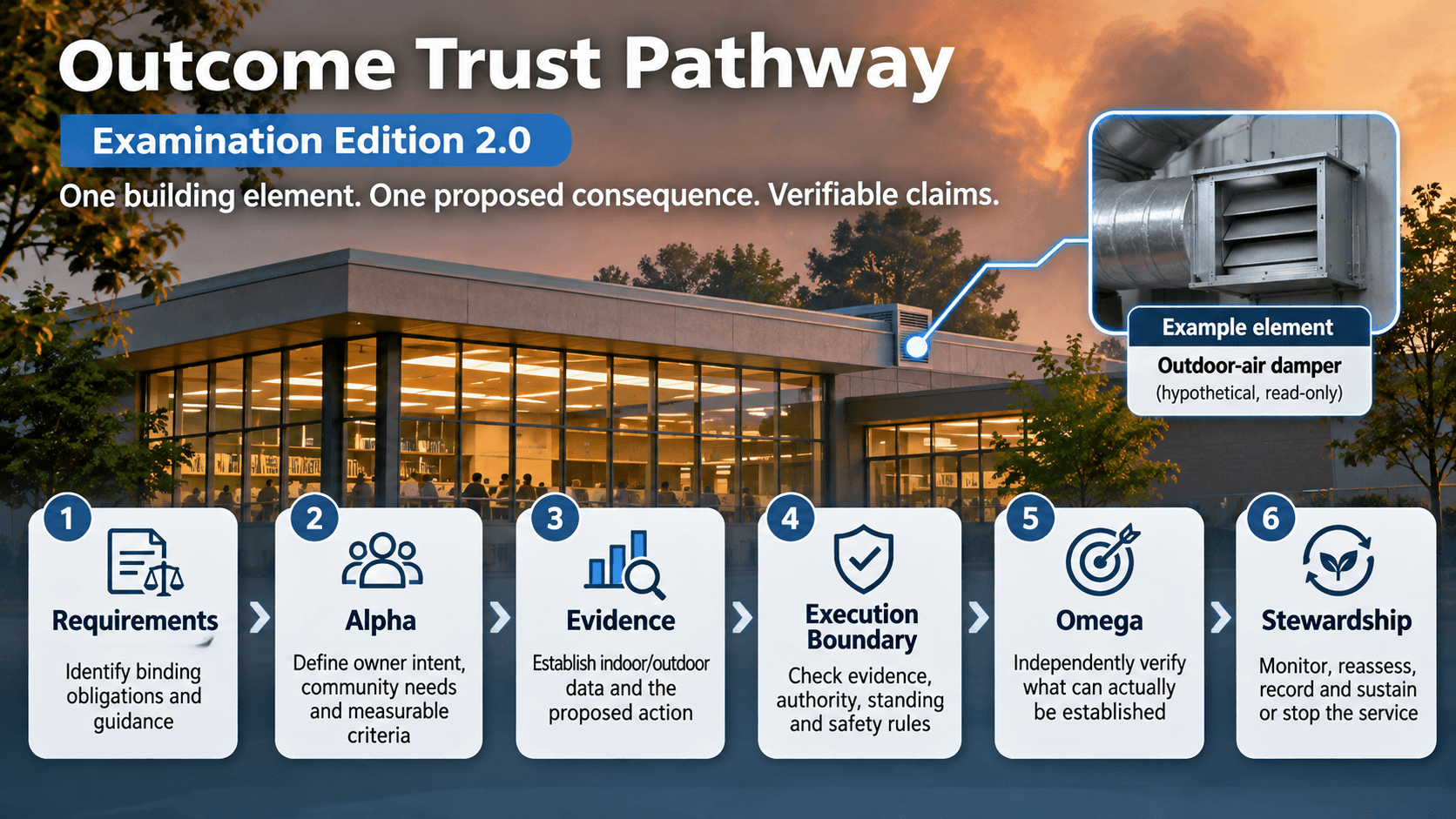
From lawful owner intent to independently examinable outcomes. Follow one hypothetical outdoor-air damper request through the requirements, evidence and execution boundary.
Working reference, not an operational pilot. The building, action, evidence fixtures, illustrated sensor values and results are hypothetical. No facility owner, municipal approval, PAE data access, real-world actuation, partner endorsement, or independently verified health benefit is claimed. The illustrated Omega slide contains fictional example values and checkmarks.
Key lesson: A forecast can inform a decision; it cannot authorize a building action.
CONNECTING THE LESSONS · 01 / 08
What you just learned
A building's public-service promise needs applicable requirements, legitimate owner intent, an evidence trail, a decision boundary, independent outcome proof, and stewardship. A wildfire forecast can trigger examination but cannot itself authorize changing equipment.
What you are about to learn
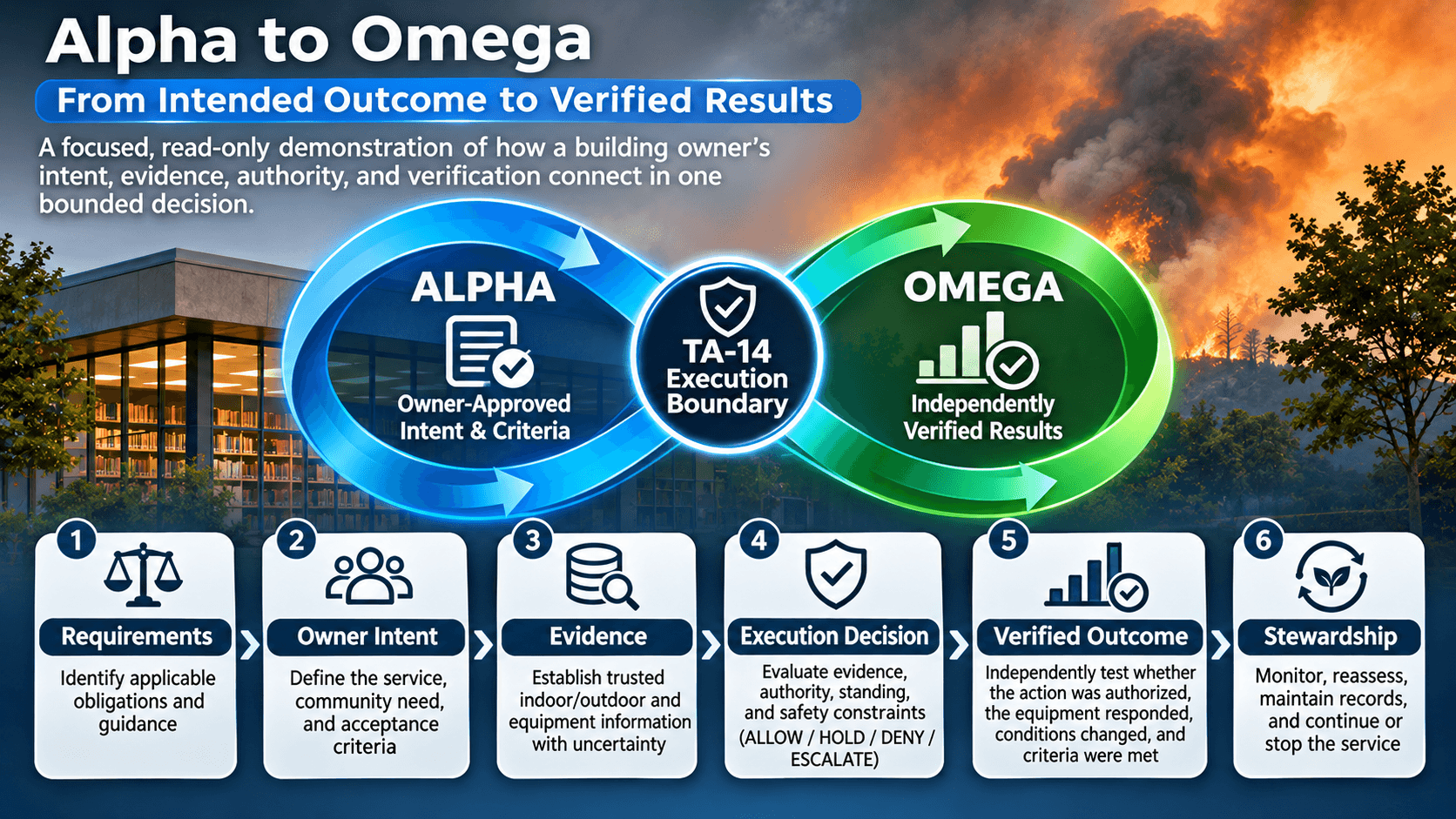
Define Alpha, the owner's intended service, and Omega, the independently examinable result. These endpoints tell us what must be specified before selecting sensors, rules or equipment.
Agree on the purpose and proof before engineering the solution
Key lesson: Owner intent and independently verifiable success must be specified in advance.
CONNECTING THE LESSONS · 02 / 08
What you just learned
Alpha is the owner's lawful and measurable intention, informed by community needs; Omega is the evidence required to demonstrate delivery. Neither a conceptual diagram nor an approved request establishes a real outcome.
What you are about to learn
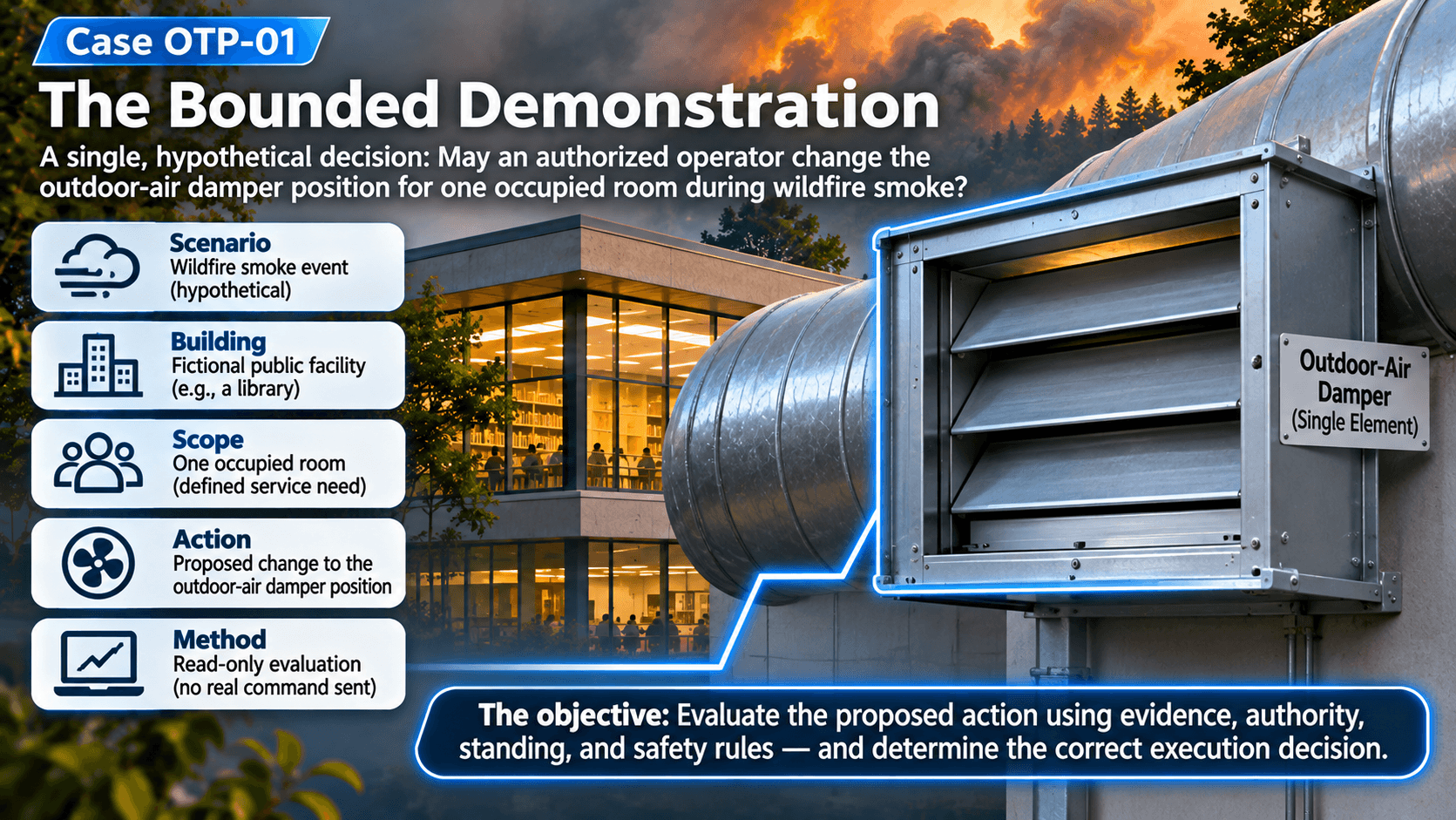
Narrow that promise to case OTP-01: one hypothetical occupied room, one outdoor-air damper and one time-limited proposed change. We will examine the request without operating equipment.
Key lesson: The case asks whether a proposed consequence may occur, not whether a model sounds persuasive.
CONNECTING THE LESSONS · 03 / 08
What you just learned
The case is bounded to a single discretionary damper proposal during possible wildfire smoke. AI may recommend the action, but no real owner, operator, facility or control permission has been established.
What you are about to learn
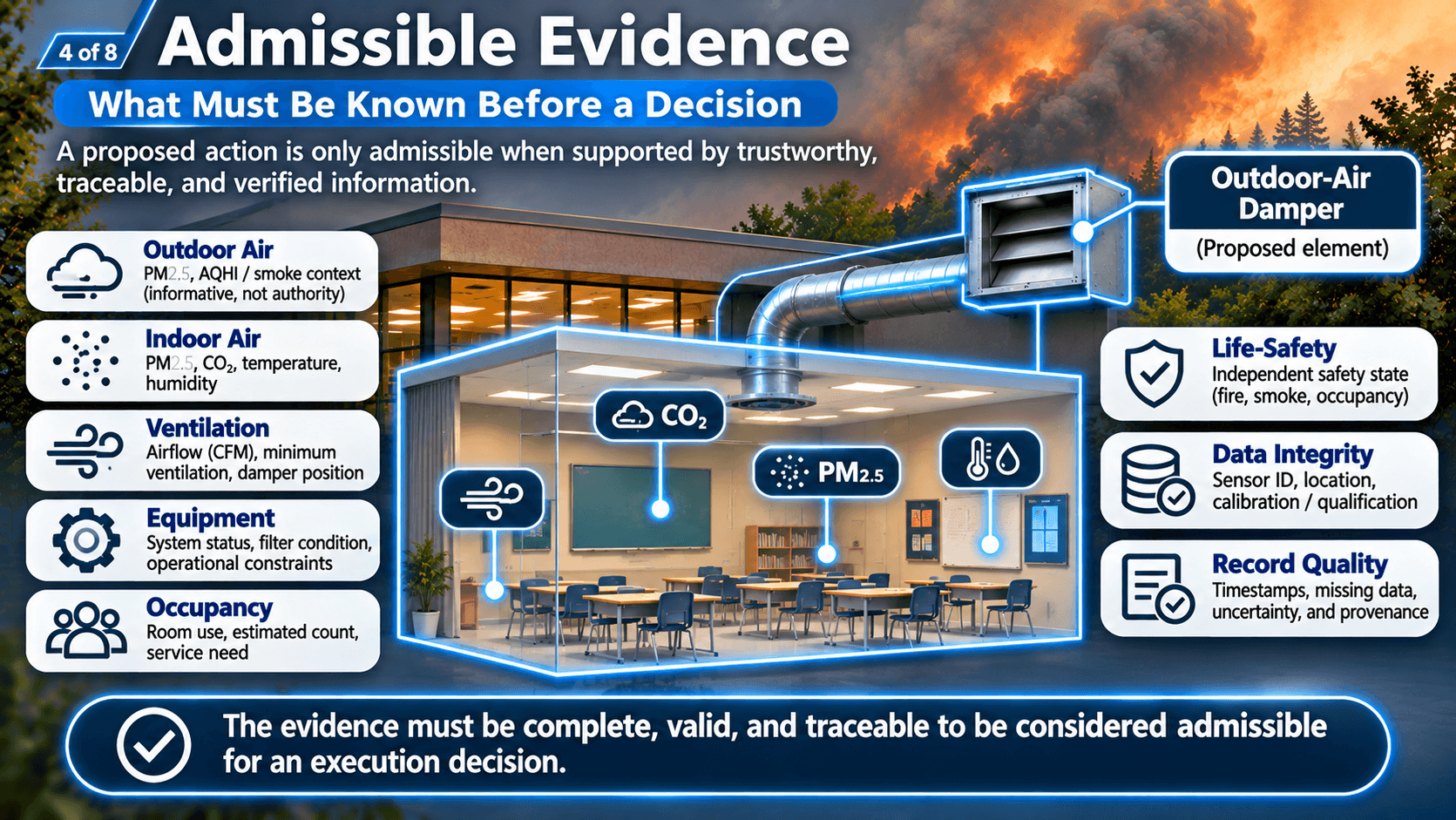
Identify which environmental, equipment, safety and provenance records must be present before this particular request can even be evaluated.
Key lesson: Missing or invalid mandatory evidence cannot be silently replaced by prediction.
CONNECTING THE LESSONS · 04 / 08
What you just learned
Relevant measurements must be attributable, timely and fit for purpose. Missing indoor PM2.5, uncertain ventilation minima or inadequate provenance cannot be replaced by a model's confidence.
What you are about to learn
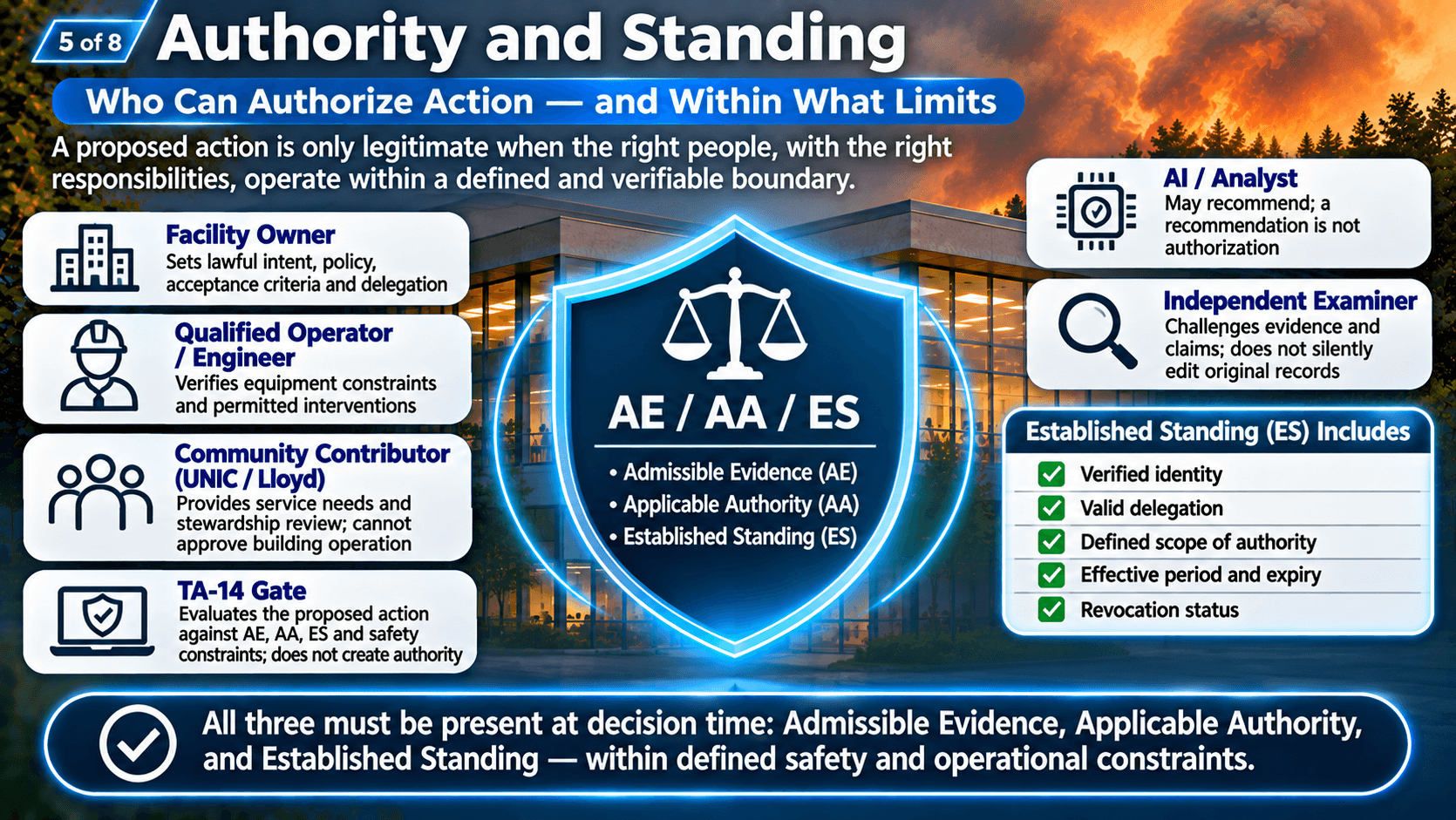
Separate data quality from legal permission: who sets the service objective, who can operate the building, and whether the requesting actor has valid delegated standing.
Key lesson: The proposed governance gate checks authority; it does not create authority.
CONNECTING THE LESSONS · 05 / 08
What you just learned
Admissible Evidence, Applicable Authority and Established Standing are different checks. Standing concerns the actor's identity, delegation, scope and validity—not CO₂, occupancy or sensor readings.
What you are about to learn
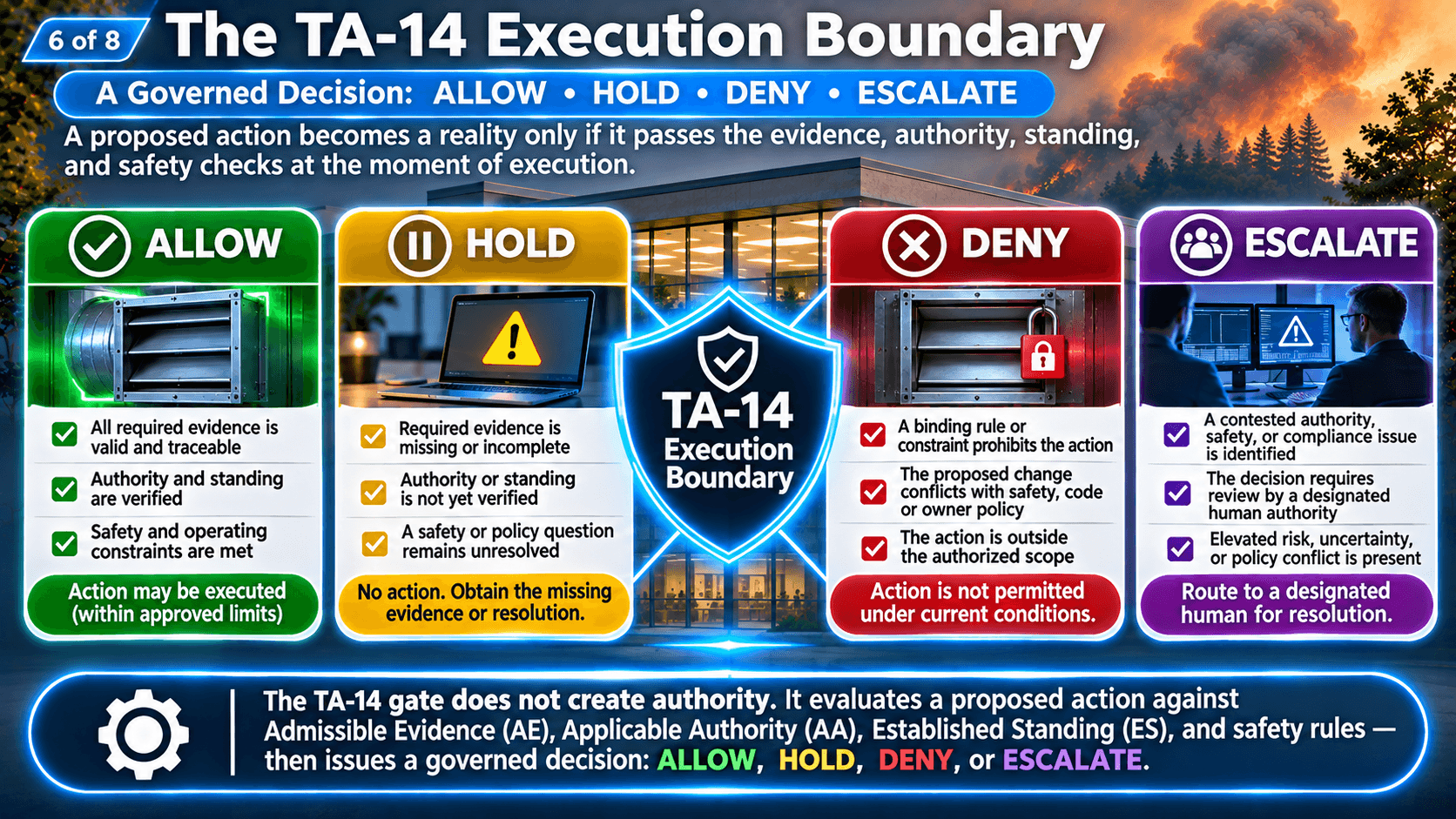
Apply those checks at the proposed execution boundary. Distinguish ALLOW, HOLD, DENY and ESCALATE, and see why this synthetic case is expected to HOLD.
A governed choice at the proposed consequence boundary
Key lesson: A simulated HOLD never sends a command; resolving missing evidence requires a fresh decision.
CONNECTING THE LESSONS · 06 / 08
What you just learned
The specified OTP-01 fixture is expected to HOLD because mandatory evidence and authorization are unresolved. No discretionary actuation is issued; a new evaluation is required after remediation.
What you are about to learn
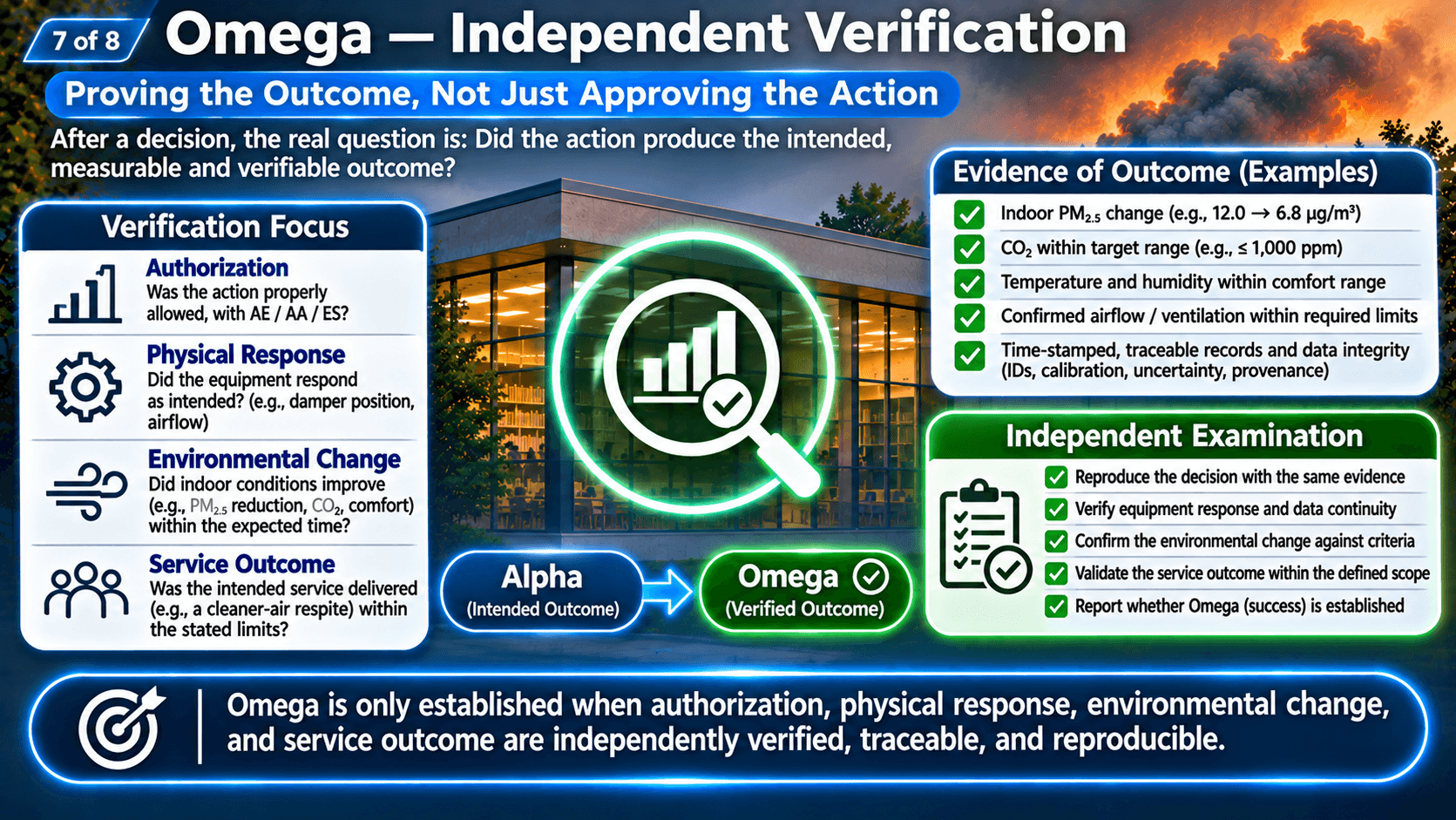
Ask what Omega could actually verify. A defensible decision record is separate from proof that equipment responded, air changed or the owner's service criteria were met.
Four distinct claims, four distinct evidence paths
Illustrative values and green check marks are NOT real measurements, achieved outcomes, or examiner approvals.
Key lesson: An ALLOW decision is not proof of cleaner air. A simulated outcome is not an observed one.
CONNECTING THE LESSONS · 07 / 08
What you just learned
The read-only examination can specify an authorization trace but cannot establish physical damper movement, improved indoor air or successful occupant service. Image values and checkmarks are illustrative only.
What you are about to learn
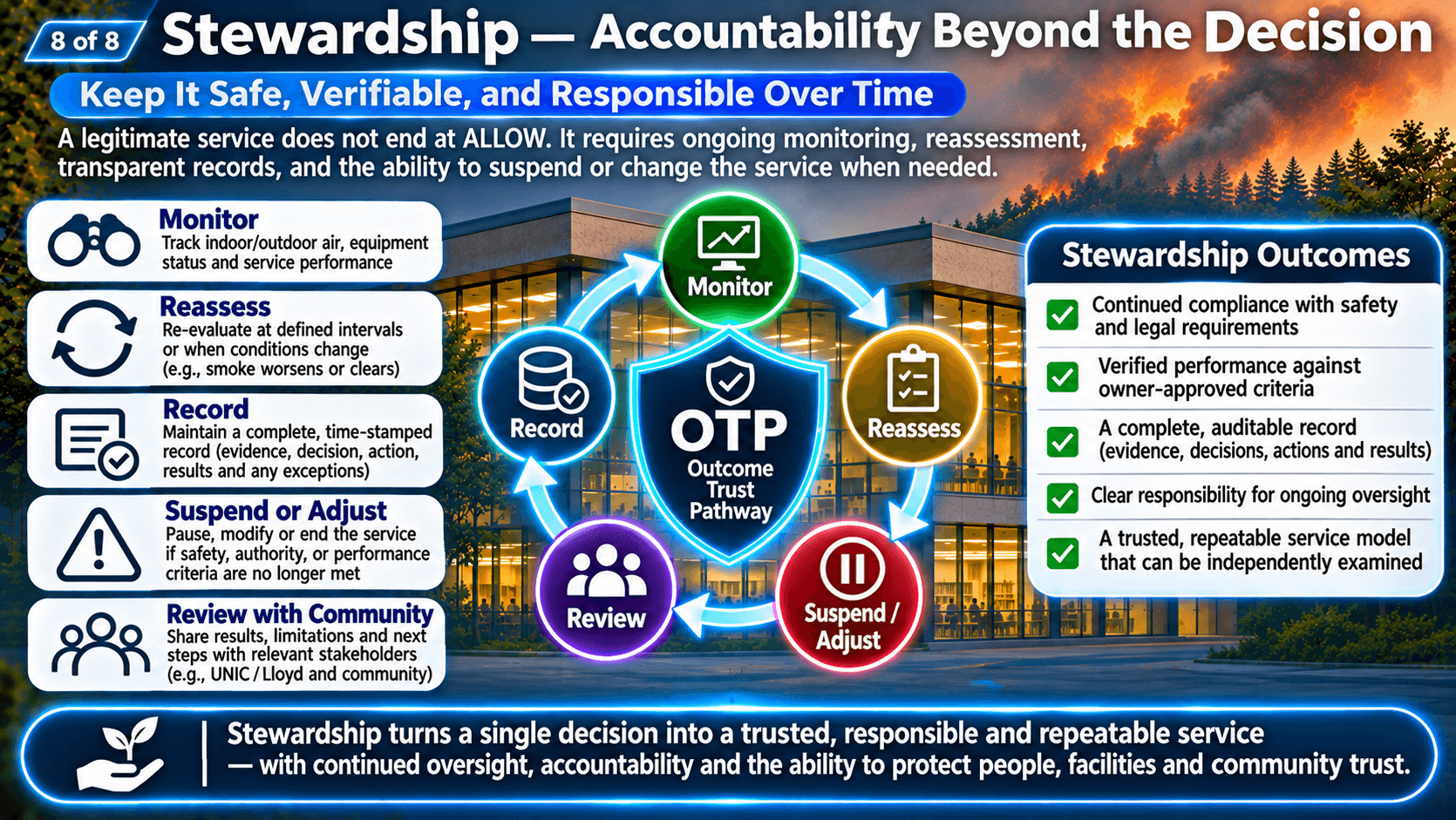
Finish with stewardship: continuous monitoring, reassessment, preserved exceptions, suspension authority and community-informed review after any future real implementation.
Maintain, reassess, preserve and suspend when necessary
Key lesson: A credible service remains accountable as circumstances change.
CONNECTING THE LESSONS · 08 / 08
What you just learned
The pathway runs from requirements and lawful intent through evidence, authorized decision, independent verification and continuing accountability. Each stage has its own owner, evidence and limits.
What you are about to learn
Test your understanding in the simulated OTP-01 decision challenge below. Select the expected determination, then compare it with the documented missing evidence and standing.
AI recommends a 60-minute discretionary damper adjustment. Indoor PM2.5 evidence is missing, the required ventilation minimum is unverified, and the operator’s delegation has not been established. Independent emergency and life-safety functions remain outside this proposed gate. What is the expected decision for this synthetic fixture?
What would an independent examiner need?
A frozen owner-intent specification; locally reviewed requirements register; synthetic fixture with provenance and data-quality limits; versioned rules with precedence; actor delegation and standing records; expected decision traces; and a separate Omega verification plan. A read-only simulation can examine rules, but cannot prove that a real damper actuated or that a cleaner-air respite service succeeded.
Apply the governance principles to three hypothetical cases relevant to the proposed operational consequence. Choose a determination, then examine the reasoning. These cases teach the distinction between Admissible Evidence, Applicable Authority, and Established Standing; they do not issue real-world authorization.
CASE 01
Evidence is not yet admissible
A proposed consequence is supported by an observation, but the source attribution or record continuity is missing. What should happen before execution? Consider this in the context of the proposed operational consequence.
CASE 02
The actor exceeds authority
The record is current and reliable, but the proposed consequence falls outside the scope of applicable authority. What is the supported determination?
CASE 03
A higher authority is required
The proposed consequence triggers a documented requirement for review by another designated authority. What is the appropriate route?
Independent educational examples only. The questions are hypothetical and do not assess a real institution, building, person, or operating system. Actual governance determinations require case-specific evidence, applicable authority, established standing, and bounded review.