TA14 AUTHORITY GOVERNANCE INSTITUTION · INDEPENDENT ARCHITECTURAL DEMONSTRATION
Predictive Intelligence
and the Consequence Boundary
When an AI system predicts what should happen, what makes its proposed real-world intervention admissible and authorized to happen now?
INDEPENDENT EDUCATIONAL DEMONSTRATION · NO LIVE COMMANDS · NO FROZEN BASELINE · NO FORMAL TA14 DISPOSITION. All signals, decisions, charts, outcomes, identities and timestamps shown in the teaching images are hypothetical illustrations. No endorsement, integration or participation by BAS vendors or third parties is implied. Some visuals depict conditional success examples rather than actual verified results.
↓ DOWNLOAD TECHNICAL GOVERNANCE REFERENCE v2.0 (PDF)THE GOVERNING QUESTION
Does this proposed consequence have sufficient Admissible Evidence, Applicable Authority, and Established Standing to become reality NOW?
Reality → Record → Continuity → Admissibility → Binding → Commit → Execution → Outcome. Prediction is not permission. Observed is not inferred. Inferred is not authorized.
IMAGE 01 / 08
The Predictive Revolution
Sensors observe; predictive models infer. Neither produces permission.
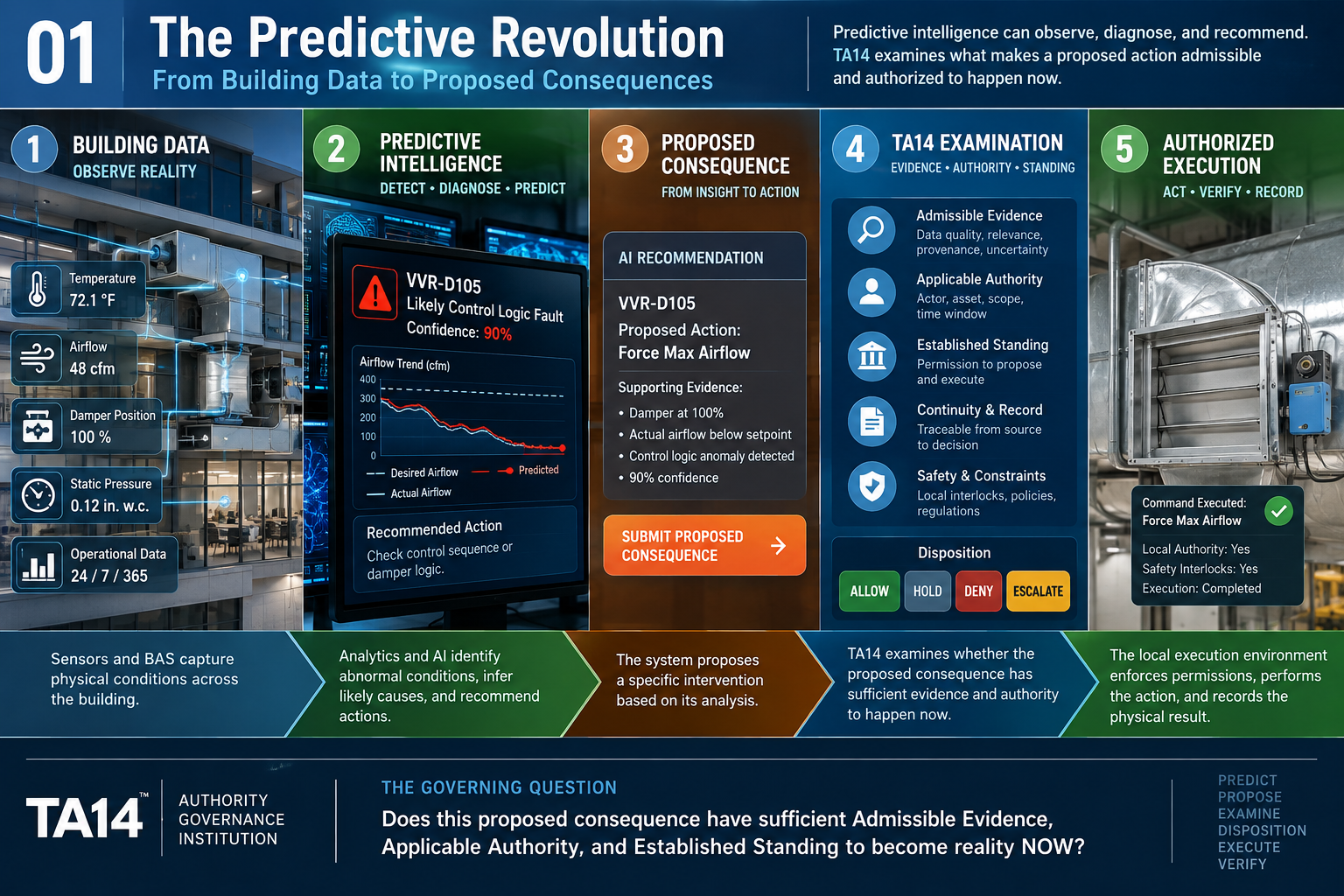
Follow the numbered teaching sections on the image. The page does not auto-scroll.
Section one, physical observation: BAS sensors report temperature, pressure, airflow, damper position and operating mode. These are recorded claims and may require validation. Section two, model interpretation: predictive software compares present signals with trends and produces a fault hypothesis or forecast, with a stated confidence and version. Section three, the proposed action: maintenance dispatch, sequence change, override and continued observation are different consequences with different risk. Section four, the boundary: prediction alone supplies neither local permission nor established standing. TA14 examines a bounded proposal before any locally governed execution.
IMAGE 02 / 08
The Diagnosis
A high confidence estimate is still an inference, not a measured cause.
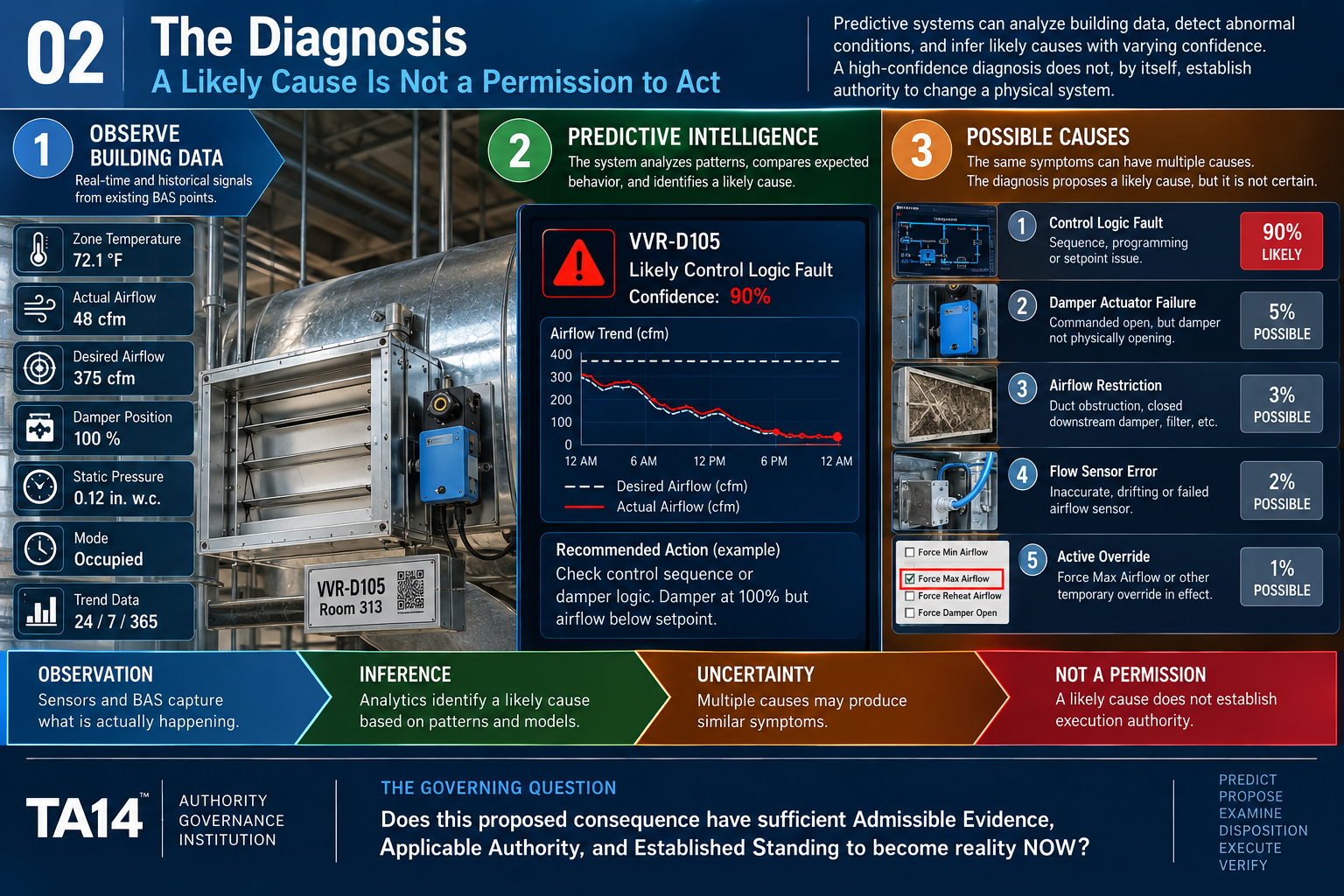
Follow the numbered teaching sections on the image. The page does not auto-scroll.
Section one, observed readings: the illustrative terminal requests three hundred seventy five CFM but reports forty eight CFM and one hundred percent damper position. We do not yet know if this last point is a command or feedback. Section two, model inference: control logic is proposed as the likely cause with ninety percent confidence. That percentage does not prove calibration or causation. Section three, alternative causes: upstream static pressure, a faulty airflow pickup, actuator disconnection, duct restriction or point mapping could explain the discrepancy. Section four, evidentiary consequence: preserve the raw points, timestamps, override conditions and uncertainty. The diagnosis is a candidate for examination, not an instruction to actuate.
IMAGE 03 / 08
The Proposed Consequence
Different interventions create different risks and require separate examinations.
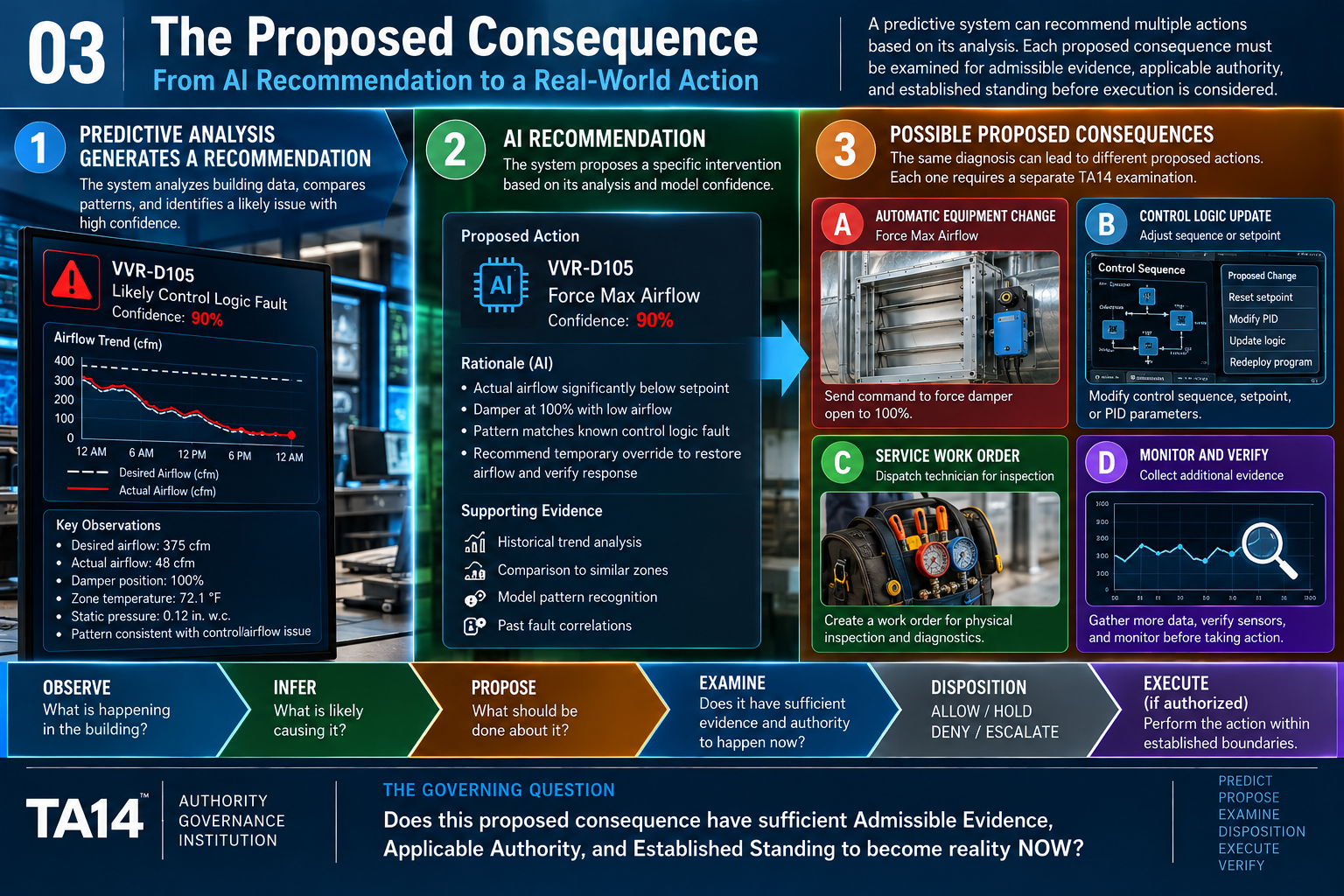
Follow the numbered teaching sections on the image. The page does not auto-scroll.
Section one, turn a hypothesis into an explicit proposal naming the asset, actor, requested command and time window. Section two, distinguish observation and technician review from a physical setpoint change or damper override. Different actions demand different admissibility and authority. Section three, bind proposed limits, urgency, units, valid operating mode, local role and safety constraints. Section four, do not transfer an approval from one action to another. Every material new proposed consequence must return to examination. Analytics proposes; it does not acquire permission to execute.
IMAGE 04 / 08
The Evidence Boundary
Separate original observations, transformations, hypotheses and validated evidence.
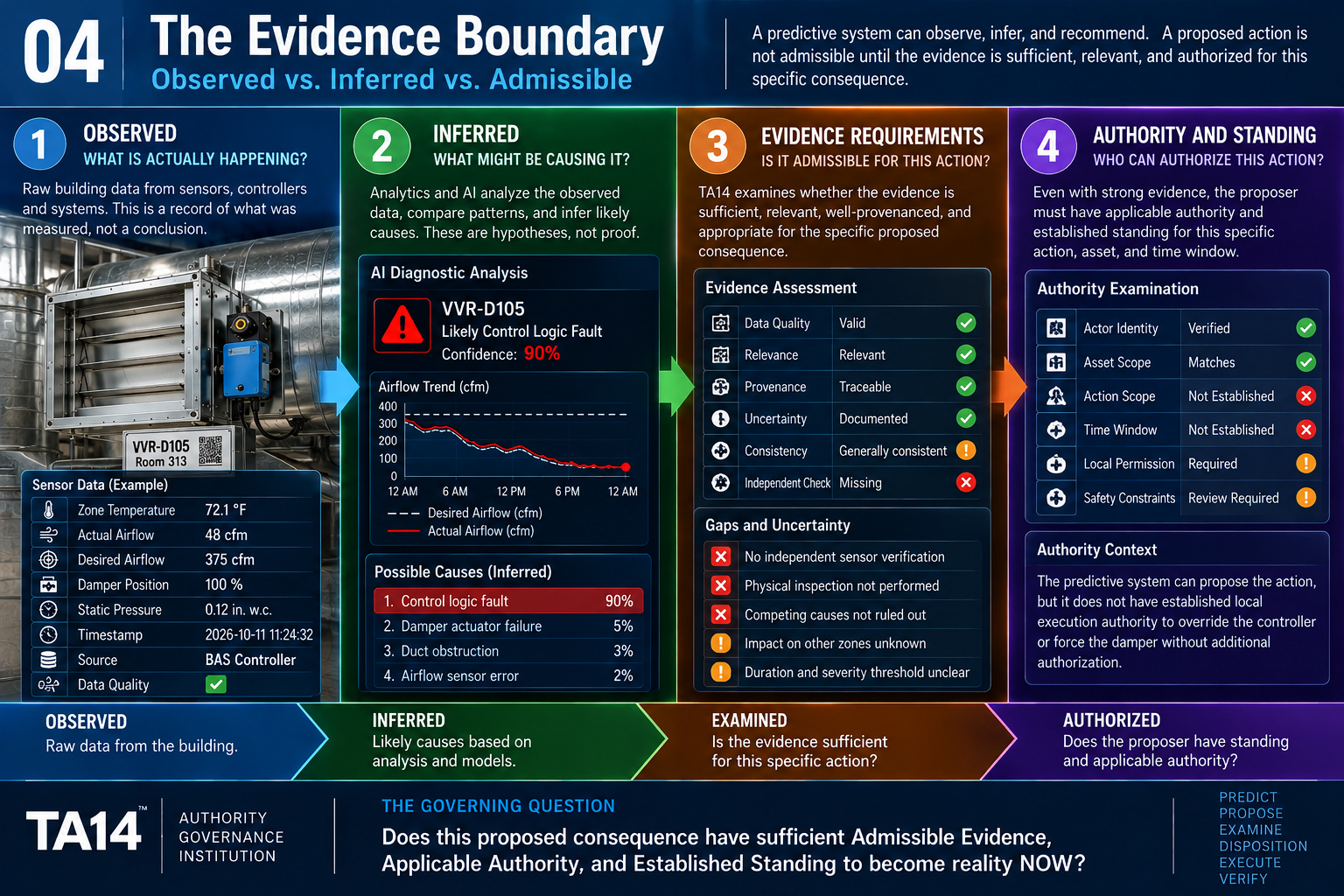
Follow the numbered teaching sections on the image. The page does not auto-scroll.
Section one, preserve raw BAS readings with their original units, timestamps, sources and point identities. Section two, keep normalized points, conversions and adjusted measurements separate, documenting method, version and uncertainty. Section three, identify the model hypothesis, alternative causes and confidence score as inferred records rather than measured reality. Section four, test relevance, provenance, freshness and completeness against the specific contemplated action. An admissible input does not make every derived output admissible. Observed is not inferred; inferred is not authorized.
IMAGE 05 / 08
The TA14 Examination
Examine evidence, authority and standing before a bounded disposition.
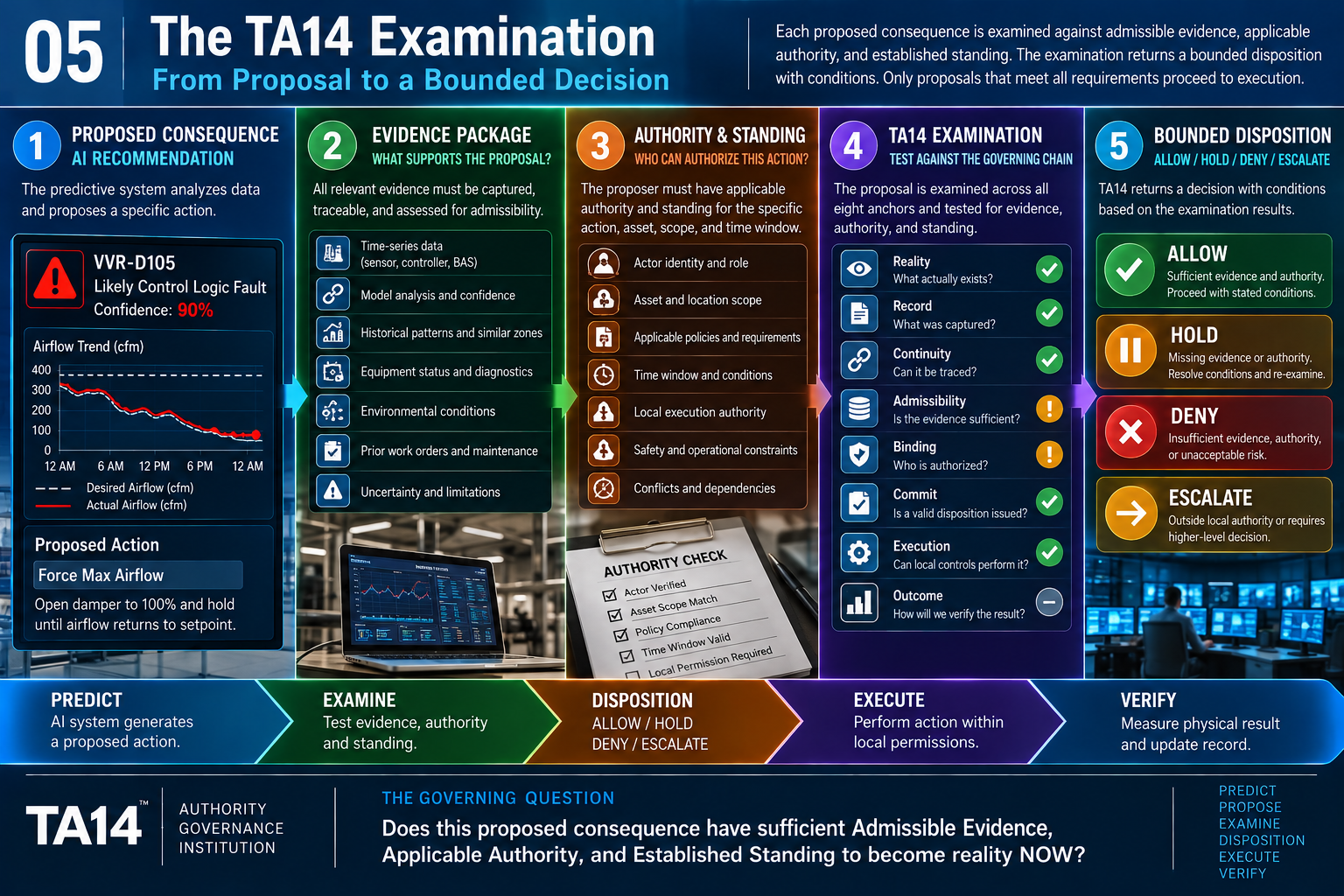
Follow the numbered teaching sections on the image. The page does not auto-scroll.
Section one, establish Reality and Record: what equipment condition is reported and what source captured it? Section two, test Continuity and Admissibility: can every transformation be traced and is the evidence sufficient for this intervention? Section three, establish Binding and Commit: does the actor have valid, locally applicable authority and standing for this asset, action and time? Section four, return a reasoned disposition. ALLOW is bounded; HOLD requires missing proof; DENY rejects a prohibited action; ESCALATE requires a named accountable reviewer. Neither HOLD nor ESCALATE permits execution. Execution and Outcome are separately proven.
IMAGE 06 / 08
The Architectural Bridge
Authority context can travel, but execution permission must be established locally.
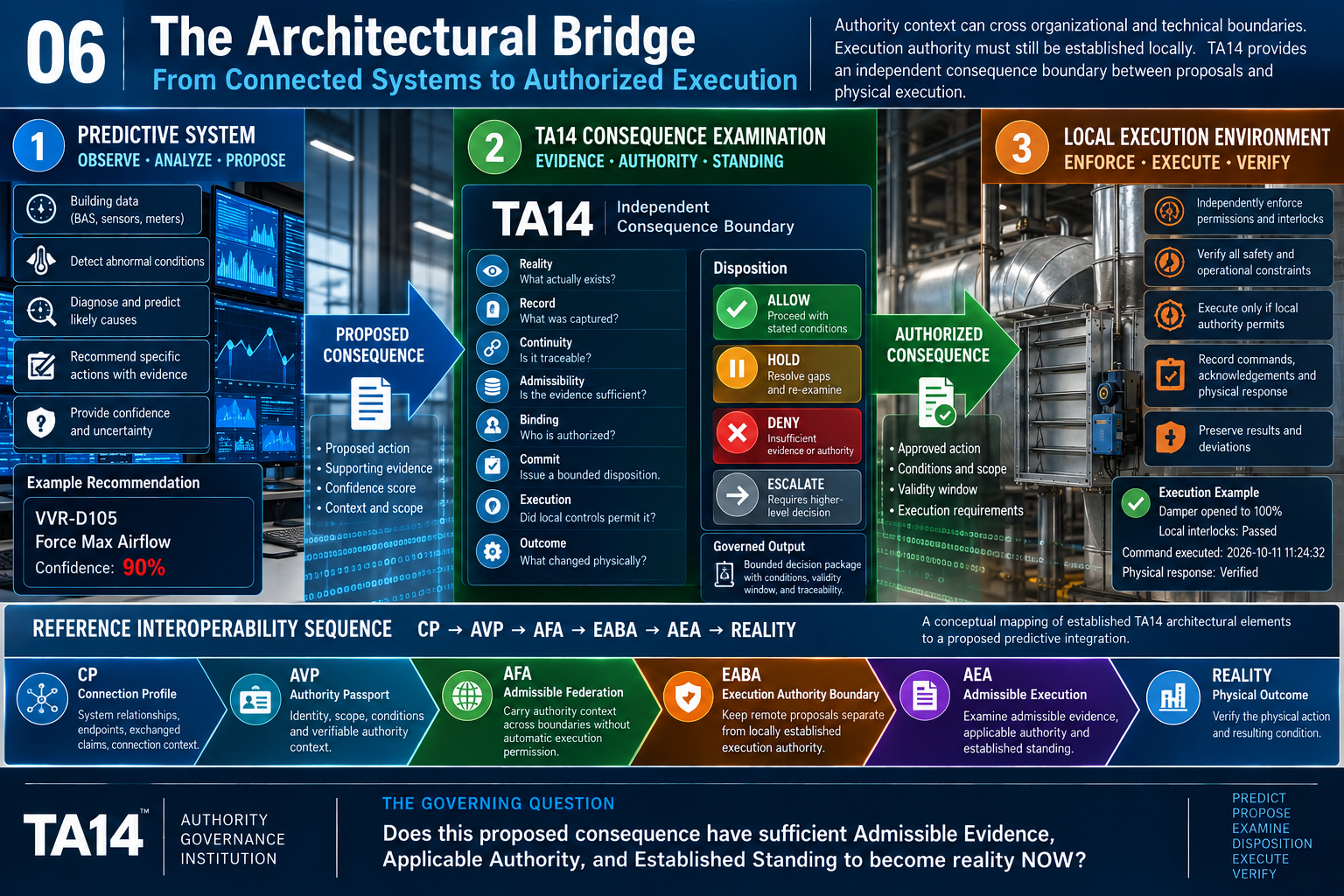
Follow the numbered teaching sections on the image. The page does not auto-scroll.
Section one, the Connection Profile describes the relationship and claims that cross between independent systems. Connection does not create control permission. Section two, Authority Passport carries inspectable actor identity, scope, limitations and validity claims. Section three, Admissible Federation Architecture allows authority context to travel while the Execution Authority Boundary Architecture prevents remote context from becoming local permission automatically. Section four, Admissible Execution Architecture examines the exact proposed consequence. The local operator or controller enforces safety and permitted execution. The measured physical outcome returns as new reality.
IMAGE 07 / 08
Illustrative Examination
A HOLD cannot silently become execution; later successful outcomes are conditional examples.
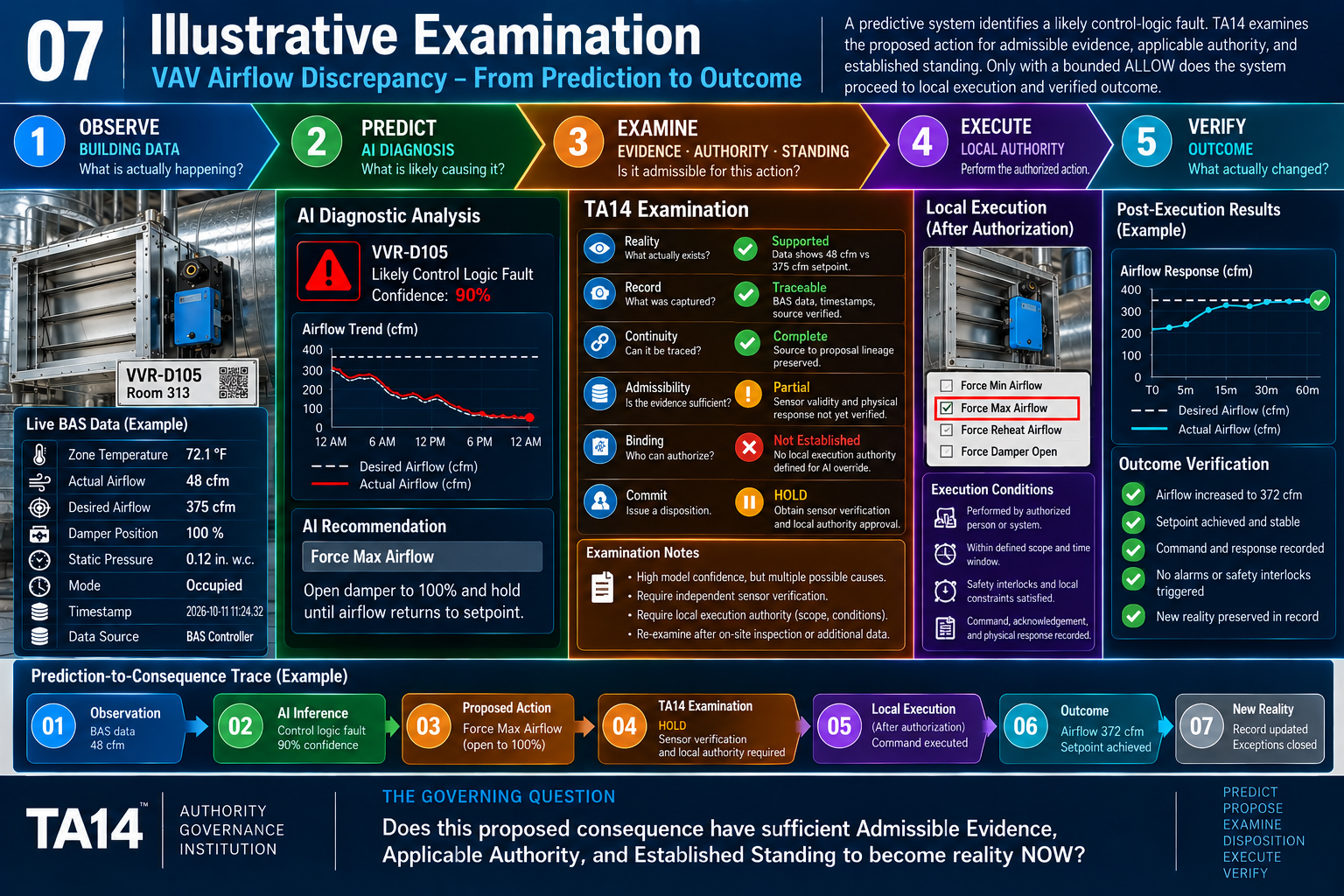
Follow the numbered teaching sections on the image. The page does not auto-scroll.
Section one, the illustrative VAV problem initially warrants HOLD for an automatic override because the reported data do not establish the cause or authority. Section two, validate the airflow sensor, actuator motion, upstream static pressure, active overrides and alternative faults without rewriting original evidence. Section three, qualified review and locally established action scope may permit a fresh, time-bound examination. A resulting ALLOW is not an actuation command. Section four, the independent local controller must still enforce current conditions, safeguards and interlocks. Any recovery shown is simulated, not observed facility performance or a formal TA14 case ruling.
IMAGE 08 / 08
Verified Outcome
A command receipt is not proof of physical recovery.
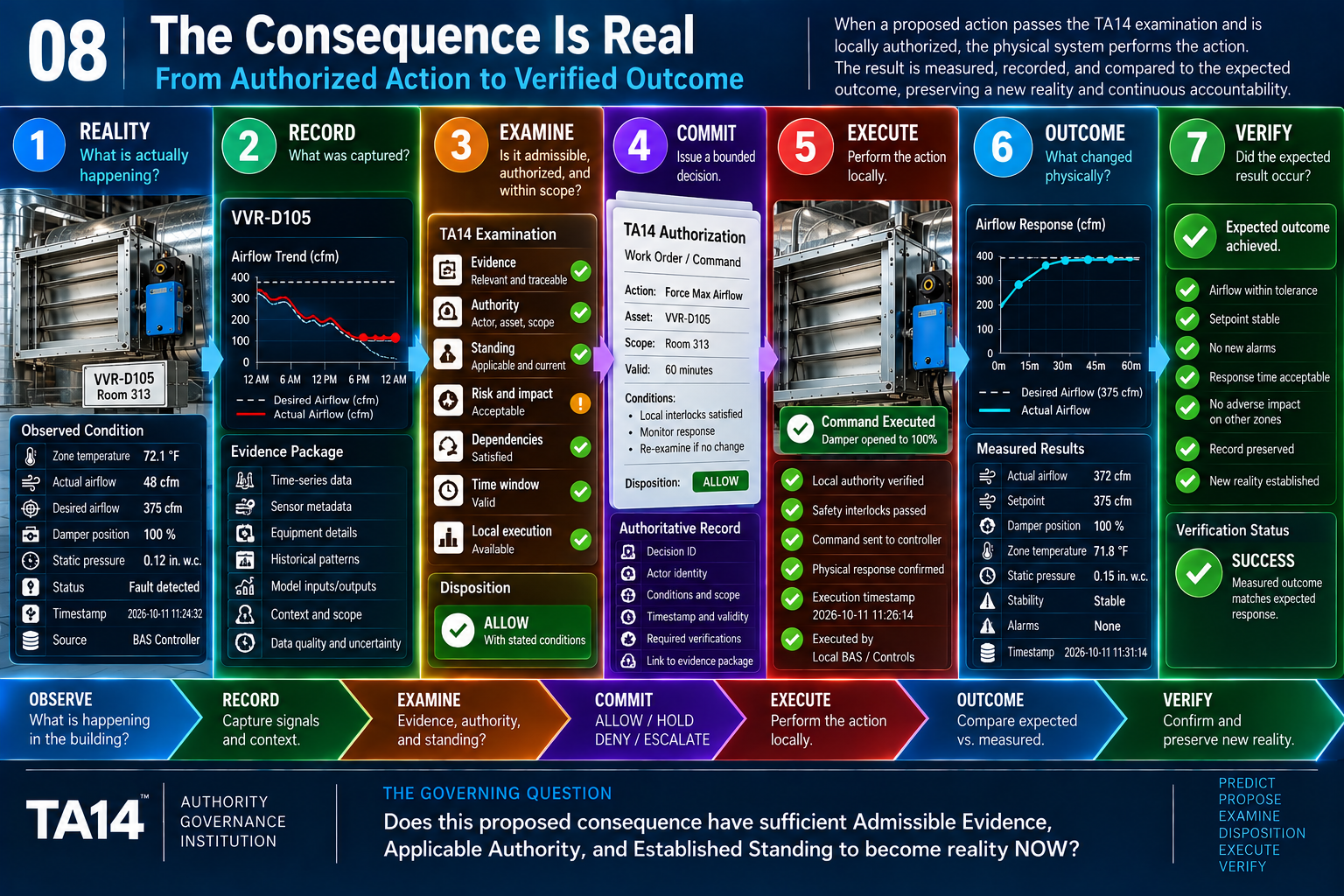
Follow the numbered teaching sections on the image. The page does not auto-scroll.
Section one, examine the final bounded disposition; it is not a reusable authorization. Section two, local execution checks permissions, physical interlocks, operating mode and current safety constraints immediately before action. Record the actual command, acknowledgement, timestamps and deviations. Section three, verify whether physical airflow, actuator response and related conditions changed as expected. A command receipt is not proof that the physical system performed. Section four, preserve unexpected effects, rollback failures and unresolved outcomes. Any material change triggers re-examination rather than an assumption of continuing authority.
Four separate responsibilities
Analytics describes a hypothesis and exact proposed intervention.
TA14 determines a bounded disposition against evidence, authority and standing.
Independent local controls enforce live permissions and safety constraints.
Physical observations establish success, failure, or a new uncertain condition.
SIMULATED GOVERNANCE EXAMINATION · NO SYSTEM CONNECTION
Test the consequence boundary
Illustrative VAV: requested airflow 375 CFM, reported airflow 48 CFM, reported damper position 100%, model confidence 90%. Choose a proposed action and change the evidence and authority assumptions.
ILLUSTRATIVE DISPOSITION
ESCALATE
A qualified accountable reviewer must evaluate an automatic override before further examination.
What is established or missing
- Current local authority and action scope not established.
- Sensor, actuator and competing causes not independently checked.
- Qualified human review and current operating conditions not established.
A simulated ALLOW never initiates a command and never bypasses independent safety, operating-mode, or local permission checks. Changes to evidence, authority or conditions require re-examination.