TA14 AUTHORITY GOVERNANCE INSTITUTION · INDEPENDENT TECHNICAL PRE-EXAMINATION
A Smart City Is Not Necessarily a Governed City
Eight illustrated teaching examinations of what happens between connected-city observation and an authorized real-world consequence.
INDEPENDENT PRE-EXAMINATION · CONCEPTUAL APPLICATION · BASELINE NOT FROZEN · NO FORMAL DISPOSITION · NO MUNICIPAL ENDORSEMENT. All illustrated measurements, identities, law/policy examples, approvals, performance changes, and outcomes are hypothetical; this is not evidence of a deployed municipal system.
GREENBUILD AI SUMMIT · OCTOBER 20, 2026 · PRESENTATION COMPANION
Become the Building: From Intelligence to Authorized Action
An independent TA14 conceptual teaching companion to the ONUMA Become the Building exercise using the PAE Living Building as a shared reference. It illustrates why participant claims, graph relationships, and AI-generated insights must remain distinguishable from evidence, applicable authority, established standing, and permission to execute.
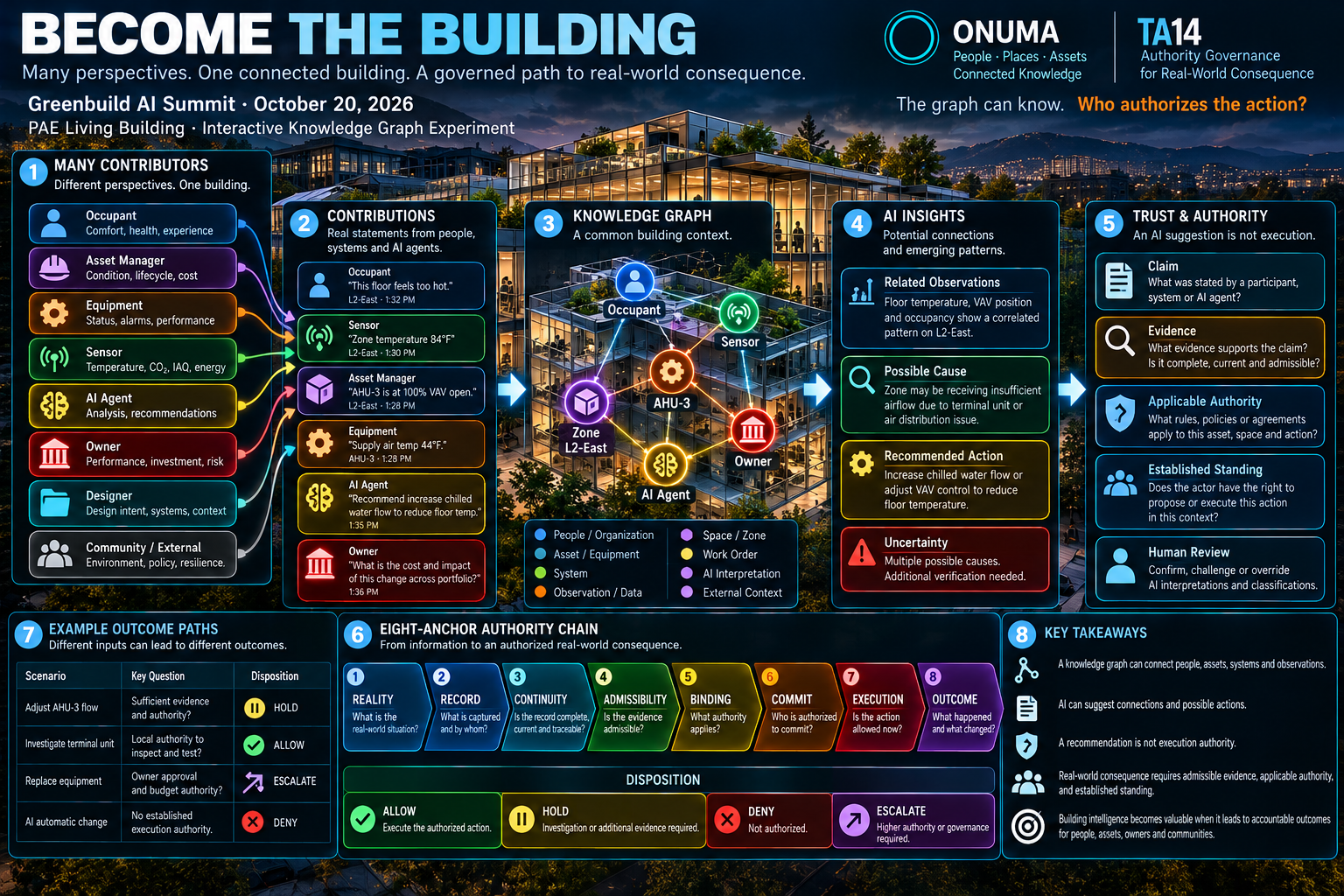
INDEPENDENT CONCEPT · NOT AN ONUMA ENDORSEMENT, PARTNERSHIP ANNOUNCEMENT, OR DEPLOYED INTEGRATION. All depicted building inputs, temperatures, decisions, and outcomes are hypothetical teaching examples. This graphic is not a verified transcript or operational record. The slide is provided for illustration and should receive editorial review before external presentation.
The governing question
Does this proposed consequence have sufficient Admissible Evidence, Applicable Authority, and Established Standing to become reality NOW?
Reality → Record → Continuity → Admissibility → Binding → Commit → Execution → Outcome
NUMBERING KEY: The 01–08 labels below are showroom teaching-image numbers, not the eight TA14 architectural anchor numbers. The overview is Teaching Image 01; Reality is architectural Anchor 01 but Teaching Image 02; Record is architectural Anchor 02 but Teaching Image 03. Some original infographic trackers visually emphasize a different number. Use the architectural labels given above each image as the authoritative sequence. Original artworks are retained without alteration.
ORIGINAL TEACHING IMAGE 01 OF 08
Overview of all eight architectural anchors
Smart City Governance Overview
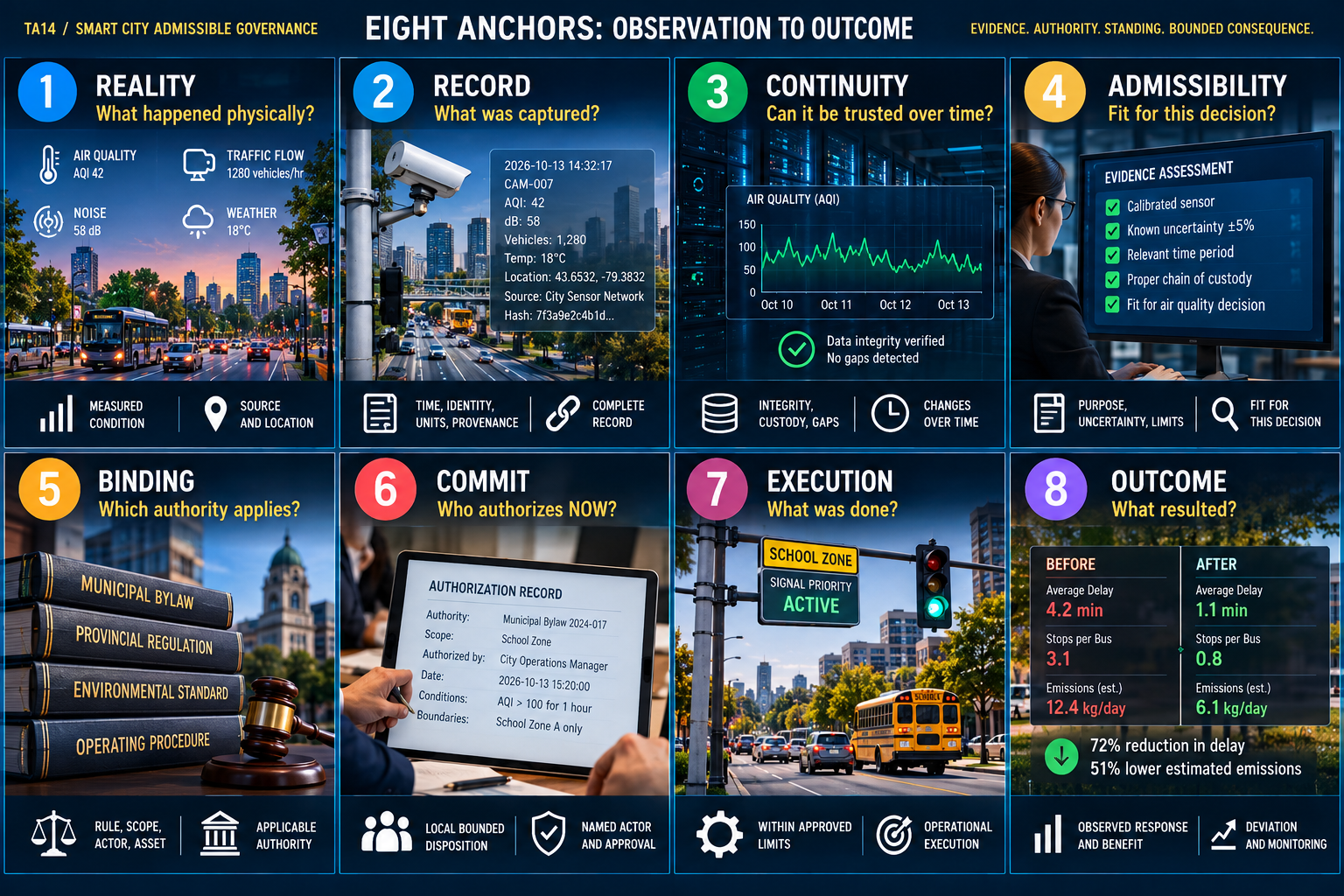
Welcome to the smart city governance overview. This illustration brings together infrastructure, sensing, data exchange, decision-making and physical action. Notice that connectivity is not the same as permission. A city platform may identify rising electricity demand and recommend reducing cooling across public buildings. But one building could be an emergency shelter or critical care facility. The recommendation may be technically plausible while the proposed action remains unauthorized. TA14 examines eight architectural anchors: Reality, Record, Continuity, Admissibility, Binding, Commit, Execution and Outcome. At the consequence boundary, ask whether Admissible Evidence, Applicable Authority and Established Standing are sufficient NOW. ALLOW means a bounded action can proceed. HOLD means necessary conditions remain unresolved. DENY means the action fails a governing requirement. ESCALATE means an authorized determination is needed. The image is conceptual, not a deployed city or validated result. Our goal is to understand how connected intelligence can be made accountable before it changes the physical world.
This overview is the approved first image in the eight-image showroom sequence; the separate Smart City companion poster remains in the downloadable technical reference.
ORIGINAL TEACHING IMAGE 02 OF 08
Architectural anchor 01 — REALITY
Reality — What Actually Happened?
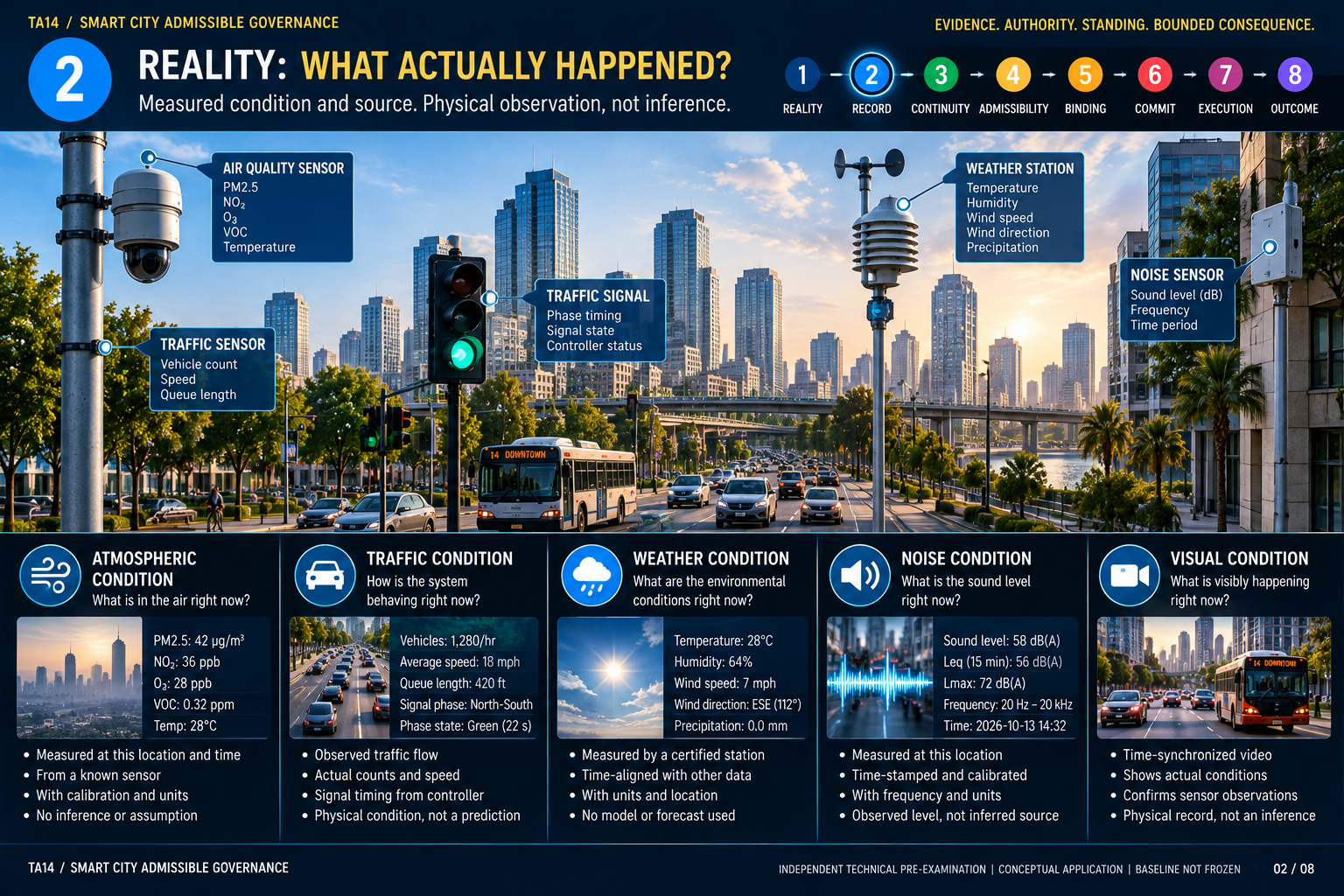
Illustration numbering caution: this original image's internal progress tracker does not identify the architectural anchor taught by this section. Architectural anchor 01 — REALITY is the authoritative label. The source image has not been edited.
This illustration begins at Reality, the first architectural anchor. Examine the depicted sensors and infrastructure as examples of observations, not proof of actual measurements. Suppose a roadside sensor reports elevated particulate matter while traffic sensors report congestion. These observations may coincide, but they do not prove traffic caused the pollution. A trustworthy observation needs an identified asset and source, time, units, calibration status, location and operating context. An algorithm may infer a cause or predict exposure; that inference must remain distinct from the raw reading. Before restricting traffic, changing ventilation or issuing an alert, a responsible system must establish exactly what was observed and what remains uncertain. Missing calibration, ambiguous location or stale readings can justify a HOLD on a consequential intervention even when an alert is useful for investigation. The numbers in the illustration are hypothetical. Reality establishes the observed condition; it does not by itself authorize a response.
ORIGINAL TEACHING IMAGE 03 OF 08
Architectural anchor 02 — RECORD
Record — What Was Preserved?
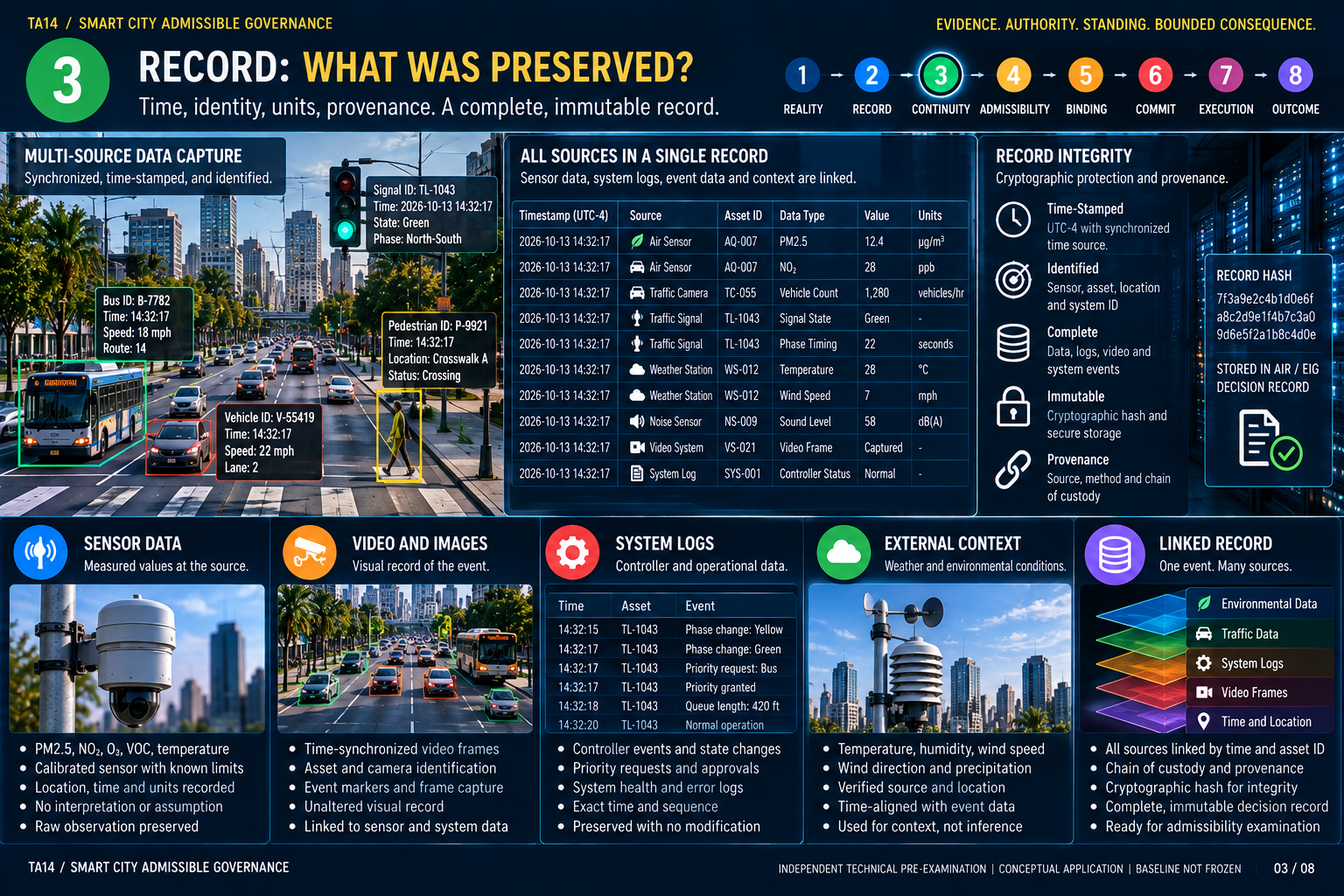
Illustration numbering caution: this original image's internal progress tracker does not identify the architectural anchor taught by this section. Architectural anchor 02 — RECORD is the authoritative label. The source image has not been edited.
Here the image moves from a momentary observation to a durable Record. Imagine a municipal water sensor reporting a pressure drop. The original reading, the alarm generated from it and an AI prediction of a leak are three distinguishable records. Preserve source identity, timestamp, units, provenance, relevant metadata and every transformation. A normalized dashboard value must not silently replace the original measurement. Two dashboards showing the same result may both depend on one upstream sensor, so agreement is not automatically independent corroboration. A reviewer should be able to trace what was collected, what was calculated, by whom or by which service, and when changes occurred. If the record cannot be reconstructed, a proposed high-consequence repair or shutdown may need to remain on HOLD while evidence is recovered. This teaching illustration does not certify any record system. It shows why an attractive visualization is not equivalent to an inspectable evidentiary history.
ORIGINAL TEACHING IMAGE 04 OF 08
Architectural anchors 03 and 04 — CONTINUITY + ADMISSIBILITY
Continuity and Admissibility
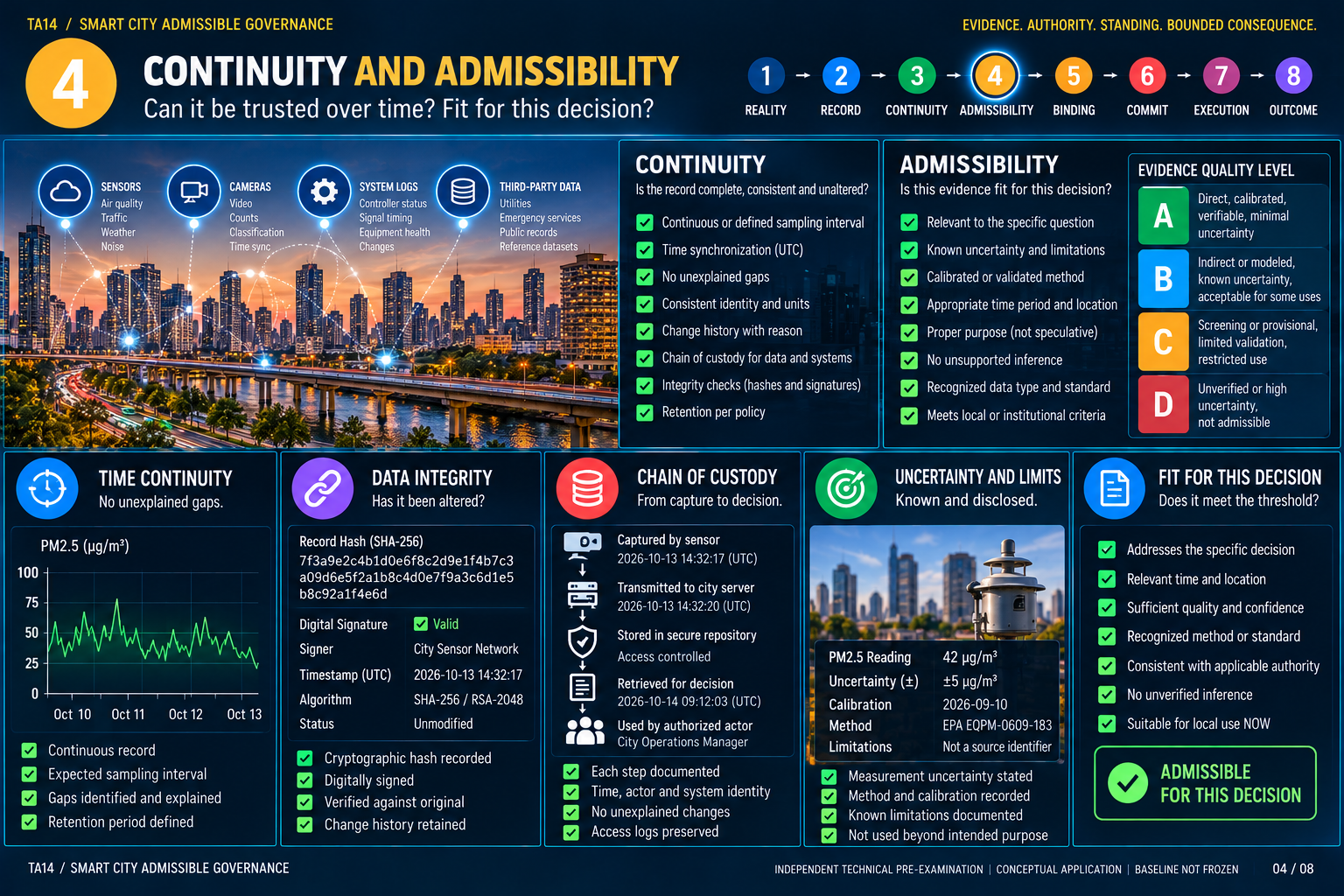
This illustration combines two separate tests. Continuity asks whether a record remained intact and traceable across collection, transfer, storage and review. Admissibility asks whether that record is sufficiently relevant, reliable and fit for this particular proposed consequence. Consider air-quality readings transferred through multiple city platforms. A complete transfer log helps establish continuity, but it cannot fix a sensor that was never calibrated for the intended measurement. Conversely, a technically sound reading can lose evidentiary value if its identity or custody becomes uncertain. The decision threshold also depends on what is proposed: requesting inspection may need different support from ordering a citywide closure. Examine gaps, clock synchronization, transformations, missing context and conflicting sources. A HOLD can preserve safety and accountability while deficiencies are resolved; an unsupported claim must not be converted into authorization merely because the data passed through a trusted platform. All checks and grades depicted here are hypothetical, not a certified assessment.
ORIGINAL TEACHING IMAGE 05 OF 08
Architectural anchor 05 — BINDING, with separate applicable authority and established standing
Applicable Authority and Established Standing
.png)
This image asks two questions that must not be merged. Applicable Authority identifies the rules, legal powers, delegated permissions, contractual obligations and limits that govern a proposed action. Established Standing identifies the specific actor, role and capacity entitled to invoke that authority for this asset and consequence. Imagine an AI traffic platform recommending closure of a road near a hospital. The software may be capable of changing signals, but system access is not a lawful or institutional mandate to close the road. A city department may have authority in general while a particular operator lacks standing for this location or emergency condition. TA14 therefore examines actor, capacity, standing basis and authority relationship, including jurisdiction, time and scope. If those cannot be established, execution is held or escalated to the appropriate decision-maker. This image uses invented approvals and policy examples; it does not identify actual municipal legal authority. Capability is not authority, and applicable authority is not the same thing as established standing.
ORIGINAL TEACHING IMAGE 06 OF 08
Architectural anchors 05 and 06 — BINDING + COMMIT
Binding and Local Commit
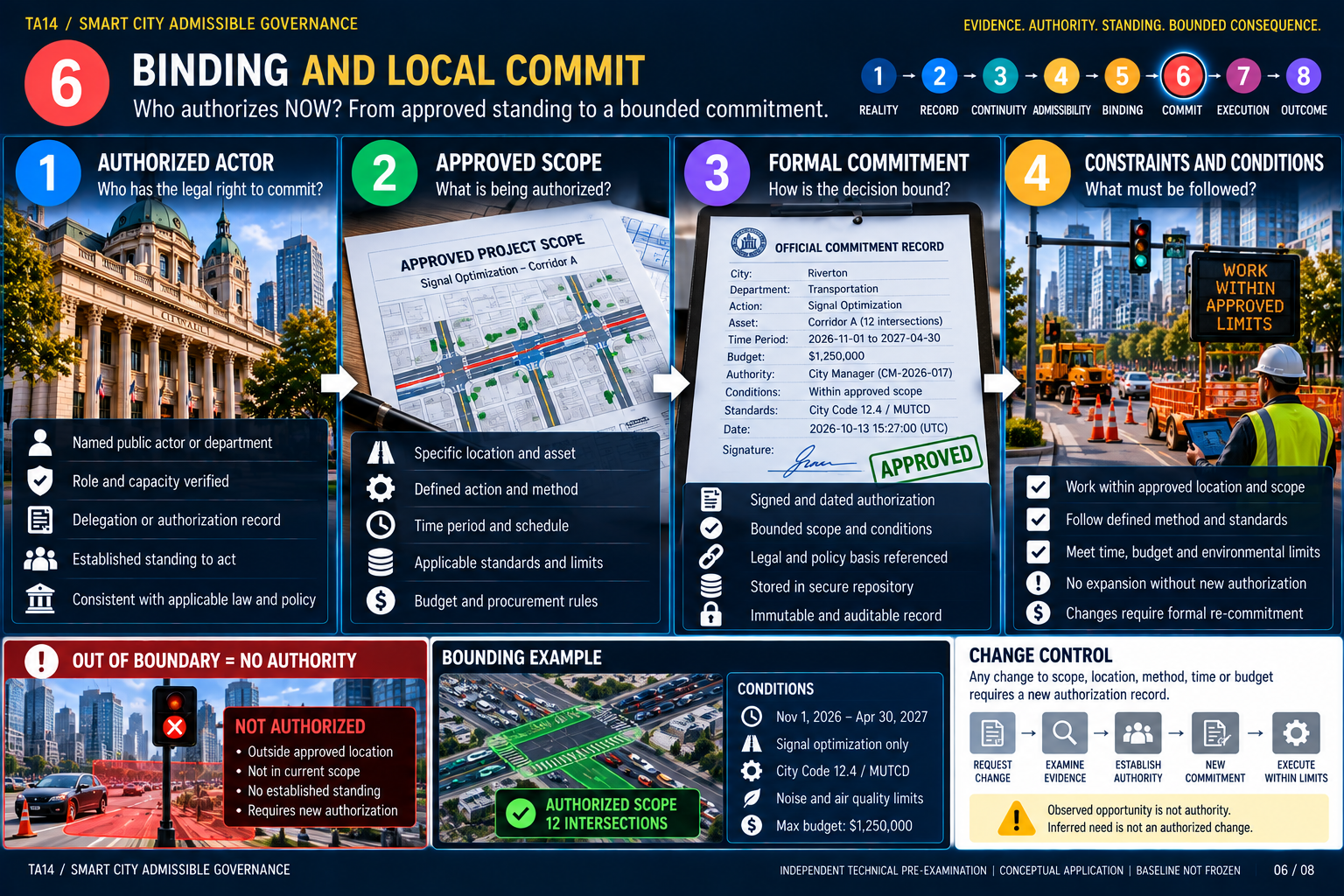
Now examine how the proposed action becomes bound to a specific local execution context. Binding identifies the actor, asset, evidence package, governing rule, permitted method, geographic scope and time window. Commit is the explicit, accountable decision to proceed within those bounds. Imagine a regional grid request to reduce demand. The request can carry useful authority context into a city's systems, but it does not automatically authorize changing a hospital's cooling setpoint. The receiving organization must establish its own execution authority and standing locally, with critical-service exceptions and safety limits addressed. If the building, operating condition or authorized actor changes, the earlier decision may no longer cover the action and must be reassessed. A HOLD is appropriate when the binding is incomplete; ESCALATE when the local authority relationship requires determination. The depicted signatures, budgets and municipal identities are hypothetical. Federation can share context; it cannot silently transfer execution permission.
ORIGINAL TEACHING IMAGE 07 OF 08
Architectural anchor 07 — EXECUTION
Authorized Execution
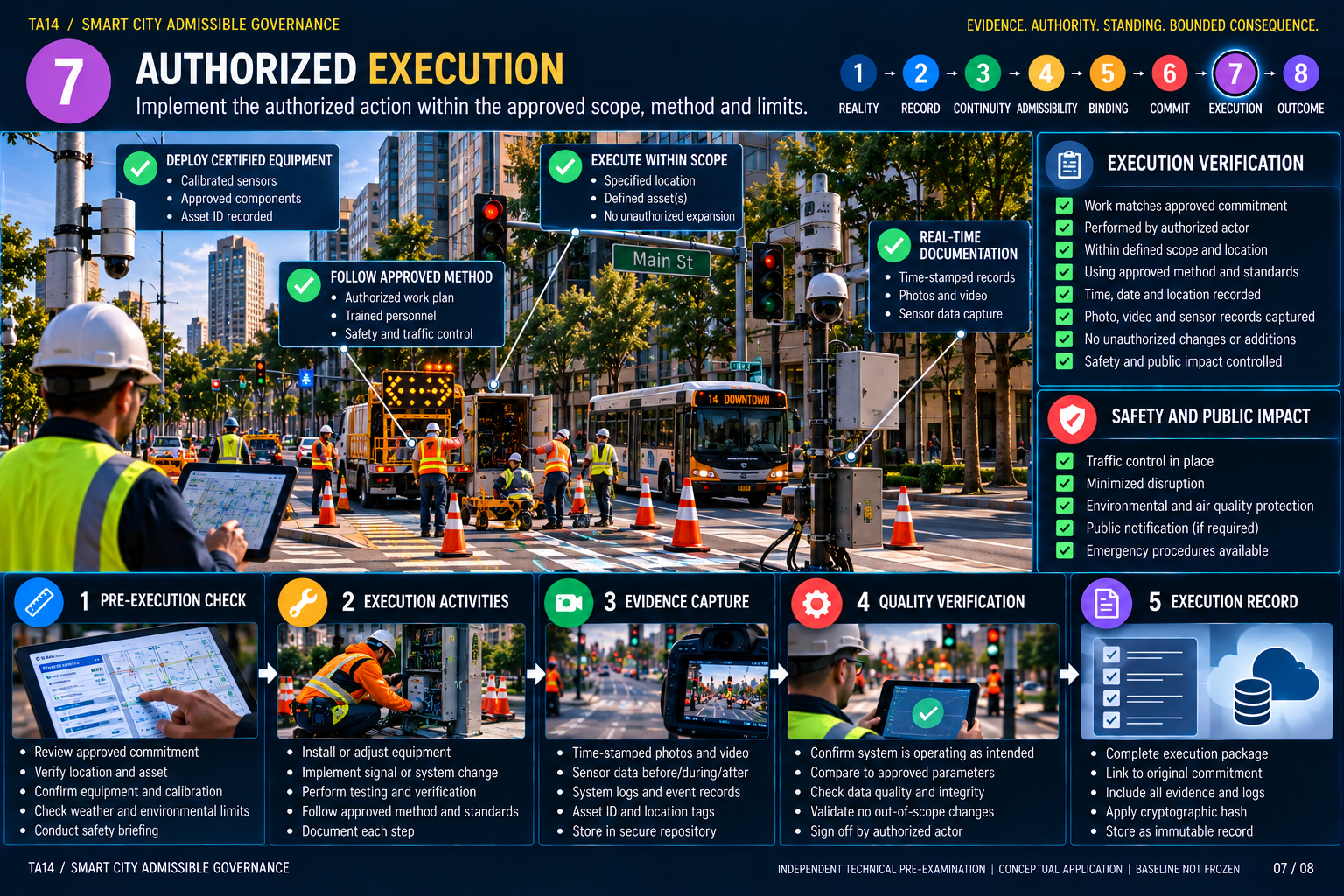
This image represents the point where an authorized decision could become a physical consequence. An ALLOW is not unlimited permission. Execution must remain constrained to the named actor or service, approved equipment, method, time window, safety checks and stop conditions. Consider a bounded change to a municipal pumping schedule. Before issuing a command, the control interface should verify that the authorization still applies and that fresh conditions have not invalidated it. During execution, preserve command identity, acknowledgments, equipment response, deviations and operator interventions. If a safety limit is crossed, evidence expires or the command drifts outside its approved scope, the system must follow defined safe interruption or escalation procedures where technically supported. A log showing that a command was sent is not proof that equipment performed as intended. The depicted operations are teaching examples, not proof of a municipal TA14 deployment. Authorized execution means controlled consequence, not merely successful command transmission.
ORIGINAL TEACHING IMAGE 08 OF 08
Architectural anchor 08 — OUTCOME
Outcome and Accountability
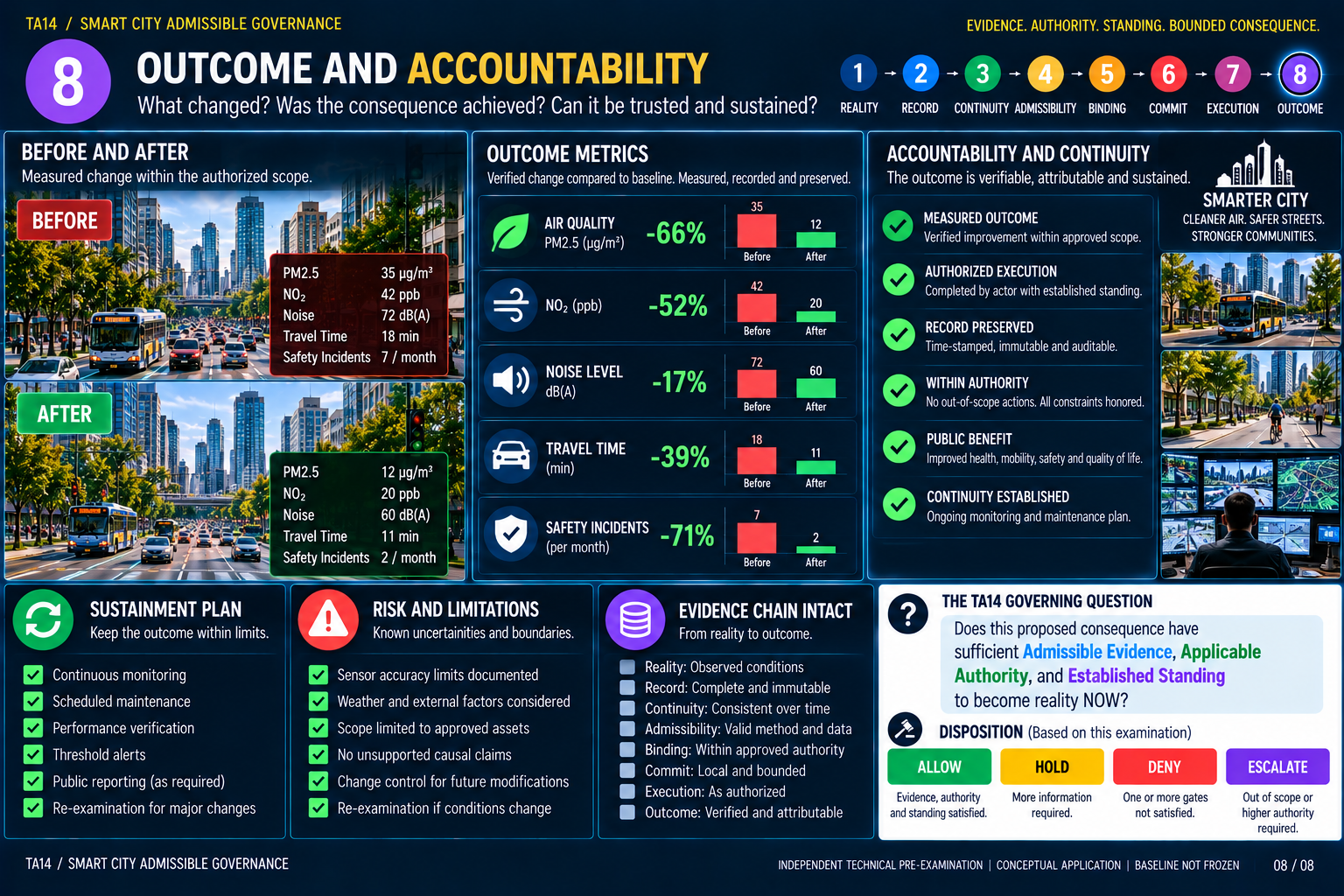
The final illustration asks what actually happened after the action. Completion is not the same as benefit. Suppose a city changes traffic timing to reduce congestion and air pollution. The command may execute correctly while the measured outcome differs from the prediction, or conditions may improve for unrelated reasons. Compare post-action observations with a defined baseline, preserving raw and adjusted data separately, along with timing, operating context, uncertainty and possible confounders. Record adverse effects and whether other neighborhoods or critical services experienced displaced harm. An accountable outcome links the original proposal, evidence, authority, standing, commit and actual execution to observed results that can be independently reviewed. If the outcome is uncertain, report uncertainty rather than claiming success. The before-and-after values in this image are entirely hypothetical and demonstrate no verified municipal improvement. The governance journey ends with an inspectable outcome, not with an unexamined claim that the system worked.
What the examination does not establish
This public room teaches TA14's evidence-and-authority boundary. It makes no claim that a municipality has approved, certified, deployed, or tested TA14; that pictured interventions occurred; or that the visualized outcomes are independently verified. The technical reference describes how a named municipal owner could define a bounded pilot and its acceptance criteria.
Observed is not inferred. Inferred is not authorized. Capability ≠ Authority.
← Explore all TA14 showrooms