TA14 AUTHORITY GOVERNANCE INSTITUTION · INDEPENDENT TECHNICAL PRE-EXAMINATION
When Community Air Becomes Evidence
Tamale, Northern Ghana
From household exposure concerns to defensible environmental evidence, locally authorized intervention, and verified outcomes.
Independent educational demonstration. All pictured people, scenarios, measurements, charts and decisions are illustrative. No field data verification, frozen baseline, formal TA14 disposition, partnership, Ghana Health Service, Quali-Breeze, Kombian James Libaarbor or Air Aware Labs endorsement is claimed.
↓ Download Technical Governance Reference v2.3 (PDF)English chapter narration is available using your device’s speech voices. Samantha is used only if installed.
Eight illustrated chapters. Select Play Narration for browser speech; a Samantha voice is used when available. Images remain independently scrollable.
ONE COMMUNITY SCENARIO · SEVEN EVIDENCE BOUNDARIES
Follow a proposed intervention from concern to outcome
Every observation, measurement, person and proposed action in this walkthrough is hypothetical. No Ghanaian household, clinician or organization has been examined.
01 · Community concern
A household reports smoke during cooking. This is a report, not a verified exposure measurement.
Explore the corresponding chapter ↓CHAPTER 01 / 08
When Community Air Becomes Evidence
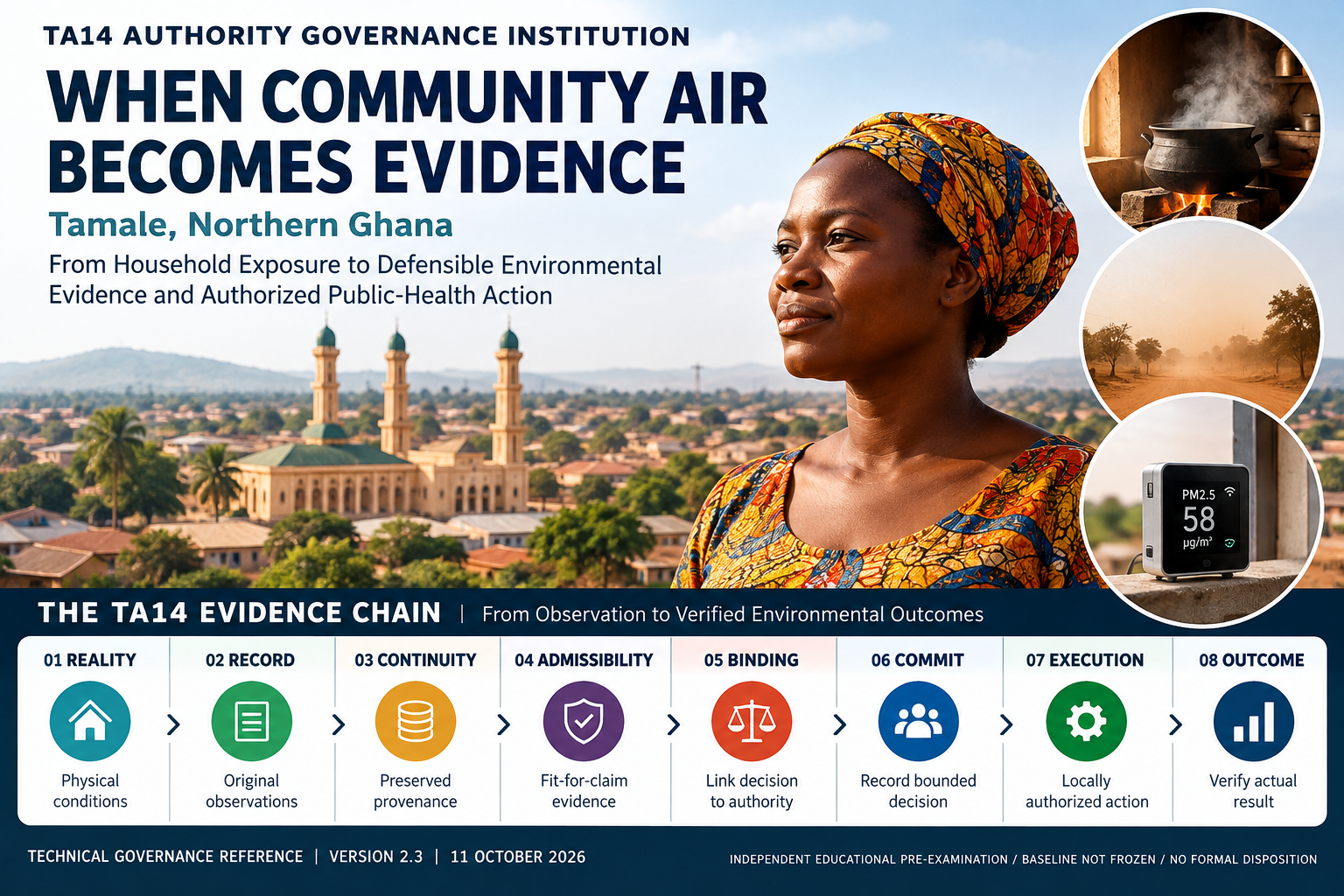
Chapter one. Tamale, Northern Ghana. Community air is a public health concern. TA14 asks how observed conditions can become defensible records, locally authorized interventions, and verified outcomes. This is an independent educational demonstration, not a report of field measurements.
CHAPTER 02 / 08
Community Reality
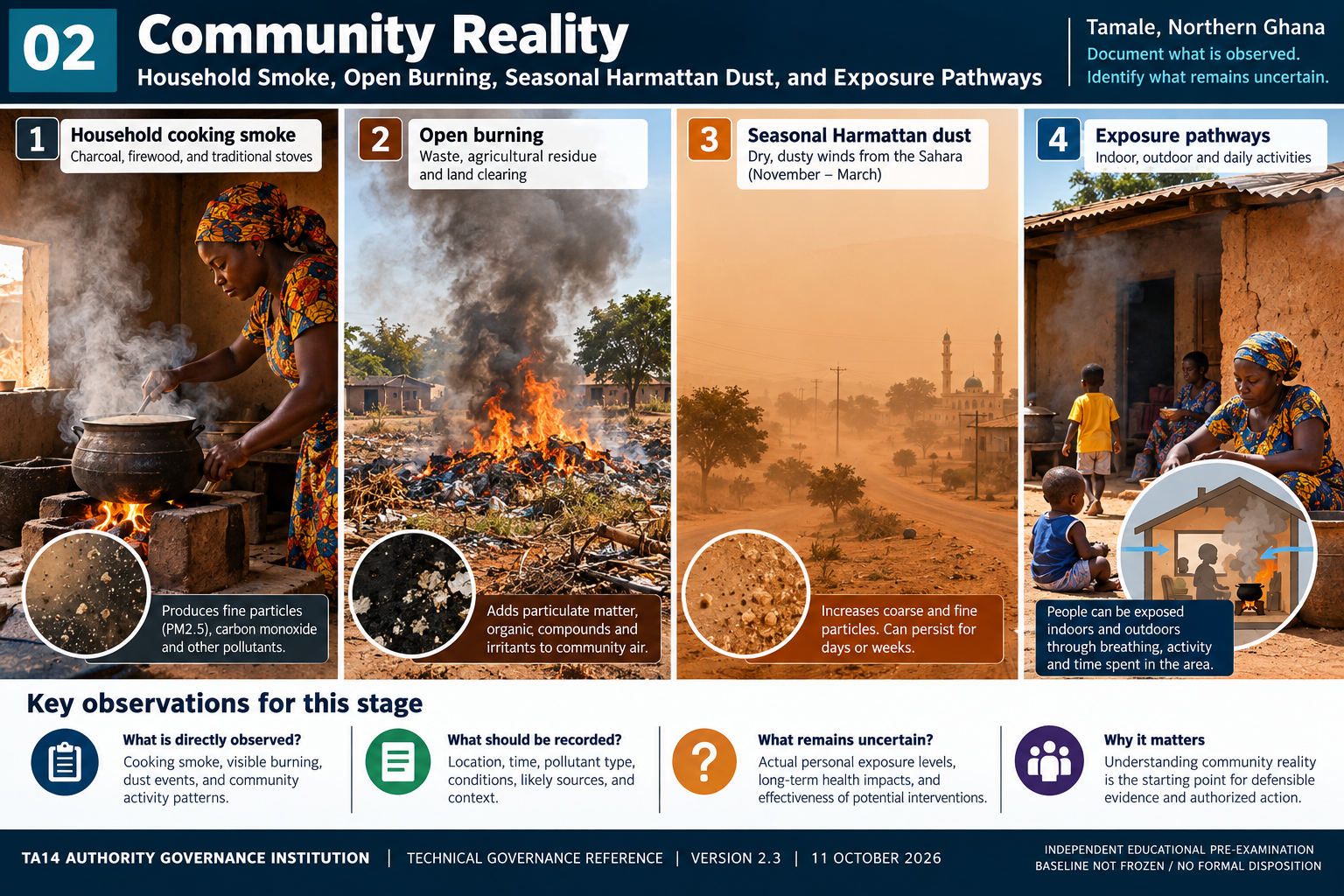
Chapter two. Household cooking smoke, open burning, seasonal Harmattan dust and daily activity can create different exposure pathways. Observe conditions without assuming the source, individual dose, or health effect. Document what is seen and what remains uncertain.
CHAPTER 03 / 08
Environmental Observation
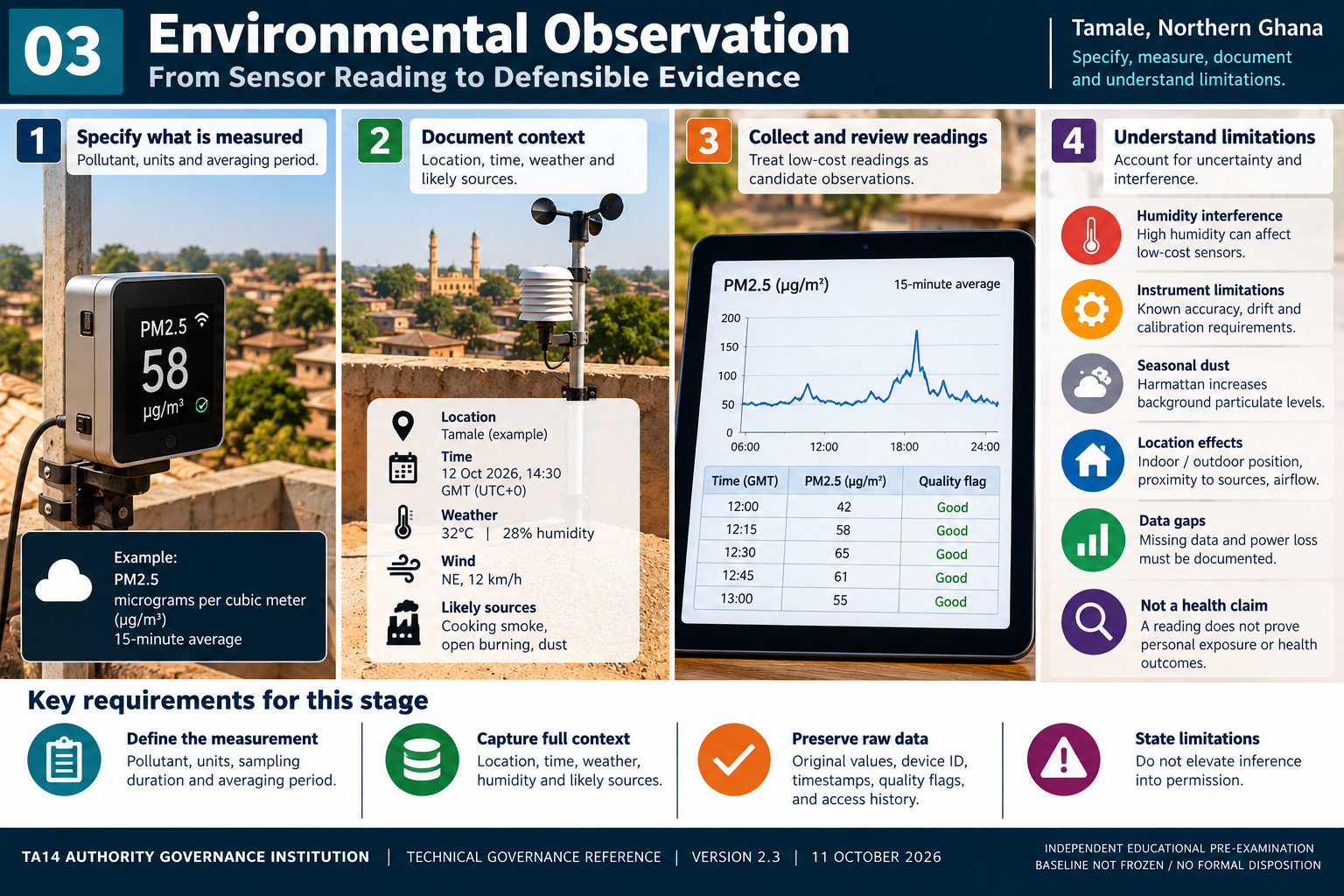
Chapter three. Define the pollutant, units and averaging period. Preserve device identity, placement, timestamp, meteorology and quality flags. A low cost sensor reading is a candidate observation, not automatic proof of exposure or harm. All numbers illustrated are hypothetical.
CHAPTER 04 / 08
Atmospheric Integrity Records
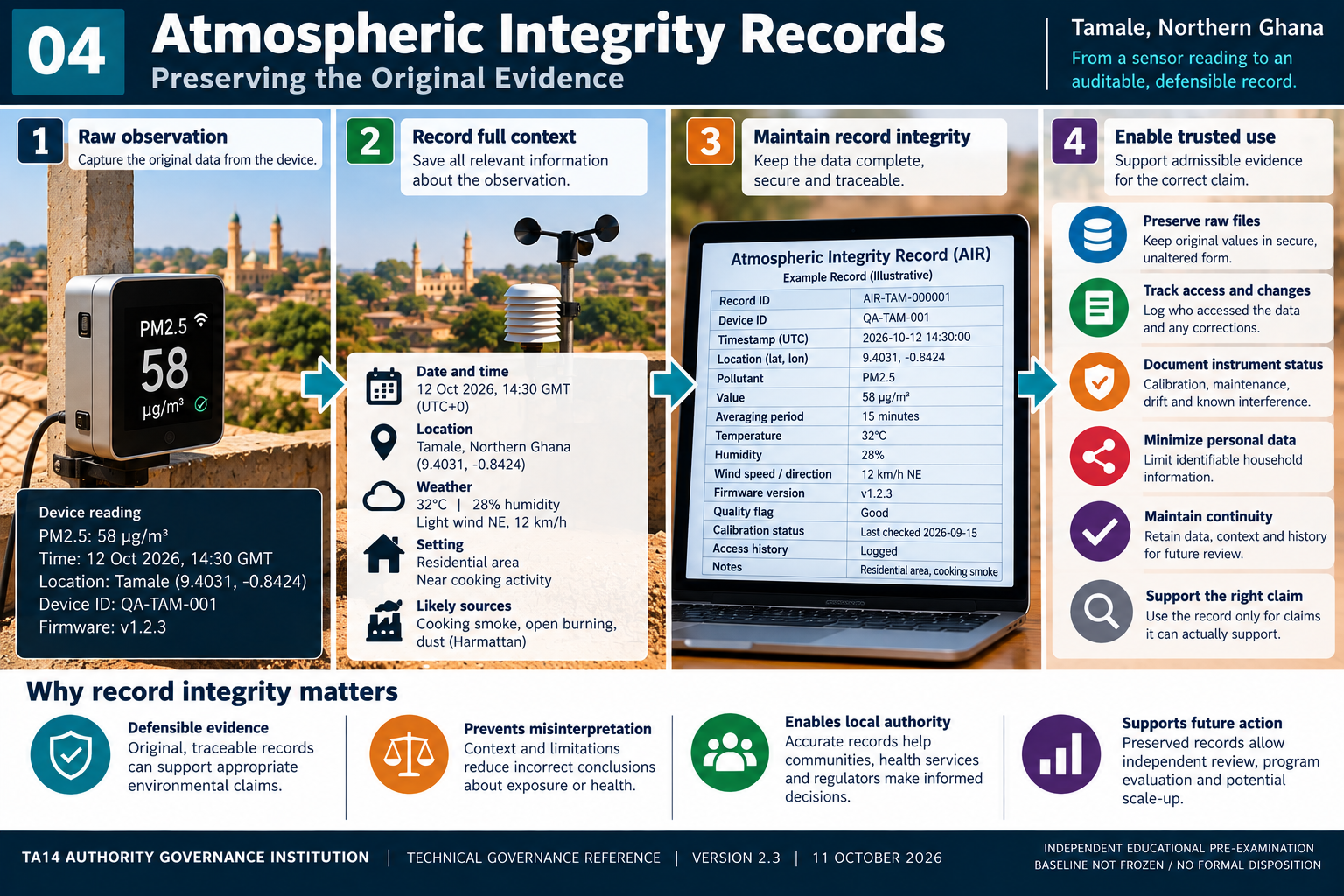
Chapter four. An Atmospheric Integrity Record preserves original readings, provenance, context, changes and uncertainty. Keep raw and adjusted data separate. Preserve access history and protect household privacy. The illustrated record is fictional.
CHAPTER 05 / 08
Community Intervention
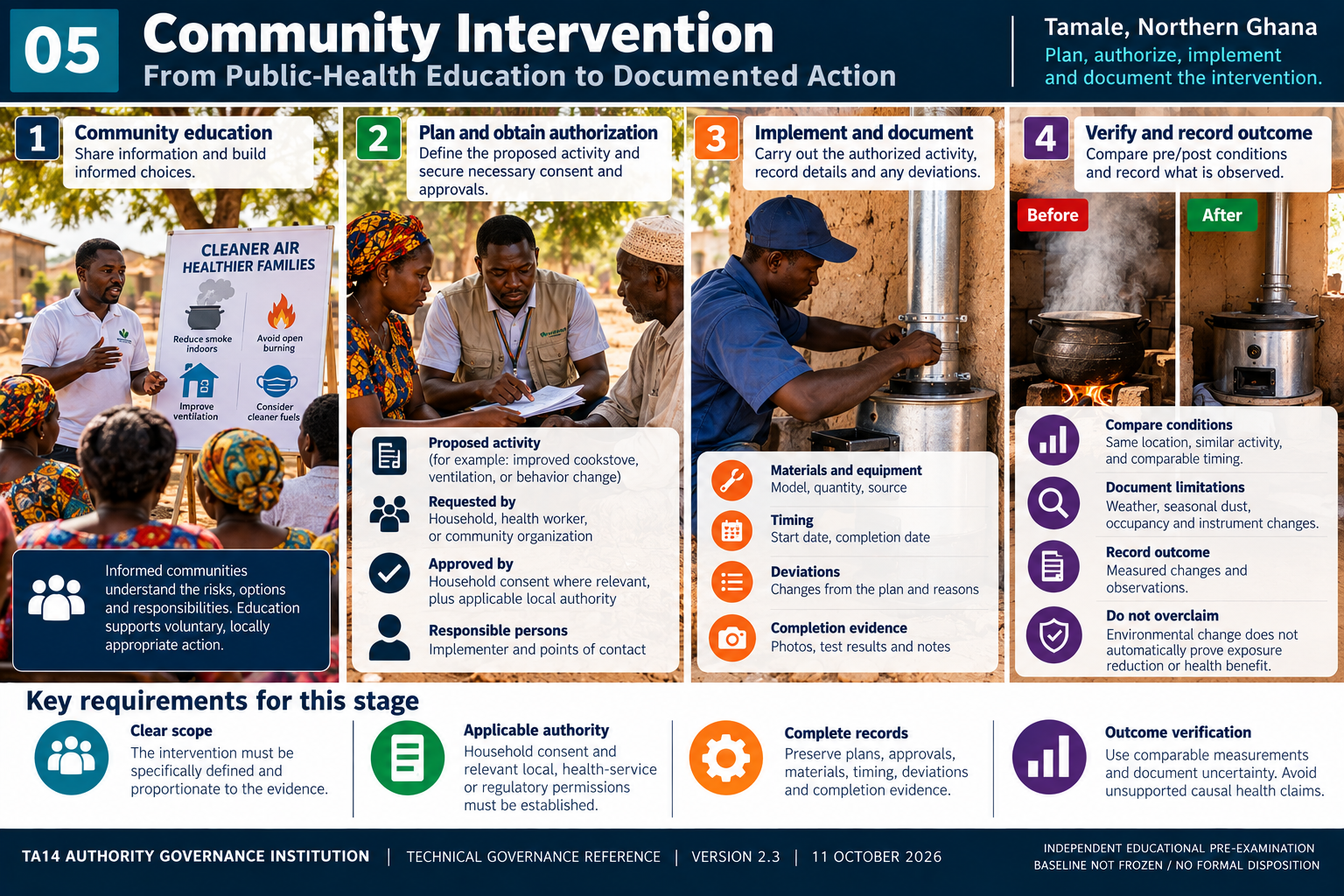
Chapter five. Community education, household consent, proposed changes and implementation must be documented. Who requested the action? Who has permission? What was actually done? The illustrations are teaching scenarios, not evidence that a program was implemented.
CHAPTER 06 / 08
Evidence Admissibility
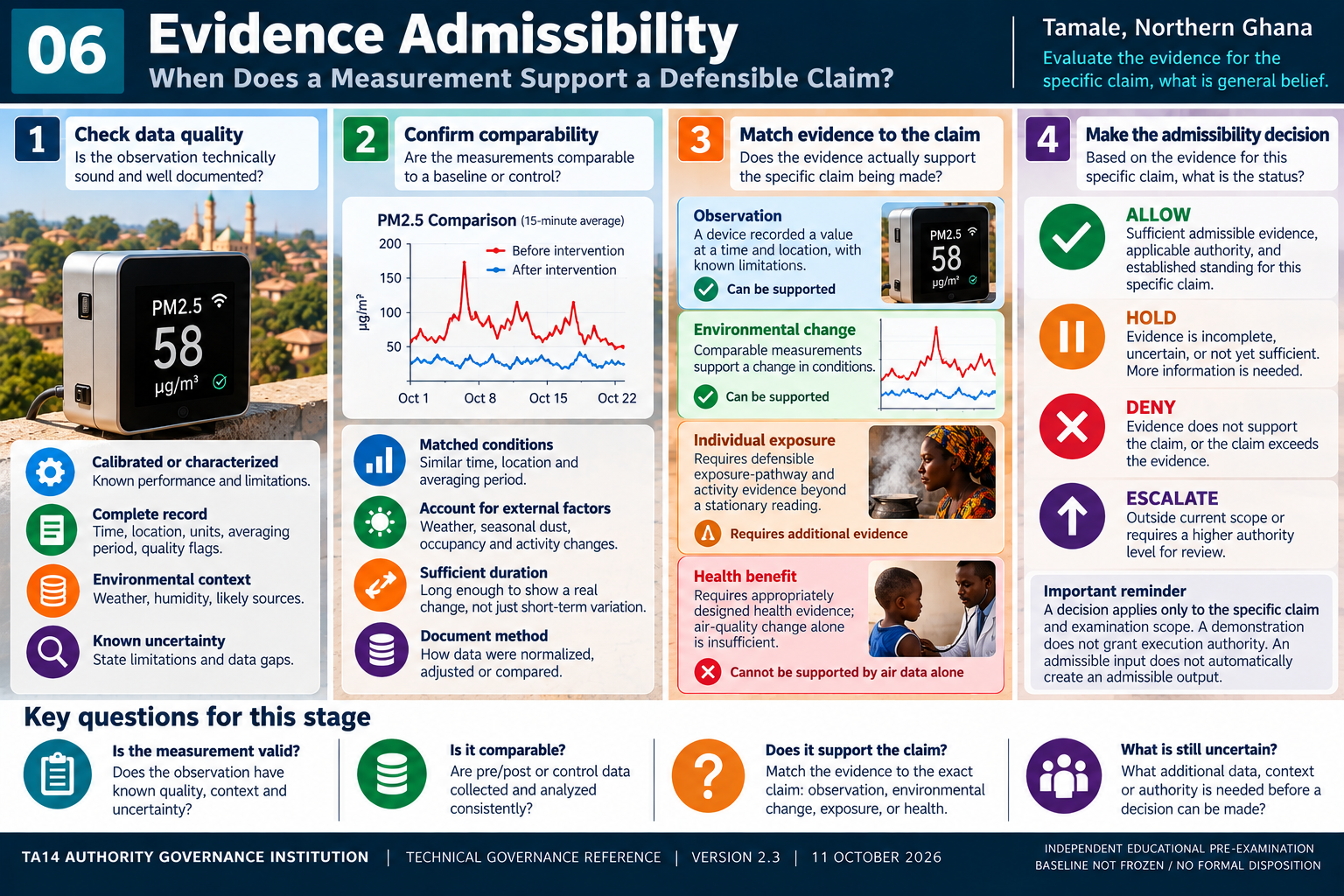
Chapter six. Examine data quality, comparability, context and claim-specific sufficiency. A change in monitored air quality does not automatically prove personal exposure reduction or health benefit. The TA14 dispositions are allow, hold, deny and escalate. This showroom makes no formal disposition.
CHAPTER 07 / 08
Local Execution Authority
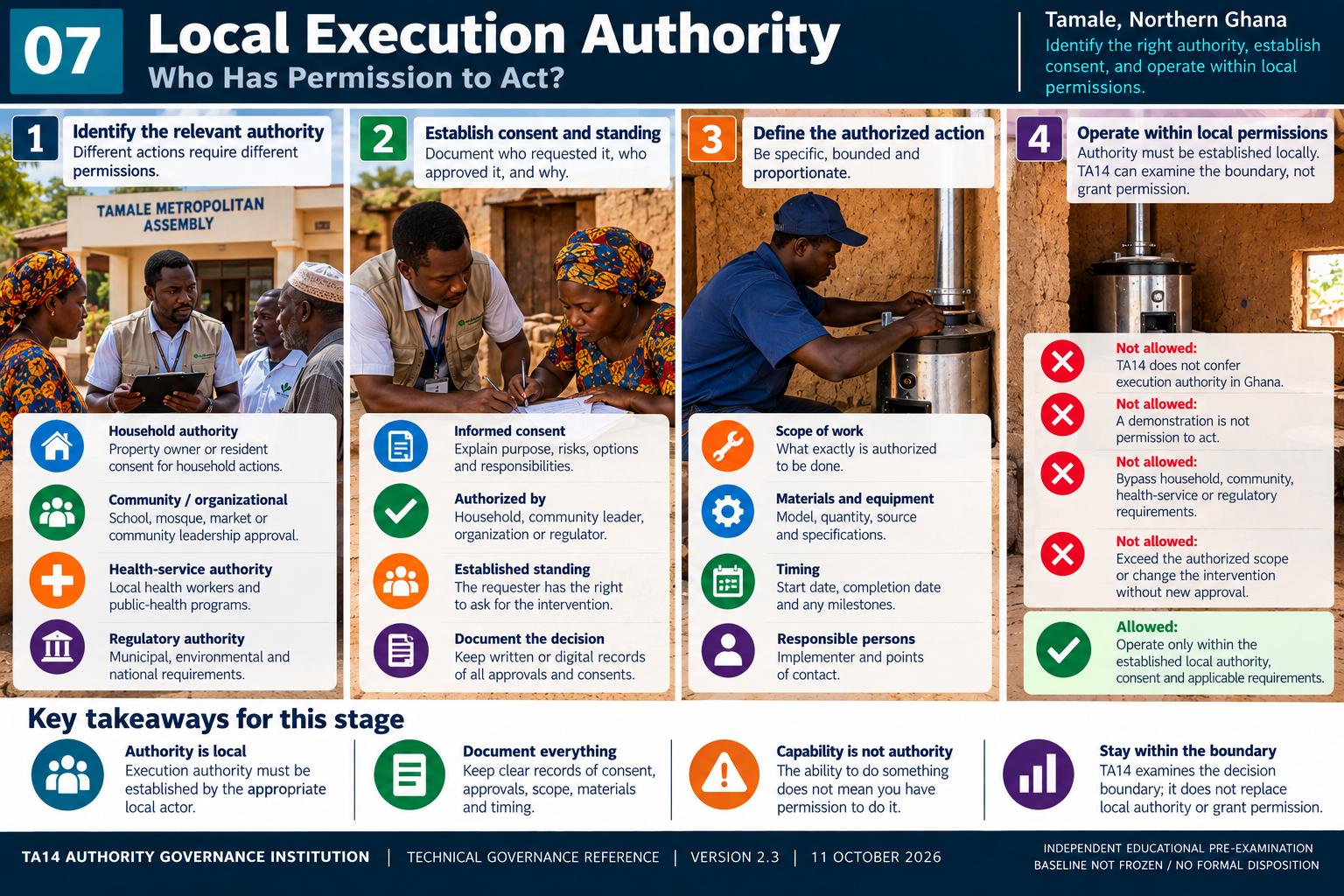
Chapter seven. Capability is not authority. Establish consent, applicable local permission, responsible actors and bounded scope before execution. TA14 does not grant authority in Ghana and cannot override household, health service or regulatory requirements.
CHAPTER 08 / 08
Verified Outcomes
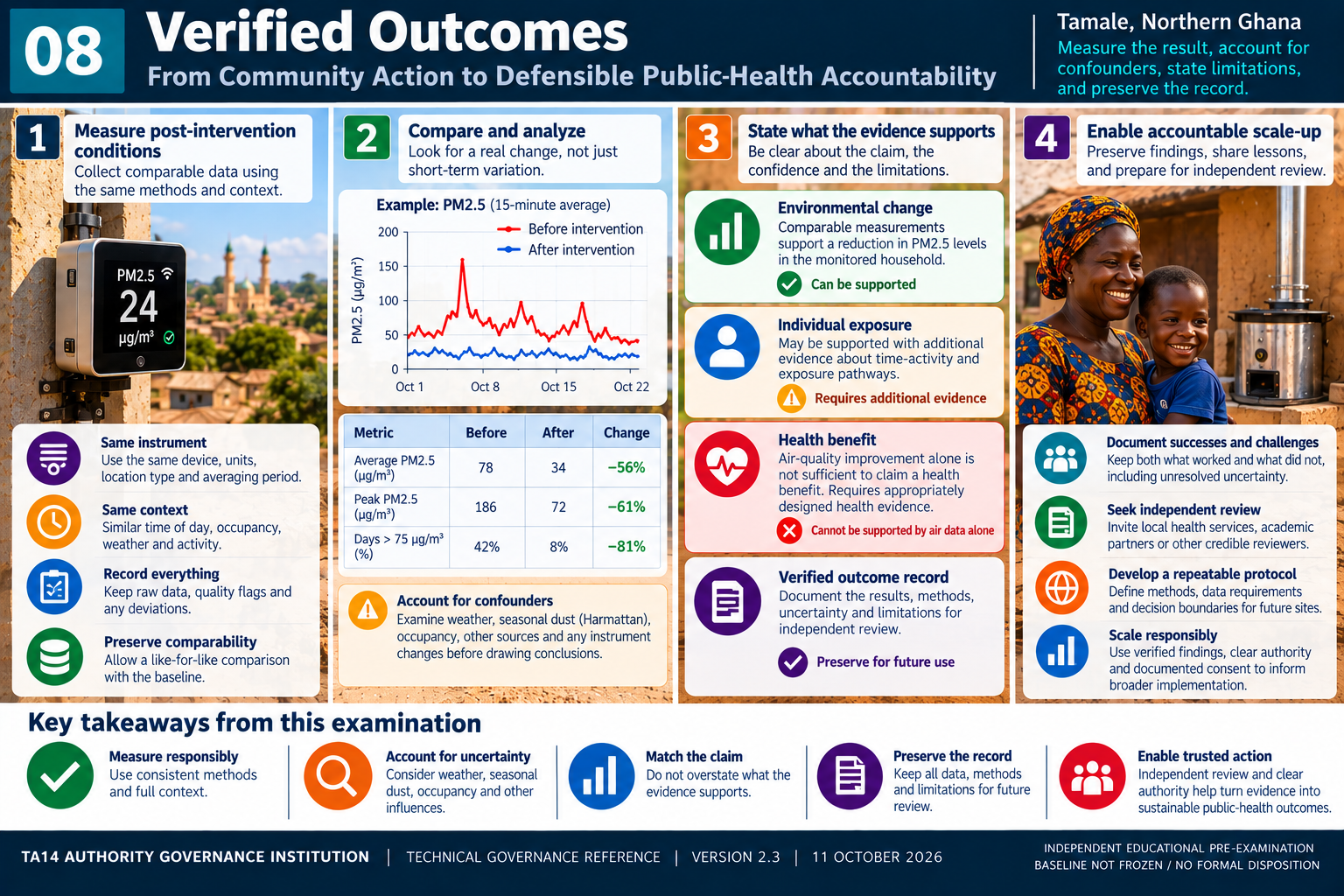
Chapter eight. Compare like with like after intervention, accounting for seasonal dust, weather, occupancy, instruments and activity. Record both successes and uncertainty. Environmental improvement is not proof of a health benefit. The displayed charts and results are hypothetical.
Interactive Evidence & Authority Examination
Entirely hypothetical: A community monitor reports a PM2.5 value of 68 µg/m³ (24-hour average) and proposes a household cookstove modification. This is an invented teaching number, not a Tamale measurement, exposure finding or health conclusion.
For each independent gate, choose what the hypothetical case file actually establishes. Your selection is an assertion for learning purposes, not independent verification.
HOLD — ILLUSTRATIVE
At least one evidence, permission, standing or outcome condition remains unestablished. Preserve HOLD.
Does this proposed consequence have sufficient Admissible Evidence, Applicable Authority, and Established Standing to become reality NOW?
Possible TA14 dispositions: ALLOW / HOLD / DENY / ESCALATE. This simulator issues no formal disposition, makes no real-world authorization and does not establish any health effect.
Field-practitioner review · Your expertise matters
This independent demonstration invites constructive technical criticism from community health and environmental practitioners. It does not imply their participation, approval or endorsement.
- Which community exposure pathways are missing or oversimplified?
- What observations can field teams actually document reliably?
- Which household consent, public-health or regulatory boundaries must be represented?
- What seasonal, cultural or instrument factors would undermine a before/after comparison?
Interested in a bounded technical exploration? Send your observations, proposed scope and any permission constraints in writing. Do not submit identifiable household or patient information through an unsolicited message.
Email independent technical feedback →A discussion or submission does not establish registered governance, institutional standing or a formal TA14 examination.