TA14 AUTHORITY GOVERNANCE INSTITUTION · INDEPENDENT PRE-EXAMINATION
Preserving School Air
as Admissible Evidence
Chiang Mai, Thailand · Two smoke seasons · From classroom PM2.5 observation to evidence, authority, and verified consequence.
A guided interpretation of AirGradient's published comparison of classroom air purifiers and positive-pressure systems. This is not an independent verification of the underlying measurements.
.png)
The governing question
Does this proposed consequence have sufficient Admissible Evidence, Applicable Authority, and Established Standing to become reality NOW?
Reality → Record → Continuity → Admissibility → Binding → Commit → Execution → Outcome
TEACHING IMAGE 01 OF 08
Children Breathe Here
Start with the children, not the equipment. Smoke outside is a real environmental concern, but an individual child's exposure cannot be calculated from this illustration.
.png)
Children experience the air that actually exists in the classroom.
What specific conditions must be observed in occupied classrooms before an intervention can be justified?
TEACHING IMAGE 02 OF 08
From Observation to Evidence
A sensor number alone is not a complete evidence record. We need units, timestamp, instrument, location, methods, and operating context.
.png)
A PM2.5 reading becomes useful evidence only with attributable context.
Were both technologies observed during comparable school hours and under documented conditions?
TEACHING IMAGE 03 OF 08
Two Approaches, Different Results
In 2025 the reported outdoor, purifier, and included PPS means were 58.7, 24.2, and 3.4 micrograms per cubic meter. In 2026 they were 87.8, 17.4, and 5.0. These are observed group averages, not proof of a universal effect.
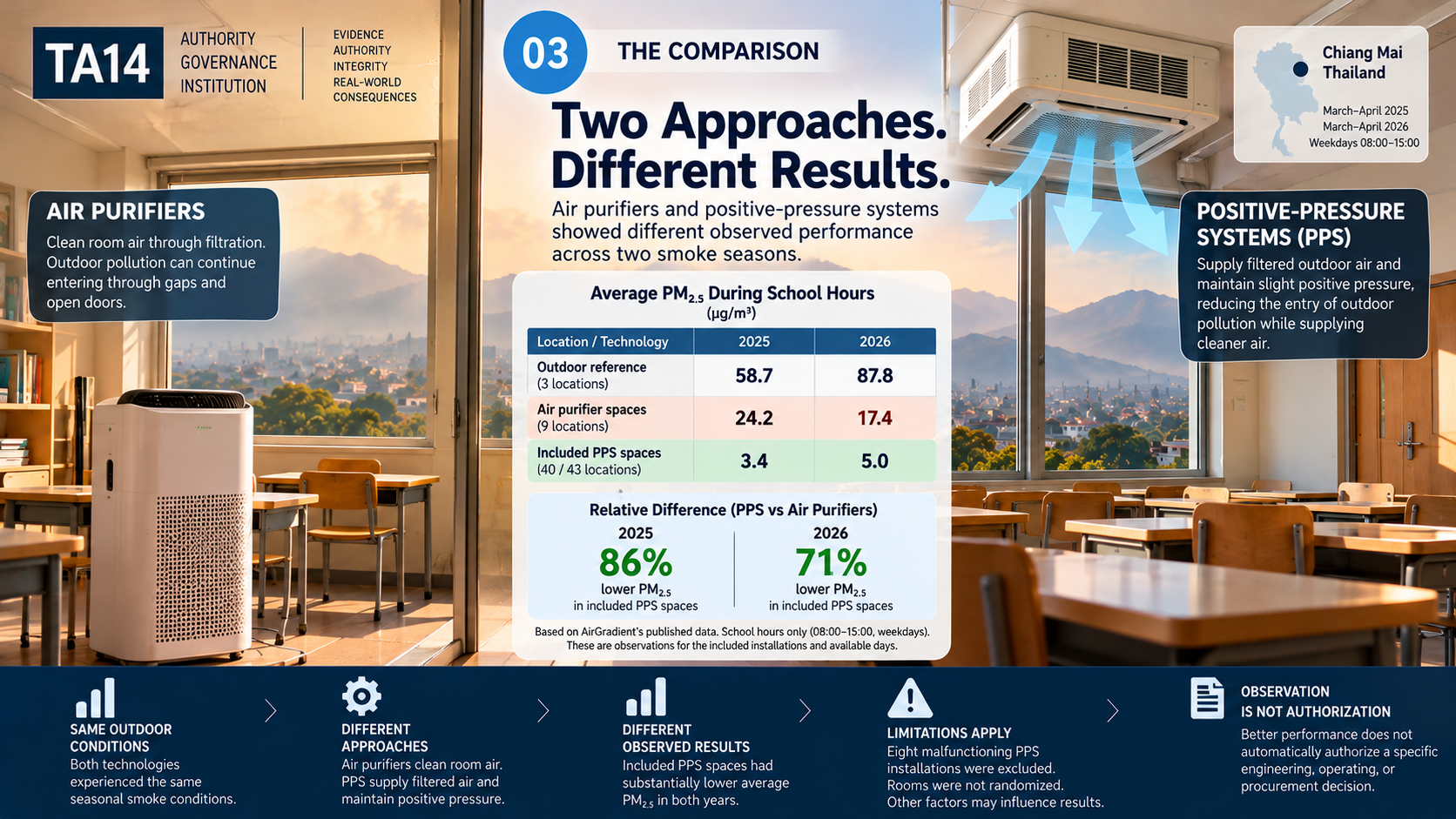
The reported classroom comparisons favor positive-pressure systems among included installations.
How does the exclusion of eight malfunctioning or unmaintained PPS systems change the interpretation?
TEACHING IMAGE 04 OF 08
The Exceptions
The eight excluded installations are a crucial operational limitation. Specific failure scenarios drawn in the teaching image are illustrative, not verified diagnoses of those eight systems.
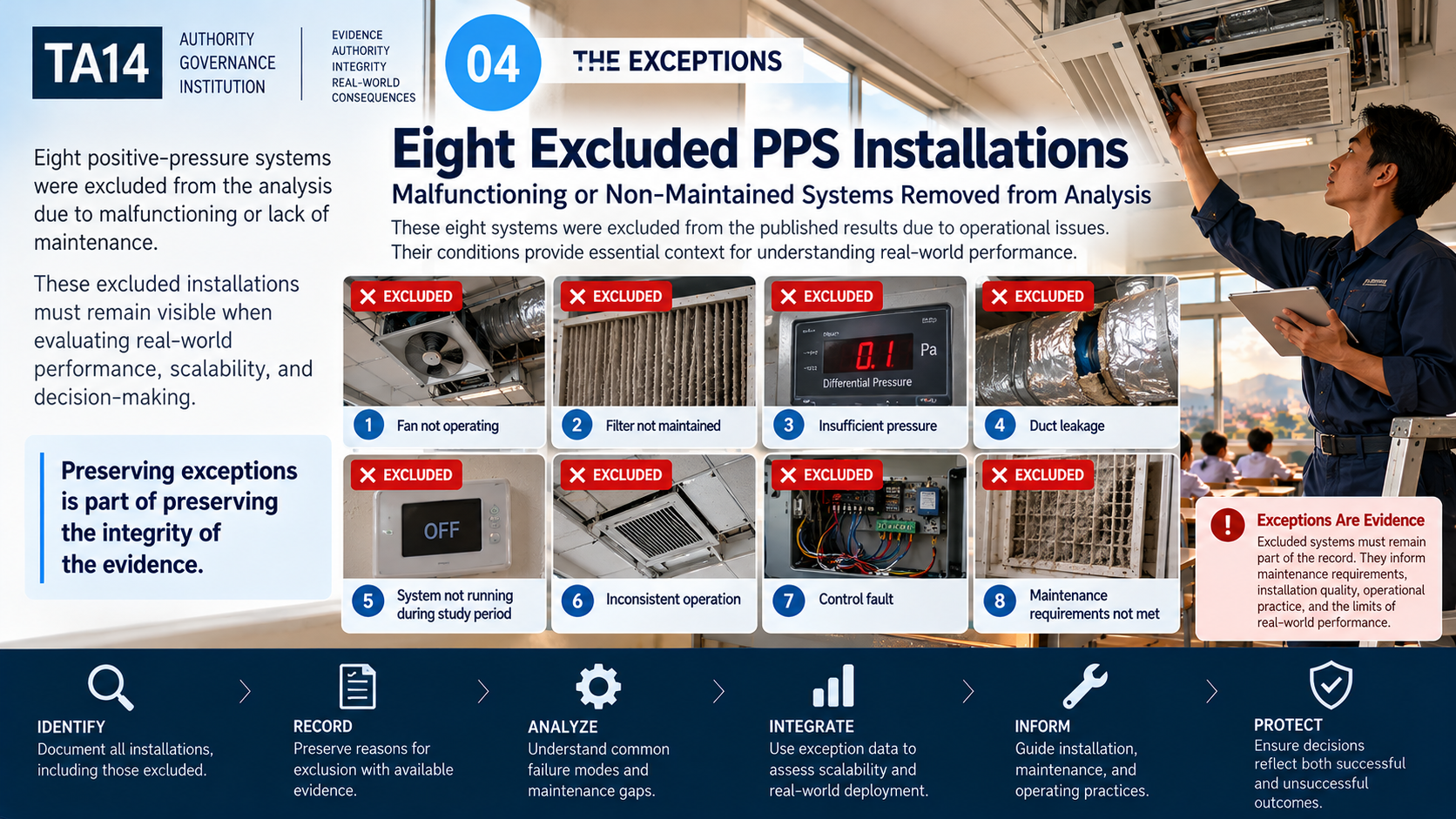
Eight malfunctioning or non-maintained installations were excluded from the performance comparison; their individual failure causes are not established here.
What maintenance, fault history, and exclusion reasons would an independent examiner need?
TEACHING IMAGE 05 OF 08
Traceable Air Quality Evidence Record
An evidence record should preserve raw values and transformations separately. Example record IDs and sample sensor values shown in this teaching image are illustrations.
.png)
Preserve raw readings, timestamps, instruments, maintenance context, methods, and limitations.
Could an independent reviewer reconstruct the comparison and identify missing records?
TEACHING IMAGE 06 OF 08
Evidence Fit for the Decision
Evidence adequate for a published observational comparison may not be adequate to authorize a particular school's construction or procurement decision.
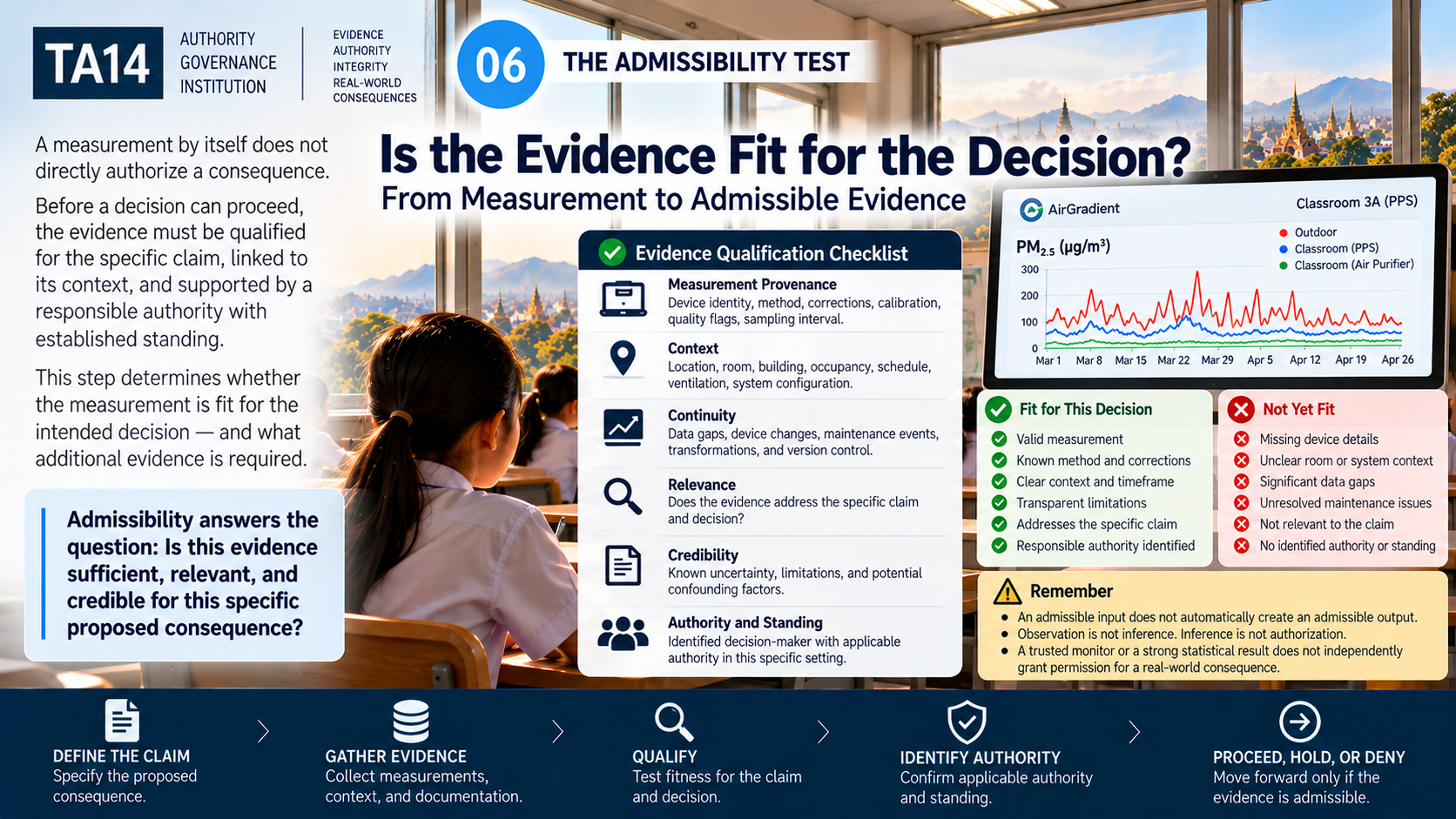
Evidence sufficient for a research comparison may not suffice for a specific school investment.
What local evidence, constraints, professional judgment, and authority remain unestablished?
TEACHING IMAGE 07 OF 08
From Evidence to Authorized Action
Research can inform a recommendation. Engineers can evaluate options. Only actors with applicable authority and standing may approve the specific consequential action.
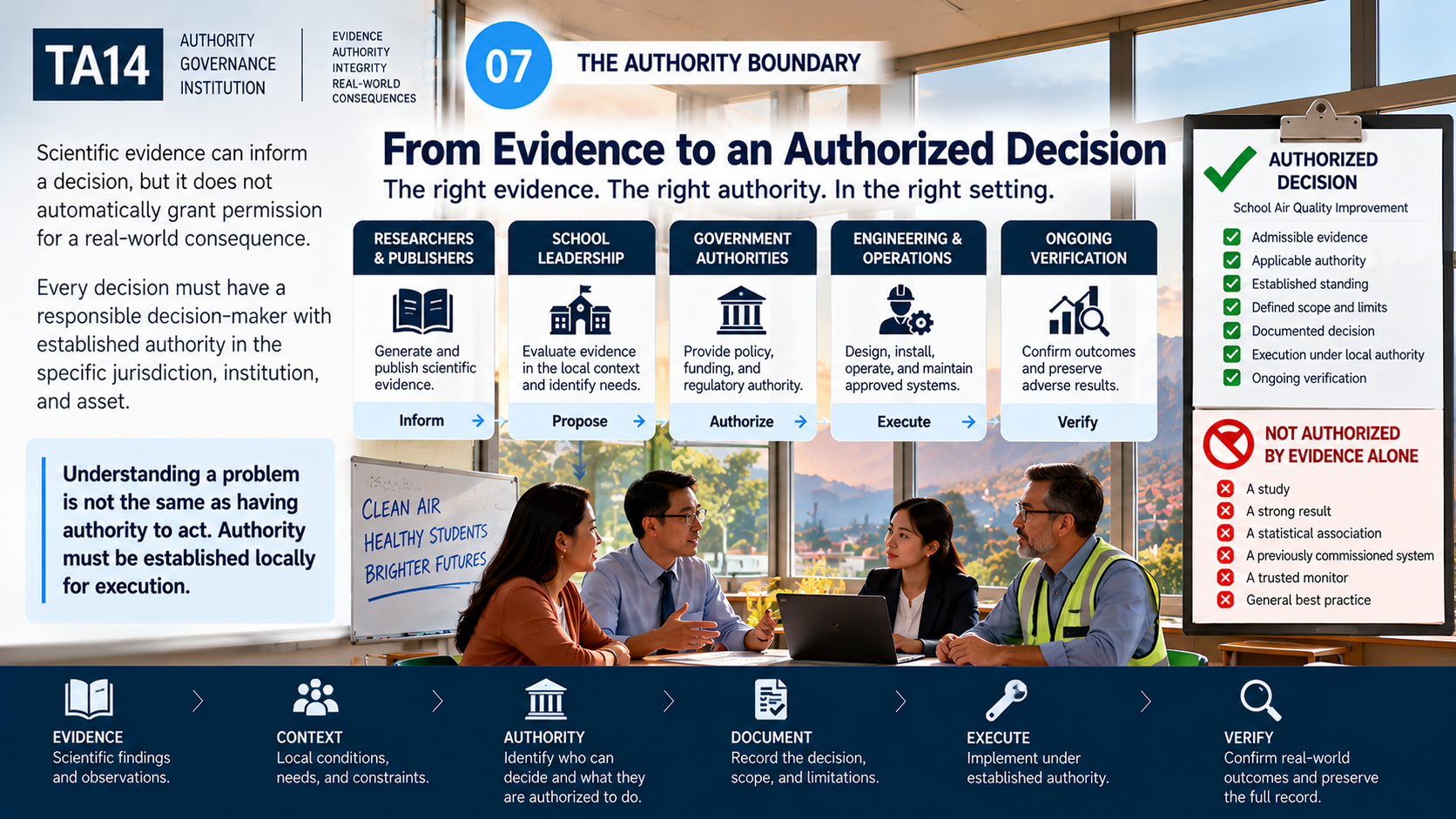
An intervention requires applicable authority, established standing, and a bounded commitment.
Who authorizes this exact scope, and when must the authorization be revalidated?
TEACHING IMAGE 08 OF 08
From Authorization to Real-World Impact
After an authorized intervention, preserve what was installed, tested, accepted, and measured. The illustration's dashboard values are examples, not original study readings. Health and attendance improvements would require separate evidence.
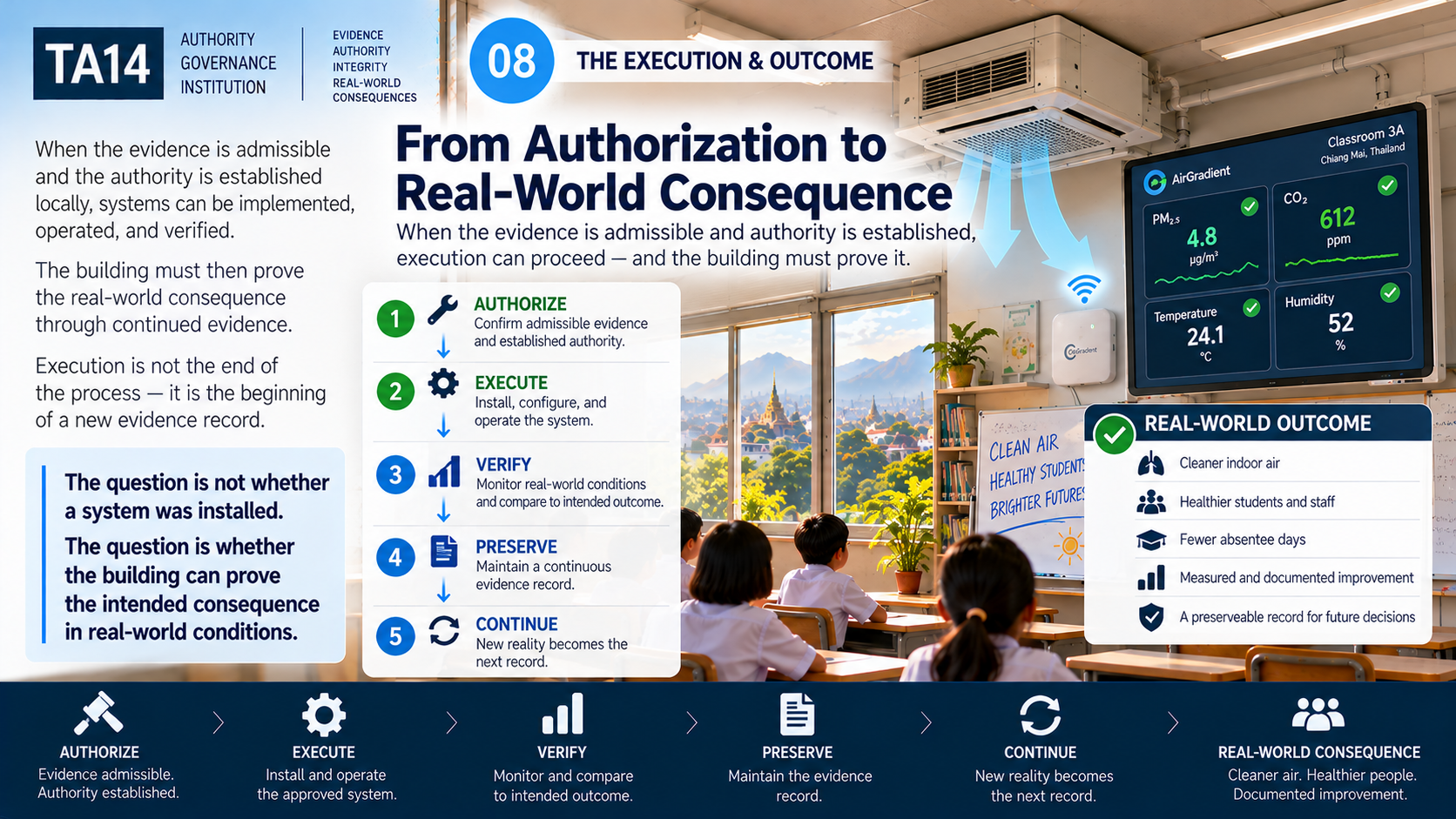
Verify what was executed, what changed, and what remains uncertain.
What outcome was actually measured, what remained uncertain, and what must be monitored next?
Reported findings and boundaries
The study reported mean classroom PM2.5 of 24.2 versus 3.4 µg/m³ in 2025, and 17.4 versus 5.0 µg/m³ in 2026, for purifier and positive-pressure groups respectively during school opening hours. These are comparisons among included installations, not randomized treatment effects. Eight malfunctioning or non-maintained positive-pressure installations were excluded. Their exclusions remain material to generalizability and operational decision-making.
Published source: AirGradient classroom field-performance study.