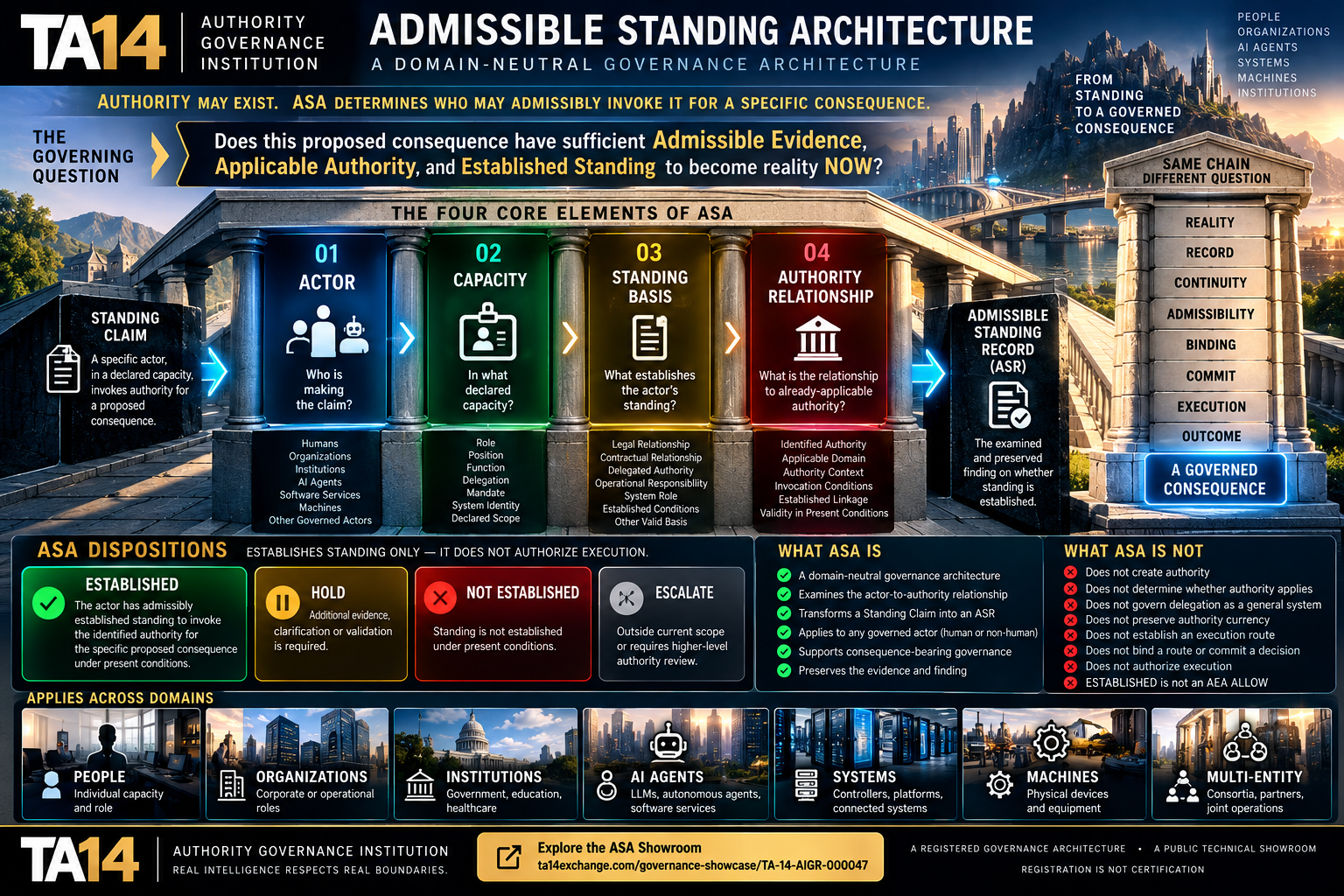
ACTOR
Who or what asserts standing?
Samantha walks through the four-anchor core, the difference between authority and standing, the Admissible Standing Record, and the exact boundary where ASA stops.
Welcome to the TA14 Admissible Standing Architecture. ASA exists because applicable authority and established standing are not the same determination. Authority answers what may legitimately govern. Standing answers who may legitimately invoke it. Start with the actor. Who or what is making the standing claim? Then capacity. In what declared role, office, assignment, agency, function, or machine capacity is that actor acting? Identity alone is not capacity. Third is standing basis. What admissible evidence supports the claimed relationship? A credential, login, license, contract, passport, technical capability, or organizational affiliation may contribute evidence, but none automatically manufactures standing. Fourth is authority relationship. How does the standing basis connect this actor, in this capacity, to the already applicable authority for this specific proposed consequence now? ASA then produces an Admissible Standing Record with one of four dispositions: Established, Not Established, Hold, or Escalate. Established means the actor to authority relationship has been established for the examined standing claim. It does not authorize execution. ASA does not create authority. It does not decide whether authority applies. It does not bind an execution route. It does not commit a decision. And ASA Established is not AEA Allow. The deeper TA14 rule is simple: no applicable authority can manufacture standing, and no standing determination can itself authorize execution. This is why standing is its own governance problem.
Who or what asserts standing?
In what capacity is the actor acting?
What admissible basis supports the claimed relationship?
How does that basis connect this actor to already-applicable authority?
Change the claimant context and watch why authority alone cannot answer the standing question.
Owner A
Asset owner
Ownership record + current governance context
Owner relationship to already-applicable authority is supportable for this consequence.
What can be relied upon as evidence for this consequence?
What authority legitimately governs this proposed consequence now?
Who, in what capacity, has the admissibly established relationship necessary to invoke that authority?
No admissible evidence can manufacture authority. No applicable authority can manufacture standing. No standing determination can itself authorize execution.
Actor. Declared capacity. Standing basis. Actor-to-applicable-authority relationship. A bounded ASR disposition: ESTABLISHED, NOT ESTABLISHED, HOLD, or ESCALATE.
Create authority. Decide authority applicability. Repair delegation. Preserve authority currency. Establish an execution route. Perform Binding. Commit a decision. Authorize execution. Guarantee outcome.
TA14 Admissible Standing Architecture · TA-14-AIGR-000047 · v1.0-RC1 · Registration is not certification.