INPUT
Candidate request enters the workflow.
Govern the path — not just the output.
SWI is a registered evidence-governance architecture for examining how a candidate AI or automated workflow moves from an input toward a consequence-bearing action. This showroom teaches the registered claims without turning registration into certification.
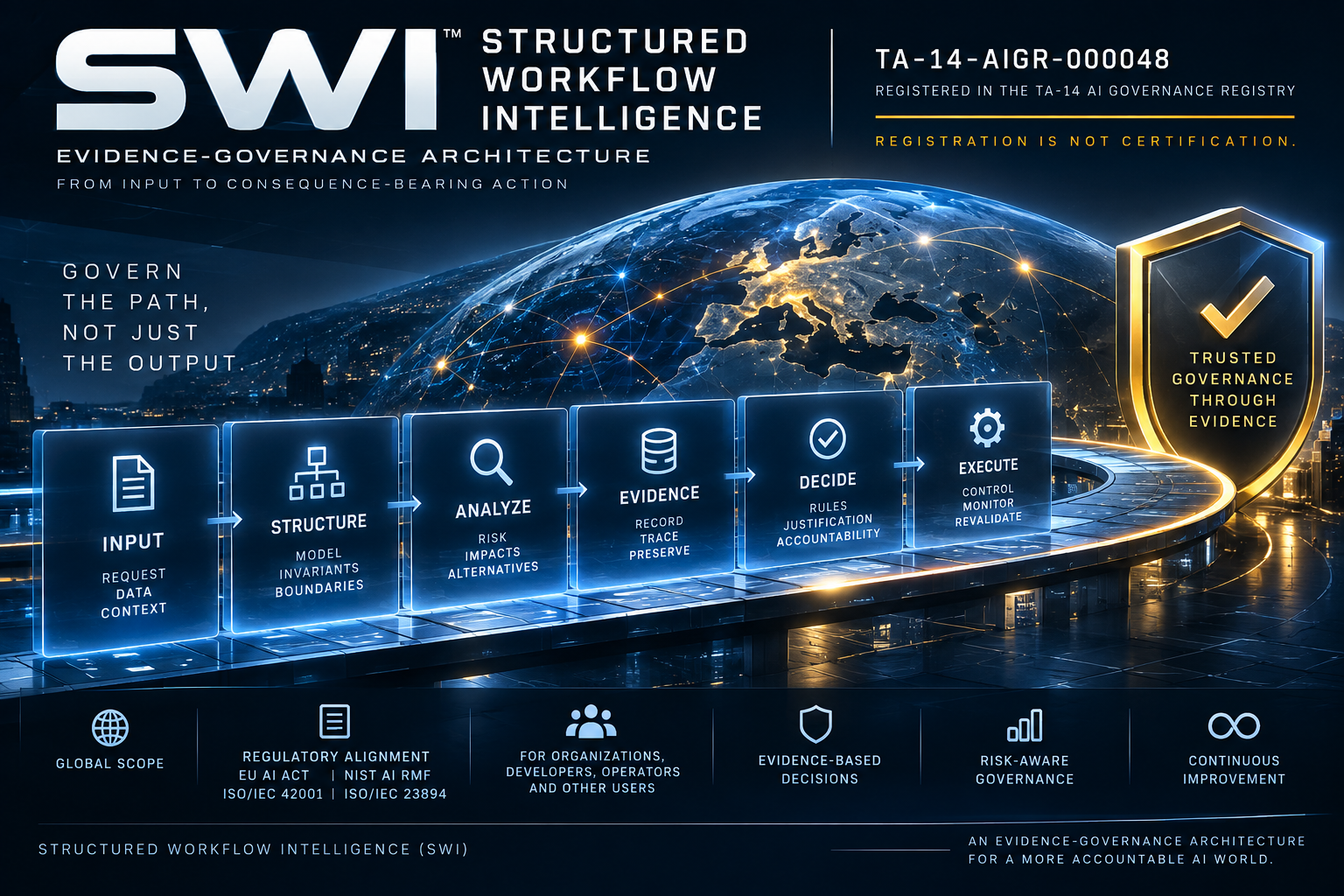
This is Structured Workflow Intelligence, registered as TA-14-AIGR-000048. Start at input. A request enters a governed workflow. Structure separates the request from the conditions that must be satisfied. Analysis can inspect risk, impacts and alternatives, but computation does not create authority. Evidence records what supports the decision and preserves what failed. Decide is a bounded governance outcome, including a deny or halt path when admission conditions are not satisfied. Execute is deliberately separated: a recorded governance decision does not prove that an external system enforced it. That boundary matters. SWI is registered, but registration is not certification, and the preserved record states that SWI remains sealed and not production ready.
Select a condition and watch the declared governance path respond. The model teaches SWI's registered position; it is not a TA-14 runtime certification.
Candidate request enters the workflow.
Workflow conditions and boundaries are structured.
Risk, impacts and alternatives can be examined.
Decision evidence is recorded and preserved.
Defined admission conditions produce a bounded decision.
External execution remains a separate enforcement dependency.
SWI's useful governance contribution is not another AI answer. It is the attempt to make the path inspectable: what entered, how the workflow was structured, what analysis occurred, what evidence survived, what decision was recorded, and where responsibility passes to an external execution system. That makes the workflow pressure-testable instead of merely impressive.
A candidate request is not yet a governed consequence. Conditions, boundaries and admission logic must become explicit before a decision can carry weight.
A result is stronger when the record preserves supporting evidence, rejected evidence and failures instead of presenting only the successful path.
A governed workflow must be able to stop. Missing authority, bad-integrity evidence or unmet admission conditions cannot be repaired by confidence or capability.
SWI can preserve a governance decision. That does not prove an external API, agent, machine or institution obeyed it. The handoff remains a separate proof burden.
The current-main reproduction includes two failed tests, including a node-registry failure. That is not a reason to cosmetically weaken the showroom. It is exactly why preserved evidence matters: a governance record should retain adverse observations alongside successes. The submitted reproduction was participant-commissioned and AI-assisted, not an independent TA-14 examination.
SEPARATE PROOF BURDEN
TA-14-AIGR-000048 is a public registered governance record. The Registry accepted the record as sufficiently attributable, bounded and preserved.
Registration is not certification. TA-14 did not certify SWI's performance, legality, safety, production readiness, or fitness for execution.
The preserved SWI evidence records successful reproduced test runs, tampered-evidence rejection, bad-integrity rejection, and also preserves two failed tests in the current-main reproduction. The submission identifies the reproduction as participant-commissioned and AI-assisted, not an independent examination.