GOVERNED
CONNECTION PROFILE
What must a building, asset, or city expose so independent systems can connect meaningfully — and TA-14 can govern a proposed consequence at the boundary between proposal and reality?
Independent systems. Shared meaning. Governed consequence.
This is not a requirement that a building become a TA-14 system. The Connection Profile defines the permitted crossing envelope: the minimum information and relationships that must be available for a meaningful governed connection, and the maximum authority-bearing content that may cross without improperly inheriting local execution authority.
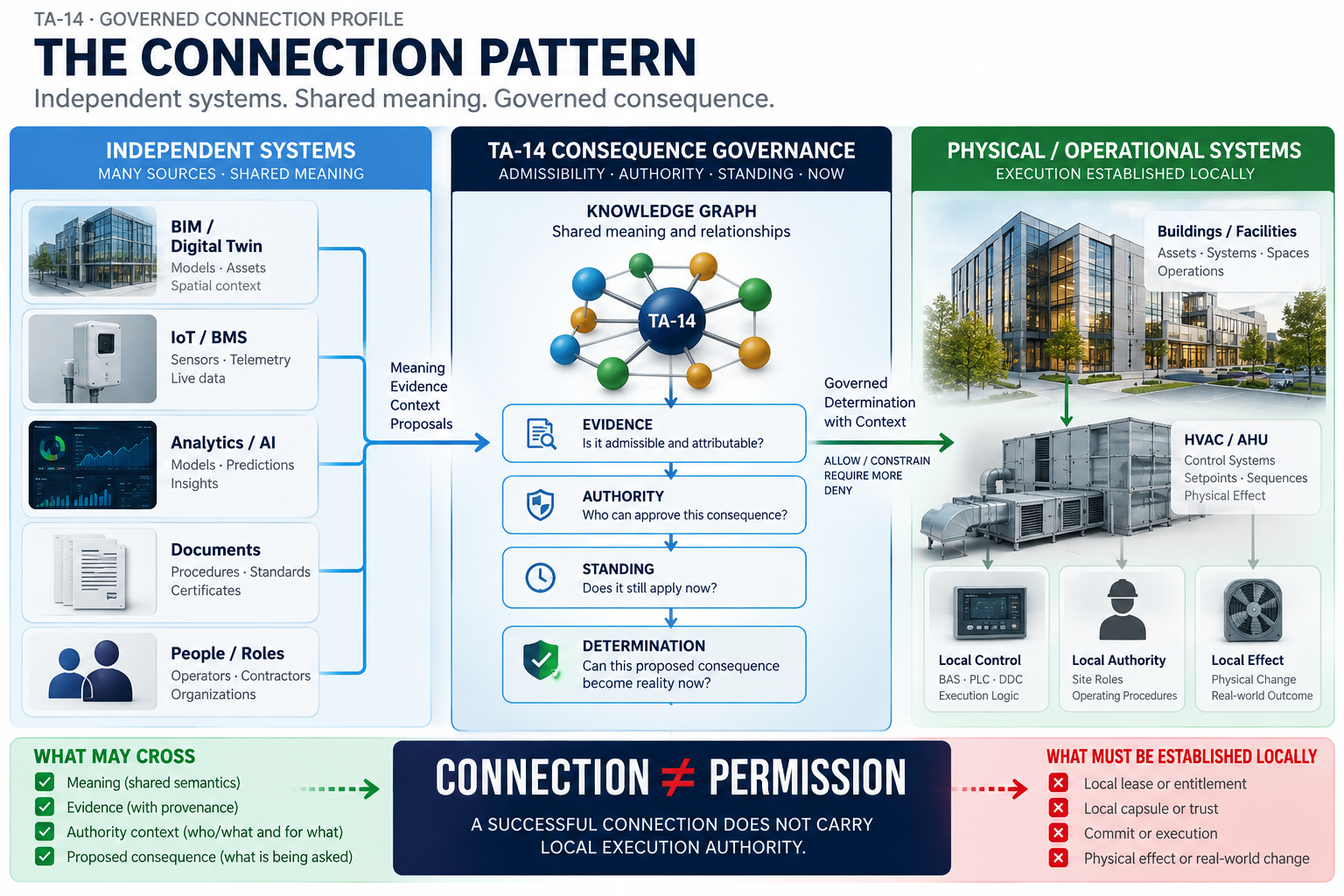
Once independent systems can share meaning, identity, and interaction, the architecture needs a hard boundary around what may cross and what must remain locally established. That is the permitted crossing envelope.
The profile says what must cross — and what cannot.
A governed connection is bounded in both directions. The minimum side establishes what must be present for the crossing to be meaningful. The maximum side prevents connectivity, trust, identity, compatibility, or a prior determination from silently becoming local execution entitlement.
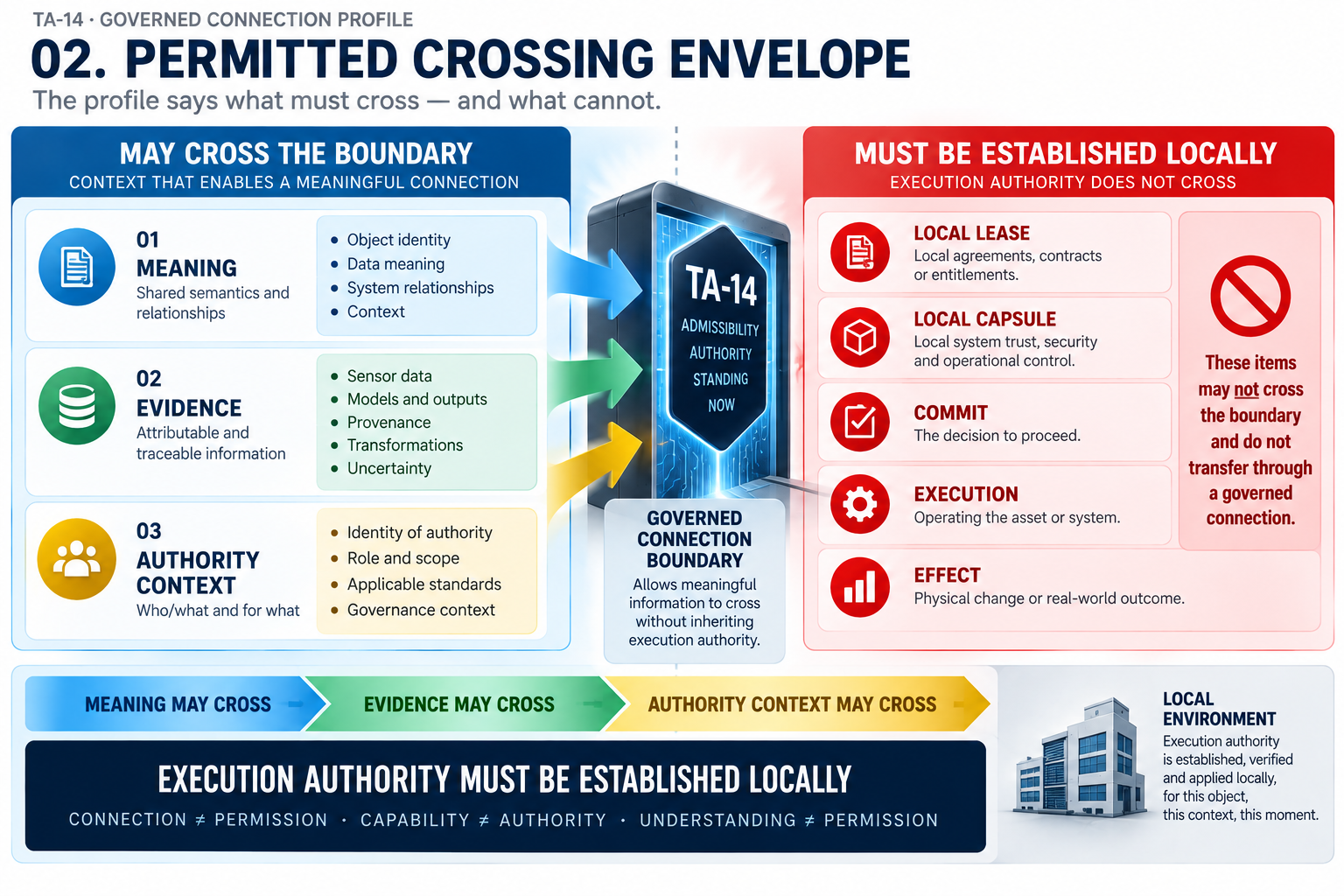
The next image turns the crossing rules into a minimum knowledge graph: what object, what reality, what consequence, what evidence, what authority, what standing, and what outcome are actually connected.
Persistent identity · current reality · explicit consequence · evidence + provenance · identifiable authority · current standing · an attached determination path.
Local lease · local capsule · commit · execution · effect. Successful crossing does not carry local permission to act.
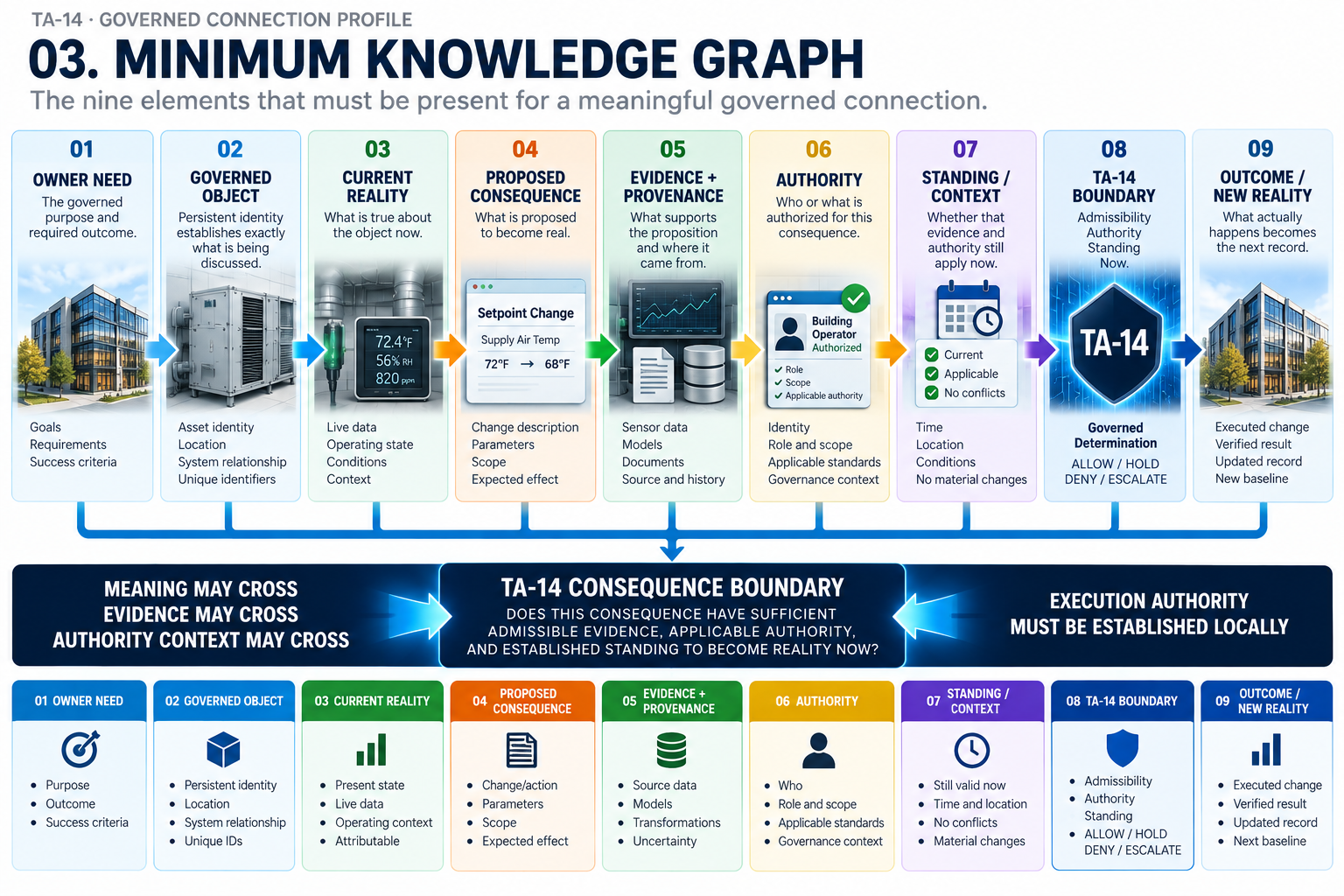
Now the architecture is pressure-tested against AHU-17. The abstract nodes become a specific asset, a specific proposed setpoint change, specific evidence, asserted authority, and a current standing question.
Attach governance to the object.

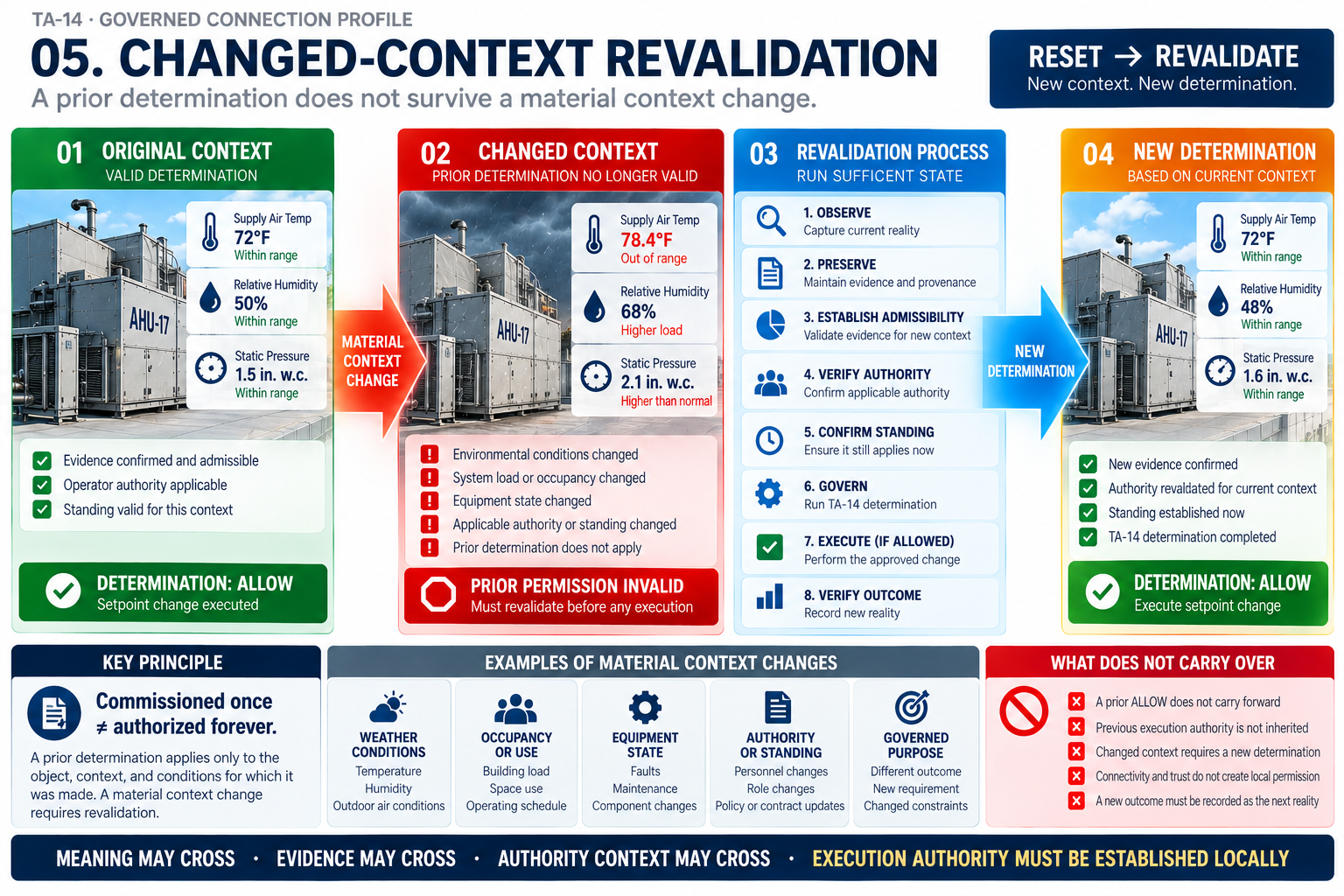
The live AHU exercise below lets you establish a sufficient state and then change material context. That transition is the reason changed-context revalidation exists.
Permission is bounded to the reality that established it.
A prior ALLOW may remain part of the record, but a material change can remove its present standing. Revalidation does not erase history. It prevents history from being mistaken for current authority.
The final image shows how the same governed object and proposition can move between independent systems as machine-readable context while execution authority remains local.
The governed state can travel as data.
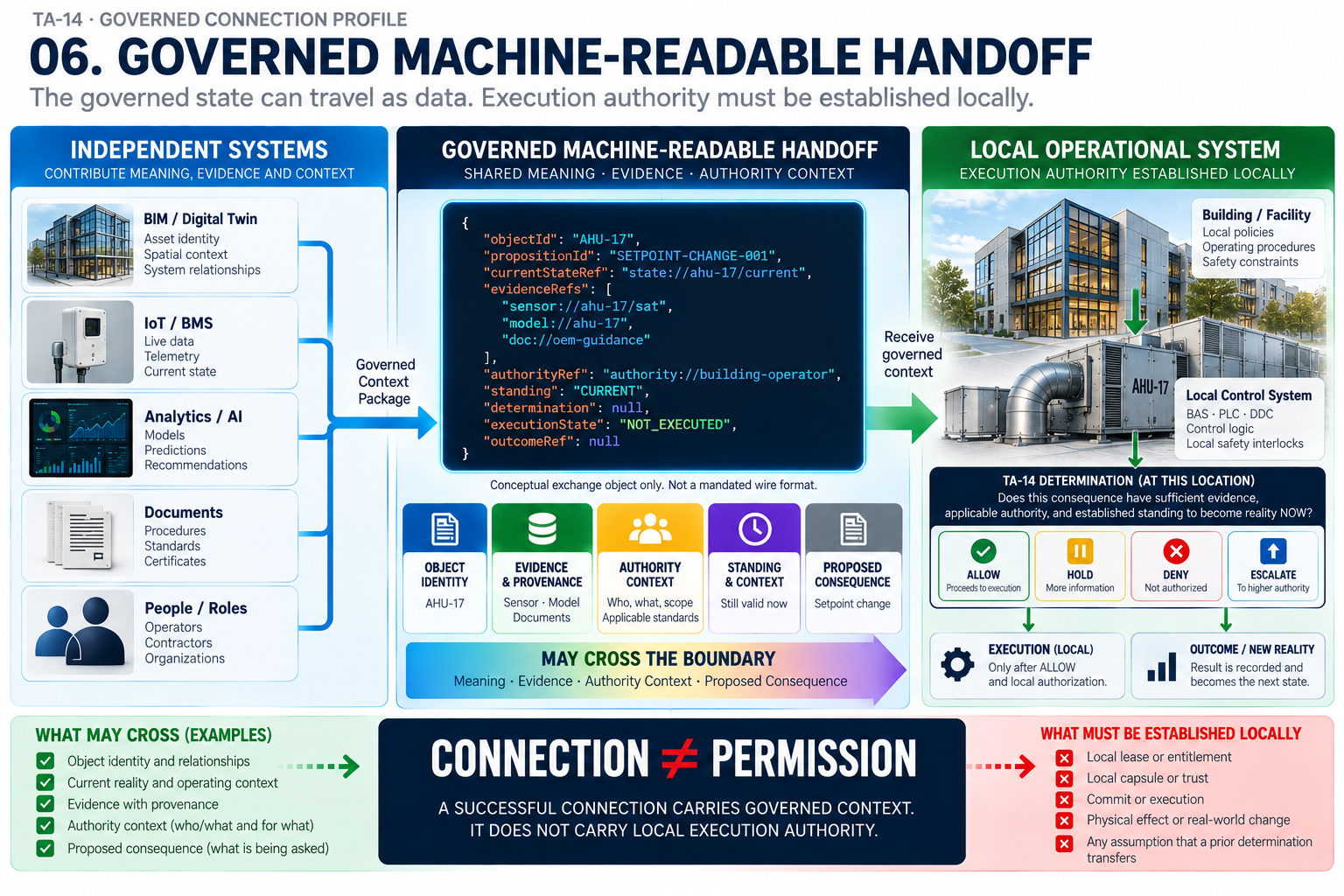
Shared meaning creates interoperability. The crossing envelope limits inheritance. The knowledge graph binds context. AHU-17 demonstrates the consequence boundary. Revalidation protects changed reality. The machine-readable handoff carries governed context without manufacturing permission. The eight rules below condense that entire sequence into operating requirements.
{
  "objectId": "AHU-17",
  "propositionId": "SETPOINT-CHANGE-001",
  "currentStateRef": "state://ahu-17/current",
  "evidenceRefs": [
    "sensor://ahu-17/sat",
    "model://ahu-17"
  ],
  "authorityRef": "authority://building-operator",
  "standing": "CURRENT",
  "determination": null,
  "executionState": "NOT_EXECUTED",
  "outcomeRef": null
}
Conceptual exchange object only. It illustrates the bounded crossing relationship, not a mandated wire format or a claim of a deployed ONUMA / CloudBIM integration. The object may carry governed context; it does not carry an inherited entitlement to commit, execute, or create effect in the receiving domain.
The governed object must be unambiguously addressable across systems.
The relevant present state of the object must be available and attributable.
The proposed change, action, or outcome must be stated before governance.
Supporting evidence must be addressable with its source and continuity.
The authority being asserted for proposal, approval, and execution must be identifiable.
Authority and evidence must still apply to this object, context, and moment.
The TA-14 determination must return to the same governed object and proposition.
ALLOW establishes a bounded determination. It does not itself operate the asset.
The governed process does not.
RDF/Turtle, persistent identity, knowledge graphs, APIs, CloudBIM, open-source or proprietary tools can participate without collapsing into one product. TA-14 governs the bounded consequence after meaning, evidence, authority, and current context are available.