REALITY
What physically existed in the building at the time?
PUBLIC TECHNICAL EXAMINATION · ARIZONA · IAQ EVIDENCE CONTINUITY
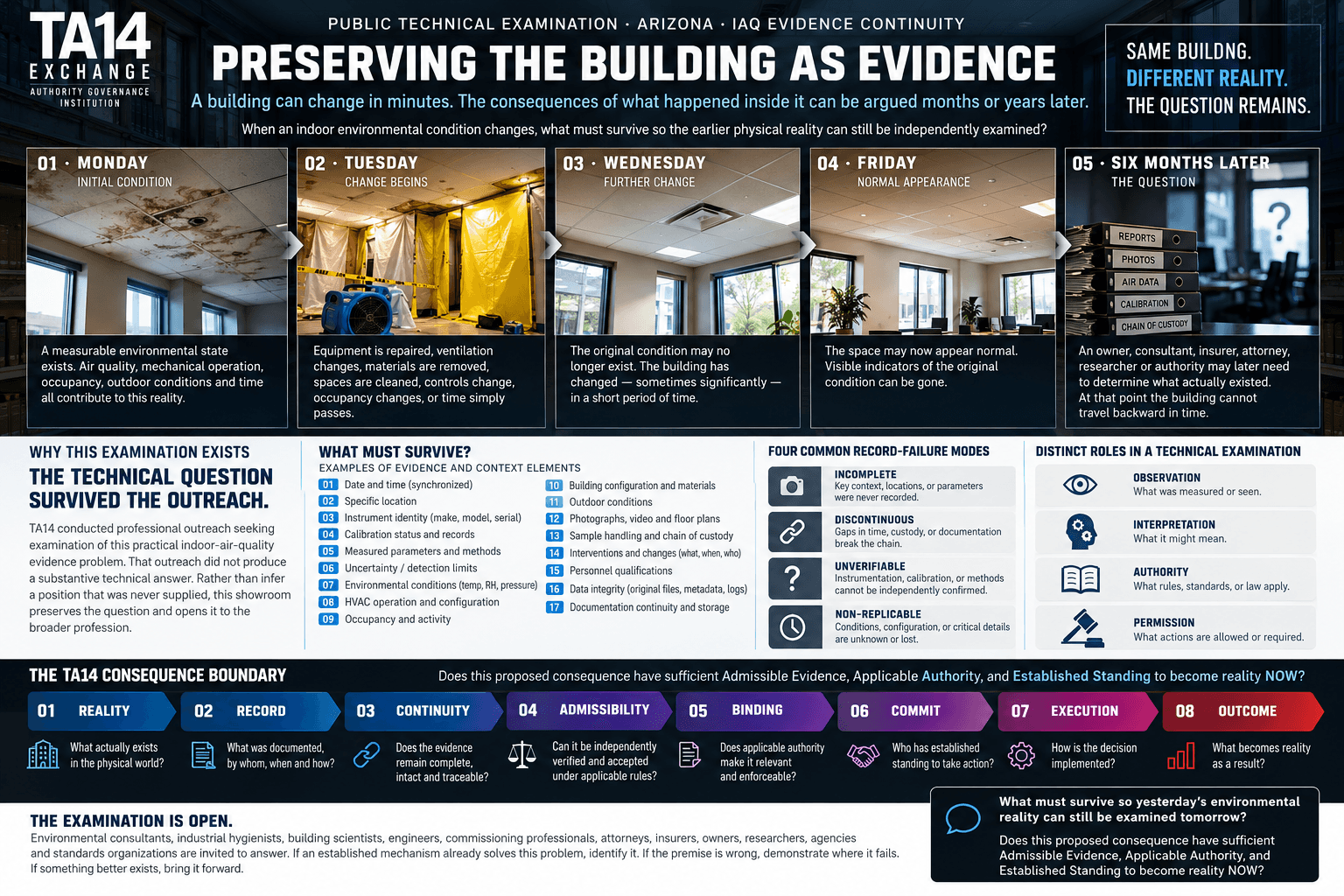
A building can change in minutes. The consequences of what happened inside it can be argued months or years later.
The technical problem is not simply whether someone collected a reading. It is whether enough trustworthy context survives for another qualified person—who was not there—to determine what actually existed, what changed, who was authorized to act, and what happened afterward.
Filters are changed. Dampers move. Equipment cycles. Spaces are cleaned. Occupancy changes. Weather shifts. Materials are removed. Controls are rewritten. The original condition can disappear before anyone realizes how important it was.
Later, an owner, consultant, attorney, insurer, physician, researcher, agency, contractor, or commissioning professional may need an answer. By then, the physical state they need to examine may no longer exist.
A SIMPLE SCENARIO
An occupied space shows an environmental condition that may matter.
Measurements, photos, samples, trends, observations or consultant notes are created.
Maintenance or an operational intervention changes the building.
The condition has changed or disappeared.
Someone asks what actually existed on Monday and what justified the intervention.
At that point, memory is not enough. A screenshot may not be enough. A summarized report may not be enough. The building itself can no longer show Monday's reality. Something had to survive.
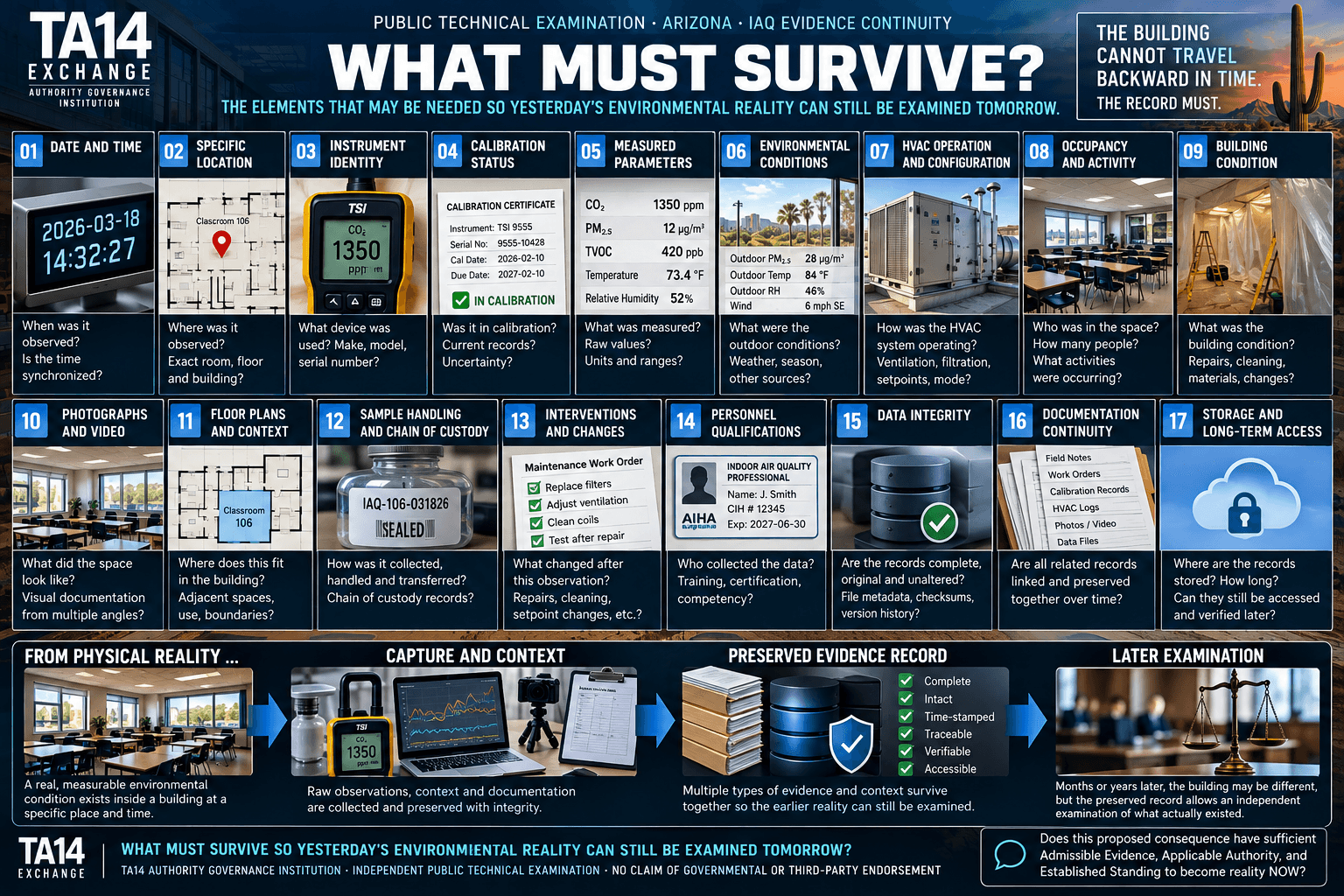
WHAT MAY NEED TO SURVIVE
TA14 is not declaring that every investigation must preserve every item below. The question is whether a defensible mechanism can determine which contextual elements are necessary for the later use being proposed.
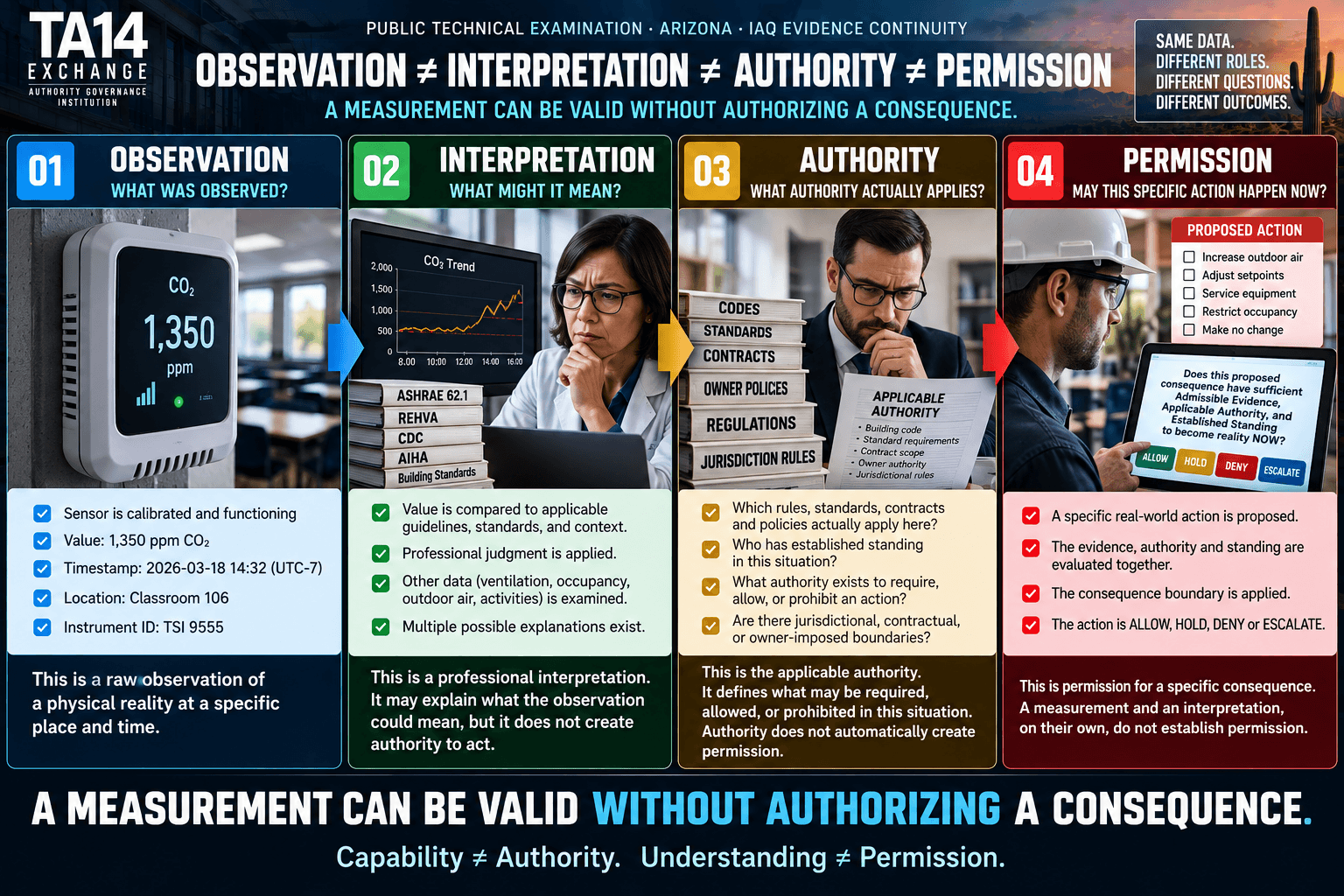
THE CRITICAL DISTINCTION
A sensor can observe. A consultant can interpret. A control system can execute. An owner can instruct. A regulator can impose obligations. Those are not interchangeable roles. Before evidence becomes consequence, the route between them must remain inspectable.
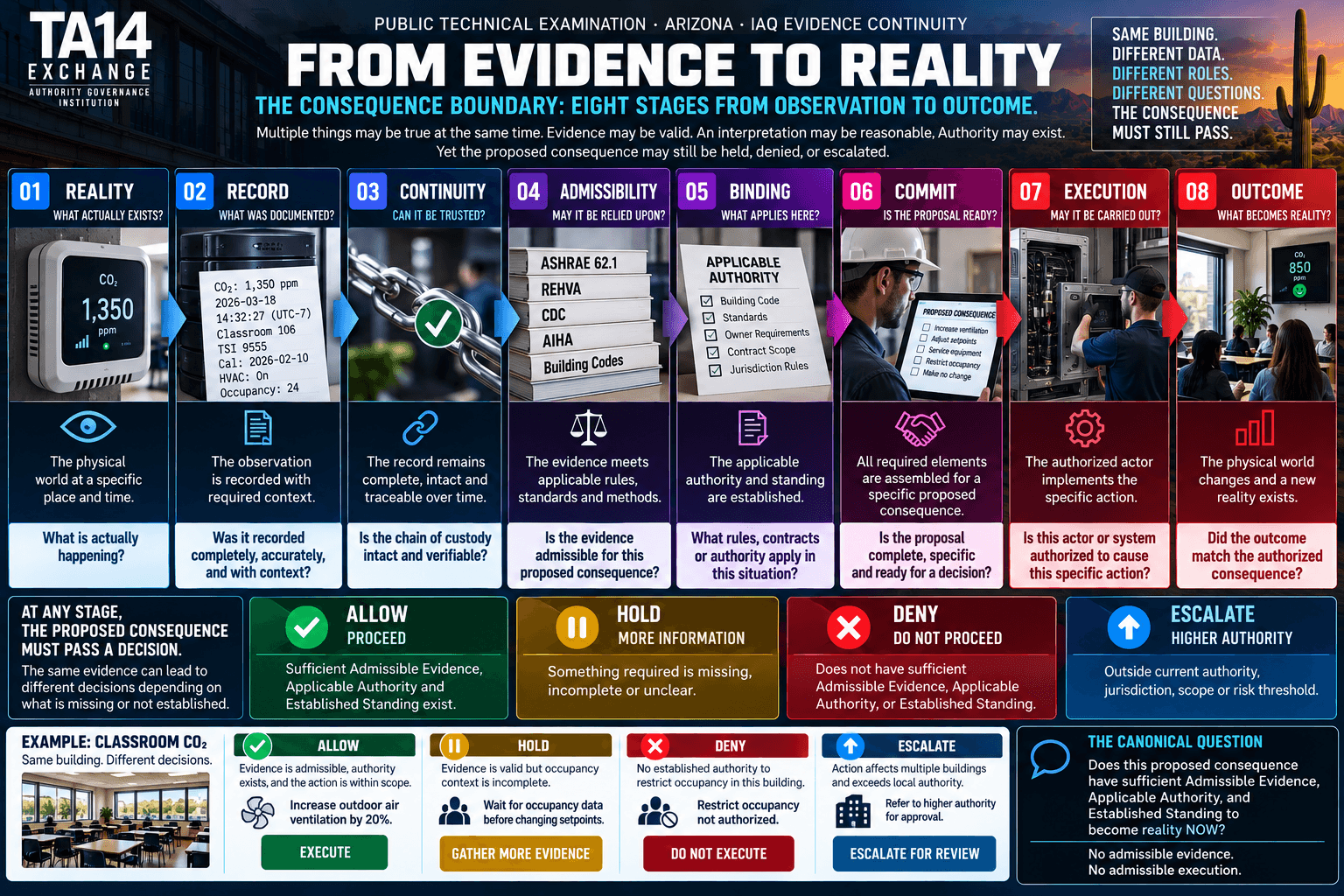
THE TA14 CONSEQUENCE BOUNDARY
What physically existed in the building at the time?
What was actually observed, measured, photographed, logged, sampled, or otherwise preserved?
Can the surviving record still be connected reliably to the original place, time, instrument, system state, and event?
Is that evidence sufficient and appropriate for the specific consequence now being proposed?
What applicable rule, obligation, contract, standard, policy, or authority actually attaches?
Has the final decision boundary been legitimately crossed?
What action was actually caused in the real world?
What changed, and what new reality must now be recorded?
WHY ARIZONA IS THE EXAMINATION SURFACE
This examination arose from Arizona-focused professional outreach concerning preservation of indoor-environmental conditions as evidence. TA14 is therefore keeping the question anchored to Arizona while deliberately avoiding an unsupported claim that Arizona law, regulation, or professional practice already requires the TA14 architecture described here.
Applicable duties, standards, contracts, professional practices and legal consequences can depend on the jurisdiction and the specific use of the evidence.
What must be preserved depends on what a later decision is asking the surviving record to prove.
Arizona practitioners are invited to identify the established mechanism, correct the framing, or submit a better evidentiary path.
WHERE THE RECORD CAN FAIL
The value survives, but the location, HVAC state, occupancy, outdoor condition, or instrument context does not.
A later conclusion is treated as though it were the original raw observation.
A technically reasonable recommendation is treated as automatic permission to cause a real-world consequence.
An intervention is recorded, but nobody preserves whether it actually produced the claimed result.
THE PROFESSION IS INVITED TO CHALLENGE THIS
If an established standard, protocol, evidentiary method, chain-of-custody practice, commissioning record, forensic procedure, or legal mechanism already solves this problem, identify it. If TA14 has framed the problem incorrectly, show where. If the architecture is incomplete, improve it. If something better already exists, bring it forward.
Use the governed submission surface for an independent review, evidence challenge, factual correction, technical comment, replication request, or other attributable response. A submission remains attributable to its submitter and does not become a TA14 finding merely because it is received.
THE QUESTION STILL STANDING
And before that surviving evidence causes anything in the real world: does the proposed consequence have sufficient Admissible Evidence, Applicable Authority, and Established Standing to become reality NOW?