Clean Air Sanctuary From Intention to a Reproducible Decision
Eight original lessons, two technical-extension lessons, one bounded library scenario, ten original adversarial test fixtures and a technical protocol for independent scrutiny of the proposed execution boundary.
PROPOSED TECHNICAL EXAMINATION · NO DEPLOYED PILOT OR CONFIRMED PARTNERSHIP. The facility, digital screens, green checks and test outcomes in the illustrations are conceptual. No building control, certification, measured air improvement, municipal approval, partner endorsement or funding award is asserted.
Does this proposed consequence have sufficient Admissible Evidence, Applicable Authority, and Established Standing to become reality NOW?
The proposed first evaluation is simulation or offline replay only. Independent life-safety and emergency procedures are outside the discretionary action gate and retain their own applicable authority.
EIGHT IMAGE-GUIDED LESSONS
Scroll straight down through all eight lessons. Every image, Samantha narration, explanation and takeaway appears in sequence without clicking Next.
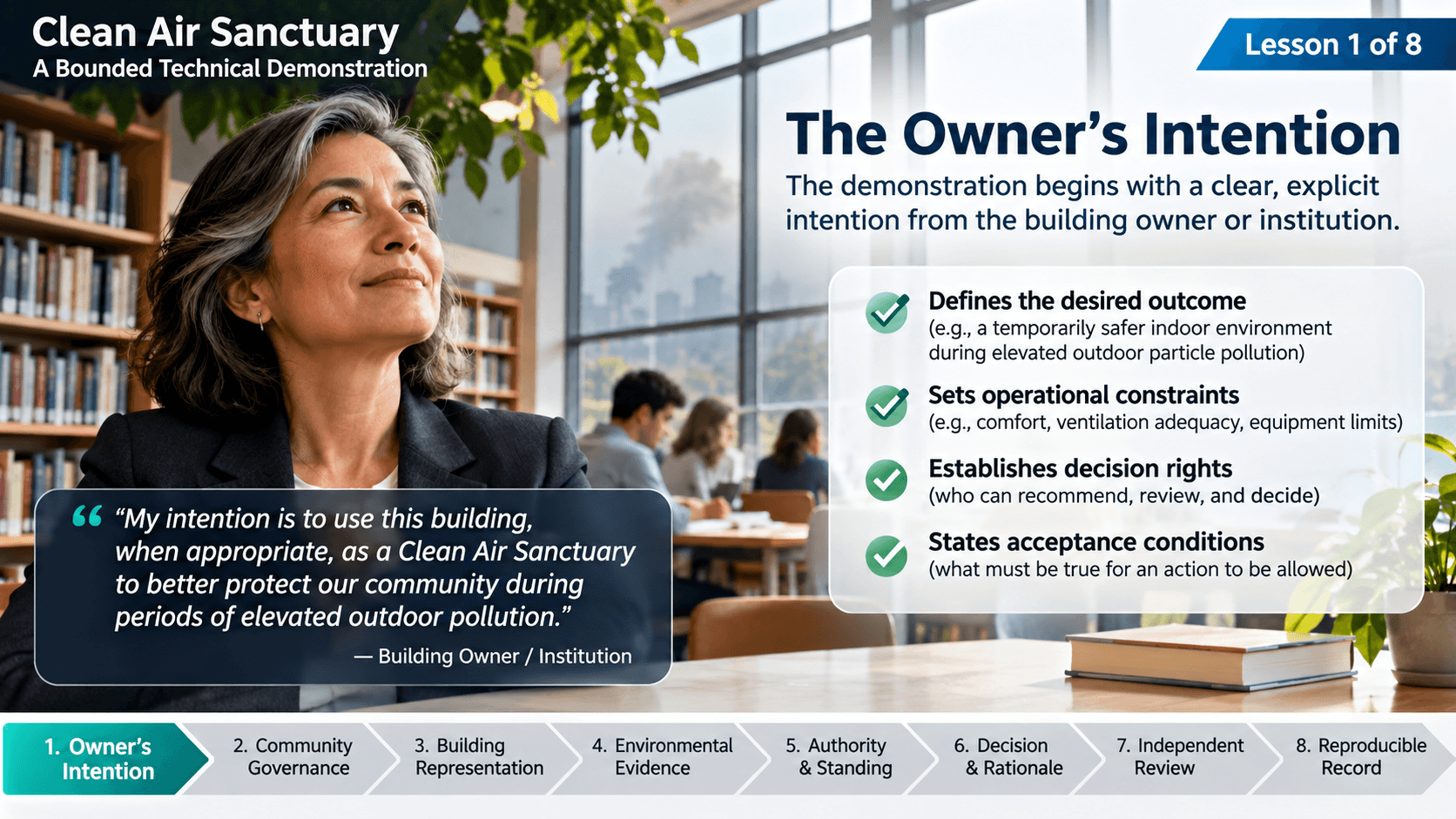
01 / 08 · The Owner's Intention
A building owner starts with a specific public purpose, not permission for an algorithm to act.
LESSON 01 / 10 · The Owner's Intention
A hypothetical public library is considered as a temporary Clean Air Sanctuary during an outdoor particle-pollution episode. The institution must define who the refuge is intended to serve, what environmental outcome is sought, what constraints apply, and who possesses authority to approve changes. The scene is conceptual: no municipal library has been selected or approved. Owner intention cannot override statutory duties, professional safety requirements, or the needs of affected occupants. Before any technical test, the proposed action and the criteria for judging it must be written down and frozen.
WHAT YOU LEARNED
An intended benefit is an accountable requirement to test, not evidence that the benefit has occurred.
WHAT COMES NEXT
Ask how affected people can contribute without claiming authority that belongs elsewhere.
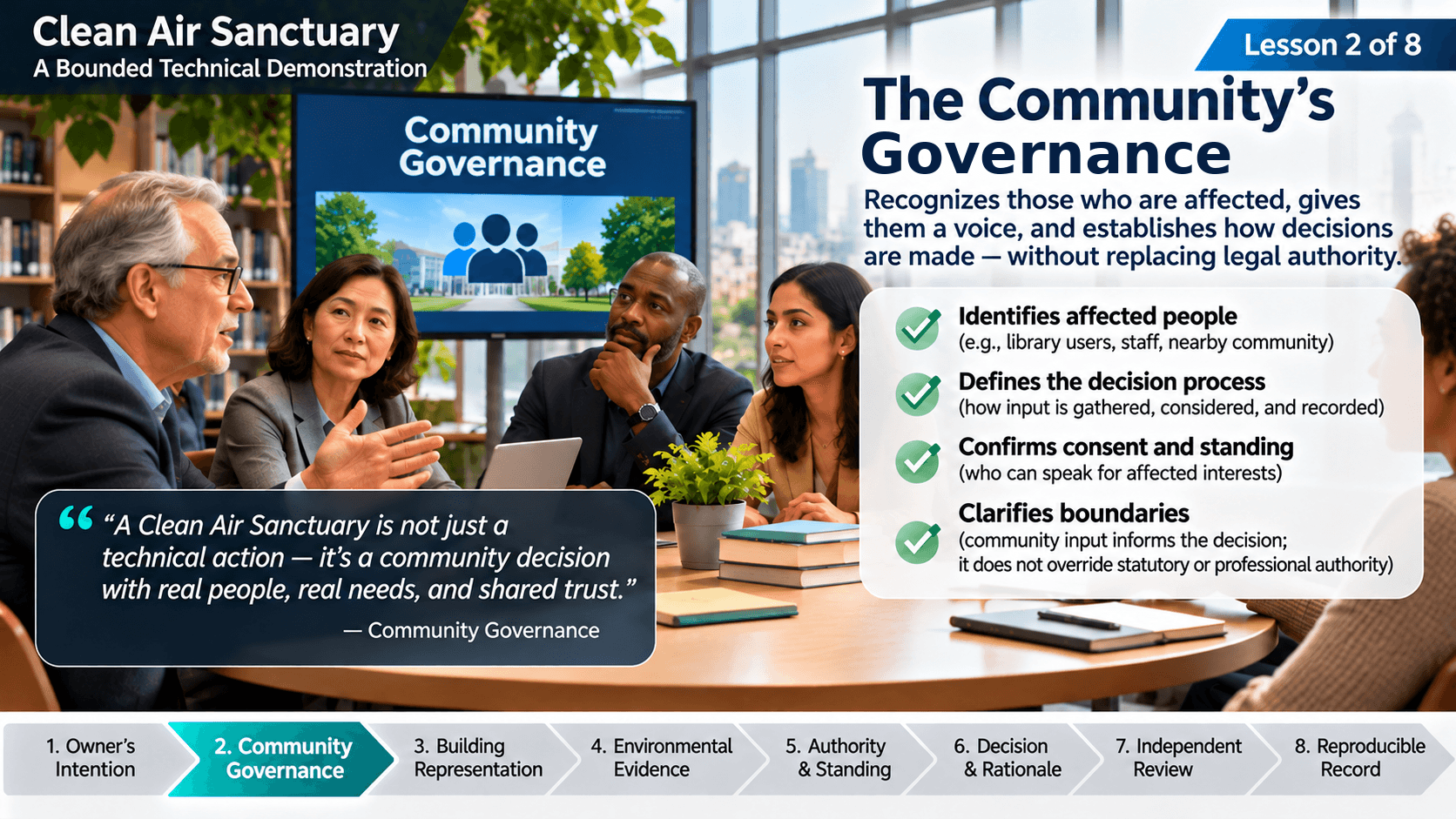
02 / 08 · Community Governance
Community needs inform the purpose and stewardship of the sanctuary, without creating automatic operational permission.
LESSON 02 / 10 · Community Governance
For a public-facing Clean Air Sanctuary, we must identify which people are affected by an intervention, how their needs will be heard, what consent or consultation requirements actually apply, and who can speak on behalf of which interests. Community preferences and institutional operating authority are not identical. A community request cannot itself authorize a change that requires approval from a building owner, qualified professional, or applicable public authority. The governance model is proposed for technical examination; no community group has formally approved this demonstration.
WHAT YOU LEARNED
Represent consent, stewardship, and community interest separately from legal and professional execution authority.
WHAT COMES NEXT
Examine how a building representation supplies context but not verified physical truth.
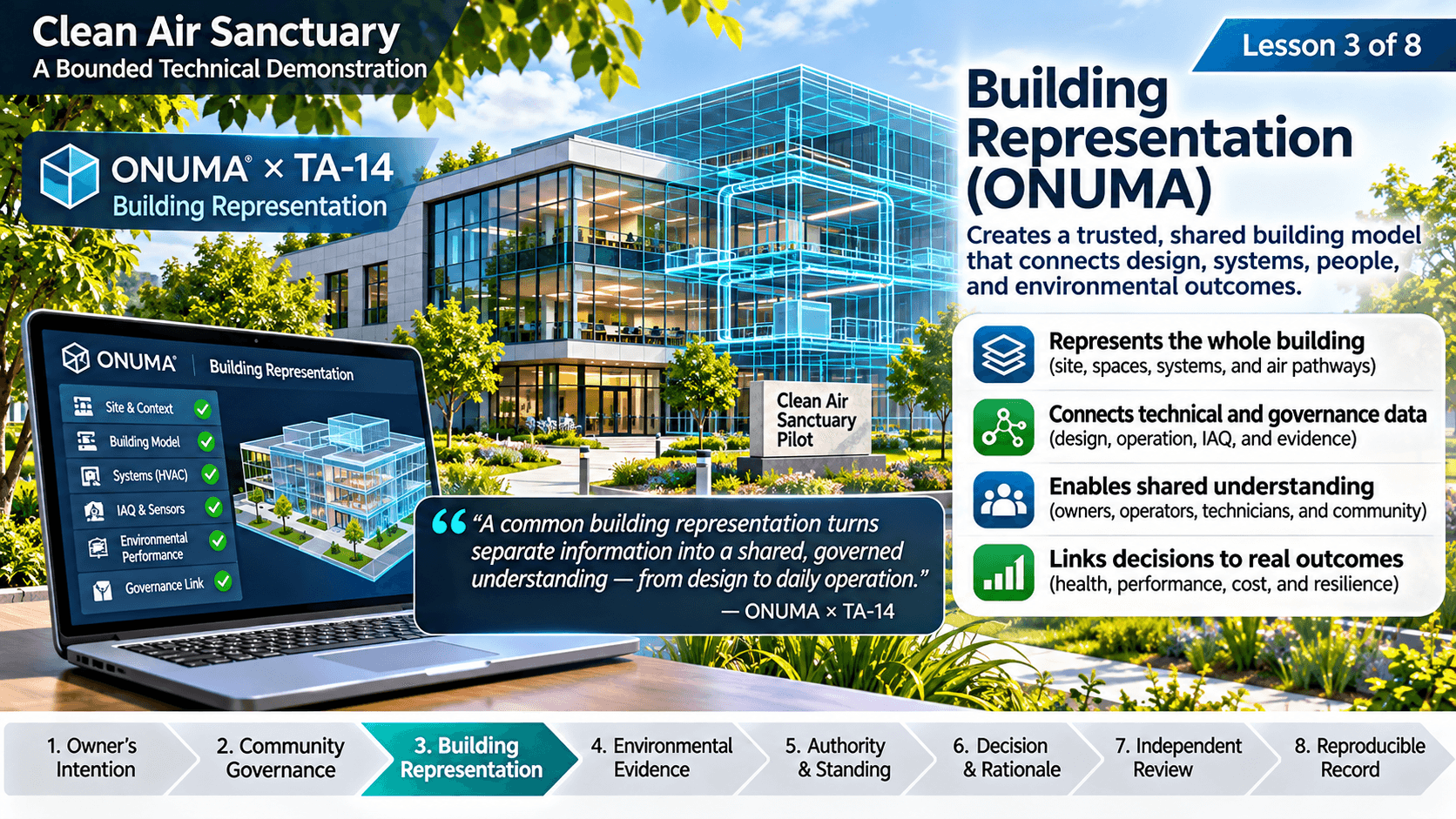
03 / 08 · Building Representation
A digital model organizes the building context; a model is not a substitute for inspected physical conditions.
LESSON 03 / 10 · Building Representation
ONUMA-type building representation can connect spaces, equipment, air pathways and operating constraints to the proposed action. For this demonstration, the model would describe the hypothetical library and the exact window or ventilation state being evaluated. Its version, limitations, assumed system capacities and any field-confirmed elements must be marked separately. A visually persuasive digital twin does not prove that sensors are calibrated, dampers respond, or the building is safe. ONUMA participation is prospective, not a formal commitment or a claim that an integration is operating.
WHAT YOU LEARNED
Building intelligence describes context; independently attributable evidence establishes observed conditions.
WHAT COMES NEXT
Test whether environmental measurements are fresh, traceable, calibrated and fit for the action.
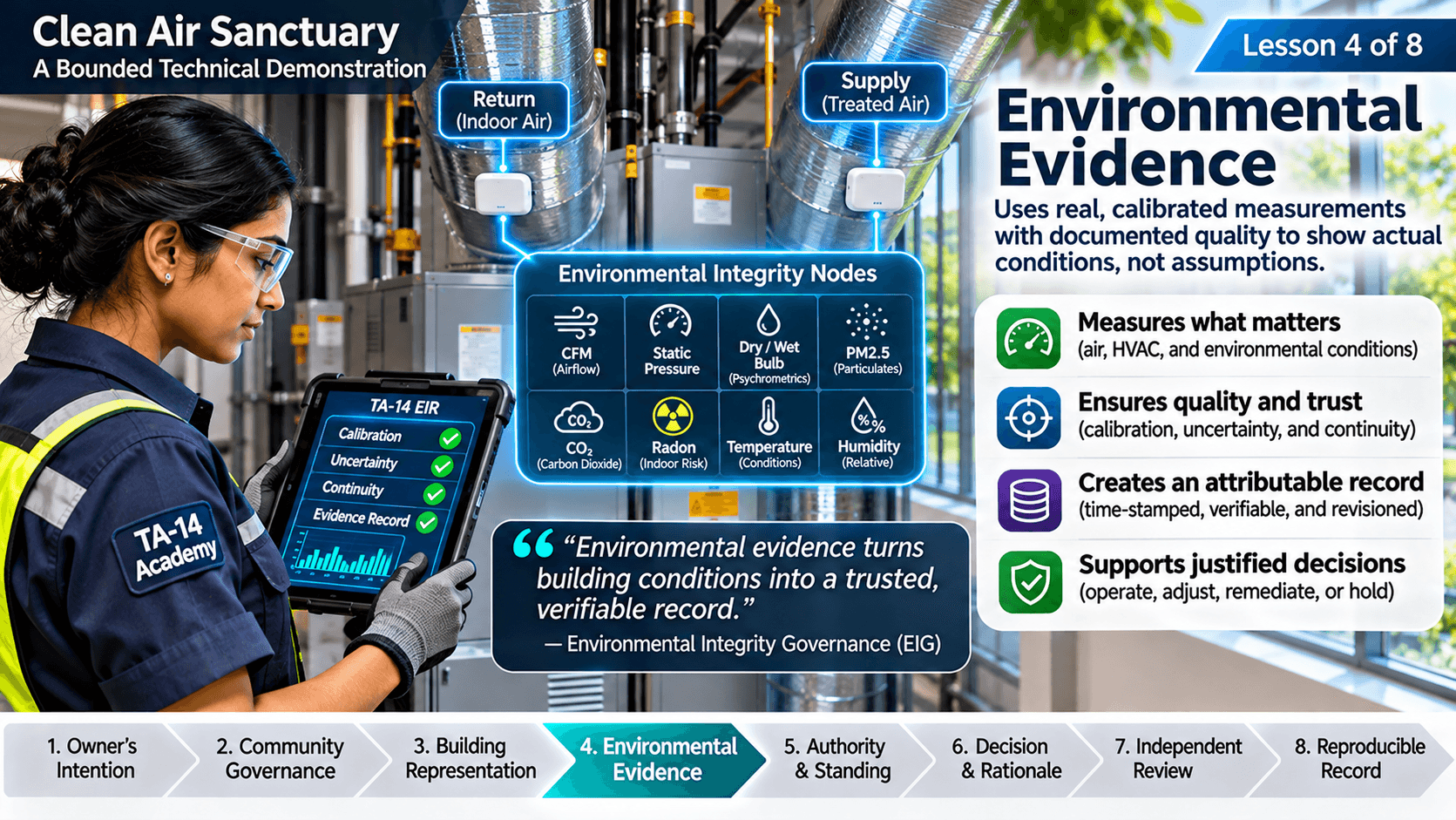
04 / 08 · Environmental Evidence
Decision-grade environmental evidence includes its provenance and uncertainty, not just a dashboard value.
LESSON 04 / 10 · Environmental Evidence
The proposed evaluation may consider indoor and outdoor particulate observations alongside ventilation indicators, carbon dioxide, temperature and humidity where relevant to the action. Each required source should preserve its identity, location, timestamp, calibration status, data age, uncertainty, gaps and revisions. The environmental integrity nodes and green confirmation marks shown here are illustrative. They do not attest to installed sensors or verified calibration at a real site. In the test harness, a missing calibration record, stale measurement or contradictory source must remain visible and prevent unsupported permission under the frozen policy.
WHAT YOU LEARNED
Missing evidence is an explicit test condition, never a fact to infer or silently supply.
WHAT COMES NEXT
Identify the authority and standing needed at the exact moment of the proposed consequence.
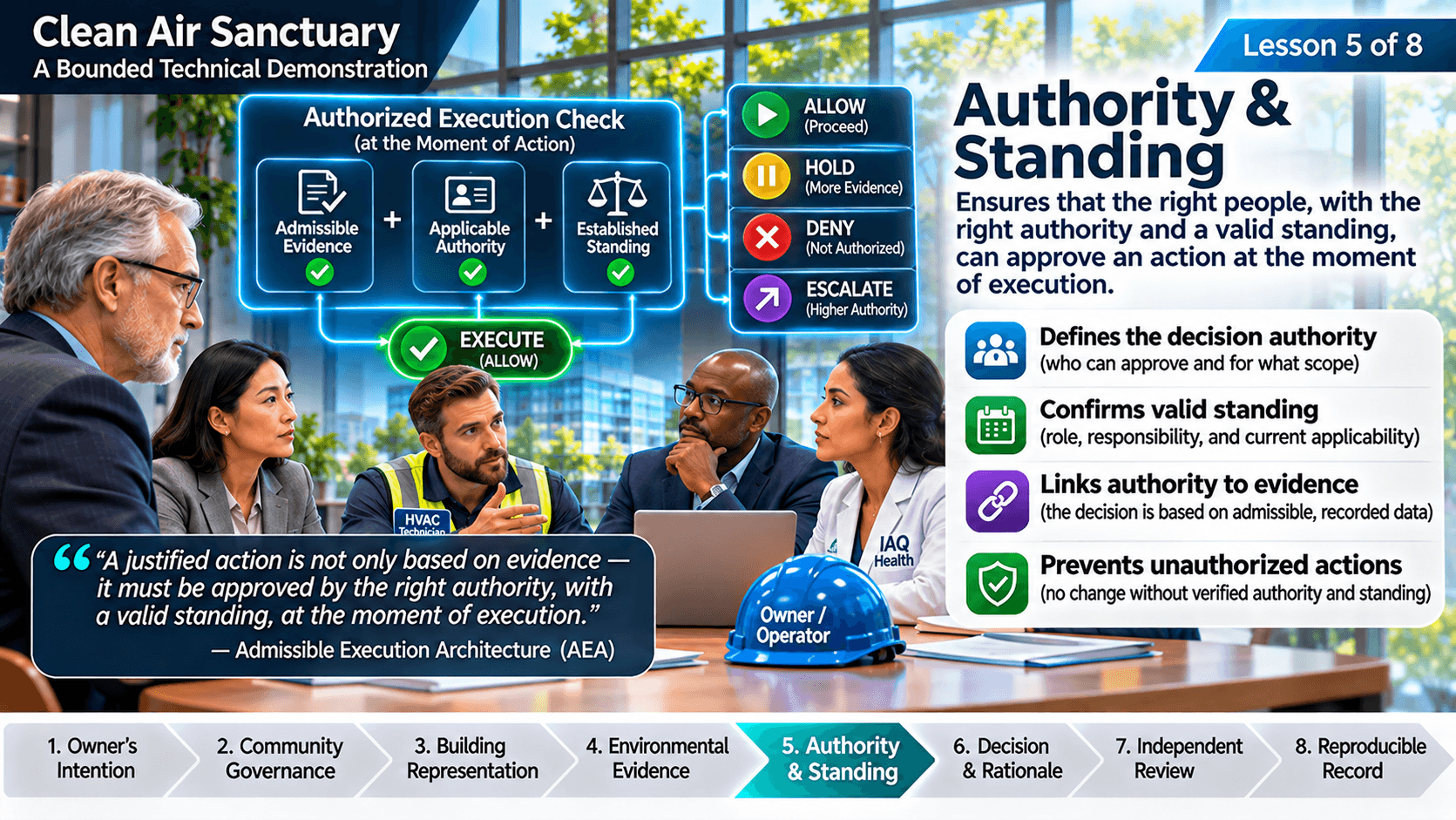
05 / 08 · Authority & Standing
A proposed action is not admissible just because the data or recommendation looks convincing.
LESSON 05 / 10 · Authority & Standing
TA-14's Admissible Execution Architecture examines Admissible Evidence, Applicable Authority, and Established Standing for a particular action at the moment of decision. The owner, responsible professional, operator and community steward may have distinct rights and obligations; none inherits another's authority automatically. In the proposed simulation, the decision boundary may return ALLOW, HOLD, DENY or ESCALATE. An ALLOW is limited to the stated scope and duration within the test harness. Any real facility action would require separate institutional permissions, engineering review and safety controls.
WHAT YOU LEARNED
Authority must apply to this action, this actor, this place and this moment.
WHAT COMES NEXT
Examine why the decision was issued and whether the reason can be independently reconstructed.
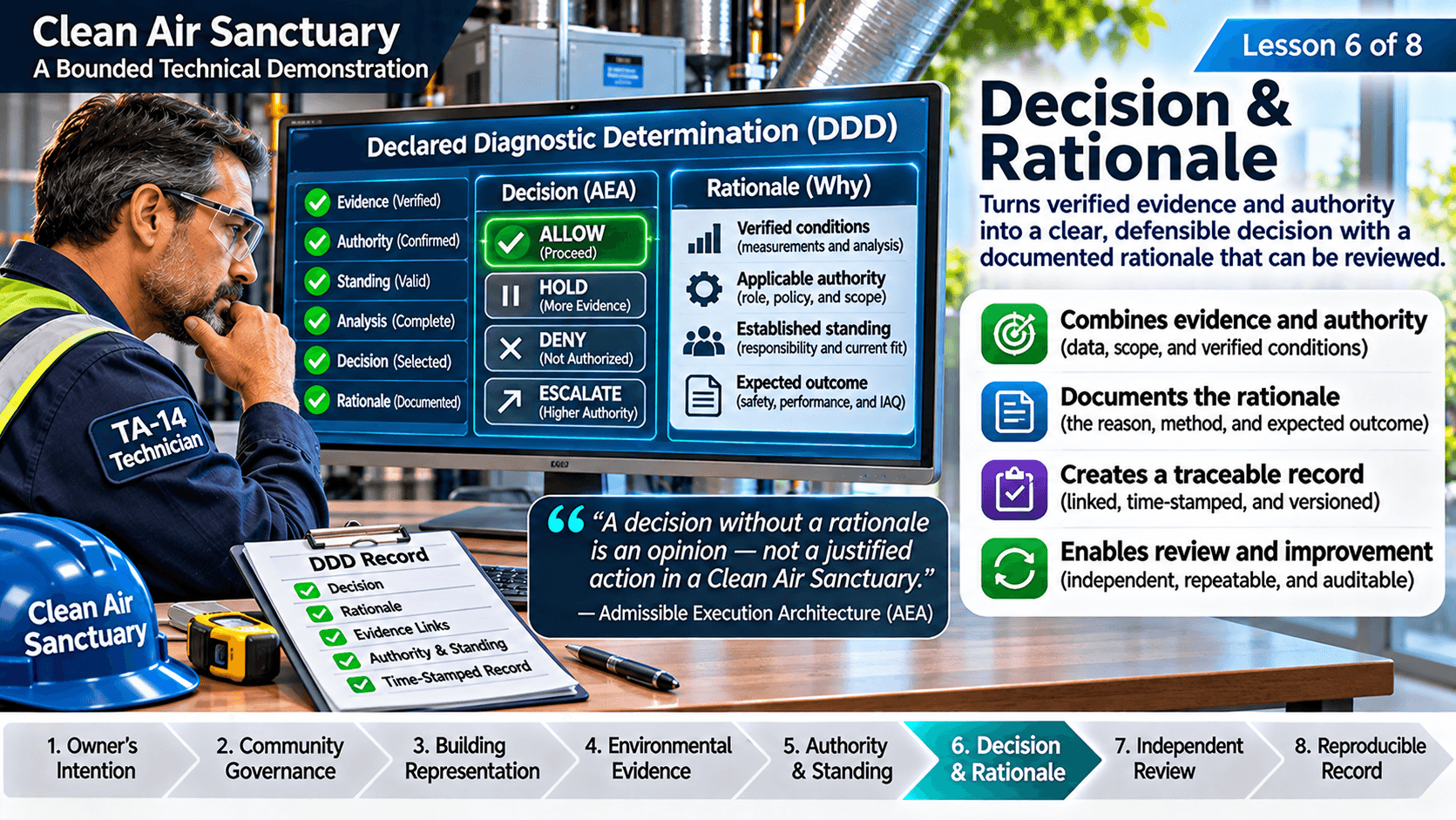
06 / 08 · Decision & Rationale
Every disposition must record the tested conditions, governing rule and reason for its result.
LESSON 06 / 10 · Decision & Rationale
A reproducible decision binds the candidate consequence, evaluation time, evidence snapshot, policy version, authority and standing to one transaction identifier. The demonstration tests four dispositions. ALLOW means the exact simulated action satisfies its frozen prerequisites. HOLD means required evidence or another prerequisite is insufficient. DENY means the action violates a prohibition or hard limit. ESCALATE means an authorized person or institution must resolve an authority conflict. This illustration includes DDD, short for Declared Diagnostic Determination, an HVAC diagnostic term; DDD is not a required artifact for every Clean Air Sanctuary governance decision. The proper demonstration output here is a recorded AEA disposition with a reviewable rationale. The green ALLOW depiction is hypothetical, not a verified result.
WHAT YOU LEARNED
A decision, an attempted execution, and a verified environmental outcome are three separate claims.
WHAT COMES NEXT
Invite a reviewer to test the rules against cases specifically designed to expose failure.
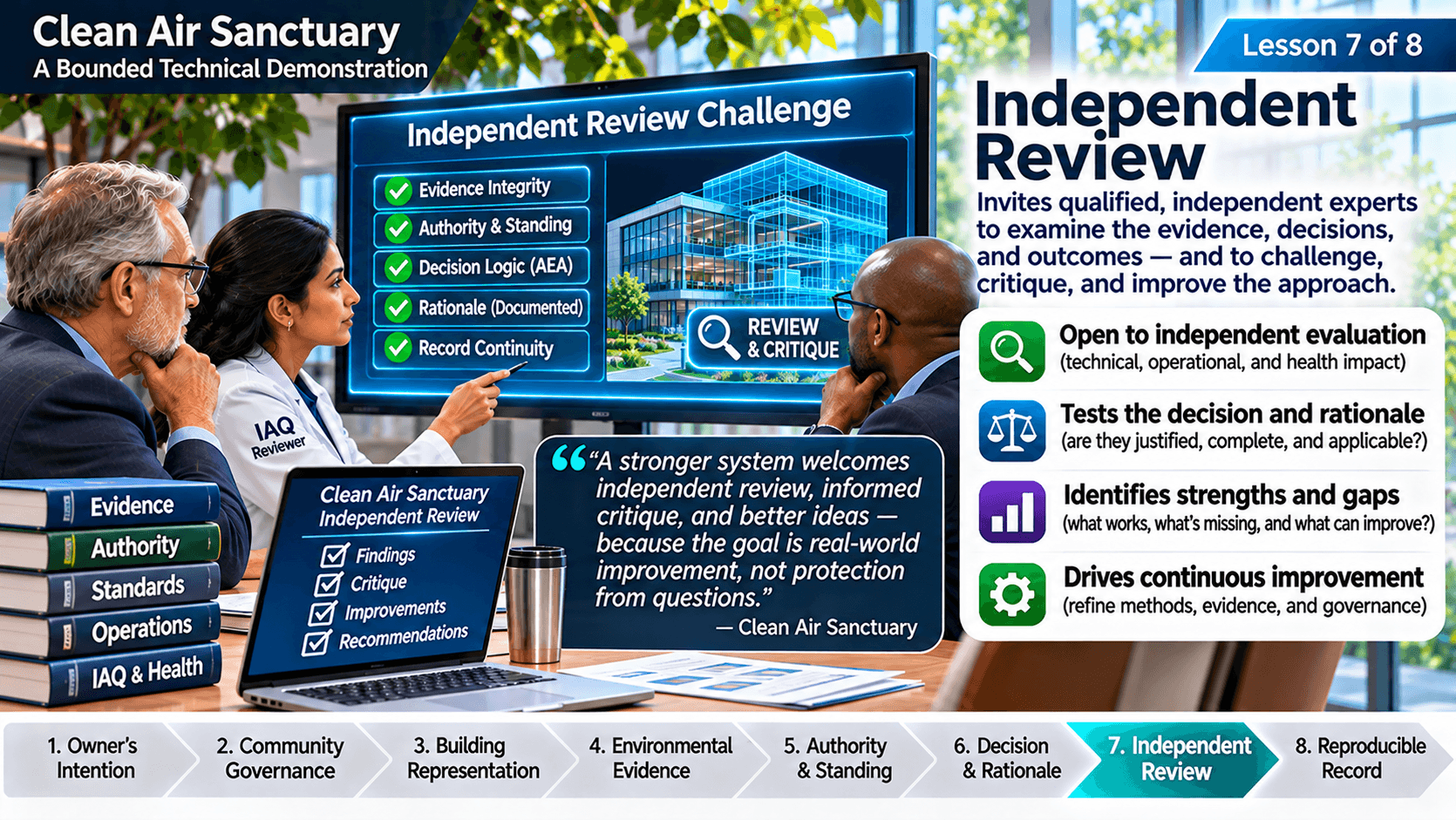
07 / 08 · Independent Review
A credible demonstration invites independent reviewers to challenge assumptions and reproduce decisions.
LESSON 07 / 10 · Independent Review
The protocol proposes ten adversarial fixtures: a valid baseline, missing calibration, a persuasive prediction without authorization, a prohibited action, an authority conflict, an unestablished emergency claim, stale data, an unverified outcome, borrowed jurisdictional permission and contradictory measurements. Before any run, participants must freeze one expected disposition per fixture and the precedence rules that resolve conflicts. Reviewers should receive the scenario, policy, authority matrix, inputs, raw logs, exceptions and revisions. Green checkmarks in the image are conceptual and do not imply independent tests have already passed.
WHAT YOU LEARNED
A justified HOLD or DENY can be a successful governance test; results must be reproducible and failures retained.
WHAT COMES NEXT
Preserve the full decision history so another examiner can replay what was known and what occurred.
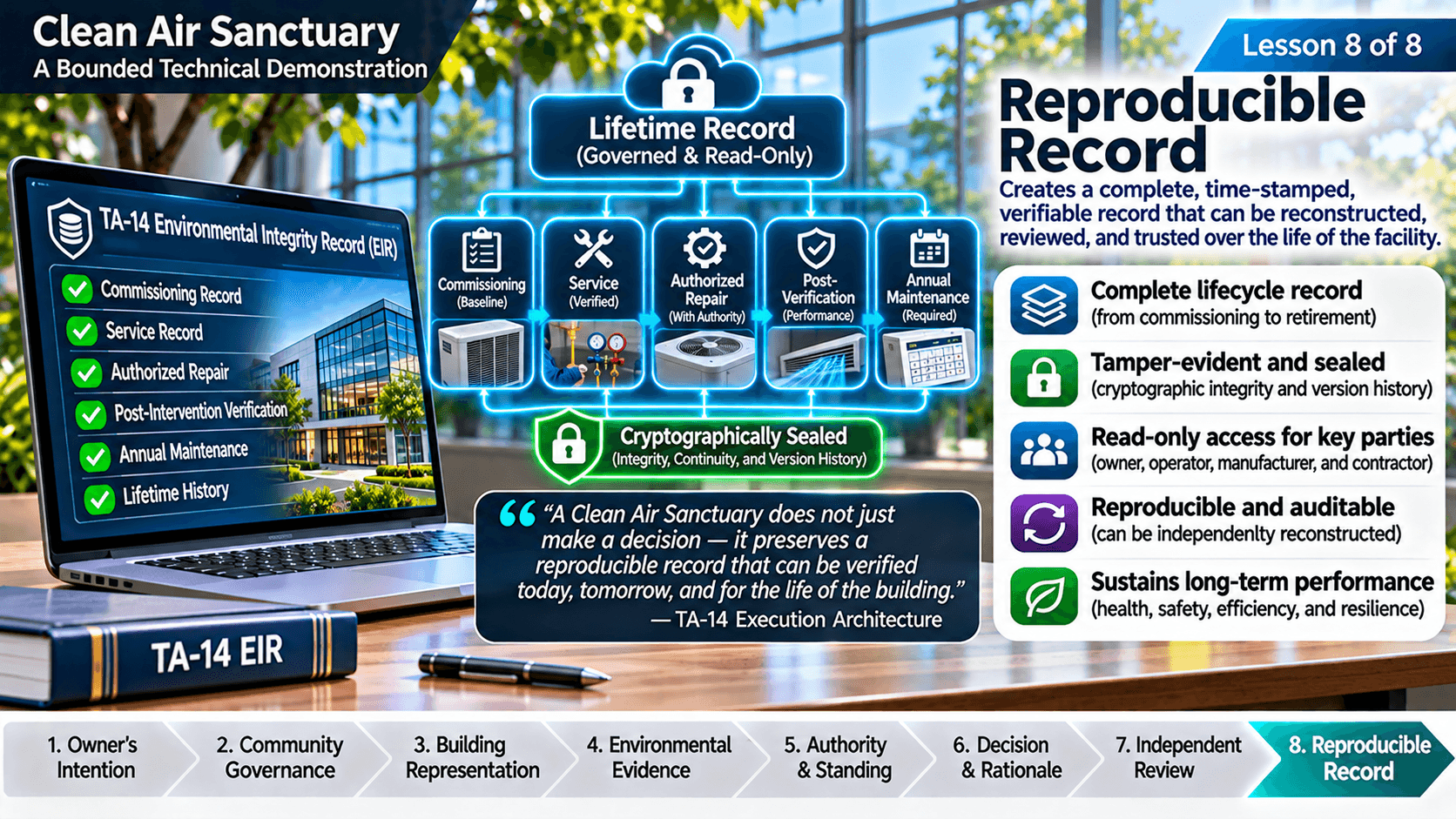
08 / 08 · Reproducible Record
The final product of the first demonstration is a challengeable decision record, not a claim of a completed lifetime deployment.
LESSON 08 / 10 · Reproducible Record
A reproducible record should bind what was proposed, what evidence was available at that time, which policy and authority applied, who held standing, the disposition, any simulated action attempt and the observed or unverified outcome. Preserve source, receipt, decision and action timestamps; revision lineage; gaps; failures; and reviewer findings. The lifetime record, completed maintenance items, cryptographic seal and green checkmarks in this illustration describe proposed capabilities or aspirations, not verified operations in a real Clean Air Sanctuary. The first controlled test must produce a bounded replayable package; longer-term stewardship and physical verification would require further work and authorization.
WHAT YOU LEARNED
Record integrity makes the decision inspectable; it does not itself prove improved air quality or health.
WHAT COMES NEXT
Read the technical protocol and challenge the proposed test before any field deployment.
TECHNICAL EXAMINATION EXTENSION · LESSONS 09–10
Community authority and independent deployment review
Two additional educational examinations address community consent and stewardship, and the controls separating offline simulation from authorized field deployment. The original eight lessons and all ten adversarial fixtures remain unchanged. These are proposed controls, not independently validated operational findings.
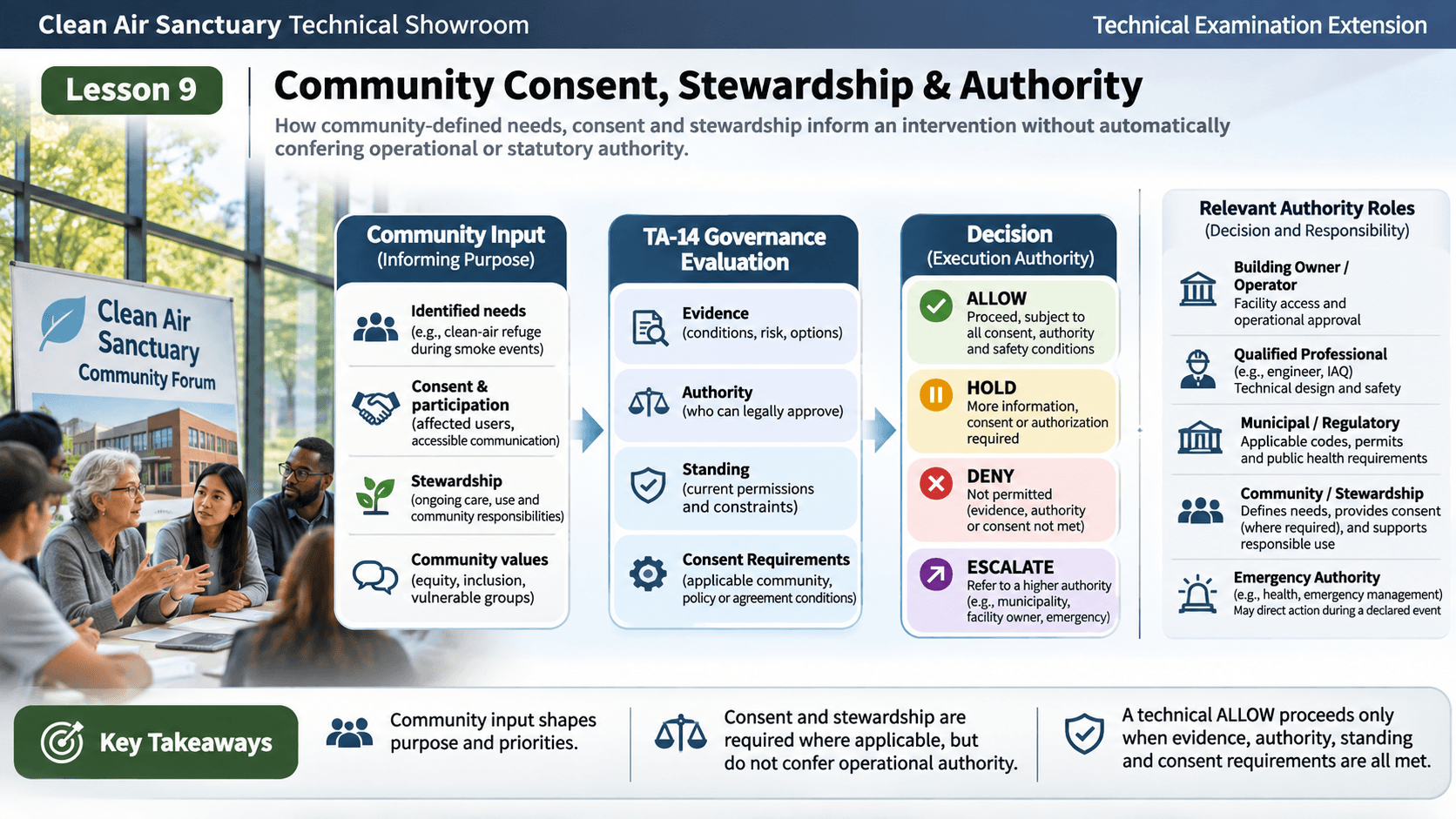
09 / 10 · Community Consent, Stewardship & Authority
Community-defined needs shape the purpose of a refuge; applicable consent and stewardship obligations must be examined without converting participation into operational permission.
LESSON 09 / 10 · Community Consent, Stewardship & Authority
This educational extension responds to the question of how community consent and stewardship enter the proposed Clean Air Sanctuary governance record. Identify the affected people, consultation or consent requirements that actually apply, the record of engagement, any withdrawal or change of conditions, and those accountable for ongoing stewardship. Keep the community's voice distinct from municipal, owner, professional and emergency authorities. At the execution boundary, test admissible evidence, applicable authority, established standing and all applicable consent conditions for the exact proposed action. If an obligatory consent condition is absent or unresolved, do not infer permission: HOLD, DENY or ESCALATE according to the frozen rule. Community consultation neither grants building-control rights nor overrides life-safety duties. This diagram is a hypothetical governance model, not an approved community agreement or a verified deployment.
WHAT YOU LEARNED
Community input establishes priorities and relevant obligations; it does not independently confer legal or operational authority.
WHAT COMES NEXT
Examine the independent checks required before any simulated decision could progress toward physical action.
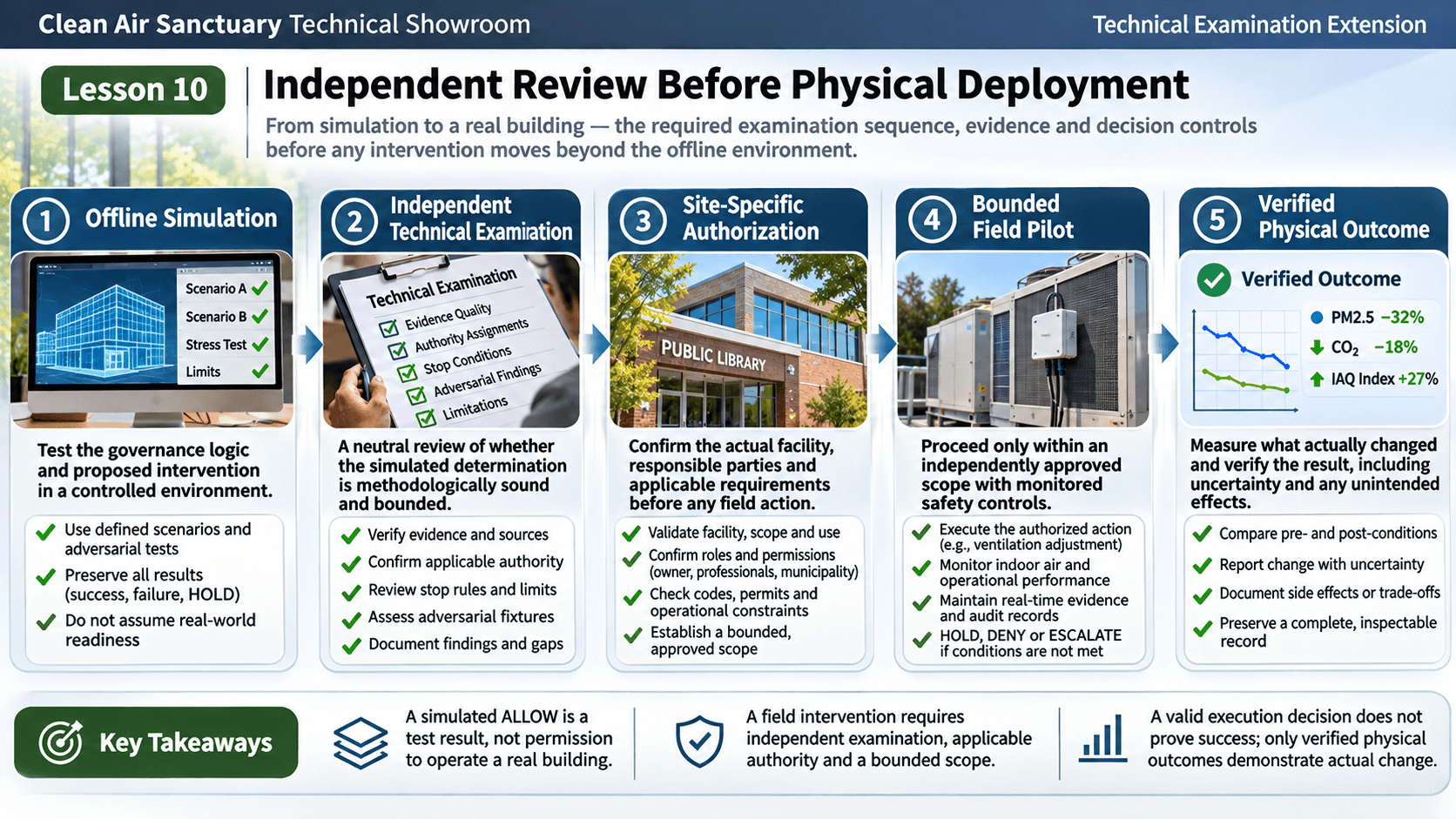
10 / 10 · Independent Review Before Physical Deployment
A simulated ALLOW is a bounded teaching result, not authorization to operate a building or proof of cleaner air.
ILLUSTRATIVE DATA ONLY: The percentages and charts printed within this image are fictional teaching graphics, not actual PM2.5, CO₂, air-quality index or pilot results. No real-world environmental improvement has been demonstrated by this image.
LESSON 10 / 10 · Independent Review Before Physical Deployment
The proposed progression has five distinct stages: offline simulation with preserved successes, failures and HOLDs; independent examination of frozen rules, evidence sources, authority assignments, stop conditions and reproducibility; site-specific approvals by the actual owner, qualified professionals and applicable public authorities; a separately authorized, safety-monitored bounded field pilot; and independent measurement of physical outcomes including uncertainty, side effects and trade-offs. The pictured library, equipment, check marks, trends and percentage changes are fictional illustration only. In particular, the PM2.5, carbon dioxide and index percentages displayed are not field readings, measured improvements or claims of efficacy. No facility has been selected or approved and no independent validation or field pilot is asserted. An ALLOW within an offline test cannot cross into operational control without a fresh, separately authorized site-specific decision.
WHAT YOU LEARNED
A defensible simulated disposition, permission for a field intervention and verified environmental improvement are three different claims.
WHAT COMES NEXT
Use the original ten adversarial fixtures and independent-review challenge to test the proposed governance boundary.
INTERACTIVE TECHNICAL EXAMINATION · SIMULATED POLICY ONLY
Can you reproduce the disposition?
Select a frozen test fixture, then choose the expected AEA outcome. The answers below are predeclared proposed expectations, not results of an executed test. No real command is sent.
Required calibration record missing
All ten proposed adversarial fixtures
ID
Condition
Expected
F01
Evidence, authority, standing and constraints all valid
ALLOW
F02
Required calibration record missing
HOLD
F03
Strong prediction but no action authorization
HOLD
F04
Action violates a known hard limit
DENY
F05
Competing authority claims require an adjudicator
ESCALATE
F06
Emergency authority claimed but unestablished
HOLD
F07
Evidence exceeds the frozen freshness bound
HOLD
F08
Authorized simulation but outcome remains unverified
ALLOW
F09
Lagos authority reused for a Canadian building
HOLD
F10
Material contradiction in required sensor streams
HOLD
F08 deliberately separates an admissible decision from an unverified outcome. A passing gate does not demonstrate physical air-quality improvement. All thresholds, rule precedence and actor permissions remain subject to approval and freeze before testing.
INDEPENDENT REVIEW CHALLENGE
What evidence would justify the claim?
01 · Exact consequence
Which window or ventilation state, bounds, duration and rollback are being evaluated?
02 · Evidence integrity
Can a reviewer inspect instrument provenance, calibration, uncertainty, timestamps and revisions?
03 · Authority and standing
Which jurisdiction, institution and named actor can approve the decision now?
04 · Deterministic policy
Were one expected disposition per fixture and all precedence rules frozen before testing?
05 · Execution isolation
Can the harness demonstrate that no non-ALLOW disposition results in simulated actuation?
06 · Reproducibility
Can an independent reviewer replay the decisions using the preserved package alone?
PUBLICATION BOUNDARY
This showroom teaches a proposed method. Named partners are prospective participants only. Any participant commitments, municipal site, source data, test results, health outcome or funding assertion must be separately verified and approved for disclosure before publication.
TA-14 ACADEMY · INDEPENDENT REVIEW CHALLENGE
Can you defend the determination?
Apply the governance principles to three hypothetical cases relevant to air-quality intervention. Choose a determination, then examine the reasoning. These cases teach the distinction between Admissible Evidence, Applicable Authority, and Established Standing; they do not issue real-world authorization.
CASE 01
Evidence is not yet admissible
A proposed consequence is supported by an observation, but the source attribution or record continuity is missing. What should happen before execution? Consider this in the context of air-quality intervention.
CASE 02
The actor exceeds authority
The record is current and reliable, but the proposed consequence falls outside the scope of applicable authority. What is the supported determination?
CASE 03
A higher authority is required
The proposed consequence triggers a documented requirement for review by another designated authority. What is the appropriate route?
Independent educational examples only. The questions are hypothetical and do not assess a real institution, building, person, or operating system. Actual governance determinations require case-specific evidence, applicable authority, established standing, and bounded review.