Admissible Evidence
Attributable, relevant observations with sufficient currency, context, and known uncertainty.
TA-14 AUTHORITY GOVERNANCE INSTITUTION / FLAGSHIP TECHNICAL SHOWROOM
The command was authorized. Then the world changed. Explore the engineering boundary between a decision that was permitted and a consequence that remains justified.
Proposed architecture and examination protocol. Imagery and data are illustrative. No independently certified production outcome is claimed.
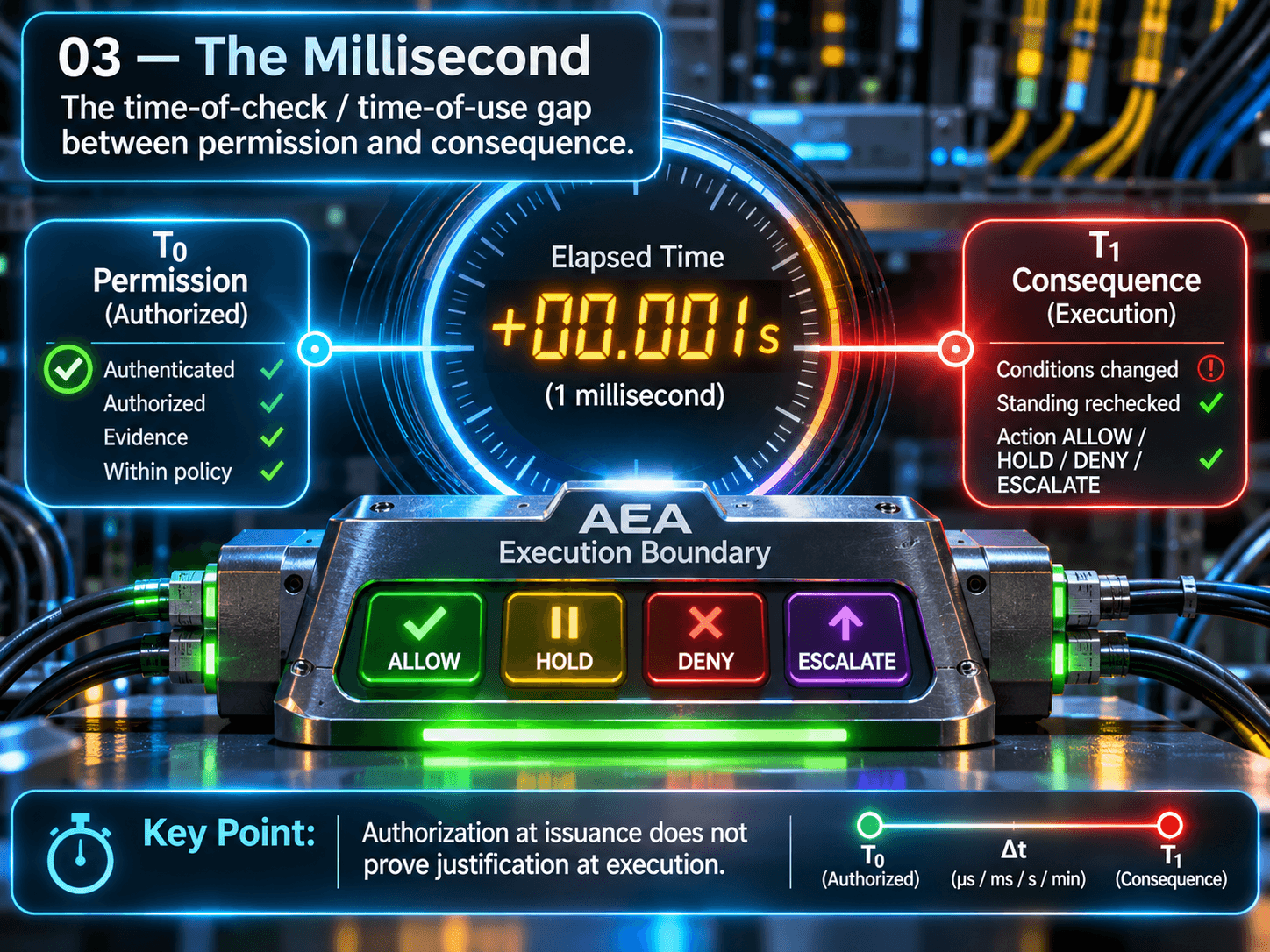
A command can be authentic, authorized when issued, and still lack sufficient standing when executed.
This is a time-of-check/time-of-use problem. The millisecond is a metaphor: execution gaps may span any interval relevant to the actual hazards and architecture.
Attributable, relevant observations with sufficient currency, context, and known uncertainty.
The specific action must fit legitimate requirements, permissions, delegations, and equipment limits.
Evidence and authority must still apply to the exact proposed consequence when execution is attempted.
Eight original teaching graphics, eight distinct lessons, and optional Samantha narration placed directly beneath each visual. Read each step in order, or jump to any section.
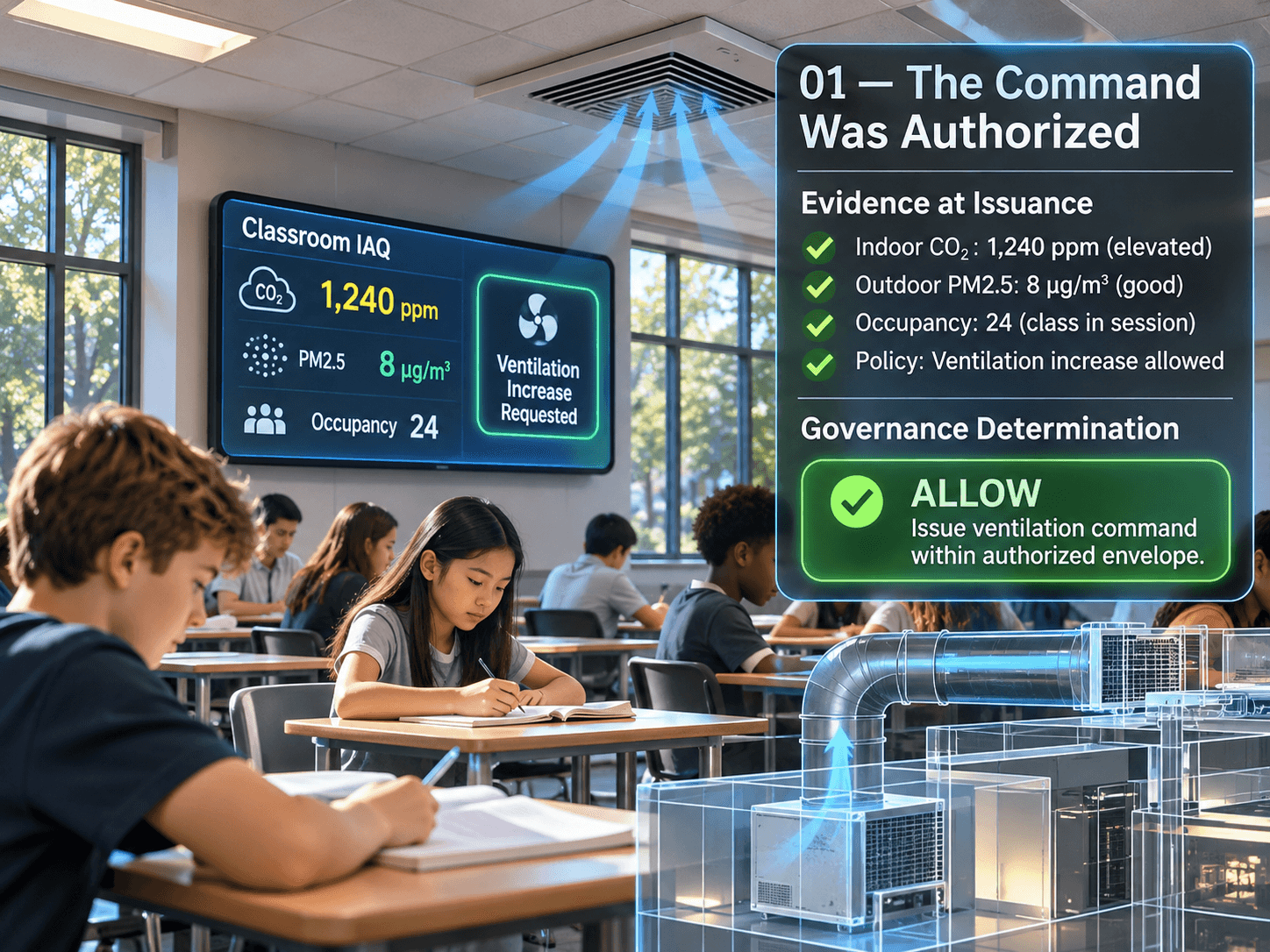
Lesson one. The command was authorized. Consider a school classroom. Occupants arrive, indoor carbon dioxide rises, and an automated system proposes an outdoor air adjustment. Within established operating requirements and a verified envelope, a bounded authorization may be appropriate. But remember the word bounded. Authentication, current evidence, applicable authority, and established standing must apply to the specific action. The numerical values in this artwork are hypothetical teaching values, not field measurements. Next, reality changes.
A classroom becomes occupied. Indoor carbon dioxide rises and the controller proposes increasing outdoor-air ventilation. An authorized operating policy, current environmental evidence, and a permitted operating envelope can support a bounded instruction.
Important qualification. The readings in the illustration are hypothetical, not observed measurements. Elevated CO₂ is informative but does not by itself establish a health-based ventilation decision.
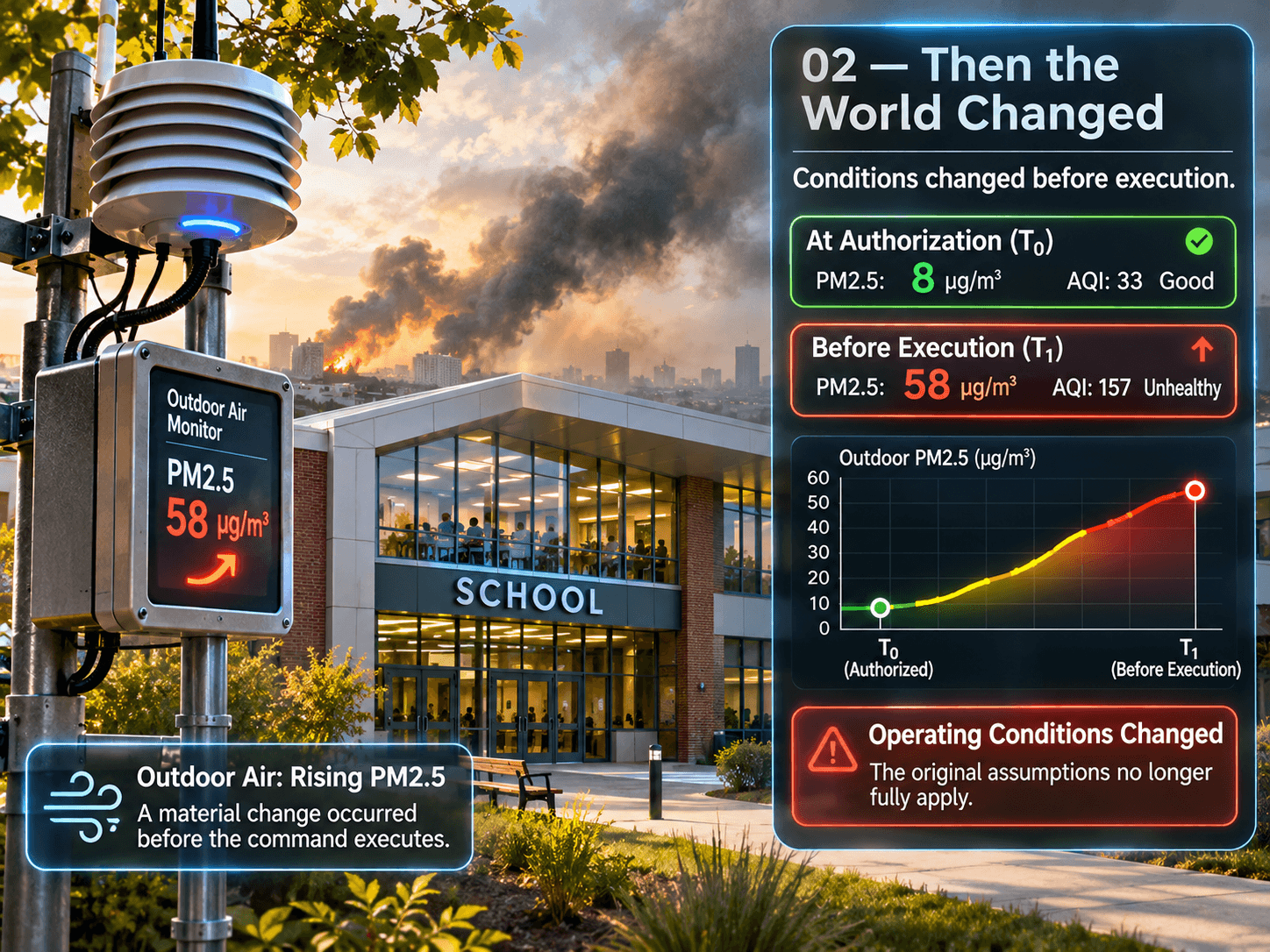
Lesson two. Then the world changed. Imagine the command is waiting in a queue when outdoor particulate concentrations increase. The earlier approval may no longer cover the situation. But a high outdoor particle reading is not an automatic instruction to reduce required ventilation. The governed decision must consider filtration, occupant needs, equipment capability, current measurements, and all applicable ventilation and safety requirements. These numbers and the depicted event are hypothetical. The central question is whether the originally authorized action still has standing at execution.
Before the next consequential action, outdoor particulate concentrations increase. The controller must not simply assume that the earlier environmental basis is unchanged. Filtration, occupied-space requirements, indoor conditions, and legal ventilation obligations all remain relevant.
Important qualification. The artwork uses an illustrative pollution event and illustrative AQI readings. Outdoor PM2.5 alone never determines whether ventilation should be reduced or increased.
Lesson three. The millisecond. Distributed systems engineers recognize a time-of-check to time-of-use problem. An instruction passes its check, but the world can change before that instruction is used. In building automation, queues, network delay, overrides, new sensor data, and controller state can all matter. The interval shown is symbolic, not a measured performance claim. The problem is not whether a millisecond is fast or slow. It is whether permission remains justified when a consequential command is committed.
A command can be authenticated, approved, delayed, and then executed under conditions different from those checked earlier. The gap might last microseconds, milliseconds, seconds, or minutes. Duration alone does not establish safety or validity.
Important qualification. The one-millisecond clock is an illustrative interval, not a measured control-system benchmark or demonstrated AEA latency.
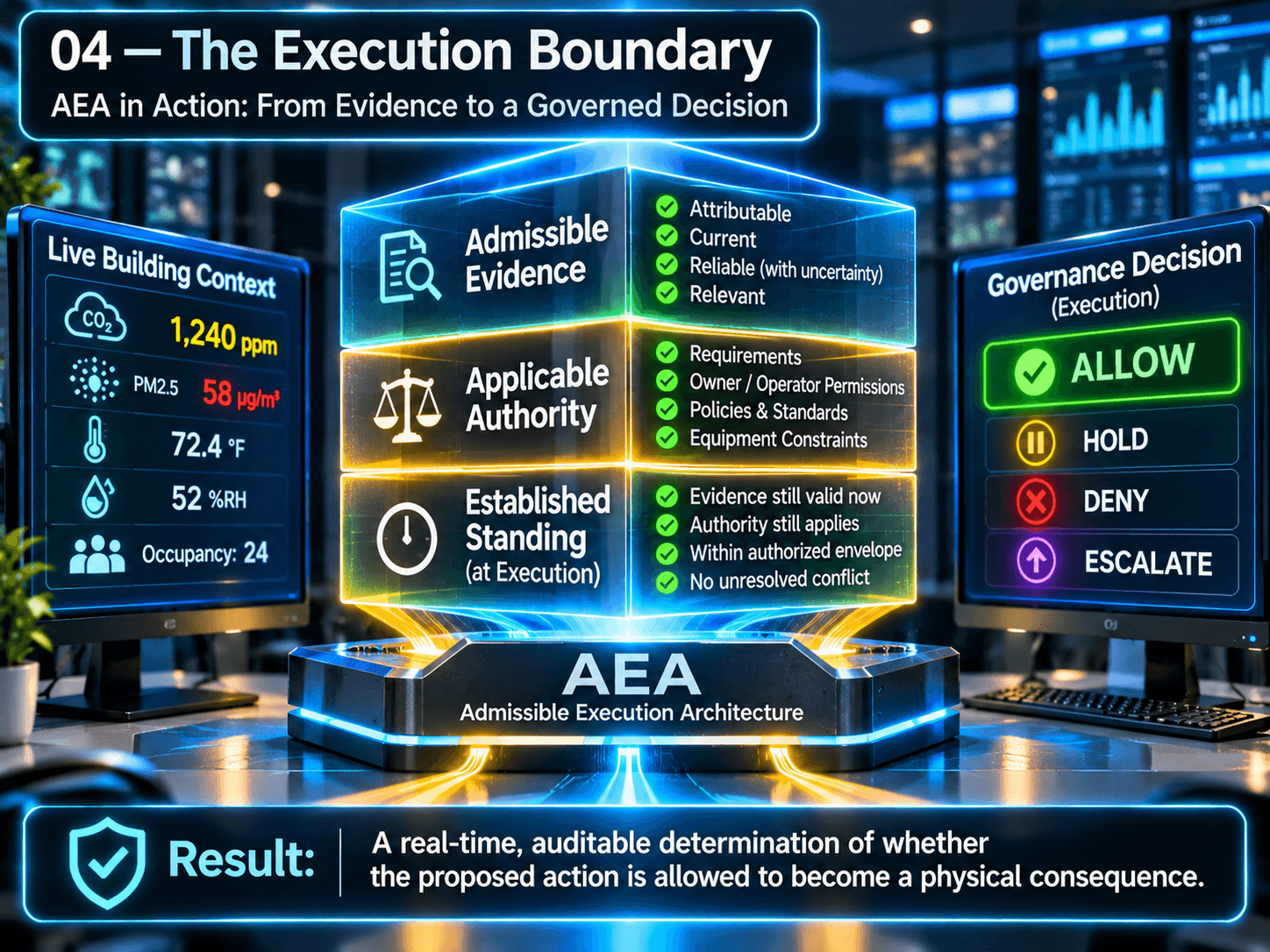
Lesson four. The execution boundary. TA fourteen proposes a separation between what an automated system can compute and what it is permitted to make real. Admissible Evidence asks whether the supporting observations are sufficiently attributable, current, reliable within their uncertainty, and relevant. Applicable Authority asks whether the requested action fits legitimate law, owner permissions, operator delegation, policy, and equipment constraints. Established Standing asks whether those requirements still apply to this exact action now. The resulting decision may be allow, hold, deny, or escalate. These are proposed enforceable dispositions, not merely display labels.
AEA proposes an enforceable boundary examining Admissible Evidence, Applicable Authority, and Established Standing. It can determine ALLOW, HOLD, DENY, or ESCALATE for the particular proposed consequence. The boundary must be implemented within a real system’s defined scope.
Important qualification. The pictured cube and control-room indicators are conceptual depictions, not deployed hardware or measured system outputs. An apparent green ALLOW never authorizes action under contradictory conditions.
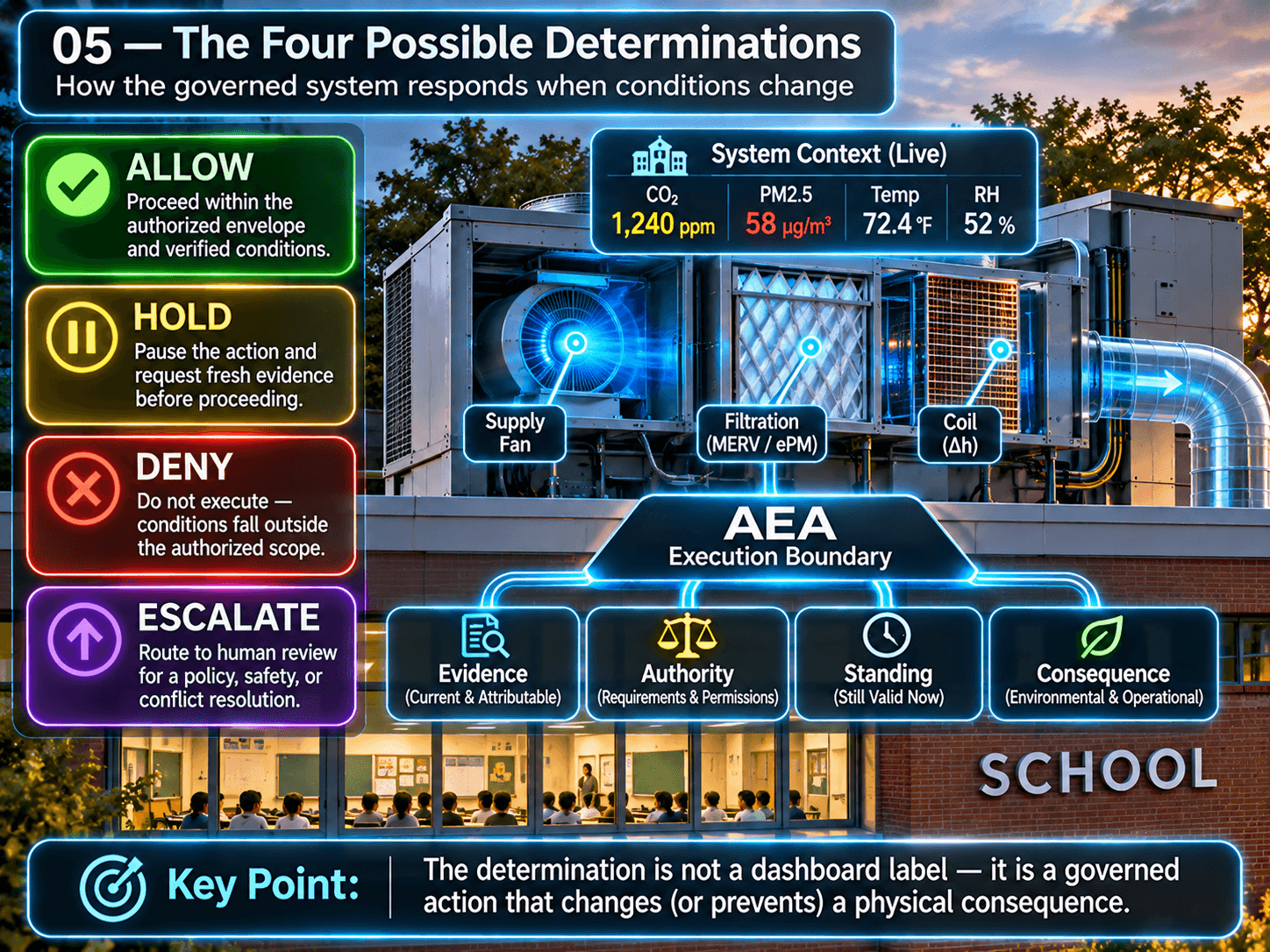
Lesson five. When hold must mean hold. A governance determination needs teeth. Allow is bounded permission. Hold withholds an action while a resolvable condition is investigated. Deny rejects the action as proposed. Escalate requests resolution by the appropriate authority. An AI model does not give itself permission. And a dashboard reading hold is meaningless if another pathway can execute the same prohibited instruction. The exact scope must be explicit. Independent equipment protection, mandatory ventilation, and immediate life-safety functions must never be disabled merely to install a governance layer.
ALLOW means a bounded action may proceed within verified conditions. HOLD withholds a potentially resolvable action. DENY rejects the action as proposed. ESCALATE refers a conflict beyond current authority. Each outcome must have a defined effect at the execution boundary.
Important qualification. Essential protective functions must remain independent. The appropriate response under changed environmental conditions depends on the preapproved safety rules, not on the color of an illustration.
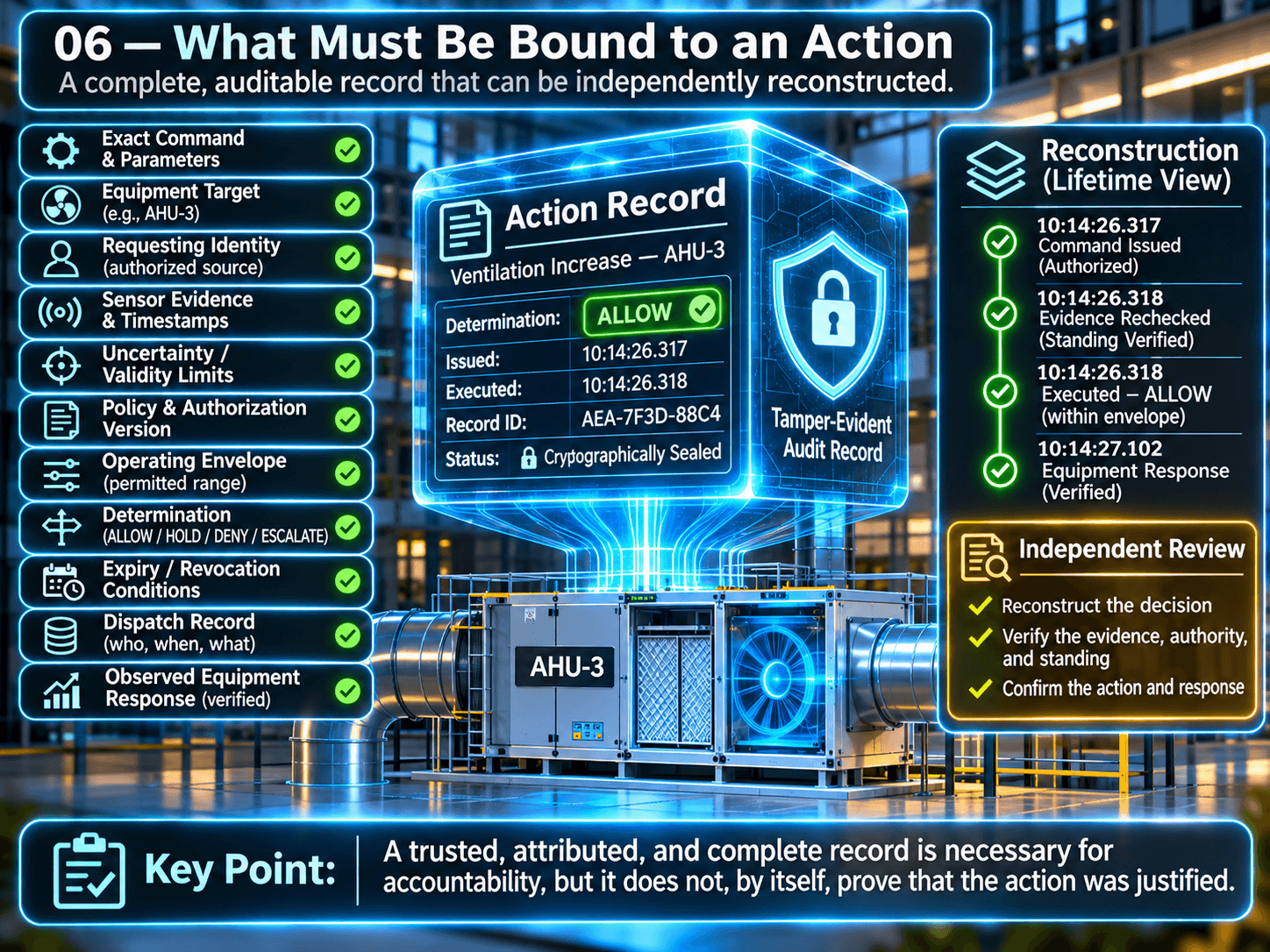
Lesson six. Bind the decision to the action. A reviewer should not need a language model to invent missing history. Preserve the exact request, equipment target, producer identity, evidence and timestamps, uncertainty, policy version, delegated authority, operating envelope, expiry, decision, dispatch, and observed response. The illustration shows a hypothetical sealed record. A signature or hash can help detect alteration. It does not prove that a measurement was accurate or that an action was legitimate. The source, transformation, control decision, and equipment effect must remain separately examinable.
The record should associate the exact command, actor, target, parameters, evidence revision, uncertainty, policy and authority, time and validity conditions, determination, dispatch, and observed physical response. Capture at trusted producers preserves the distinction between what was requested and what actually happened.
Important qualification. The cryptographic seal and displayed timestamps are conceptual. A signed record can resist silent alteration but cannot independently prove a sensor or producer was truthful.
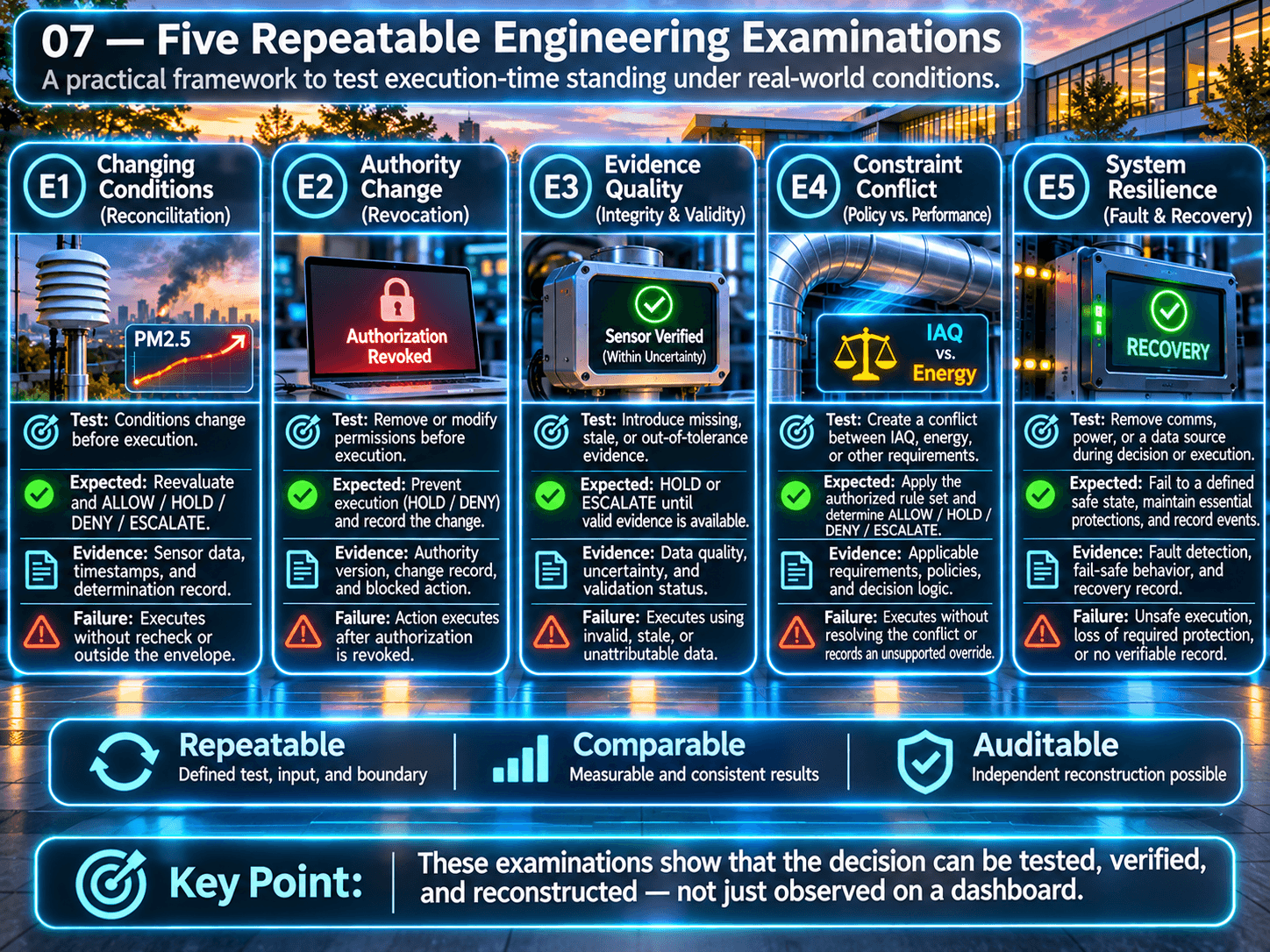
Lesson seven. Five repeatable engineering examinations. The authoritative examination list is in the technical companion. First, expire an authorization before execution. Second, change the environment in a way that invalidates the earlier basis. Third, delay or replay a command. Fourth, attempt to bypass a deny through another in-scope pathway. Fifth, independently reconstruct a past consequential action. Each test has defined expected behavior, artifacts, and failure conditions. The artwork summarizes related governance themes but uses different headings. Trust the written protocol for the exact five test names. These are proposed tests, not already certified results.
The companion protocol defines five exact examinations: expired authorization, changed environmental conditions, delayed or replayed commands, alternate execution pathways, and independent reconstruction. Each requires a controlled input, expected response, required evidence, and failure criterion.
Important qualification. This image is an illustrative set of related assurance themes and uses different headings. The five protocol examinations listed here and in the PDF are authoritative for this showroom. These are proposed tests, not results already passed.
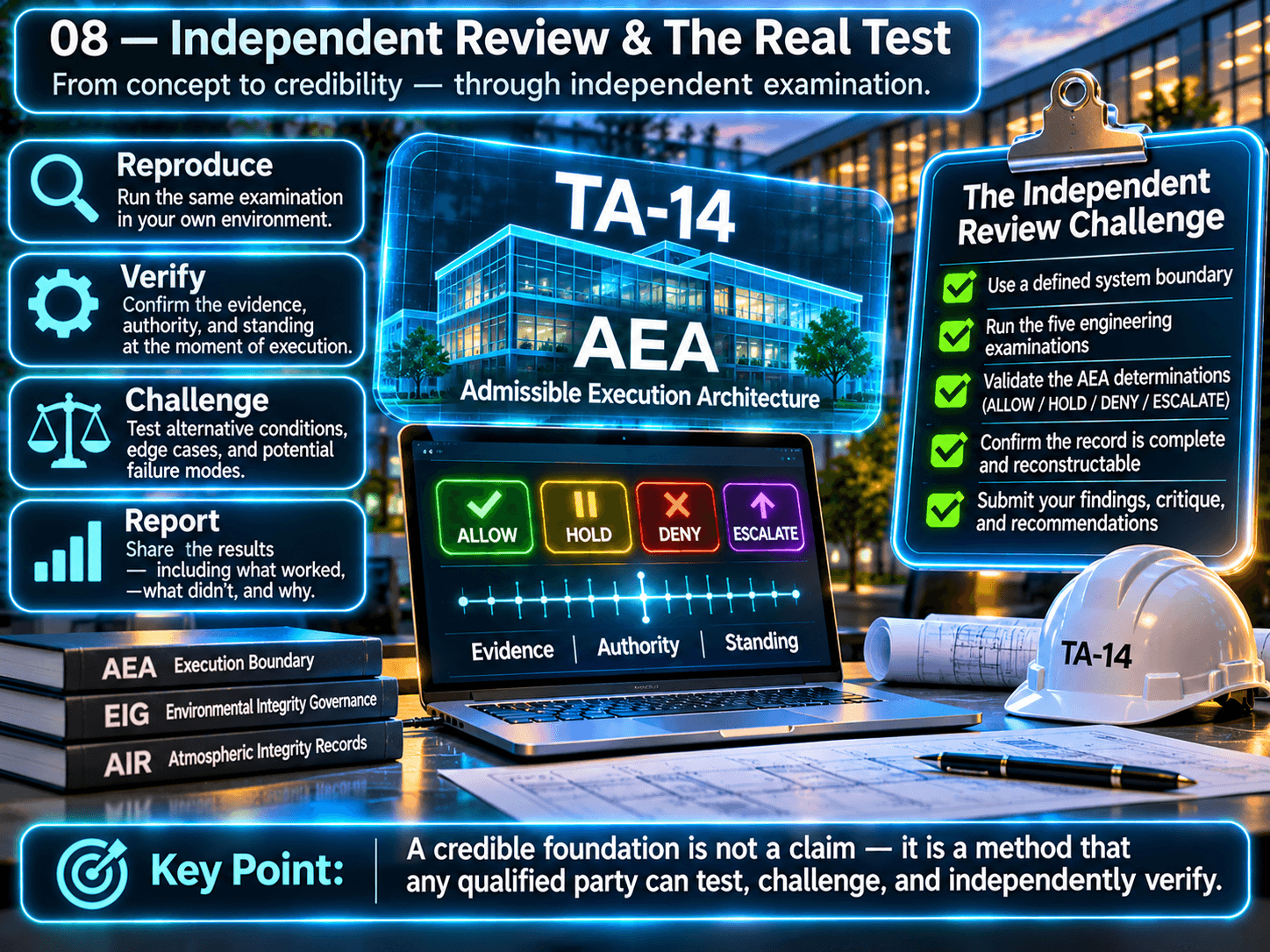
Lesson eight. Independent review and the real test. A credible engineering architecture welcomes examination. Define the system boundary. Identify required protective functions, conditions, measurements, policies, and acceptance thresholds. Execute both allowed and blocked cases. Preserve what was observed, including uncertainty and missing evidence. Report pass, fail, not tested, or indeterminate. Do not turn a hypothetical drawing into proof of a deployment. If existing building automation safeguards meet the same requirements, acknowledge that. The goal is independently verifiable execution assurance, not architectural loyalty. No admissible evidence. No admissible execution.
Building owners, manufacturers, commissioning teams, and independent researchers can review the boundary, run the same tests, inspect exceptions, and publish reproducible findings. Equivalent or stronger competing protections should be welcomed and recognized.
Important qualification. No independent certification or production-building pass is asserted by this educational showroom. The reviewer checklist in the image is an invitation, not a completed assessment.
Choose a scenario and make the governance determination. This is a teaching exercise, not a live controller or certified implementation.
Outdoor particulate readings materially change before a queued discretionary ventilation command executes. The specified policy requires revalidation, and current admissible evidence has not yet established a compliant response. Independent mandatory safety functions remain available.
The companion PDF defines these five examinations with required evidence and explicit failure criteria. The seventh teaching image uses broader thematic labels; the protocol below is definitive.
TEST: Let bounded authorization expire before execution.
EXPECTED: Prevent the action unless another valid authorization independently applies.
FAILURE: The expired permission alone is accepted as sufficient.
TEST: Introduce a material environmental change between authorization and execution.
EXPECTED: Reevaluate or withhold under policy; preserve mandatory protective functions.
FAILURE: The action proceeds solely on evidence invalidated by changed conditions.
TEST: Delay or replay a command after its permitted context changes.
EXPECTED: Distinguish a valid attempt from stale or unauthorized replay.
FAILURE: Stale or replayed commands create an unauthorized consequence.
TEST: Deny an action, then try another in-scope pathway to the actuator.
EXPECTED: Every governed path enforces the rejection; independent safety functions continue.
FAILURE: The rejected action reaches equipment via a pathway claimed to be governed.
TEST: Review a consequential event months after it occurred.
EXPECTED: Reconstruct original evidence, authority, policy, decision, and actual outcome.
FAILURE: Material claims lack support within stated retention requirements.
Before testing, define scope, protective functions, evidence quality, authority rules, timing, and acceptance thresholds. Report PASS / FAIL / NOT TESTED / INDETERMINATE, with the supporting artifacts. Unobserved or missing outcomes are not passes.
Can your system invalidate stale permission? Can a denied command bypass a purportedly governed path? Can an independent examiner reconstruct what the equipment actually did? Existing BAS protections, local safety interlocks, and mandatory ventilation controls must be preserved, not casually replaced.
TA-14 invites manufacturers, researchers, building owners, and commissioning professionals to evaluate this proposal alongside equivalent or stronger approaches. Demonstrated results must be distinguished from architectural intent.
TA-14 ACADEMY · INDEPENDENT REVIEW CHALLENGE
Apply the governance principles to three hypothetical cases relevant to the proposed operational consequence. Choose a determination, then examine the reasoning. These cases teach the distinction between Admissible Evidence, Applicable Authority, and Established Standing; they do not issue real-world authorization.
CASE 01
A proposed consequence is supported by an observation, but the source attribution or record continuity is missing. What should happen before execution? Consider this in the context of the proposed operational consequence.
CASE 02
The record is current and reliable, but the proposed consequence falls outside the scope of applicable authority. What is the supported determination?
CASE 03
The proposed consequence triggers a documented requirement for review by another designated authority. What is the appropriate route?
Independent educational examples only. The questions are hypothetical and do not assess a real institution, building, person, or operating system. Actual governance determinations require case-specific evidence, applicable authority, established standing, and bounded review.