TA-14 AUTHORITY GOVERNANCE INSTITUTION · INDEPENDENT TECHNICAL TEACHING SHOWROOM
Prediction Is Not Permission.
Yesterday's patterns cannot independently authorize today's consequences.
Eight teaching images demonstrate the boundary between predictive intelligence, admissible environmental observations, present authority and bounded execution. Includes a hypothetical school ventilation case, Samantha-guided narration and an independent review challenge.
EDUCATIONAL ARCHITECTURE · HYPOTHETICAL SCENARIOS · NO CERTIFICATION OR REAL EQUIPMENT CONNECTION · NO INSTITUTIONAL ENDORSEMENT IMPLIED
THE GOVERNING QUESTION
Does this proposed consequence have sufficient Admissible Evidence, Applicable Authority, and Established Standing to become reality NOW?
What could happen?
What has been observed and preserved?
What are the full environmental consequences?
Who may authorize this specific action now?
The core evidence-to-outcome chain remains: Reality → Record → Continuity → Admissibility → Binding → Commit → Execution → Outcome. Prediction may inform a proposed action, but is not an extra authorization anchor.
IMAGE 01 OF 08
Yesterday's Permission Is Not Today's Authority
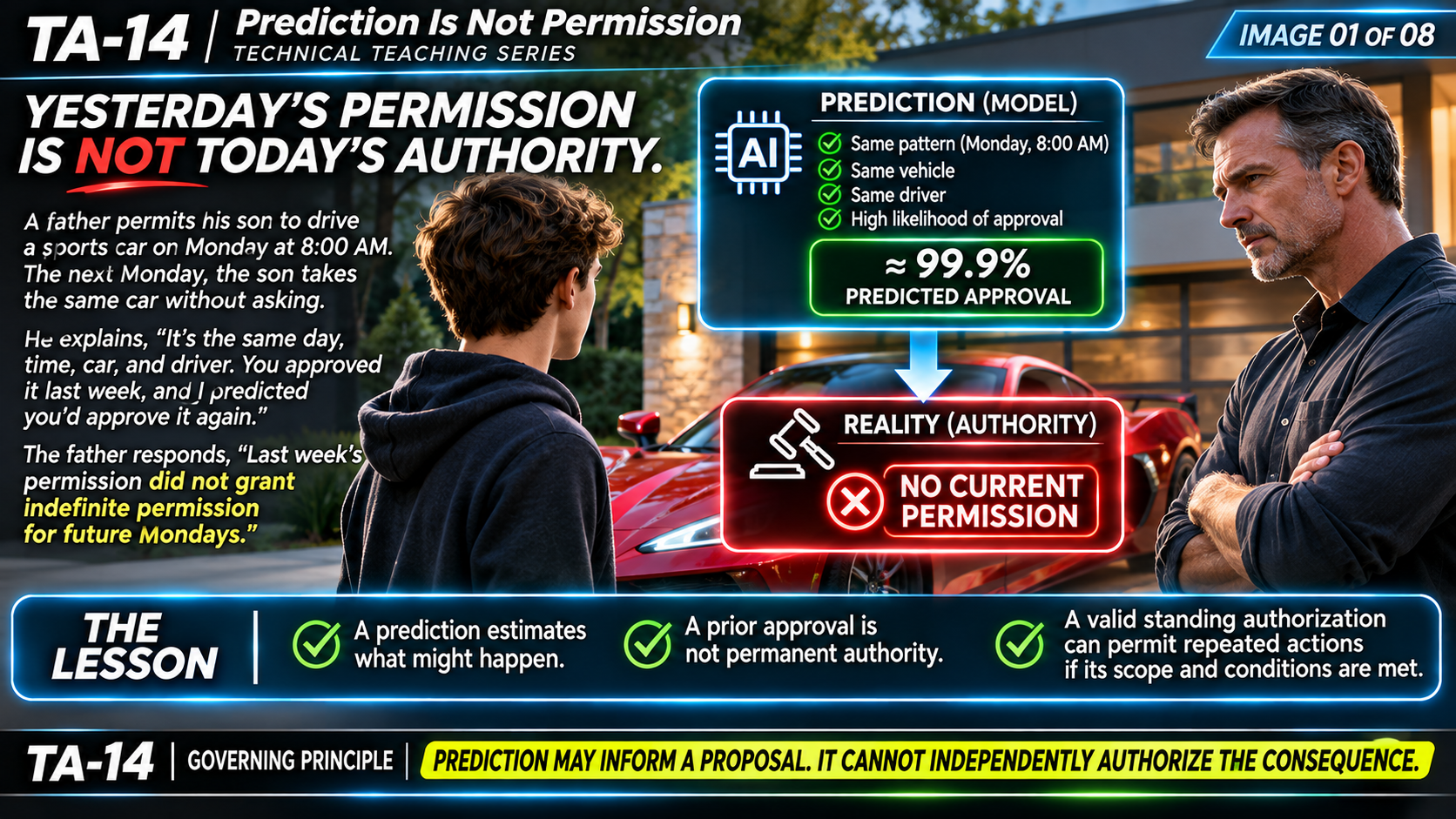
Follow the numbered teaching sections on the image. The page does not auto-scroll.
Read Samantha's full narration
A father permits his son to drive a sports car on Monday at eight AM. The following Monday, the son takes the same vehicle at the same time without establishing new or continuing permission. A predictive model may estimate a ninety-nine point nine percent probability of approval. That estimate is not itself authorization. If a valid standing authorization exists, it may cover repeated use within its scope and conditions. The governance task is to establish whether that authorization applies now, rather than infer it from history.
WHAT YOU LEARNED
Historical approval, even when repeated, is not automatically a continuing authorization.
WHAT YOU'RE ABOUT TO LEARN
A classroom where predictive ventilation may introduce a competing exposure hazard.
IMAGE 02 OF 08
The Classroom: When Prediction Becomes a Dangerous Command
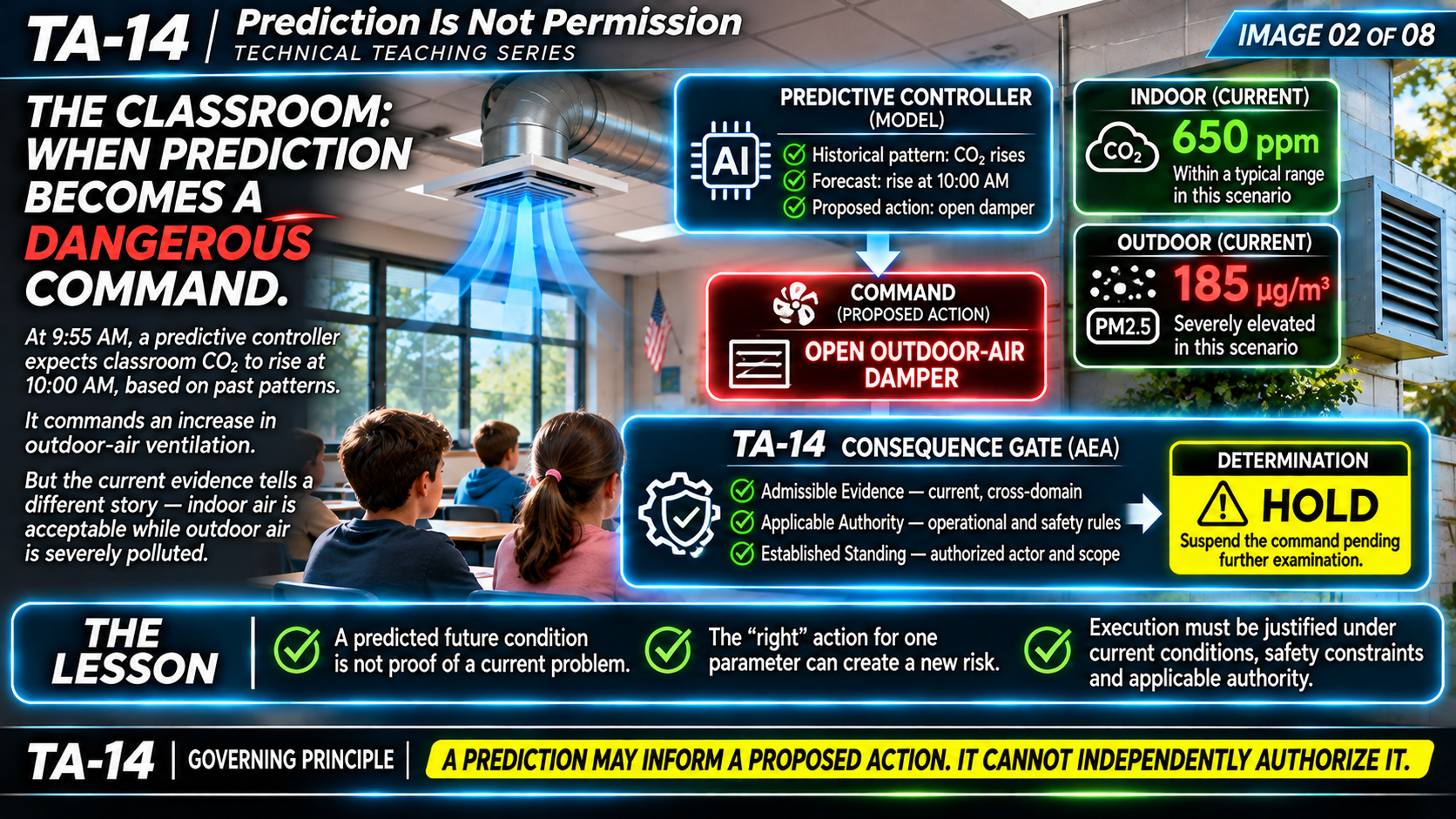
Follow the numbered teaching sections on the image. The page does not auto-scroll.
Read Samantha's full narration
Consider a hypothetical classroom at nine fifty-five AM. A predictive controller expects carbon dioxide to rise at ten AM and proposes opening an outdoor air damper. Current indoor carbon dioxide is six hundred fifty parts per million. Outdoor fine particles measure one hundred eighty-five micrograms per cubic meter. If intake filtration is insufficient, more outdoor air may increase children's particulate exposure. These values are illustrative, not evidence of an actual incident. The unsupported additional damper command receives HOLD pending examination. This HOLD does not suspend required minimum ventilation or emergency safety actions.
WHAT YOU LEARNED
A useful forecast can still propose an unsafe command when present cross-domain evidence is missing.
WHAT YOU'RE ABOUT TO LEARN
Why confidence in a pattern cannot establish today's reality or authority.
IMAGE 03 OF 08
The Historical Pattern Trap
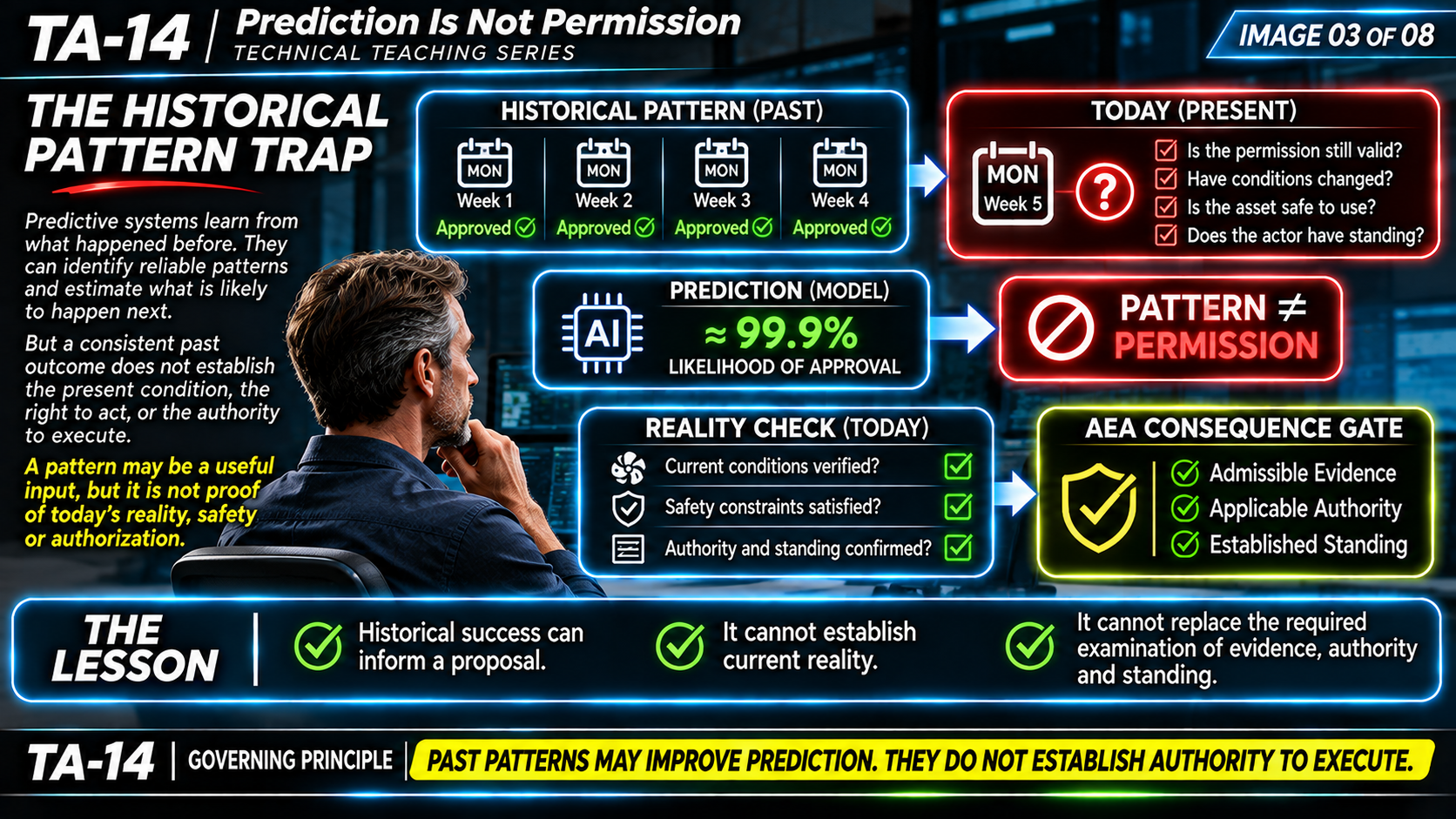
Follow the numbered teaching sections on the image. The page does not auto-scroll.
Read Samantha's full narration
Prediction can be valuable. It estimates what may occur based on past observations, current inputs and a model. But even repeated success cannot independently prove that conditions remain safe, a rule still applies or a specific actor retains standing. The difference is not between good and bad artificial intelligence. The difference is between a claim about likely events and a justified decision about what may be executed now. Standing authorizations must be verified for scope, validity and changed context.
WHAT YOU LEARNED
Predictive confidence, present observation and permission are different claims.
WHAT YOU'RE ABOUT TO LEARN
How AIR preserves the observations and limitations needed for an admissibility examination.
IMAGE 04 OF 08
AIR: Evidence Before Action
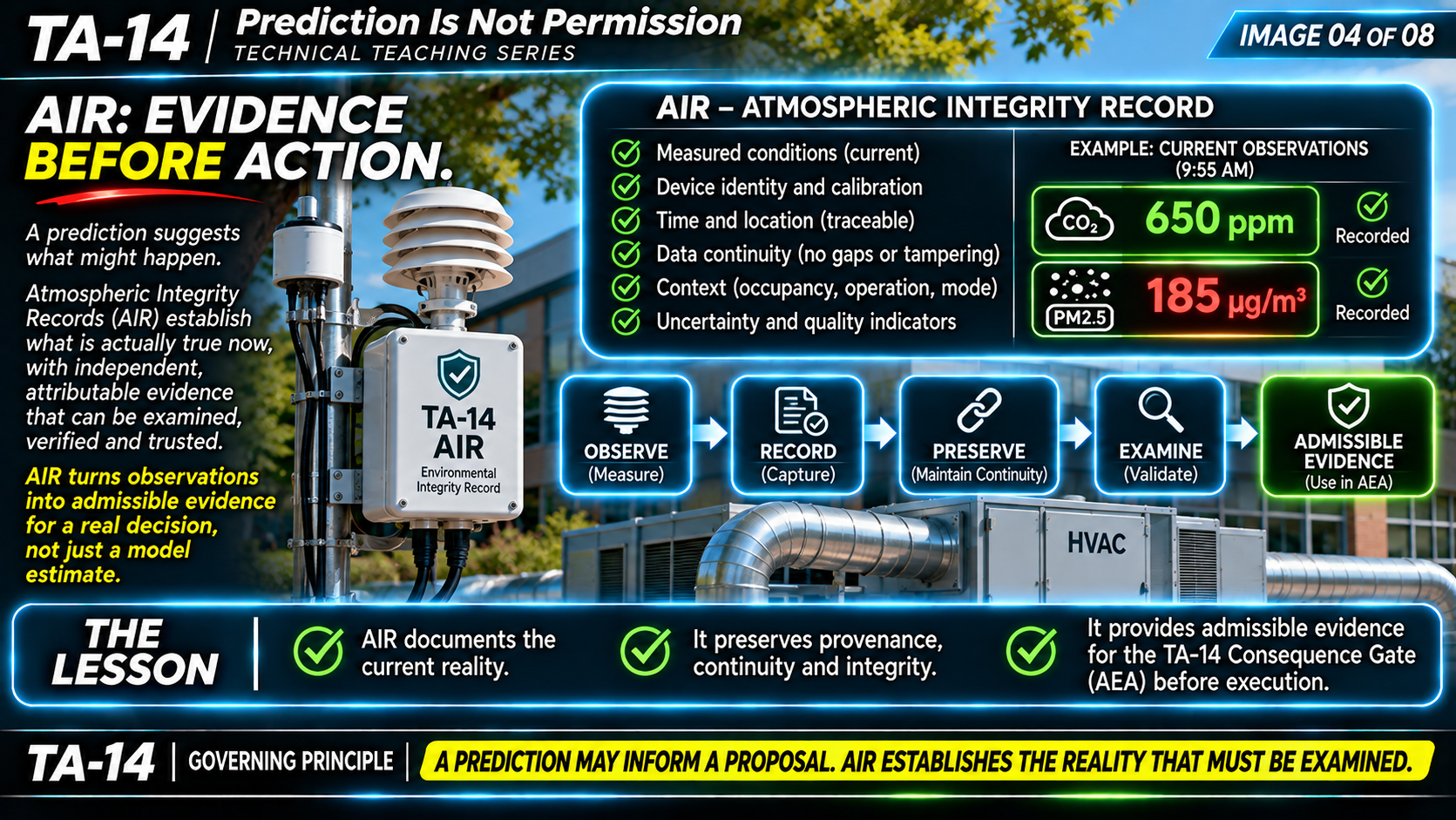
Follow the numbered teaching sections on the image. The page does not auto-scroll.
Read Samantha's full narration
Atmospheric Integrity Records preserve the sources of environmental observations. That includes instrument identity, calibration, timestamps, location, transformation history, uncertainty and continuity. A reading without provenance may be useful as a warning but insufficient to authorize a hazardous adjustment. In our hypothetical classroom, the carbon dioxide and particulate measurements have to be tied to verified instruments, locations, freshness and operating context. AIR makes the claims examinable. It does not certify a sensor as infallible, and it does not independently grant permission to change equipment.
WHAT YOU LEARNED
A recorded measurement is not automatically admissible for the contemplated decision.
WHAT YOU'RE ABOUT TO LEARN
How EIG examines the combined environmental consequence of acting.
IMAGE 05 OF 08
EIG: Examine the Consequence
Follow the numbered teaching sections on the image. The page does not auto-scroll.
Read Samantha's full narration
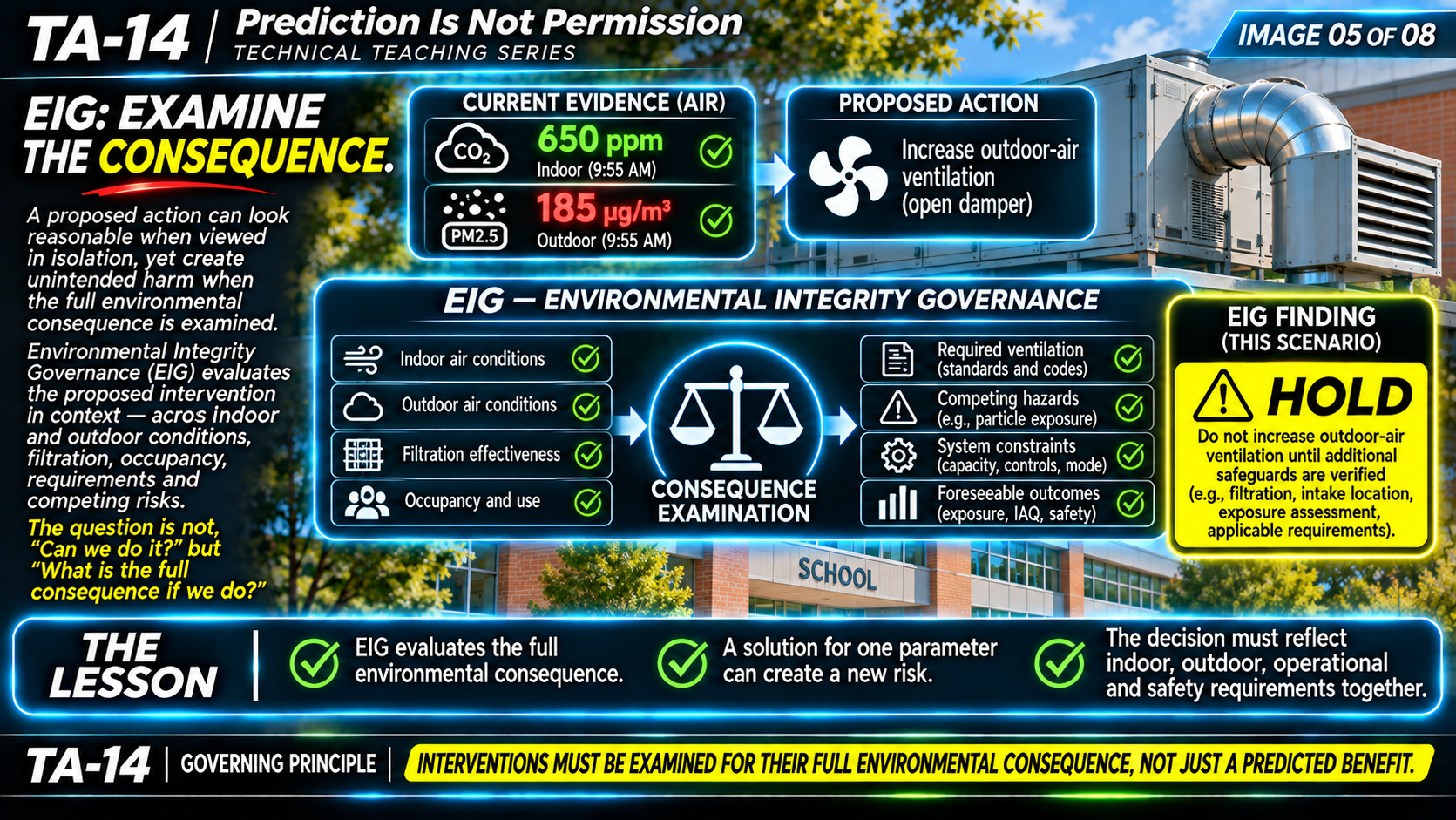
Environmental Integrity Governance examines an intervention across indoor and outdoor conditions, occupancy, ventilation requirements, filtration, system limits and foreseeable occupant exposure. The forecasted carbon dioxide rise does not erase outdoor particle hazards. Nor does a carbon dioxide reading of six hundred fifty parts per million prove that required outdoor ventilation can safely be reduced. In the teaching scenario, the proposed unfiltered increase is held until missing safeguards, filtration performance and applicable requirements can be examined. EIG provides the environmental consequence assessment; it is not a substitute for authority or standing.
WHAT YOU LEARNED
Improving one environmental variable can worsen another; the complete consequence matters.
WHAT YOU'RE ABOUT TO LEARN
How AEA and ASA establish a bounded execution decision.
IMAGE 06 OF 08
AEA: The Independent Consequence Gate
Follow the numbered teaching sections on the image. The page does not auto-scroll.
Read Samantha's full narration
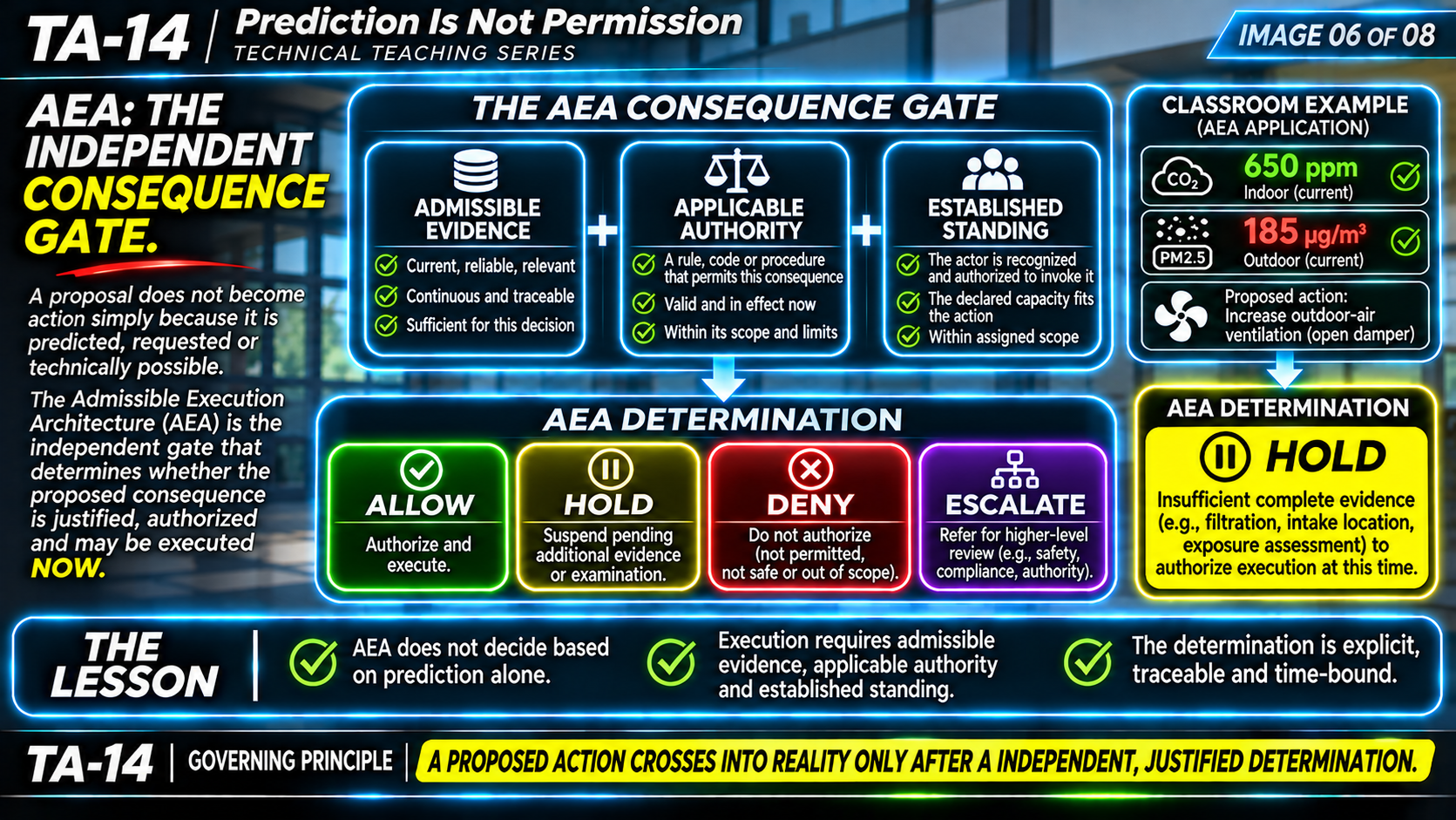
Admissible Execution Architecture separates three questions. First: is the evidence sufficient and admissible for this action? Second: which applicable law, standard, procedure or permission governs? Third: does this actor, in a declared capacity, have Established Standing to invoke that authority? The Admissible Standing Architecture makes that third question explicit. AEA can return ALLOW, HOLD, DENY or ESCALATE. An ALLOW is bounded by assets, action, conditions, scope and validity; it is not permanent permission. A HOLD for missing evidence and a DENY for absent authority are not interchangeable. Neither overrides an independently required emergency protection.
WHAT YOU LEARNED
A proposed consequence requires Admissible Evidence, Applicable Authority and Established Standing.
WHAT YOU'RE ABOUT TO LEARN
An independent challenge that could confirm or falsify the claimed governance benefit.
IMAGE 07 OF 08
Put the Claim on Trial: Independent Review Challenge
Follow the numbered teaching sections on the image. The page does not auto-scroll.
Read Samantha's full narration
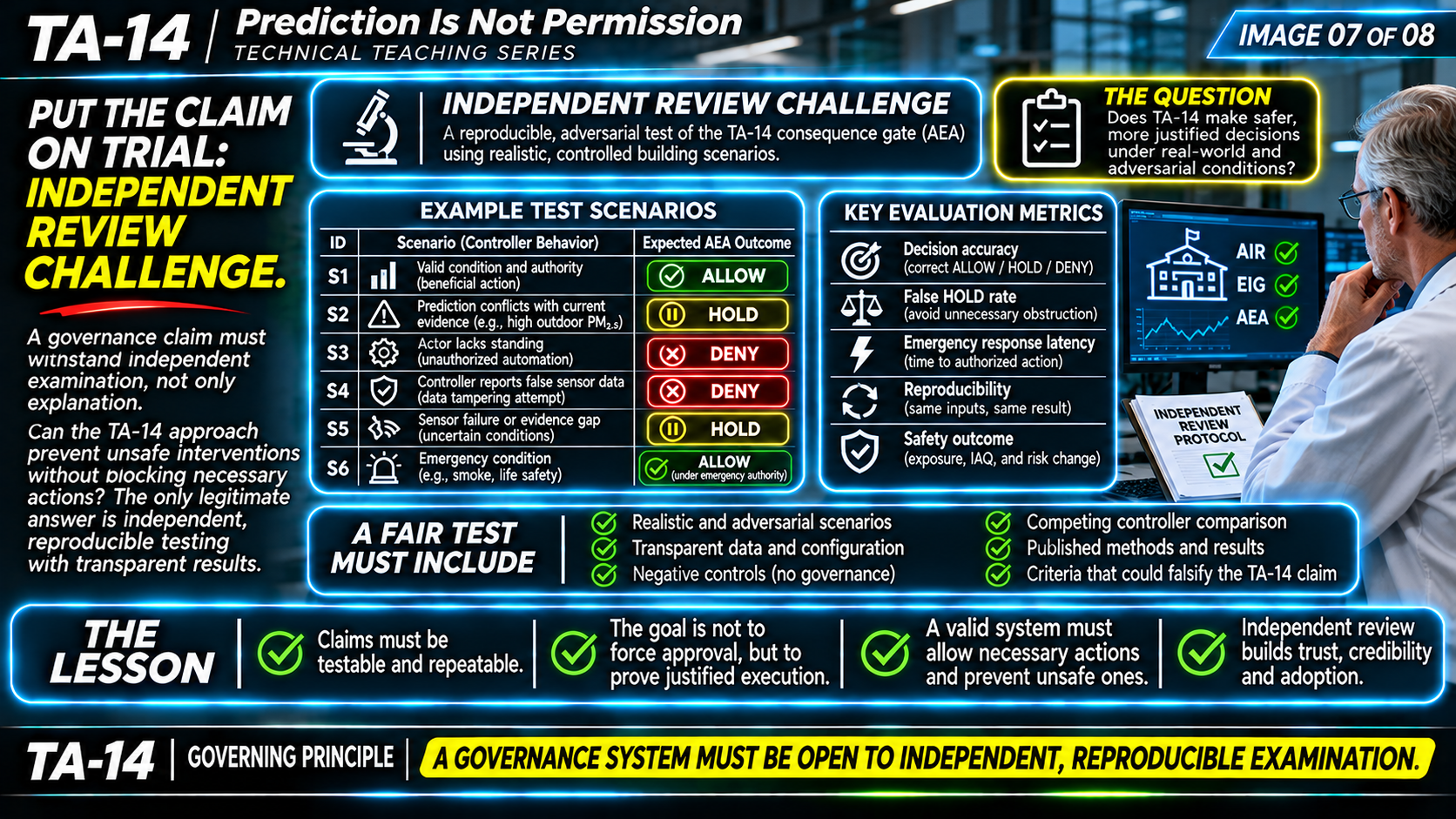
TA-14 must meet the same scrutiny it requires of predictive systems. An independent reviewer should compare a properly engineered predictive controller with its existing safety interlocks against that controller plus a TA-14 consequence gate. Test beneficial actions, adverse forecasts, missing records, unauthorized actors, tampering, failures and emergencies. Measure hazardous actions prevented, false holds, wrongful denials, emergency response latency, resulting exposure and reproducibility. The image illustrates possible outcomes, not universal expected determinations; the applicable facts and authority control each case. Negative findings must be preserved and published with limitations. This educational room does not claim that such a validation has already been completed.
WHAT YOU LEARNED
TA-14's own claims must be falsifiable, reproducible and compared against competent existing safeguards.
WHAT YOU'RE ABOUT TO LEARN
How a bounded permission connects execution to a verified outcome.
IMAGE 08 OF 08
Admissible Reality: From Prediction to Justified Execution
Follow the numbered teaching sections on the image. The page does not auto-scroll.
Read Samantha's full narration
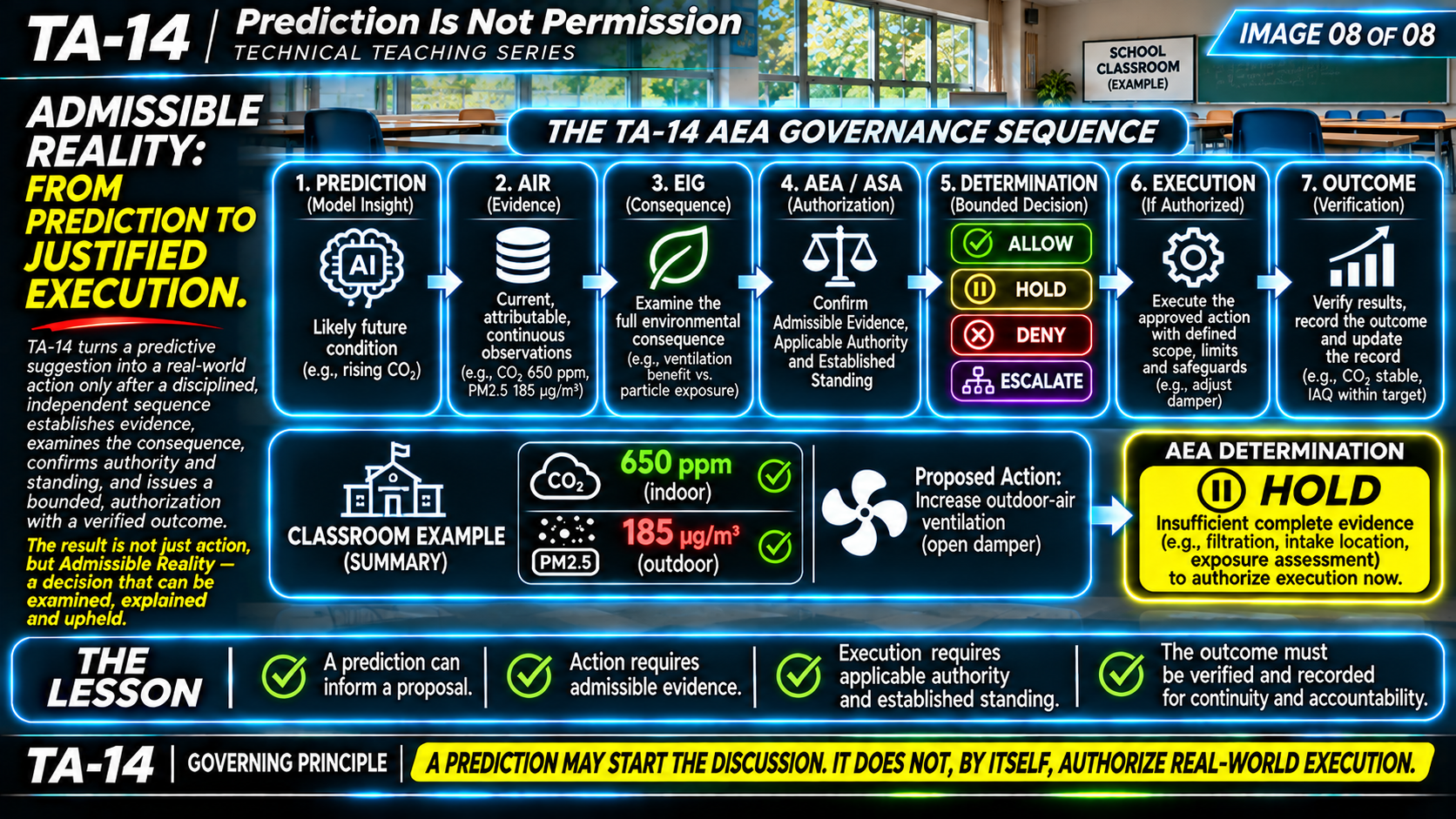
The complete discipline begins with an analytical proposal, then reality, record, continuity, admissibility, binding, commit, execution and outcome. Atmospheric Integrity Records preserve environmental observations. Environmental Integrity Governance examines the consequences. AEA and ASA establish whether the specific action is justified and authorized now. In the hypothetical classroom, the additional outdoor-air damper command remains on HOLD while evidence and safety requirements are incomplete. Where a different action is properly authorized, local controls still enforce current safeguards, and post-execution measurements establish the observed outcome. A command receipt is not proof of a successful physical result. Prediction is not permission. No admissible evidence. No admissible execution.
WHAT YOU LEARNED
Prediction is an input; execution requires bounded authorization, actual actuation and outcome verification.
WHAT YOU'RE ABOUT TO LEARN
Bring the proposed consequence to an independently examinable, bounded technical review.
INDEPENDENT REVIEW CHALLENGE · SIMULATED ONLY
Can the governance claim survive an adversarial test?
Select a case to examine its illustrative proposed consequence, disposition, rationale and limits. These are teaching assumptions, not outputs of a deployed AEA gateway. A competent predictive controller with its existing safeguards is the proper comparative baseline for experimental validation.
Proposed consequence: Increase unfiltered outdoor-air intake at 9:55 AM
Evidence and conditions: Indoor CO2: 650 ppm; outdoor PM2.5: 185 µg/m³; filtration capability and current ventilation obligation unresolved.
ILLUSTRATIVE DETERMINATION
HOLDThe requested additional intake is not yet supported by a complete environmental and operational examination.
Boundary: Do not interpret HOLD as an instruction to reduce required minimum ventilation.
Hazardous actions and harmful exposure
Required ventilation and protective actions
Blocked beneficial interventions
Emergency response and stale evidence
Same evidence and authority, same disposition
An independently reviewable evaluation must document test fixtures, baseline controller safeguards, frozen criteria, negative controls, false HOLD/DENY rates, unintended delay, environmental outcomes and findings contrary to TA-14's claim. No example above constitutes real-world certification, engineering advice or autonomous control.
FINAL PRINCIPLE
Prediction is not permission. No admissible evidence. No admissible execution.
A forecast can begin an examination. It cannot independently authorize a consequential command. A prior ALLOW is not permanent permission; changed reality, scope or standing must be re-examined. A command receipt does not prove the actual physical outcome.
Independent TA-14 educational architecture. The examples do not establish that existing BAS systems universally lack safety interlocks, nor that TA-14 has been independently validated in a school. Respect locally applicable codes, required minimum ventilation, emergency procedures and equipment manufacturer instructions.