How do we establish reliable measurements, qualified responsibility, justified interventions and long-term accountability—especially where licensing is incomplete?
This eight-part examination responds to questions raised in professional discussion about radon testing, ANSI/AARST standards, qualification, continuous monitoring, mitigation verification and homeowner stewardship. It is not affiliated with, commissioned by, reviewed by or endorsed by any named practitioner or standards body.
EDUCATIONAL STATUS · NO FIELD VALIDATION
Imagery, checkmarks, actors, equipment and decision outcomes are illustrative. The prospectus proposes governance requirements; it does not confer radon credentials, certify a property, establish legal authority or demonstrate deployed enforcement. Verify actual requirements with the applicable ANSI/AARST standards, EPA guidance and state radon program.
A measurement is not a decision. A recommendation is not authorization. Installed mitigation is not verified exposure reduction.
Follow eight original illustrations in order. Samantha narration is available directly beneath every image, followed by the lesson, a technical qualification and the question that leads to the next section.
01 · THE INVISIBLE CONDITION
A home can look safe and still require testing.
SAMANTHA · OPTIONAL AUDIO GUIDANCE
Browser speech uses the Samantha voice when available. Narration does not scroll the page.
WHAT YOU LEARNED
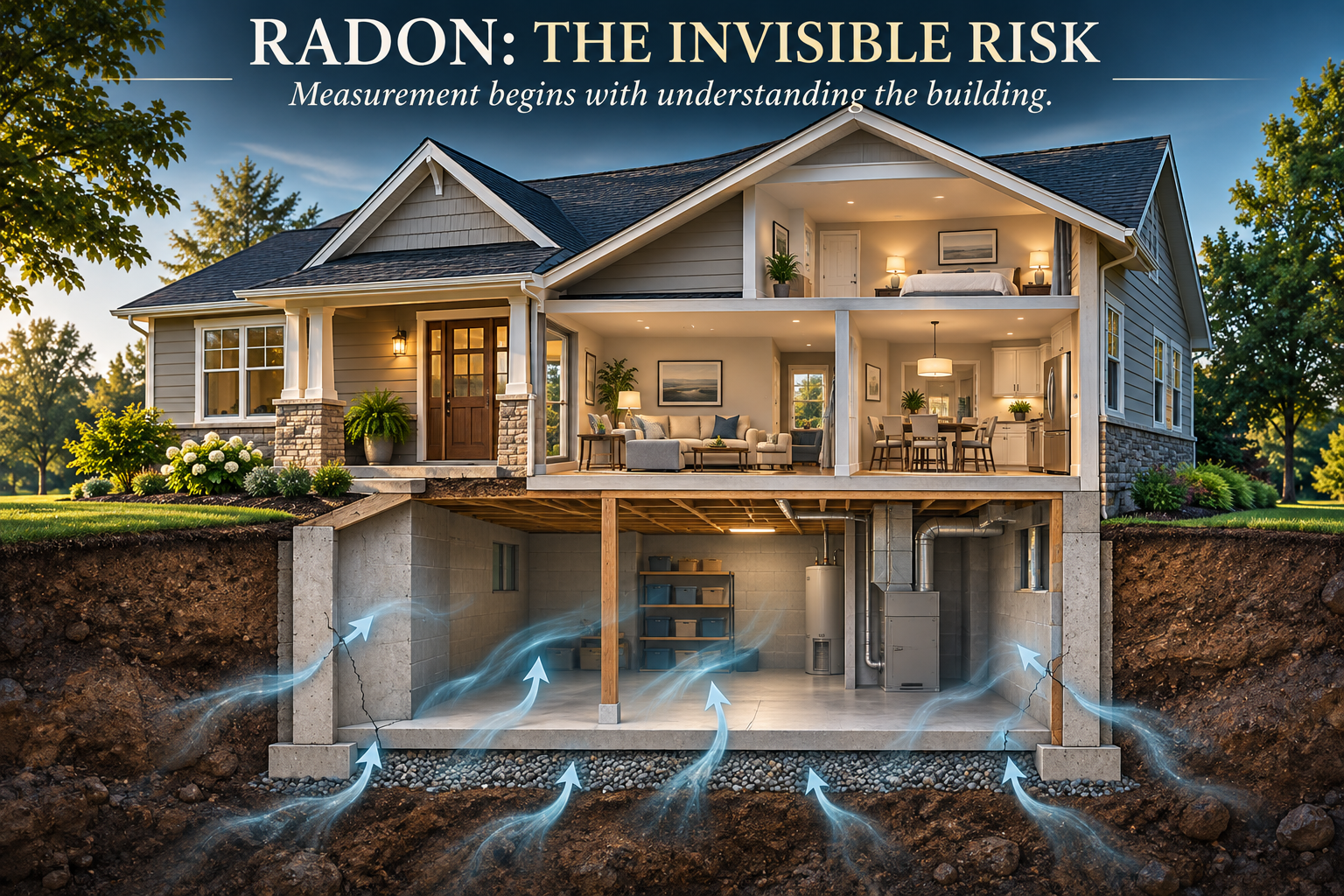
Radon is a naturally occurring radioactive gas. It cannot be detected by sight or smell, and it can enter buildings from the ground. A beautifully maintained home does not establish its indoor radon condition.
Start with the actual building and the question being asked. Appropriate testing—not appearances, assumptions or a map of nearby homes—establishes an observation at a specific place and time.
WHAT THE IMAGE DOES NOT PROVE
The blue arrows in this illustration are conceptual. Radon is invisible, and the image does not document an actual home.
WHAT COMES NEXT
What makes a test record sufficiently trustworthy to support a consequential decision?
02 · THE WHOLE PATH
A reading is the beginning of accountability, not its conclusion.
SAMANTHA · OPTIONAL AUDIO GUIDANCE
Browser speech uses the Samantha voice when available. Narration does not scroll the page.
WHAT YOU LEARNED
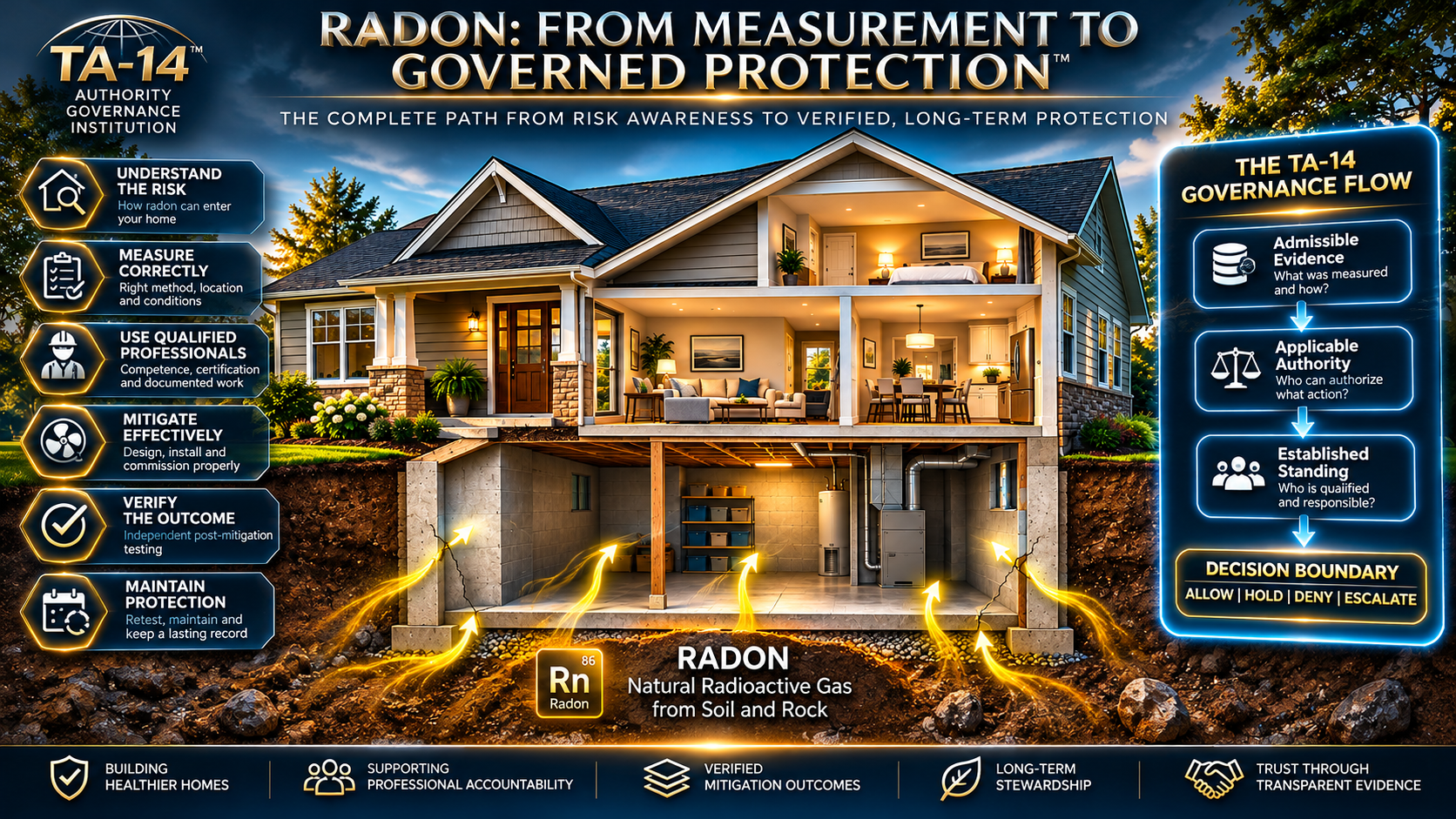
The proposed chain is: recognize potential risk, measure appropriately, establish professional responsibility, evaluate an intervention, perform authorized work, verify results and maintain protection.
Those are different evidence and responsibility boundaries. TA-14 does not issue radon credentials, impose standards or execute mitigation. The governance layer evaluates whether a proposed consequential step has support from admissible evidence, applicable authority and established standing.
WHAT THE IMAGE DOES NOT PROVE
This overview graphic is a conceptual teaching map; its checkmarks and flow are not results from a real property.
WHAT COMES NEXT
How do we know whether the original measurement was collected correctly?
03 · MEASUREMENT INTEGRITY
Method, placement, conditions and quality assurance matter.
SAMANTHA · OPTIONAL AUDIO GUIDANCE
Browser speech uses the Samantha voice when available. Narration does not scroll the page.
WHAT YOU LEARNED
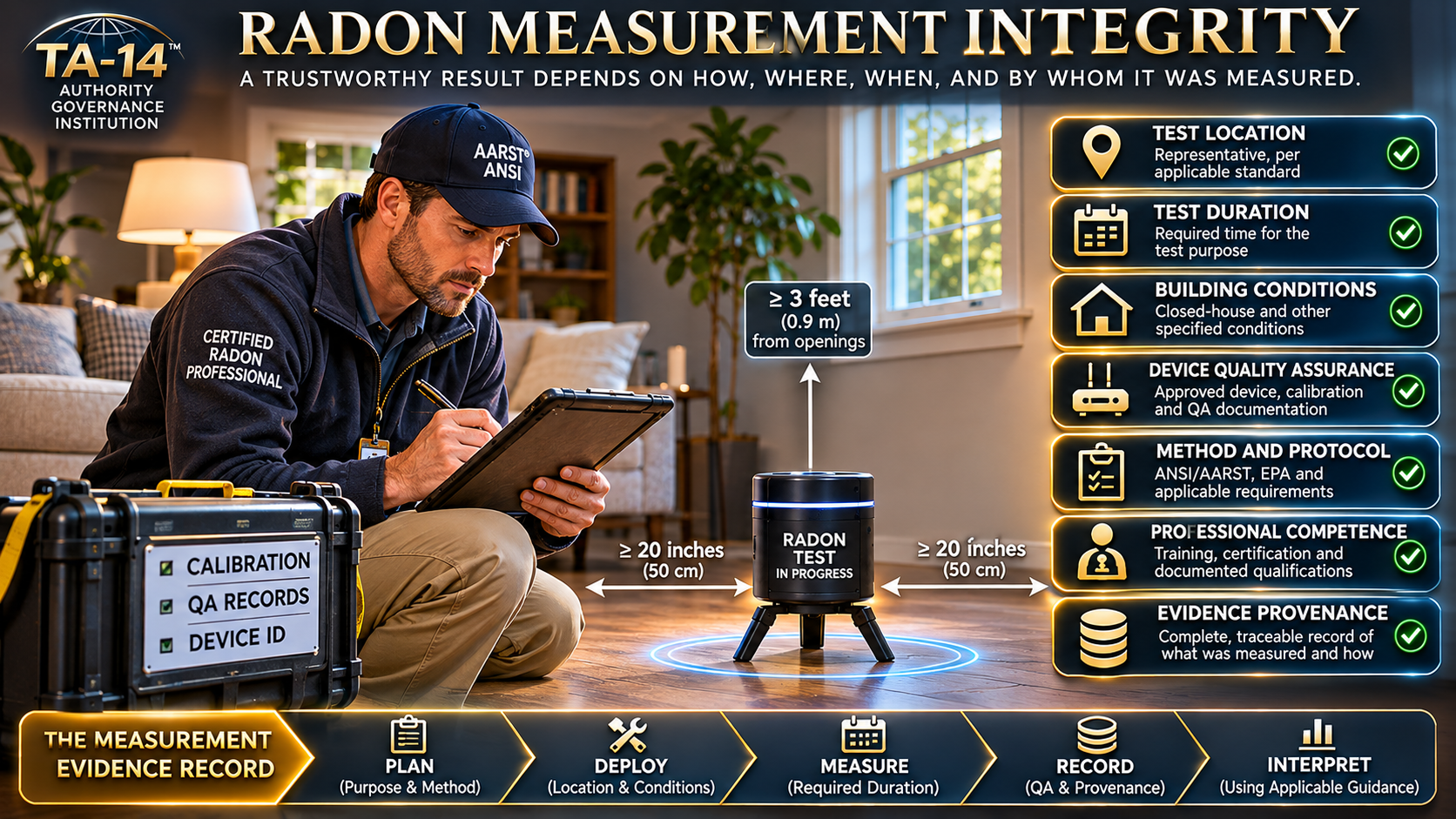
A defensible radon record identifies the purpose of the test, relevant protocol and edition, location, dates and duration, device or laboratory identity, quality-control context, building conditions, tester identity and any deviations.
Testing requirements differ for screening, real-estate transactions, diagnostic investigations and post-mitigation verification. Deviations or missing records should remain visible rather than becoming implied compliance.
WHAT THE IMAGE DOES NOT PROVE
Any numeric spacing annotations depicted in the illustration are not approved universal placement instructions. Verify exact distances and procedures against the currently applicable measurement protocol.
WHAT COMES NEXT
Who is actually qualified, and who has legitimate authority for the work?
04 · CREDENTIALS AND RESPONSIBILITY
Licensing, certification, competence and authority are not interchangeable.
SAMANTHA · OPTIONAL AUDIO GUIDANCE
Browser speech uses the Samantha voice when available. Narration does not scroll the page.
WHAT YOU LEARNED
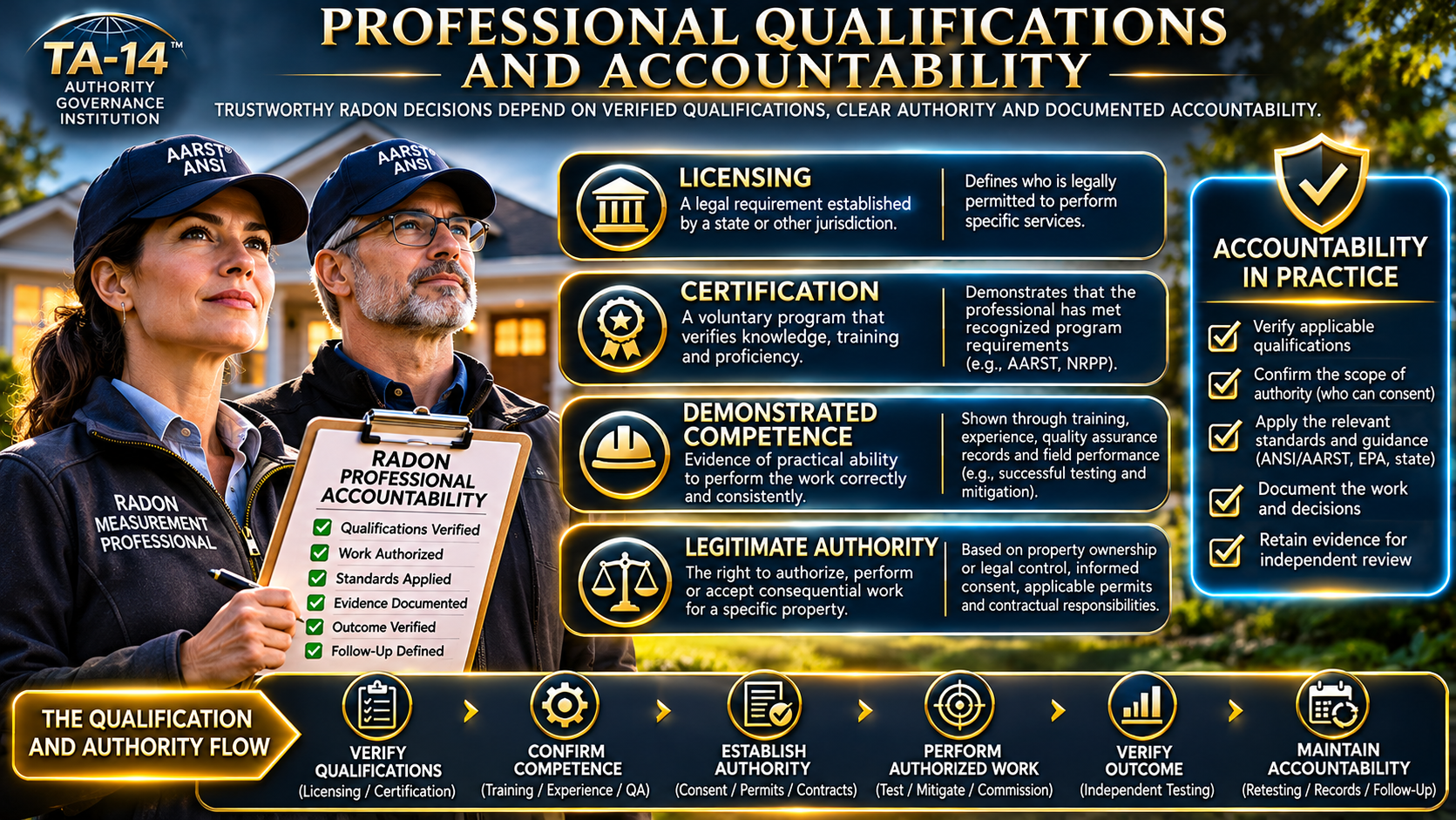
Licensing is a jurisdiction-specific legal requirement where applicable. Certification may be voluntary or legally required. Training, field competence, quality-assurance records and the right to authorize property work must be examined separately.
A proposed program could require documented competence even where state licensing is absent—but it must label such conditions as program requirements, not invented state law. The record should distinguish verified credentials from claims that were not independently checked.
WHAT THE IMAGE DOES NOT PROVE
The illustration describes certification as voluntary; that is not universally true. Certification requirements depend on jurisdiction and the specific professional role. All depicted checkmarks are hypothetical.
WHAT COMES NEXT
What happens when evidence or authority is incomplete at the proposed action boundary?
05 · ADMISSIBLE EXECUTION ARCHITECTURE
Evidence is not authority. Authority is not execution.
SAMANTHA · OPTIONAL AUDIO GUIDANCE
Browser speech uses the Samantha voice when available. Narration does not scroll the page.
WHAT YOU LEARNED
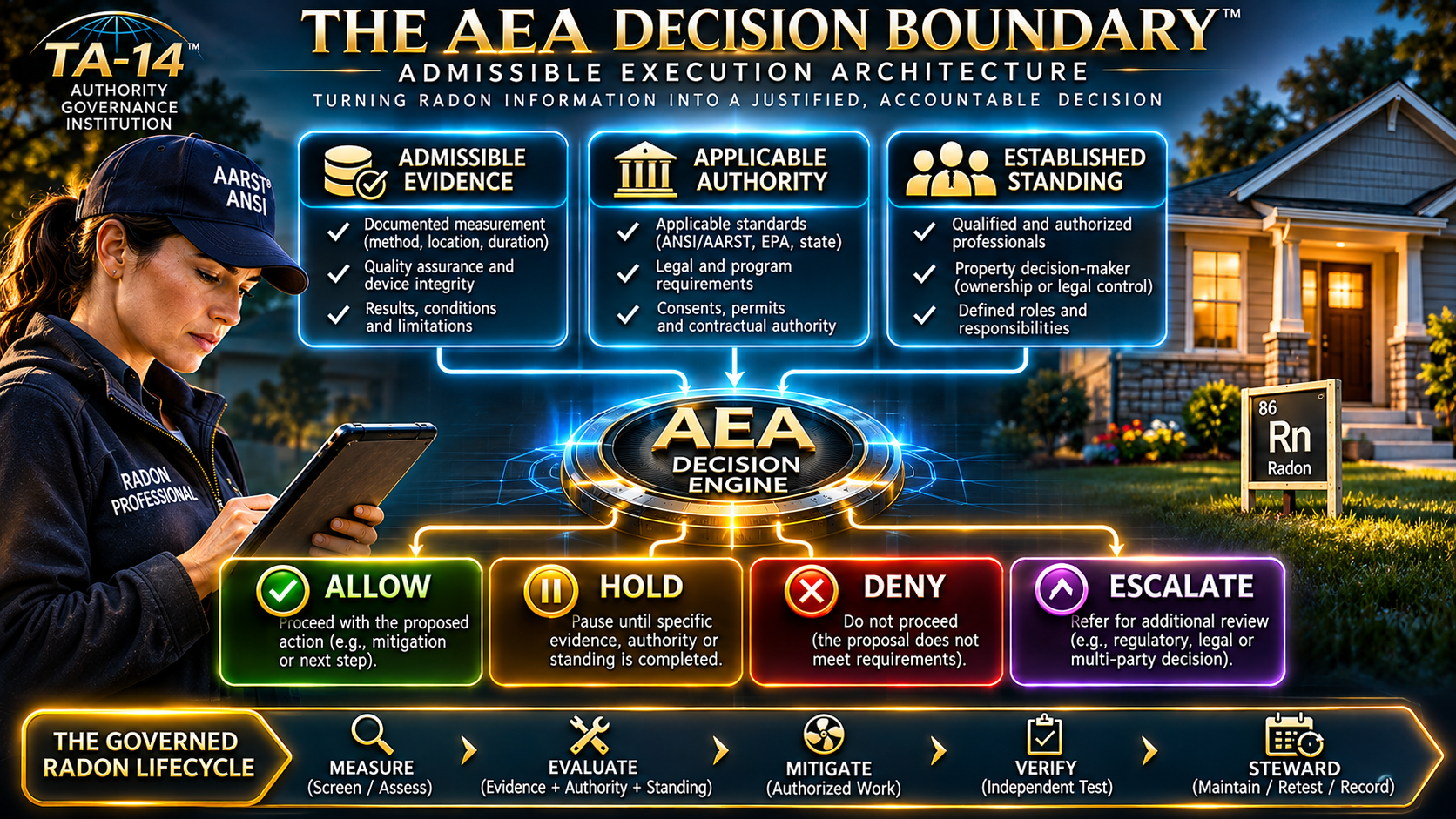
AEA evaluates whether a particular proposed consequential action has sufficient Admissible Evidence, Applicable Authority and Established Standing at the relevant moment. Conceptual outcomes are ALLOW, HOLD, DENY and ESCALATE.
The property owner or other legally authorized party establishes permission for work; qualified professionals make technical recommendations and perform their authorized roles. AEA neither creates their authority nor performs the intervention. An ALLOW is a bounded evaluation outcome, not an independent legal permit or proof of safety.
WHAT THE IMAGE DOES NOT PROVE
The illustrated “decision engine” is a teaching metaphor, not a deployed or independently certified automatic decision system. Existing health-protective actions must not be obstructed.
WHAT COMES NEXT
Who designs and installs mitigation, and what does a completed installation actually establish?
06 · AUTHORIZED MITIGATION
A mitigation system is physical work—not a governance verdict.
SAMANTHA · OPTIONAL AUDIO GUIDANCE
Browser speech uses the Samantha voice when available. Narration does not scroll the page.
WHAT YOU LEARNED
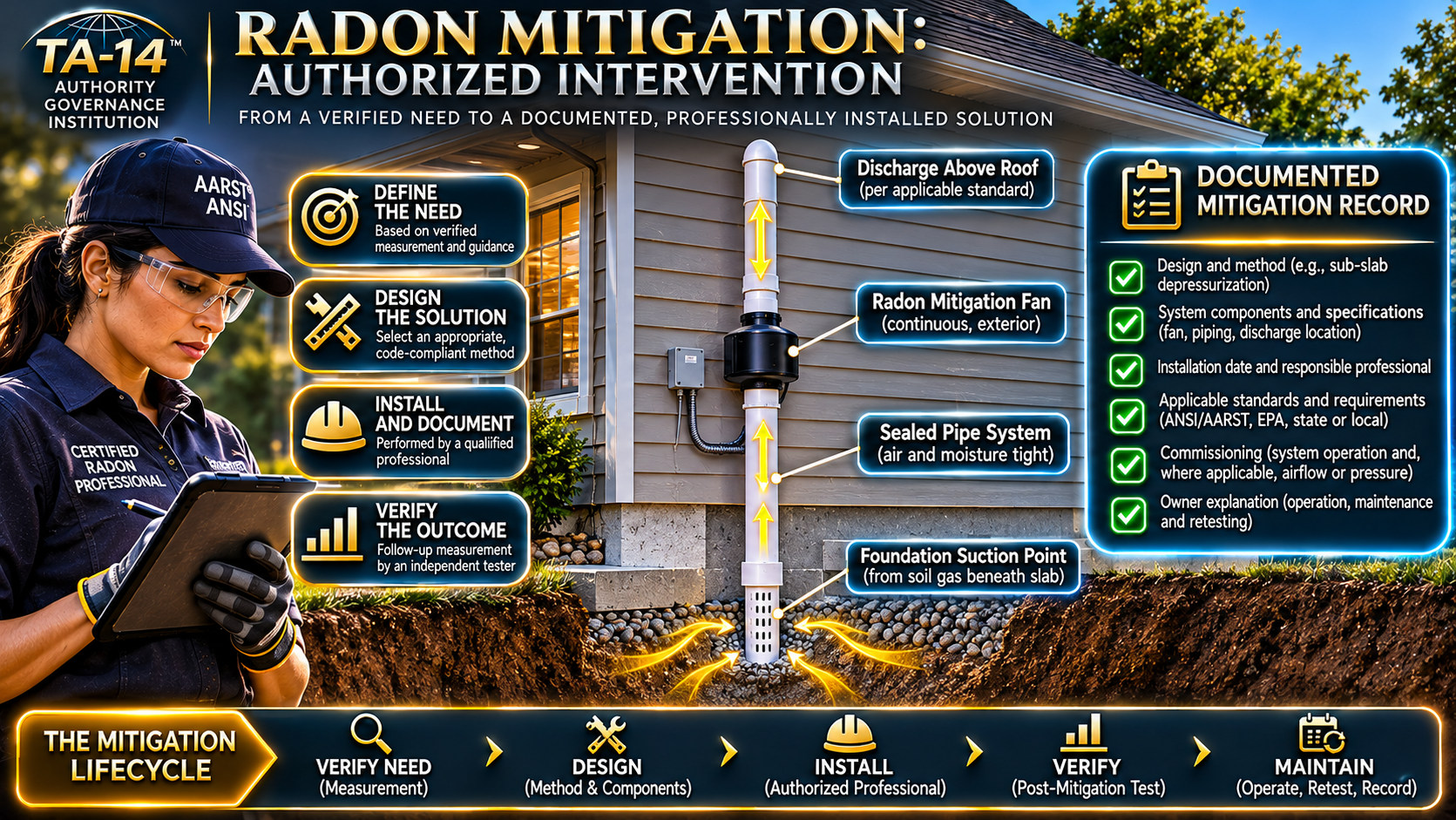
An appropriately qualified professional selects and installs a method suited to the property and applicable requirements. The responsible parties preserve scope, consent, required permits, specifications, system details, installation date, commissioning information and owner instructions.
For some buildings, active soil depressurization is a common approach. The actual design, fan location, discharge, electrical details and system verification must follow the requirements governing that property.
WHAT THE IMAGE DOES NOT PROVE
The pipework and airflow arrows are conceptual, with some illustrative directional inconsistencies. Do not use this image as a field installation diagram or code-compliance guide.
WHAT COMES NEXT
What separate evidence demonstrates whether mitigation actually worked?
07 · VERIFY THE OUTCOME
A working fan does not prove reduced exposure.
SAMANTHA · OPTIONAL AUDIO GUIDANCE
Browser speech uses the Samantha voice when available. Narration does not scroll the page.
WHAT YOU LEARNED
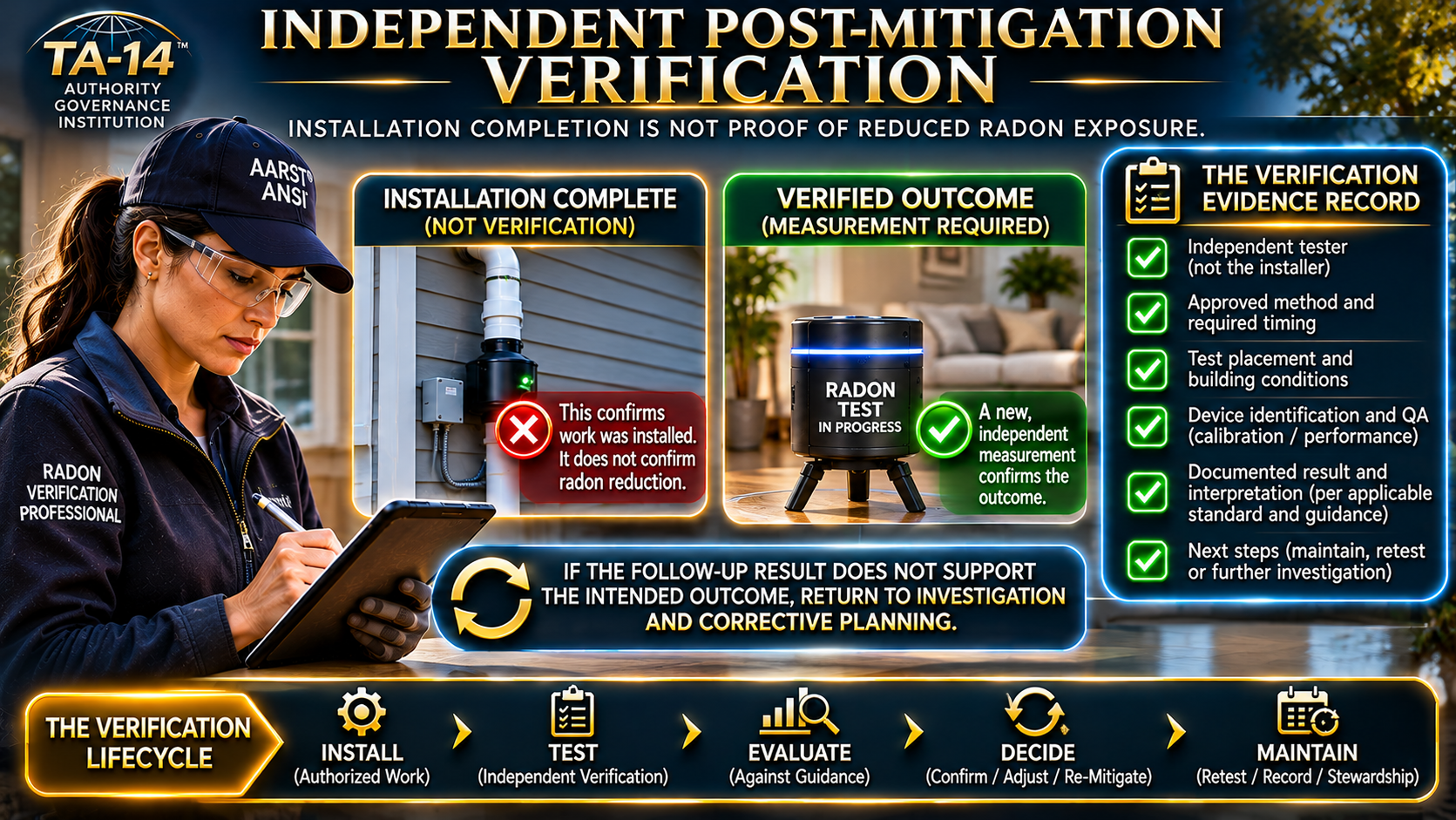
Post-mitigation testing is a separate evidence event. It requires an appropriate method, timing, location, test conditions and result, with the tester’s qualifications and independence disclosed when relevant.
A suitable follow-up result may support a bounded conclusion for the tested period and conditions. If it does not support the intended objective—or essential context is missing—the proposed effectiveness claim returns to investigation and corrective planning.
WHAT THE IMAGE DOES NOT PROVE
The green “verified outcome” graphic illustrates the required step; it does not contain a measured result or demonstrate a successful installation. Independent third-party testing is not universally mandated.
WHAT COMES NEXT
How do we preserve protection after the first acceptable follow-up result?
08 · STEWARDSHIP AND PUBLIC TRUST
The record continues after the contractor leaves.
SAMANTHA · OPTIONAL AUDIO GUIDANCE
Browser speech uses the Samantha voice when available. Narration does not scroll the page.
WHAT YOU LEARNED
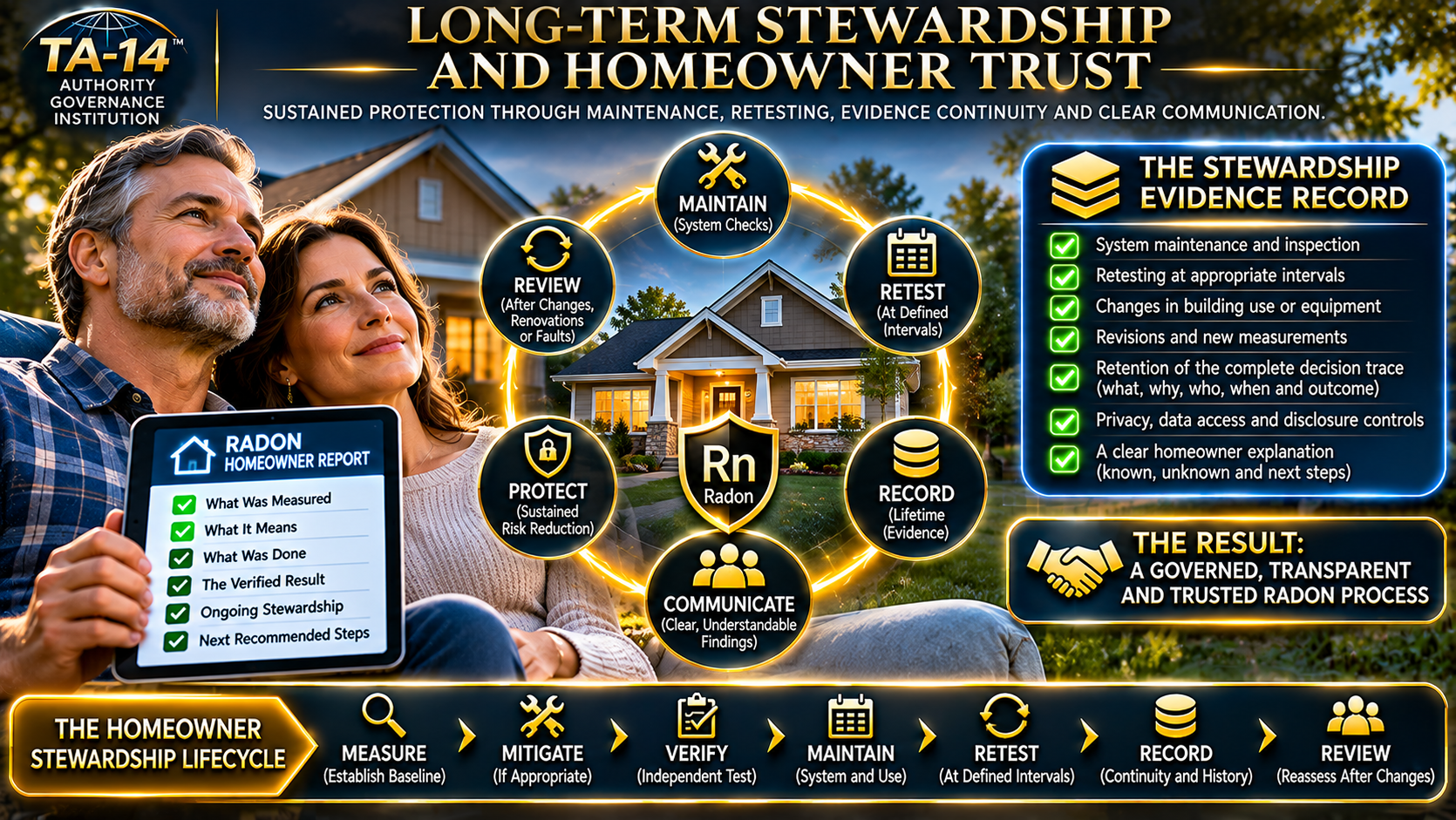
The long-term record can identify the owner of maintenance responsibilities, radon system checks, appropriate retesting intervals and triggers, building changes, new measurements, disclosure limits and a history of corrections.
A homeowner-facing report should explain what was measured, what it means, what remains unknown, who acted, what the follow-up evidence showed and what to do next. The information must be understandable without exposing private property data to unauthorized recipients.
WHAT THE IMAGE DOES NOT PROVE
The smiling homeowners and completed checkmarks are illustrative, not evidence of permanent safety. No result is a lifetime guarantee.
WHAT COMES NEXT
Examine the prospectus and challenge the proposed criteria with professional evidence.
WORKED HYPOTHETICAL · A PROPOSED CLAIM
“The radon system was installed, so the home is safe.”
The installation record may support the narrower statement that mitigation work was completed. If the proposed claim of reduced exposure lacks an appropriate attributable post-mitigation test, the illustrative AEA disposition is HOLD on that claim—not a finding that occupants must delay any independently authorized protective measures.
The responsible professionals should obtain and interpret testing according to the applicable requirements, document limitations and revisit the proposed claim. A later acceptable result remains bounded by its method, time and conditions.
INVITATION TO INDEPENDENT CRITIQUE
What would qualified radon professionals change?
TA-14 invites measurement professionals, mitigation contractors, ANSI/AARST practitioners, state radon programs, public-health specialists and homeowners to examine the proposed thresholds for evidence sufficiency, credential verification, decision authority, independent testing, retest triggers, privacy and record continuity. The current showroom is a teaching proposal, not evidence that the proposed governance model has been field validated.
Apply the governance principles to three hypothetical cases relevant to radon mitigation. Choose a determination, then examine the reasoning. These cases teach the distinction between Admissible Evidence, Applicable Authority, and Established Standing; they do not issue real-world authorization.
CASE 01
Mitigation installed, verification missing
A mitigation system was installed, but post-intervention radon measurements and record continuity have not been established. May the outcome be declared verified?
CASE 02
Claim beyond assessment scope
An actor claims regulatory clearance from a measurement protocol that does not authorize that conclusion. What is supported?
CASE 03
Specialized remediation decision
A documented condition requires an independently authorized remediation determination before further work. What is supported?
Independent educational examples only. The questions are hypothetical and do not assess a real institution, building, person, or operating system. Actual governance determinations require case-specific evidence, applicable authority, established standing, and bounded review.