TA-14 AUTHORITY GOVERNANCE INSTITUTION · INDEPENDENT TECHNICAL PRE-EXAMINATION
Radon Mitigation Is Not the End of the Evidence
From Initial Measurement to Verified Environmental Consequence
PRE-EXAMINATION · BASELINE NOT FROZEN · NO FORMAL DISPOSITION
Independent educational examination. All pictured cases, readings, identities, and decisions are hypothetical. No IEA/AARST, RadonAway, EPA, or other institutional affiliation or endorsement is claimed. This does not replace qualified radon testing, mitigation, or applicable requirements.
↓ Download Technical Governance Reference v2.0 (PDF)Does this proposed consequence have sufficient Admissible Evidence, Applicable Authority, and Established Standing to become reality NOW?
Explore eight numbered sections below. Audio is optional; scrolling remains under your control.
01 · The Invisible Condition
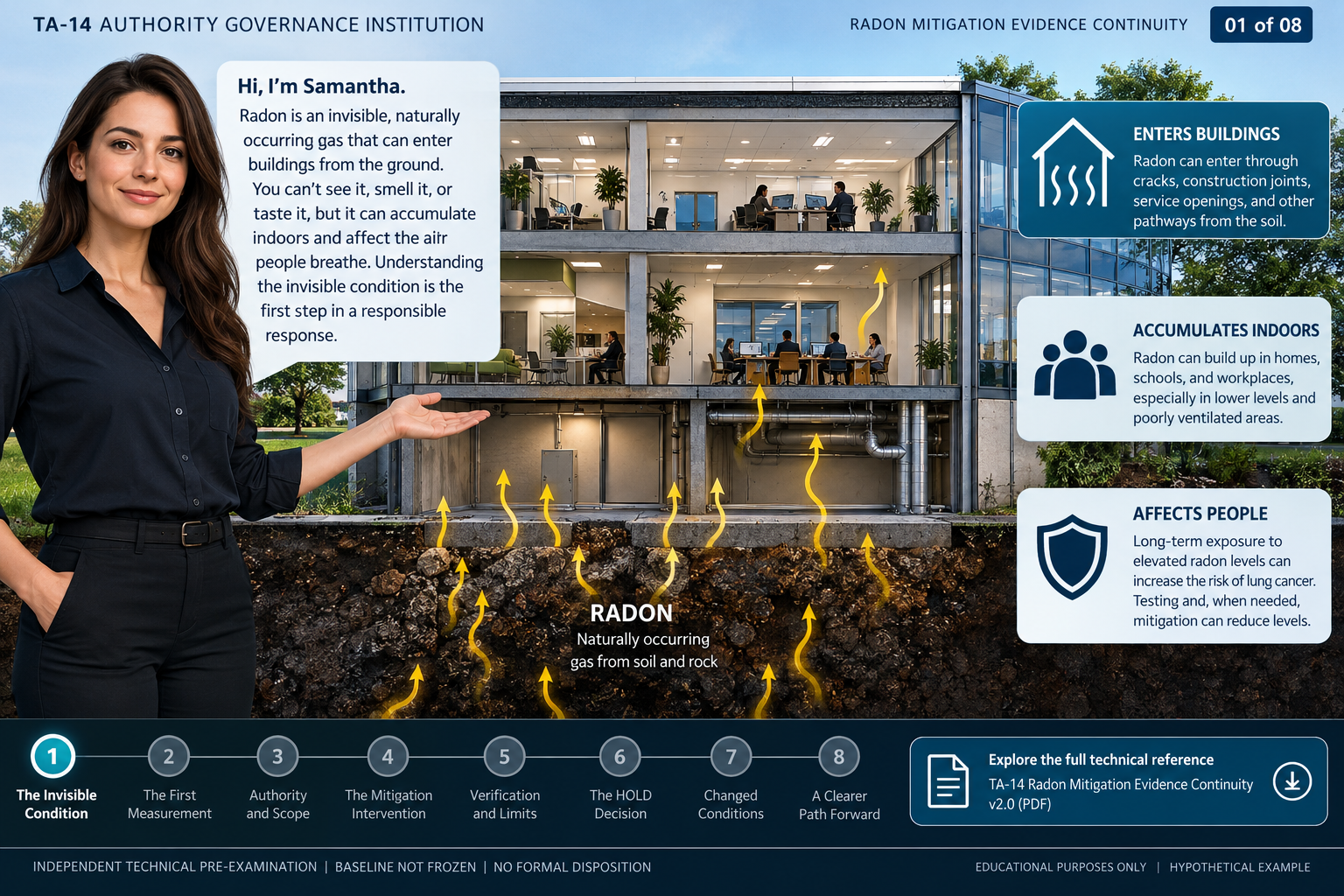
Radon is invisible. Testing establishes a bounded observation, not a permanent characterization.
Radon is a radioactive gas that cannot be seen or smelled. A building's radon condition must be established through appropriate measurement, with the test location, period, method and operating conditions identified. The observation describes that measured interval; it does not prove the building will always have the same concentration.
02 · The Original Record
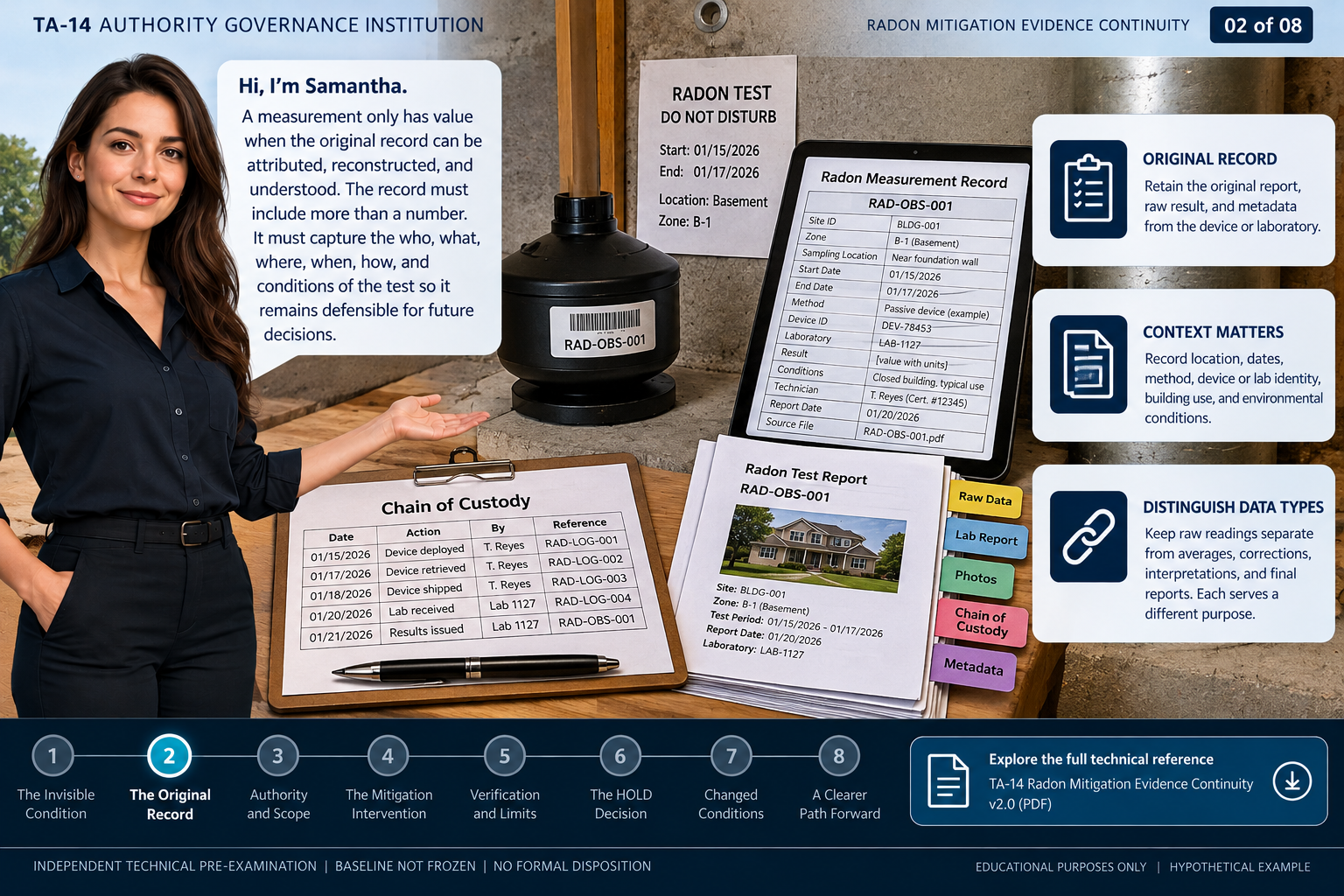
Preserve the source result, location, method, dates, and measurement context.
An original measurement record should preserve the unaltered result, test dates, tested zone, instrument or laboratory information, method, quality controls and the person responsible. A summary or dashboard can be useful, but must not replace the attributable original. If a result is corrected, preserve both versions and the reason.
03 · Evidence Continuity
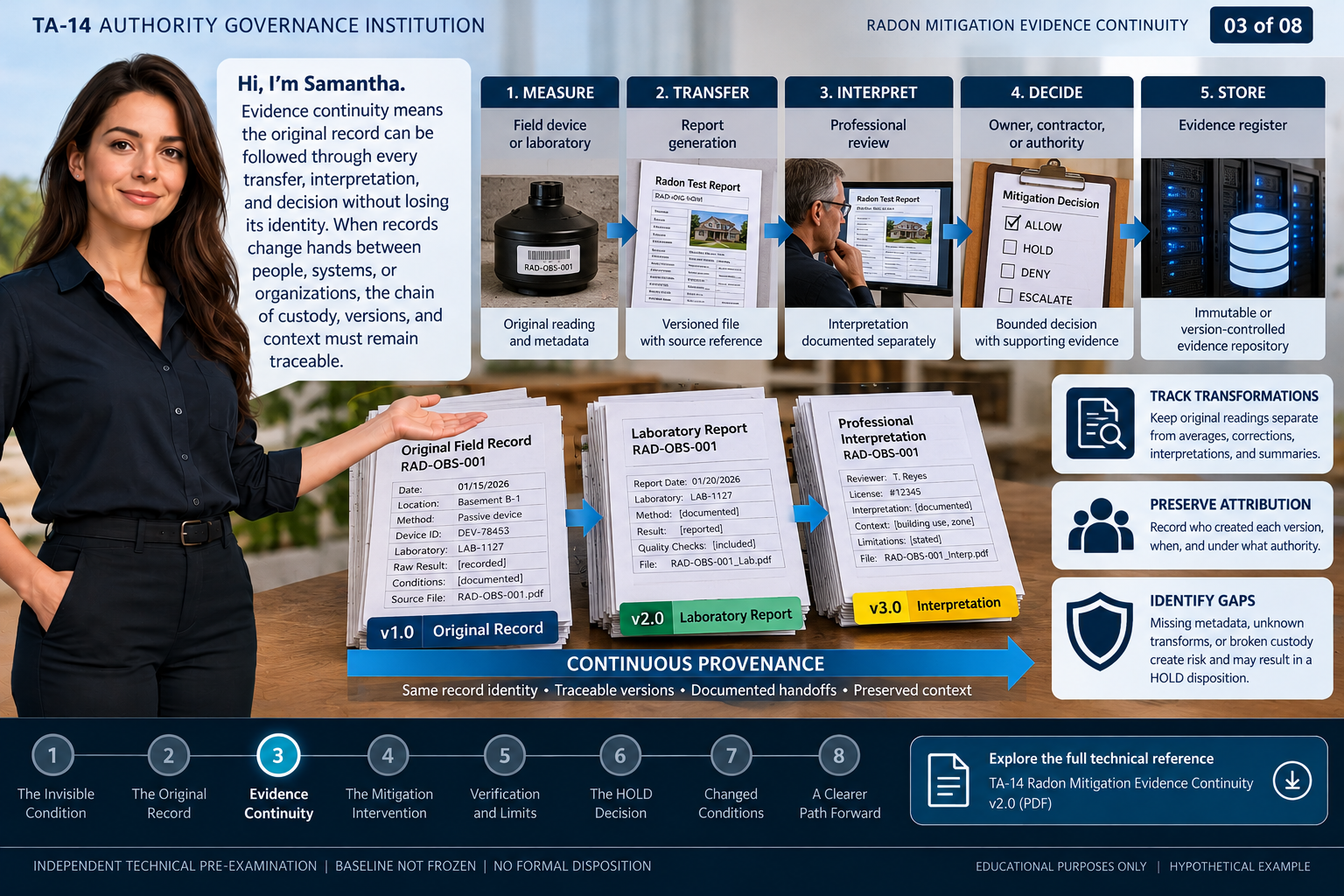
Maintain provenance as evidence moves through people, systems, and interpretations.
Evidence often crosses from a tester to a property owner, a mitigation contractor and a follow-up tester. At each handoff, preserve identity, timestamps, source records and changes in interpretation. A missing link may prevent a later claim from being independently reconstructed. Observed is not inferred. Inferred is not authorized.
04 · The Mitigation Decision
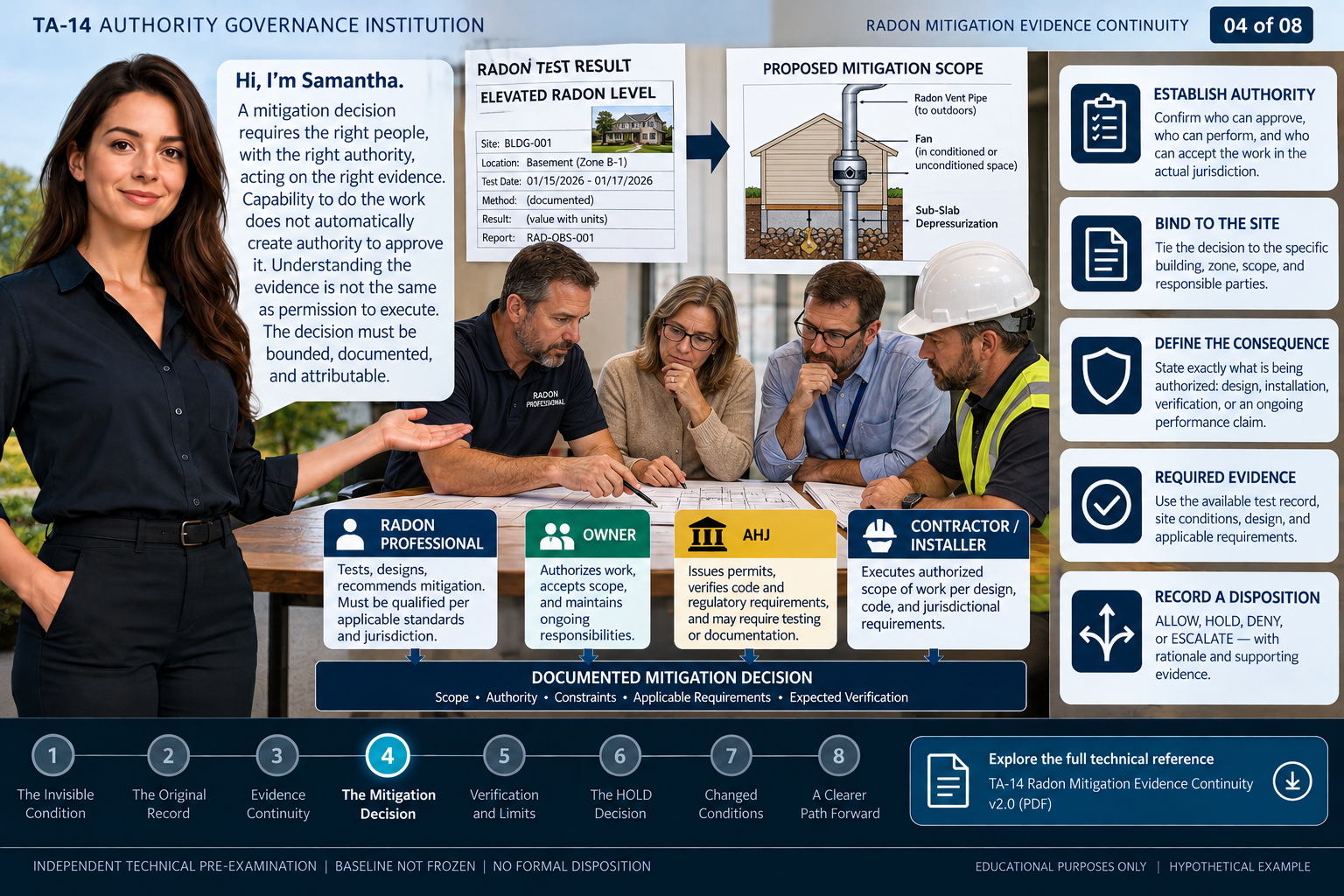
Establish who may propose, authorize, perform, and accept the work.
An elevated or otherwise concerning result can support proposing mitigation, but it does not by itself establish who can approve the work. Identify the property decision-maker, qualified professionals, applicable requirements, work scope and constraints. The governance examination distinguishes the authority to recommend from the authority to execute.
05 · Installation Is Not Verification
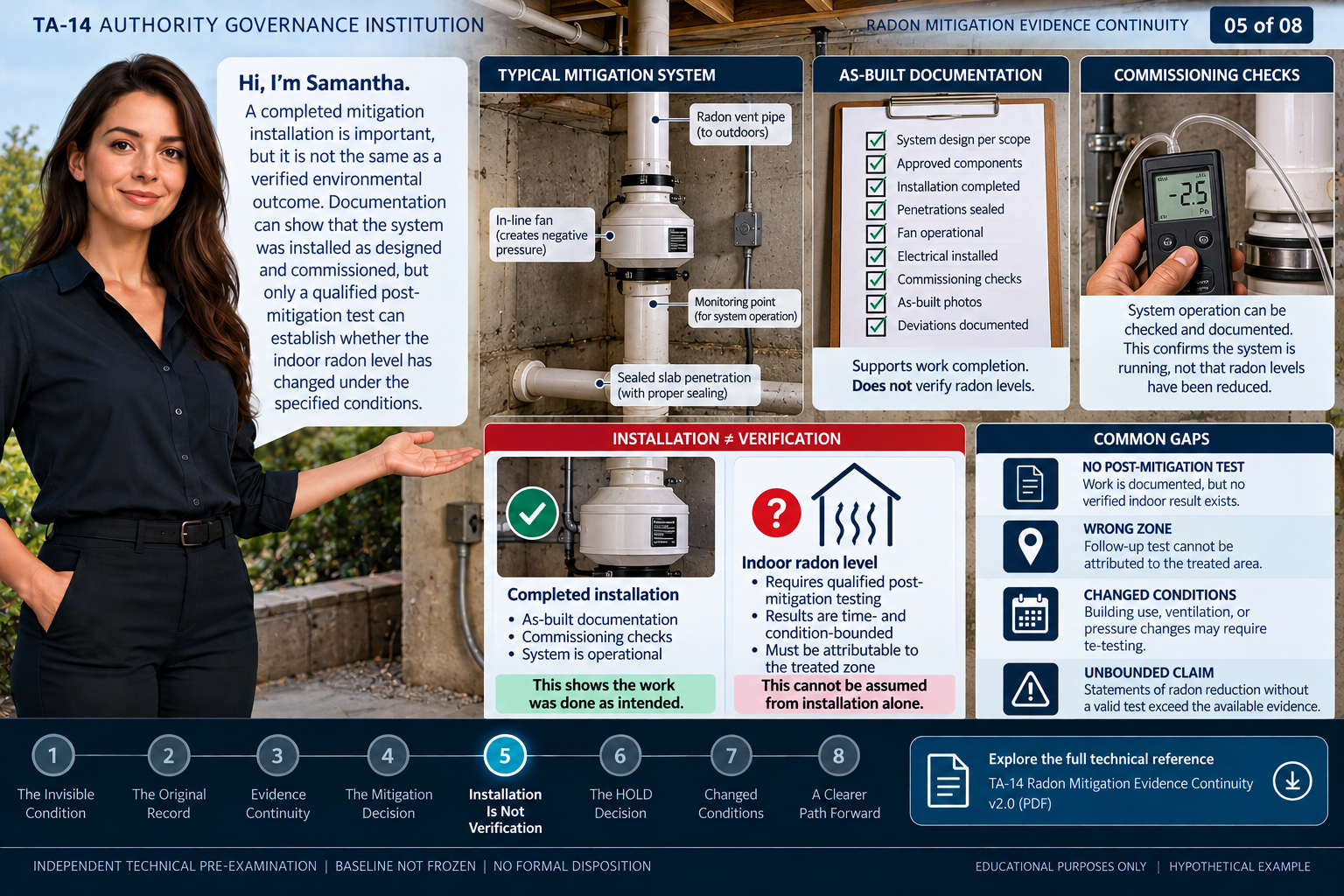
Installed equipment and commissioning do not independently prove reduced radon.
A contractor may document installed piping, a fan, electrical work, operating indicators and commissioning checks. Those records establish work performed. They do not establish that radon concentrations in the occupied zone have reached the relevant objective. Installation and environmental verification are different evidence events.
06 · The Post-Mitigation Test
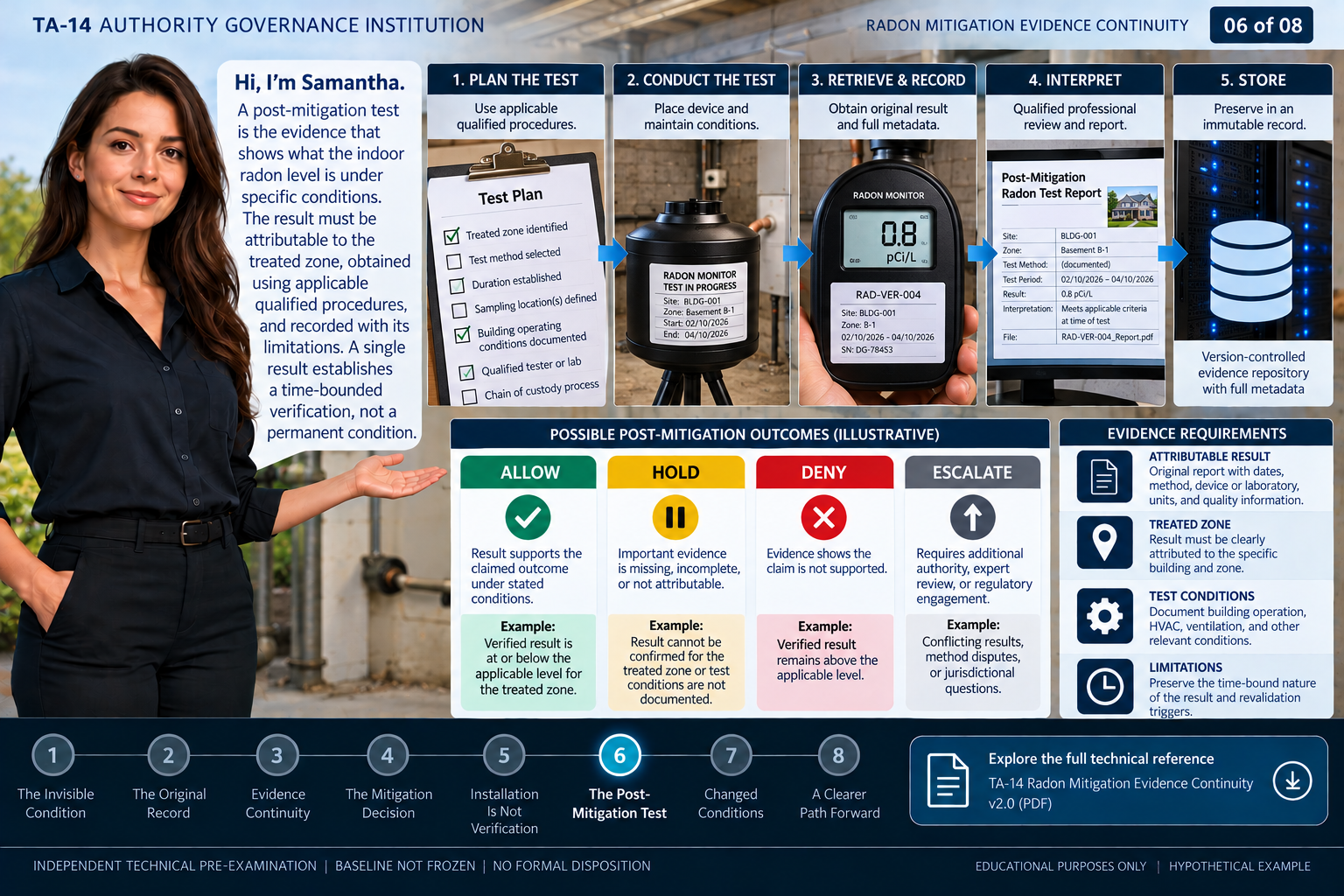
Qualified follow-up testing supports only time- and condition-bounded conclusions.
Post-mitigation testing must follow applicable qualified procedures and document the tested zone, timing, conditions, measurement method and original result. The conclusion should identify what the result supports and its limitations. Where key test context or attribution is missing, a hypothetical governance examination can HOLD the proposed effectiveness claim pending additional evidence.
07 · Changed Conditions
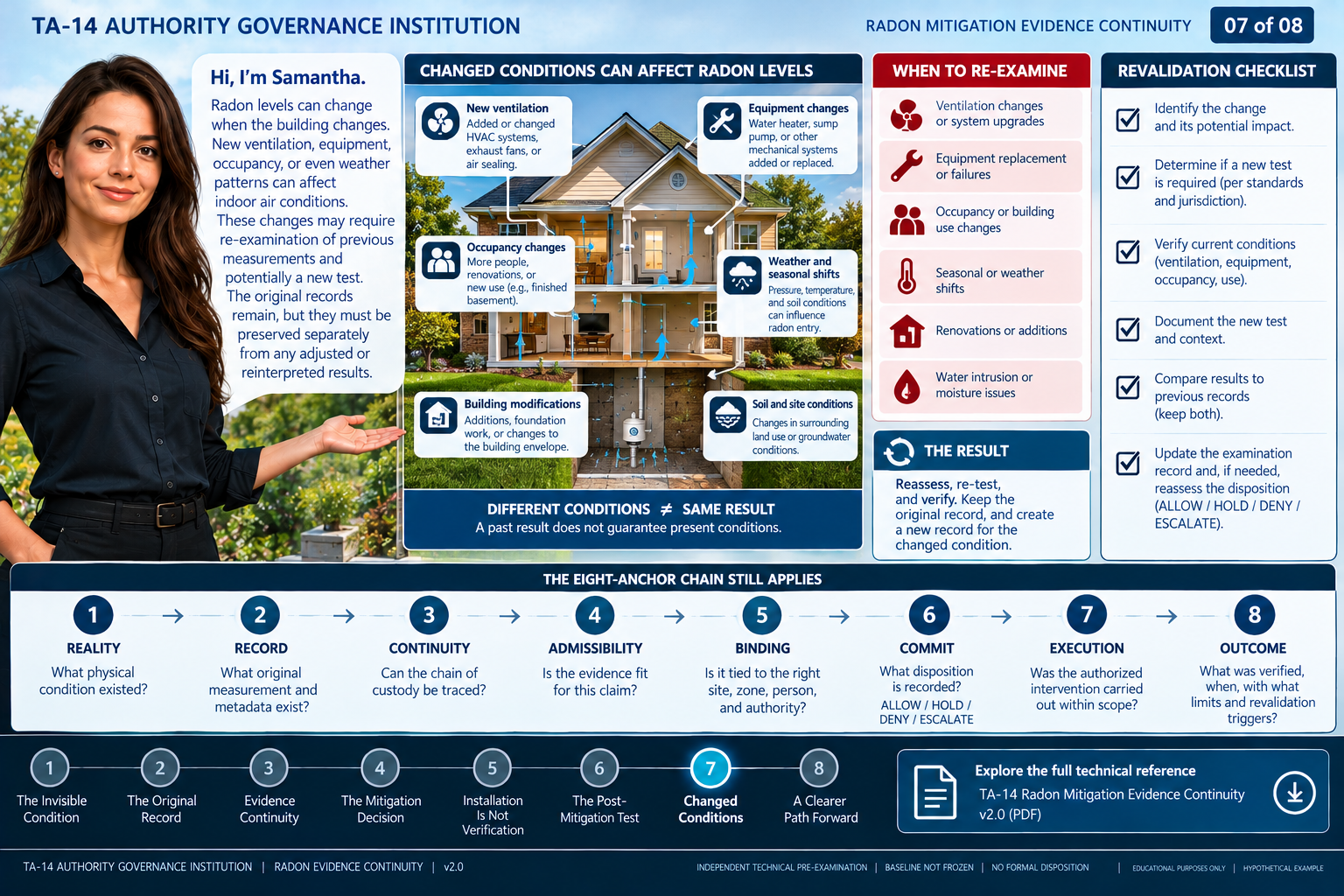
Changes in ventilation, equipment, or building use can call earlier conclusions into question.
Changes in building pressure, ventilation, mitigation equipment, renovations, foundation openings and use can affect radon concentrations. A prior valid result remains part of history, but may not establish current conditions. Record the change, determine whether retesting is required under applicable guidance, and preserve new measurements separately from the originals.
08 · Authorized Environmental Consequence
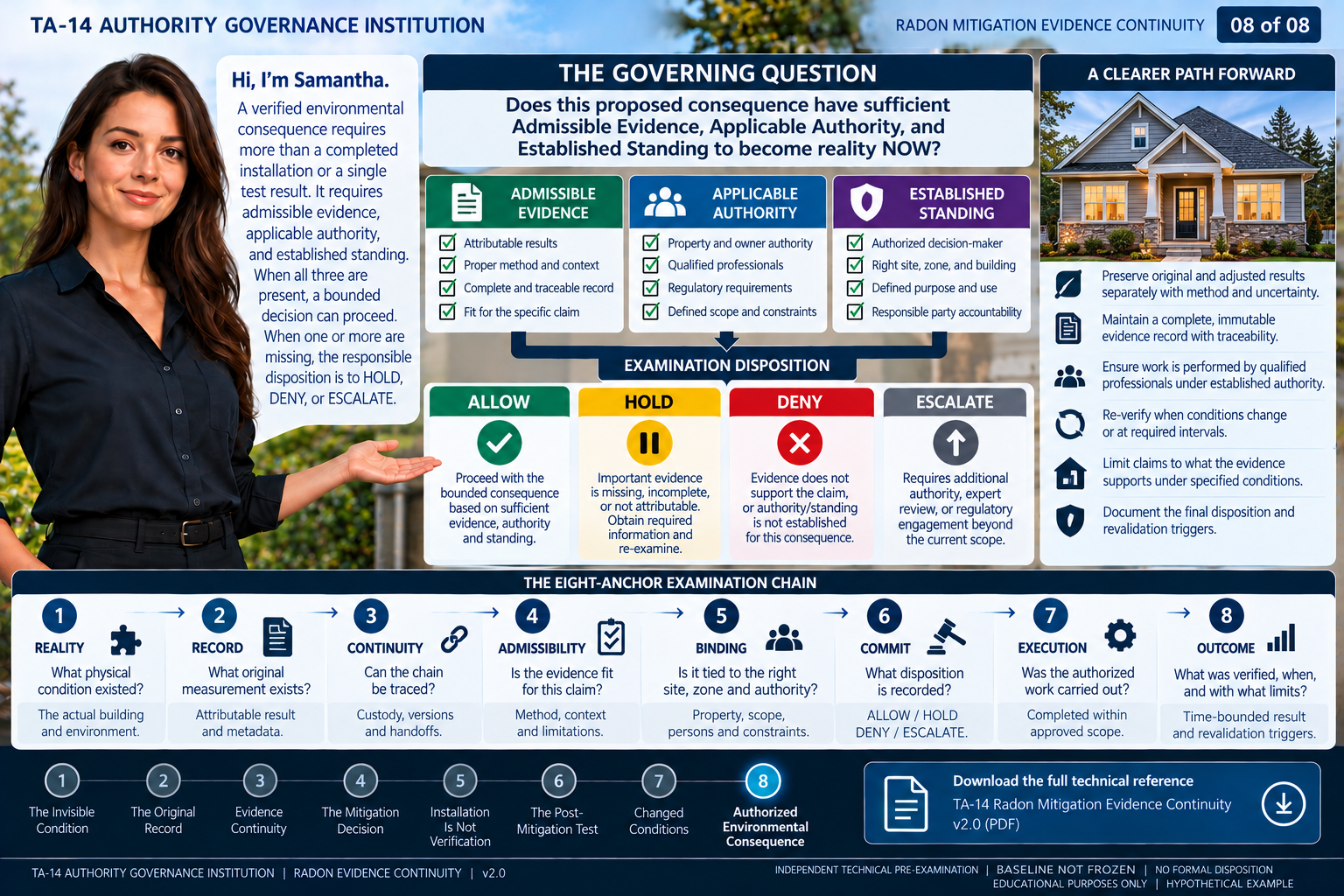
Decide only the exact claim supported by admissible evidence, applicable authority, and established standing.
The final examination asks whether this particular proposed consequence has sufficient Admissible Evidence, Applicable Authority, and Established Standing to become reality NOW. ALLOW means a bounded claim may proceed within its established scope. HOLD means important information is missing. DENY means the claim is not supported or authority is absent. ESCALATE means further expert or responsible-party review is needed. None of these illustrative dispositions is an actual certification.
Illustrative case · Why a HOLD matters
A hypothetical basement test identifies a radon concern. A qualified mitigation contractor installs a system and documents the installation. The owner then proposes the statement: “This building has been verified safe from radon.” The submitted packet contains installation photos and a fan-operation check, but no attributable post-mitigation test for the treated zone.
Illustrative disposition: HOLD. The evidence supports a claim that mitigation work was performed, not that a particular radon outcome was achieved. Obtain an appropriate post-mitigation measurement, preserve its method and context, confirm who may make the bounded claim, and re-examine the proposed statement. A later test does not establish permanent safety.
Standards and TA14 · Separate Responsibilities
Applicable radon measurement, mitigation, quality assurance, post-mitigation testing, and retesting requirements are established by relevant professional standards, regulations, and jurisdictional guidance. TA14 does not create, replace, certify compliance with, or override those technical requirements.
TA14 examines a separate decision boundary: whether attributable records, evidence continuity, applicable authority, and established standing support the exact environmental claim proposed at a particular time. Documented installation, an appropriate follow-up test, and evidence supporting longer-term conditions are different claims, each requiring appropriately bounded support.
A claim of standards compliance requires examination against the applicable requirements by appropriately qualified parties. Changes in HVAC operation, ventilation, occupancy, building structure, or other relevant conditions may warrant reassessment under the applicable technical requirements and circumstances. This educational example is not a clause-by-clause standards compliance determination.
Invitation to professional examination
TA-14 invites qualified radon measurement and mitigation practitioners, building owners, and indoor-environment professionals to challenge the proposed evidence requirements, decision boundaries, and revalidation triggers. This is an independent educational proposal, not a substitute for applicable ANSI/AARST standards, EPA guidance, jurisdictional rules, or professional judgment.
A bounded registered governance demonstration can examine a hypothetical or appropriately permissioned case without implying institutional endorsement or operational integration.
Review the radon consequence examination →