From Environmental Monitoring to Authorized Intervention
An eight-image educational examination of school indoor-air observations, defensible records, local authority, bounded HVAC intervention and verified outcome. The 2026–2027 School Air Quality Fellowship is public context, not a participant in this examination.
PRE-EXAMINATION · BASELINE NOT FROZEN · NO FORMAL DISPOSITION · NO USGBC, CENTER FOR GREEN SCHOOLS, EPA OR DISTRICT ENDORSEMENT. All illustrated readings, identities, authorizations and outcomes are hypothetical teaching examples.
WORKED EXAMPLE · HYPOTHETICAL · NO FORMAL DISPOSITION
One classroom. One proposed ventilation change. Eight authority gates.
ROOM 204 · HOLD · NO EXECUTION · HYPOTHETICAL
A teacher reports afternoon stuffiness in Room 204. An illustrative sensor log shows elevated CO₂ during occupancy. A facilities technician proposes increasing outside-air intake for that classroom's air-handling zone. This is a teaching scenario, not a finding about any school.
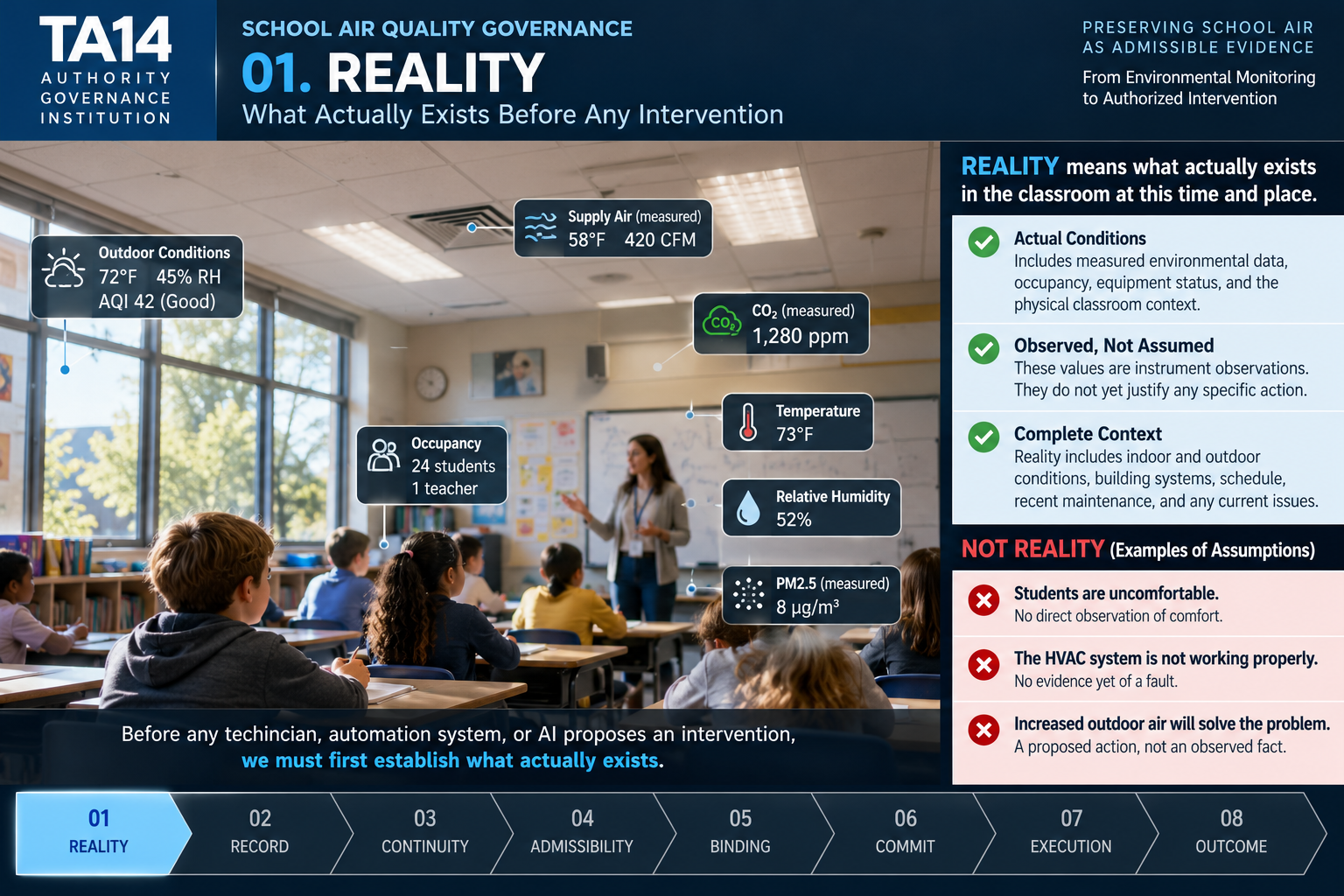
Reality: Observe occupancy, CO₂, temperature, outdoor conditions, airflow and equipment status without disturbing the system.
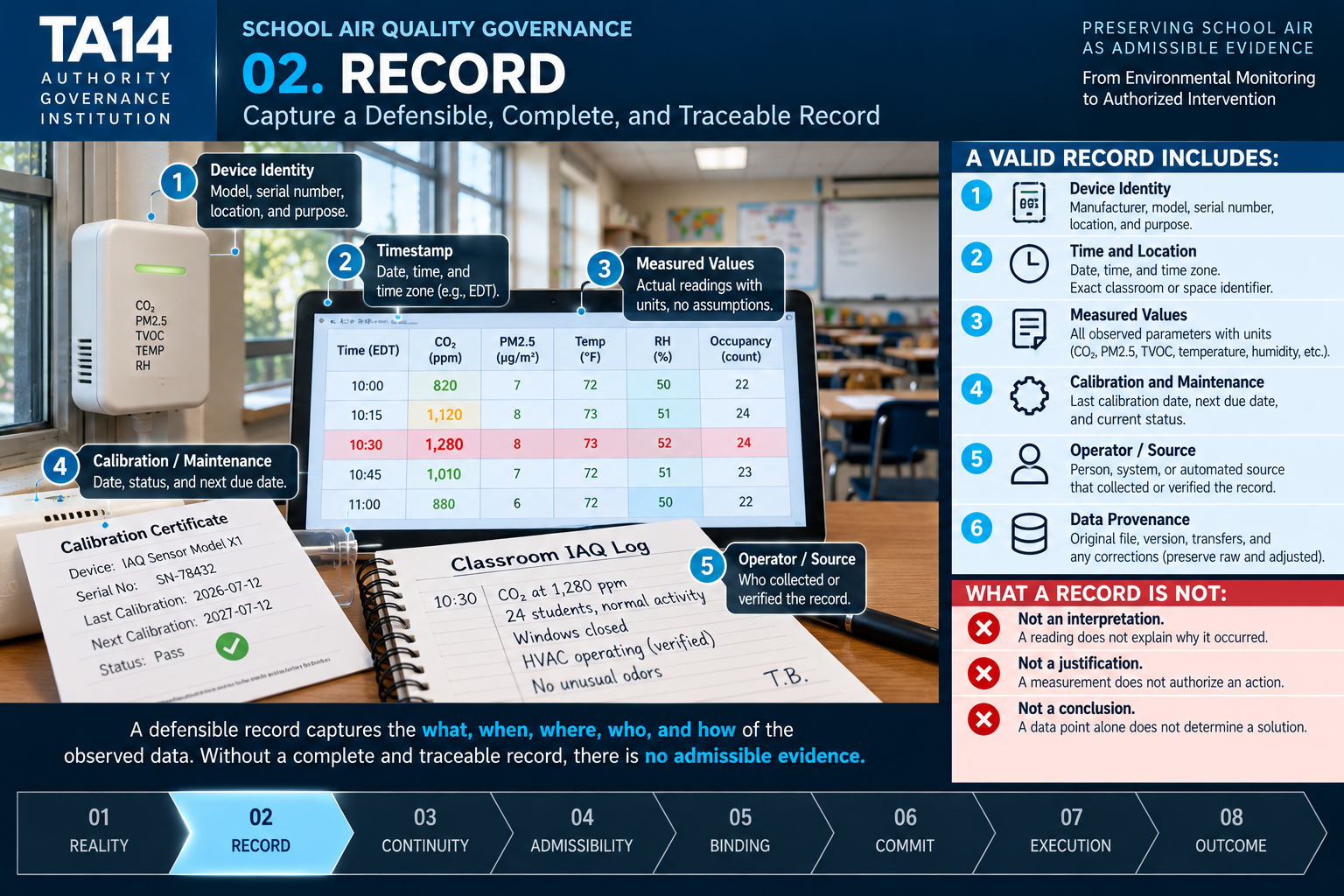
Record: Preserve timestamped raw observations, instrument identity, location and calibration information.
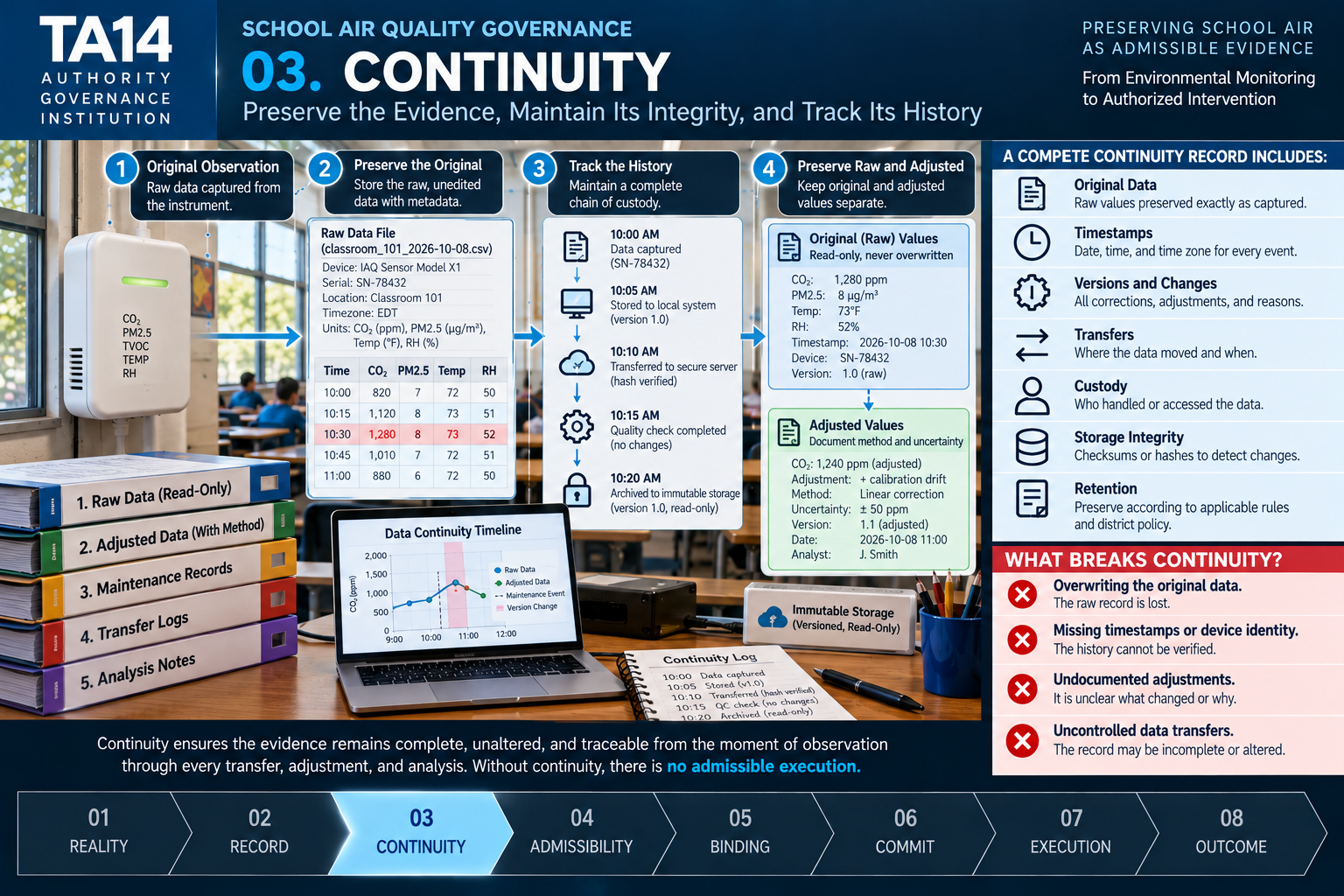
Continuity: Retain original data, custody, transformations and uncertainty separately.
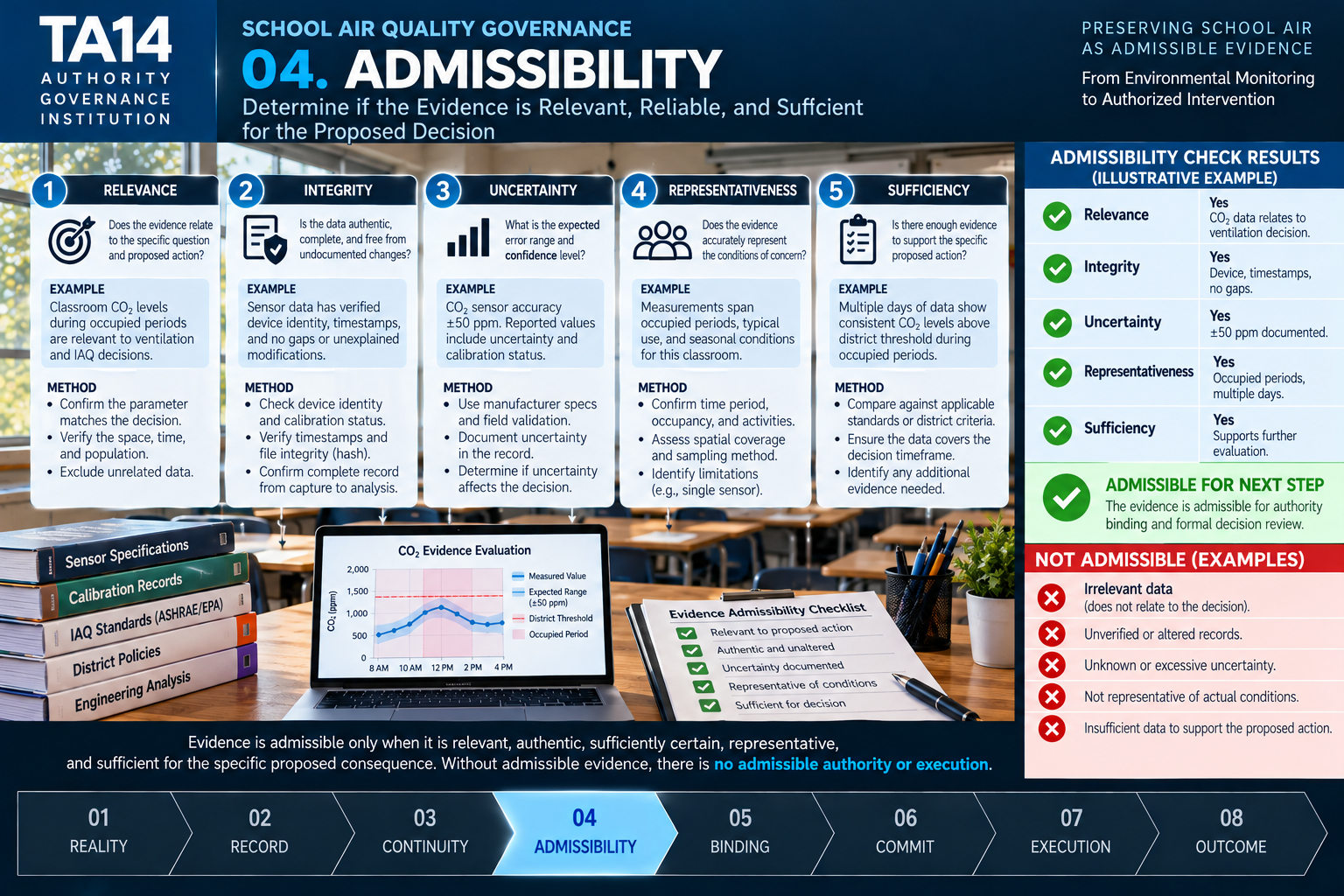
Admissibility: HOLD if sensor calibration, sampling or operating context is inadequate; evidence sufficient for investigation is not yet sufficient for execution.
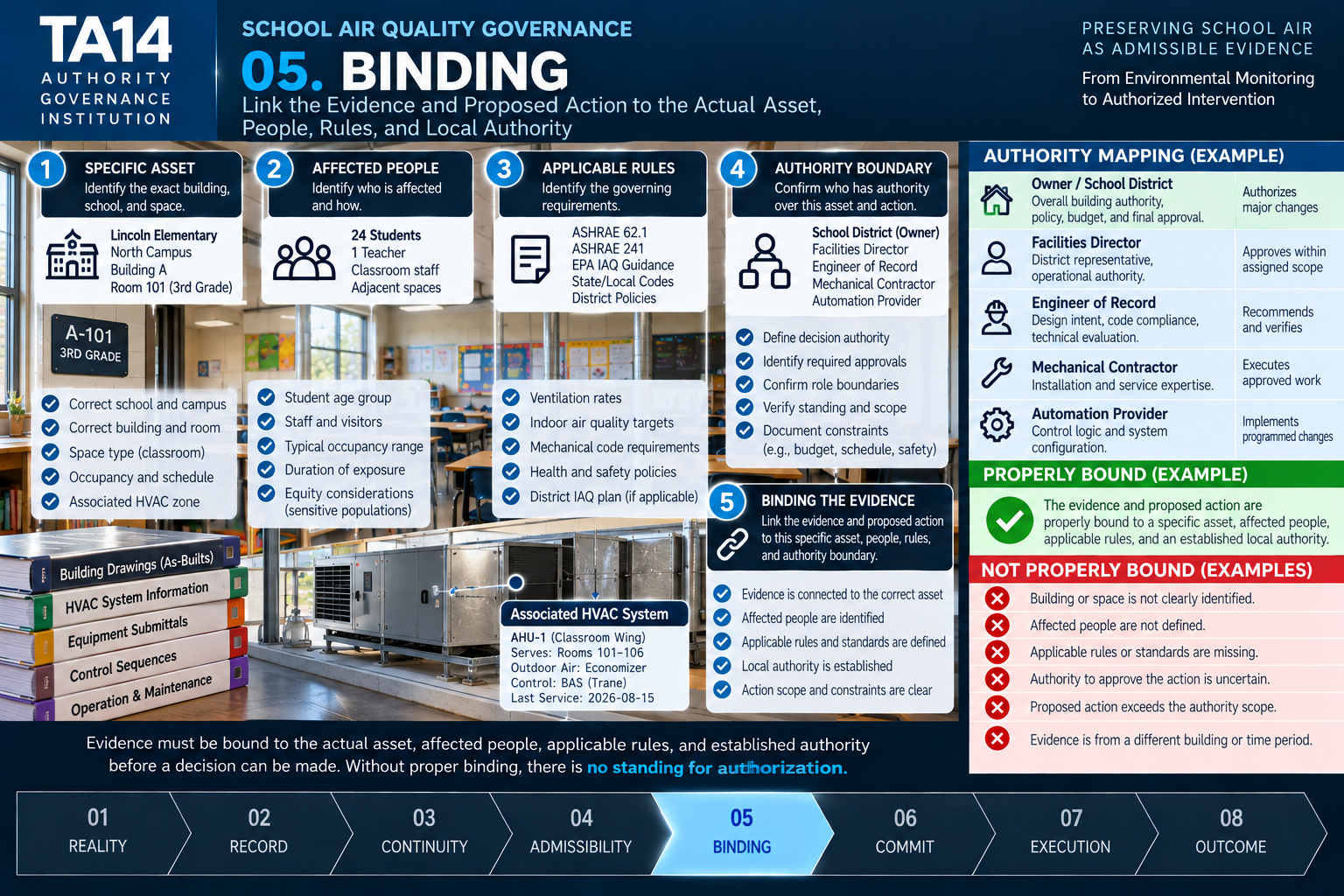
Binding: Identify Room 204, the exact HVAC asset, proposed setpoint range, affected spaces, governing constraints and local approving authority.
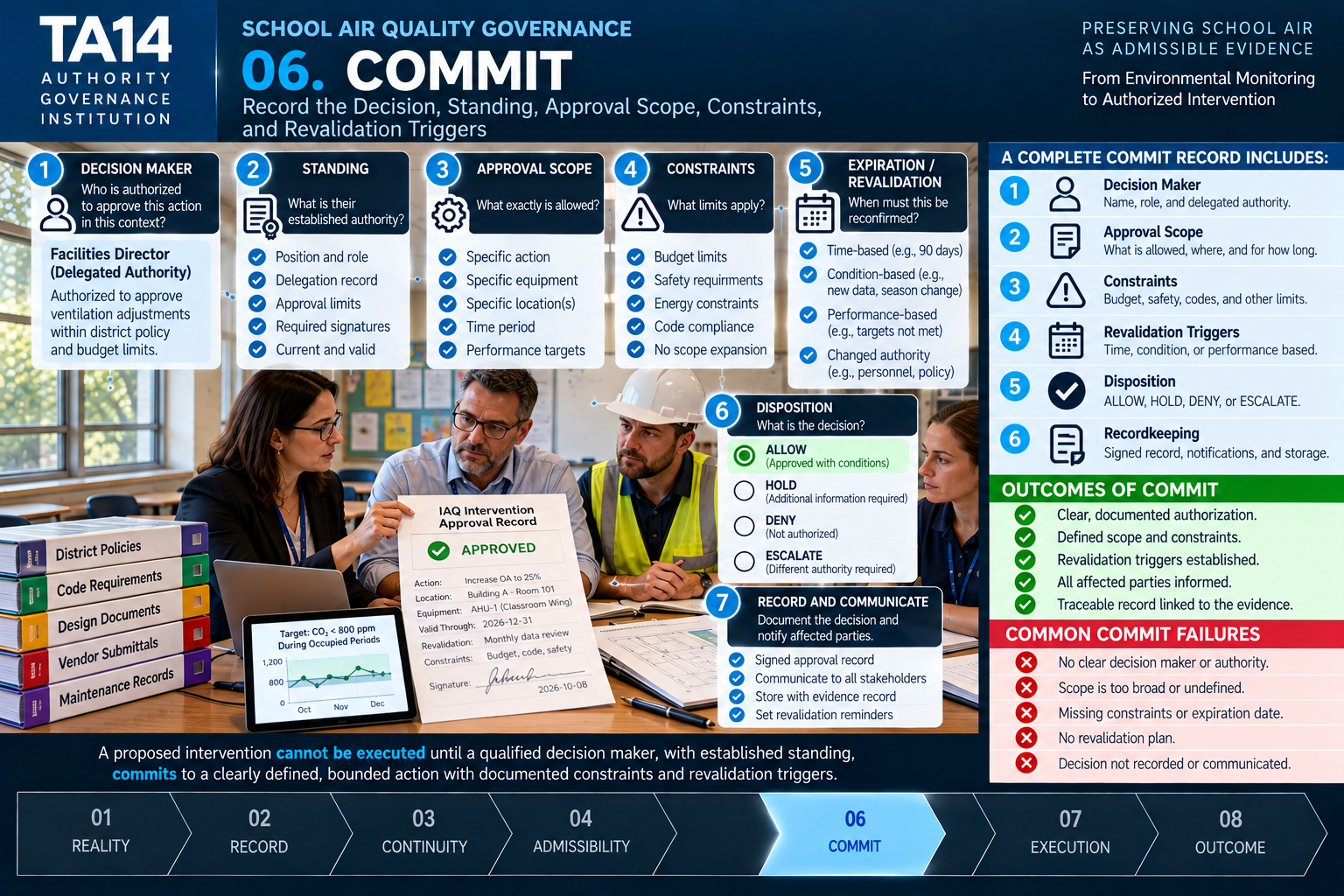
Commit: In this worked example, the proposed change remains on HOLD until evidence and authority are established. A responsible school authority could later issue a bounded ALLOW, HOLD, DENY or ESCALATE record. No illustrative approval is a real authorization.
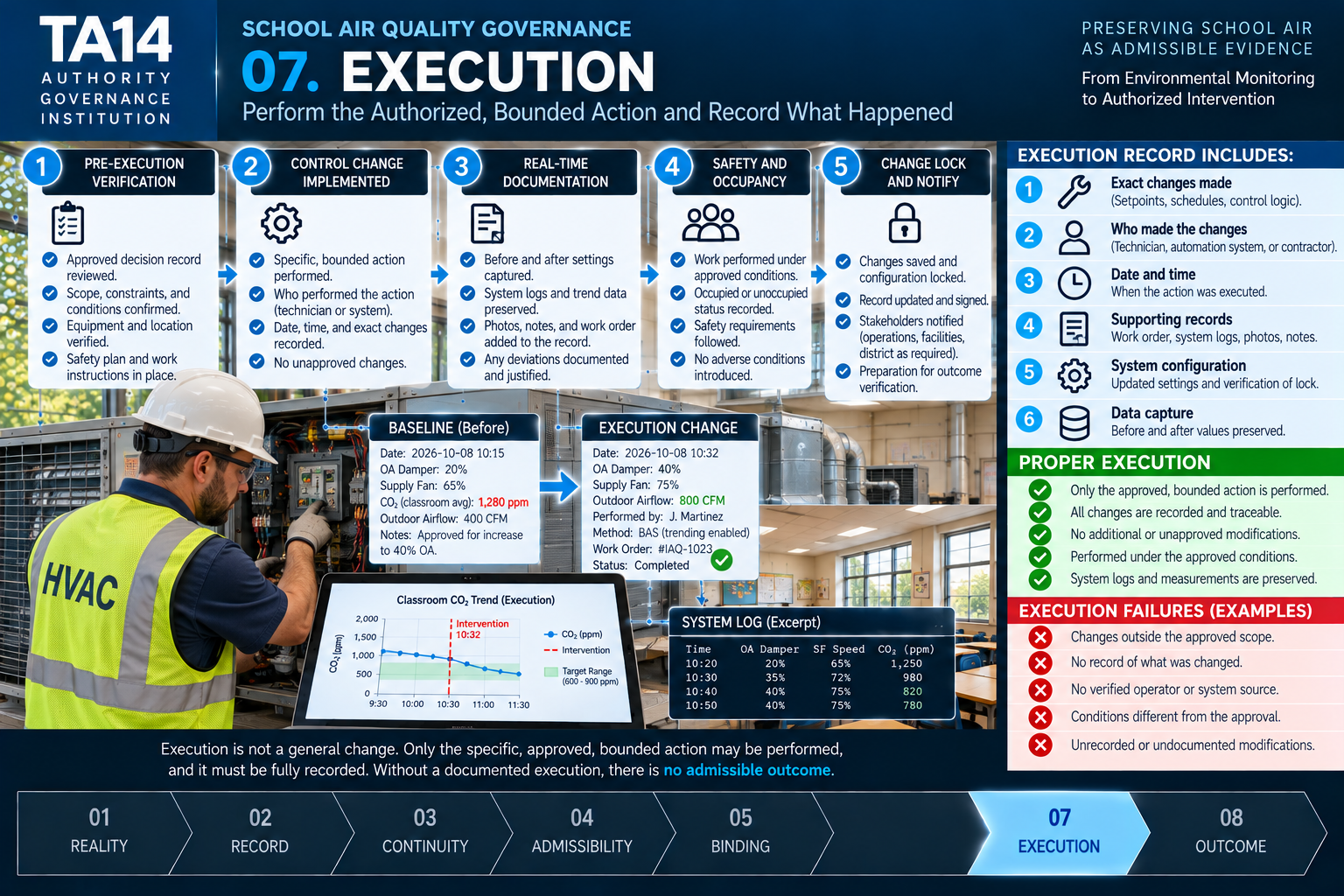
Execution: Under the illustrated HOLD, make no ventilation change. Only after a separate bounded ALLOW may an authorized actor recheck conditions and execute the approved change.
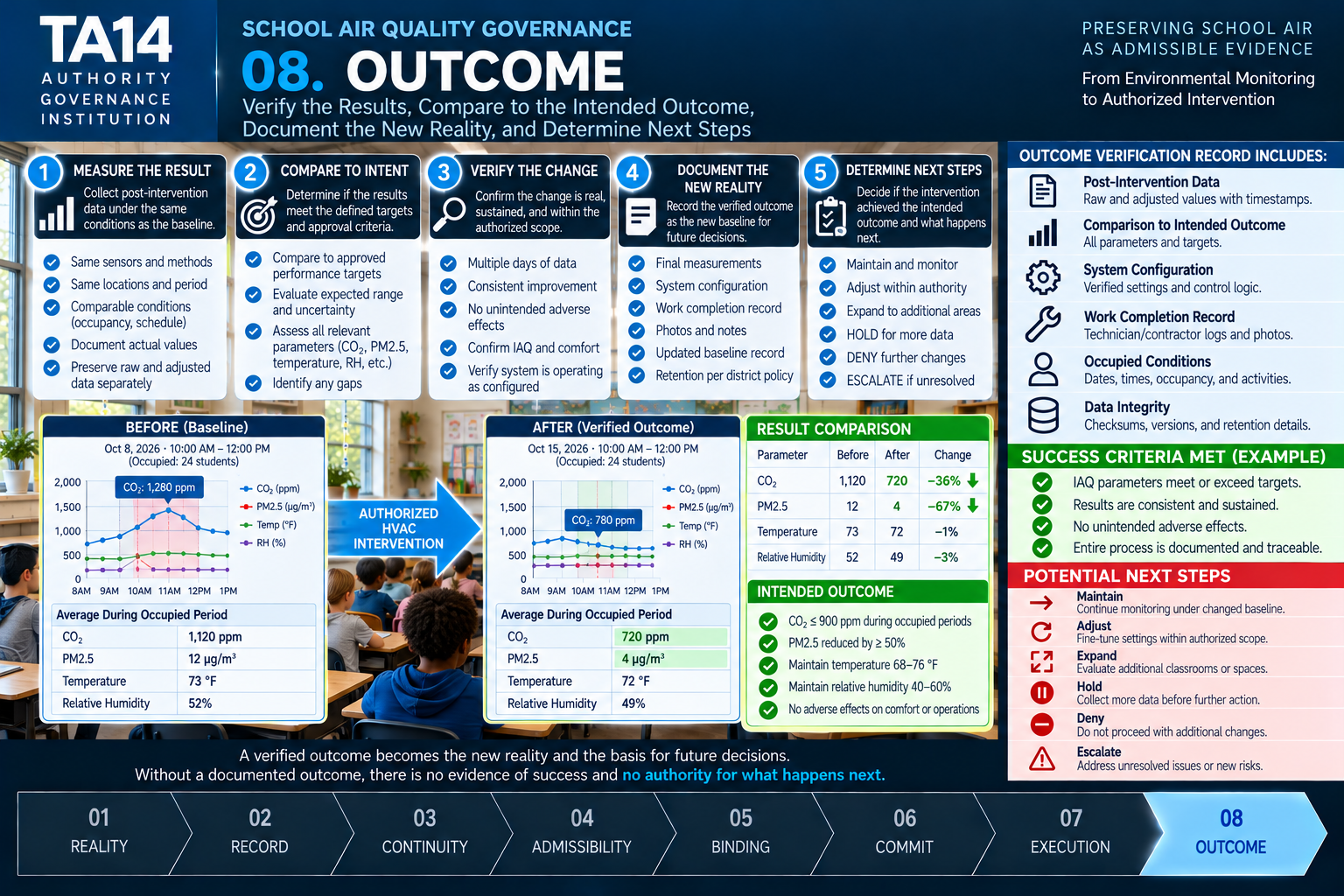
Outcome: No intervention or improvement is claimed under HOLD. If a later authorized change occurs, compare post-action observations under comparable conditions and document unintended effects.
A monitored concern is not permission to change a building. Capability ≠ Authority.
While the proposed adjustment remains on HOLD, the HVAC system stays in its previously authorized operating state. This illustrative governance HOLD does not override emergency response, life-safety duties, applicable law or separately authorized protective action. Investigate the evidence gap and escalate any urgent safety concern through the appropriate local process.
TEACHING IMAGE 01 OF 08
REALITY
Voice uses Samantha when available on this device; otherwise an English voice.
Image one. Establish what actually exists in the occupied classroom before any intervention. Identify the space, people, outdoor conditions, ventilation state and instrument observations. The displayed numbers are fictional examples, not school measurements. Observed is not inferred. A high carbon dioxide reading warrants investigation but does not by itself diagnose a system failure or authorize a change.
TEACHING IMAGE 02 OF 08
RECORD
Voice uses Samantha when available on this device; otherwise an English voice.
Image two. Preserve the original environmental observation with device identity, timestamp, units, location, calibration and operator context. A number without provenance cannot reliably support a consequential decision. Preserve raw readings before analysis. The displayed log and certificate are illustrative, not authentic records.
TEACHING IMAGE 03 OF 08
CONTINUITY
Voice uses Samantha when available on this device; otherwise an English voice.
Image three. Continuity means the original data remains traceable through every transfer, correction and interpretation. Keep raw and adjusted values separately, document methods and uncertainty, and preserve custody and version history. The example files and timestamps are fictional. A clean-looking chart cannot replace an intact evidence chain.
TEACHING IMAGE 04 OF 08
ADMISSIBILITY
Voice uses Samantha when available on this device; otherwise an English voice.
Image four. Test evidence for relevance, integrity, uncertainty, representativeness and sufficiency for the specific proposed action. An illustrative pass for further review is not authorization to adjust ventilation. If instrument accuracy, coverage or operating context is uncertain, the correct decision may be HOLD while additional evidence is gathered.
TEACHING IMAGE 05 OF 08
BINDING
Voice uses Samantha when available on this device; otherwise an English voice.
Image five. Bind the evidence and proposed action to the actual classroom, HVAC asset, affected people, applicable rules and local decision authority. An engineer's recommendation, a contractor's capability and a district's approval are distinct roles. Authority must be established locally for the precise action and current context. All named school details in the picture are fictional.
TEACHING IMAGE 06 OF 08
COMMIT
Voice uses Samantha when available on this device; otherwise an English voice.
Image six. A qualified decision-maker with established standing records a bounded disposition: ALLOW, HOLD, DENY or ESCALATE. Capture the scope, conditions, constraints, responsible actor, expiry and revalidation triggers. The illustrated approval is not a real district authorization. Commissioned once does not mean authorized forever.
TEACHING IMAGE 07 OF 08
EXECUTION
Voice uses Samantha when available on this device; otherwise an English voice.
Image seven. Execution is the approved action, not any convenient change. Verify current authority, record who or what changed which settings, preserve before-and-after configuration and operating data, and stop or escalate when conditions fall outside approved bounds. The technician, logs and measurements in this image are illustrative.
TEACHING IMAGE 08 OF 08
OUTCOME
Voice uses Samantha when available on this device; otherwise an English voice.
Image eight. Verify the actual outcome against the pre-established intended result using comparable post-action observations. Preserve unintended effects, uncertainty and the updated operating state. The image's apparent improvements are fictional teaching data, not verified student health or building performance. Outcome becomes new reality, and changed conditions require revalidation.
INSTITUTIONAL ENGAGEMENT · REGISTERED GOVERNANCE
Bring a real evidence boundary for examination.
School districts, facility operators, engineers and indoor-air practitioners may request a scoped TA14 governance examination. Establish the requesting party's standing through registered governance, identify the proposed consequence and applicable local authority, and define and freeze an evidence baseline before any formal disposition. Registration does not imply approval or guarantee an ALLOW decision.
Apply the governance principles to three hypothetical cases relevant to school air and building operations. Choose a determination, then examine the reasoning. These cases teach the distinction between Admissible Evidence, Applicable Authority, and Established Standing; they do not issue real-world authorization.
CASE 01
Classroom ventilation versus outdoor particles
A controller recommends increasing outdoor air based on indoor CO₂, but outdoor particulate conditions have materially changed since the recommendation. No new binding assessment exists. What is supported?
CASE 02
Unverified school operator
The evidence is complete, but the individual attempting to issue a district-wide building command has no established standing in that capacity. What is supported?
CASE 03
District-level safety exception
A proposed school intervention triggers a district safety approval that the site operator cannot issue. What is supported?
Independent educational examples only. The questions are hypothetical and do not assess a real institution, building, person, or operating system. Actual governance determinations require case-specific evidence, applicable authority, established standing, and bounded review.