REALITY
Identify the actual occupied-space condition and its operating context.
TA-14 AUTHORITY GOVERNANCE INSTITUTION · INDEPENDENT TECHNICAL GUIDE
Indoor air quality does not necessarily need another sensor, dashboard or standard. It needs a defensible way to determine whether an intervention is supported by evidence and authorized to happen. Monitoring observes conditions. TA-14 examines the proposed consequence.
EDUCATIONAL ARCHITECTURAL DEMONSTRATION · NO LIVE BUILDING CONTROL · NO REGULATORY OR INSTITUTIONAL ENDORSEMENT IMPLIED
↓ DOWNLOAD TECHNICAL GOVERNANCE REFERENCE v1.0 (PDF)
THE DISTINCTION
A sensor reading may justify investigation. A dashboard may support understanding. Neither automatically creates admissible evidence or permission to change a building. Atmospheric Integrity Records (AIR) address preserved environmental chronology; Environmental Integrity Governance (EIG) examines how environmental evidence is used responsibly. TA-14 tests the boundary between a proposed action and an authorized consequence.
THE GOVERNING QUESTION
THE EIGHT-ANCHOR EXAMINATION
Identify the actual occupied-space condition and its operating context.
Preserve raw readings, time, location, instrument identity and relevant HVAC state.
Keep the record attributable through changes, handoffs and missing intervals.
Determine whether the evidence supports this specific proposed action.
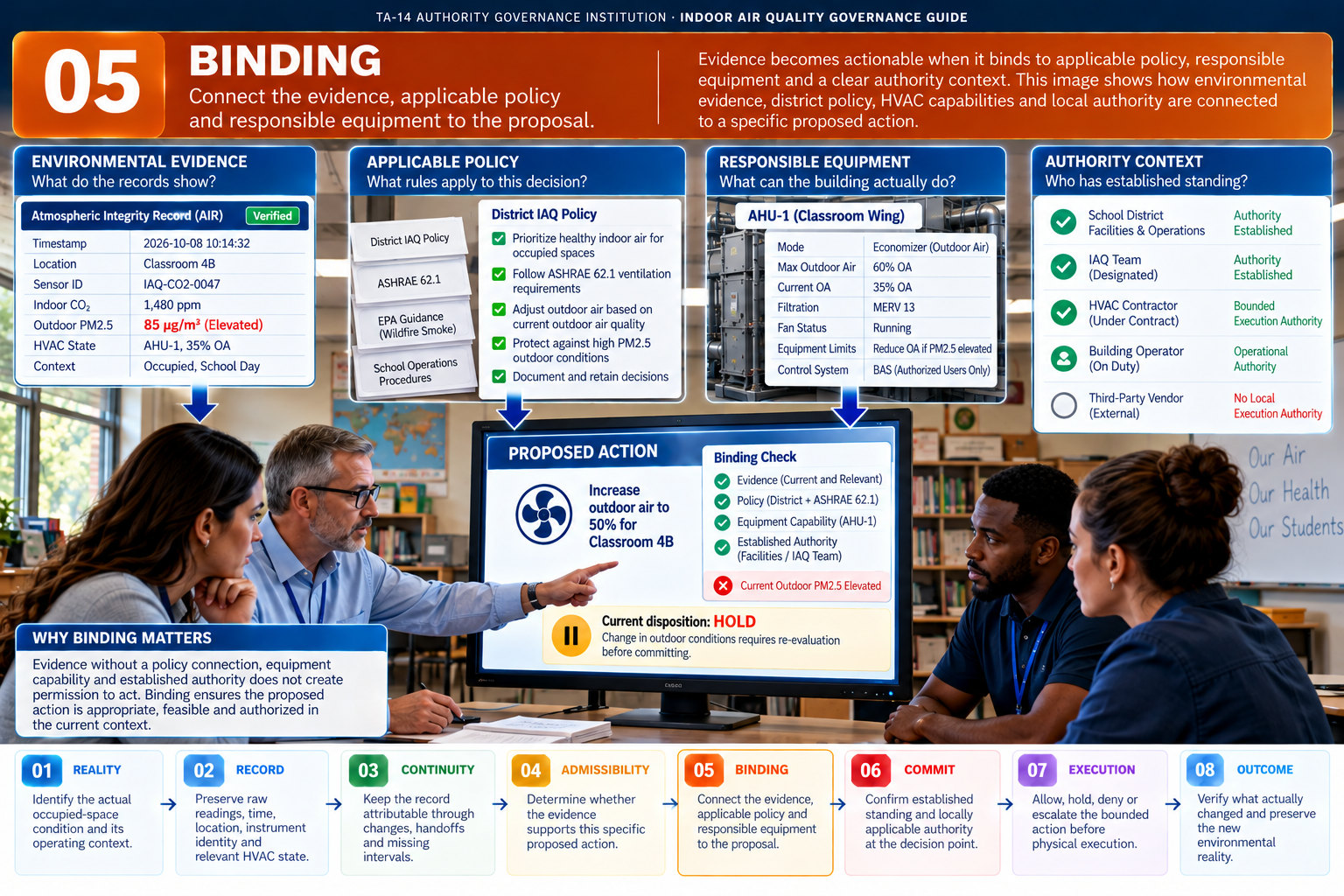
Connect the evidence, applicable policy and responsible equipment to the proposal.
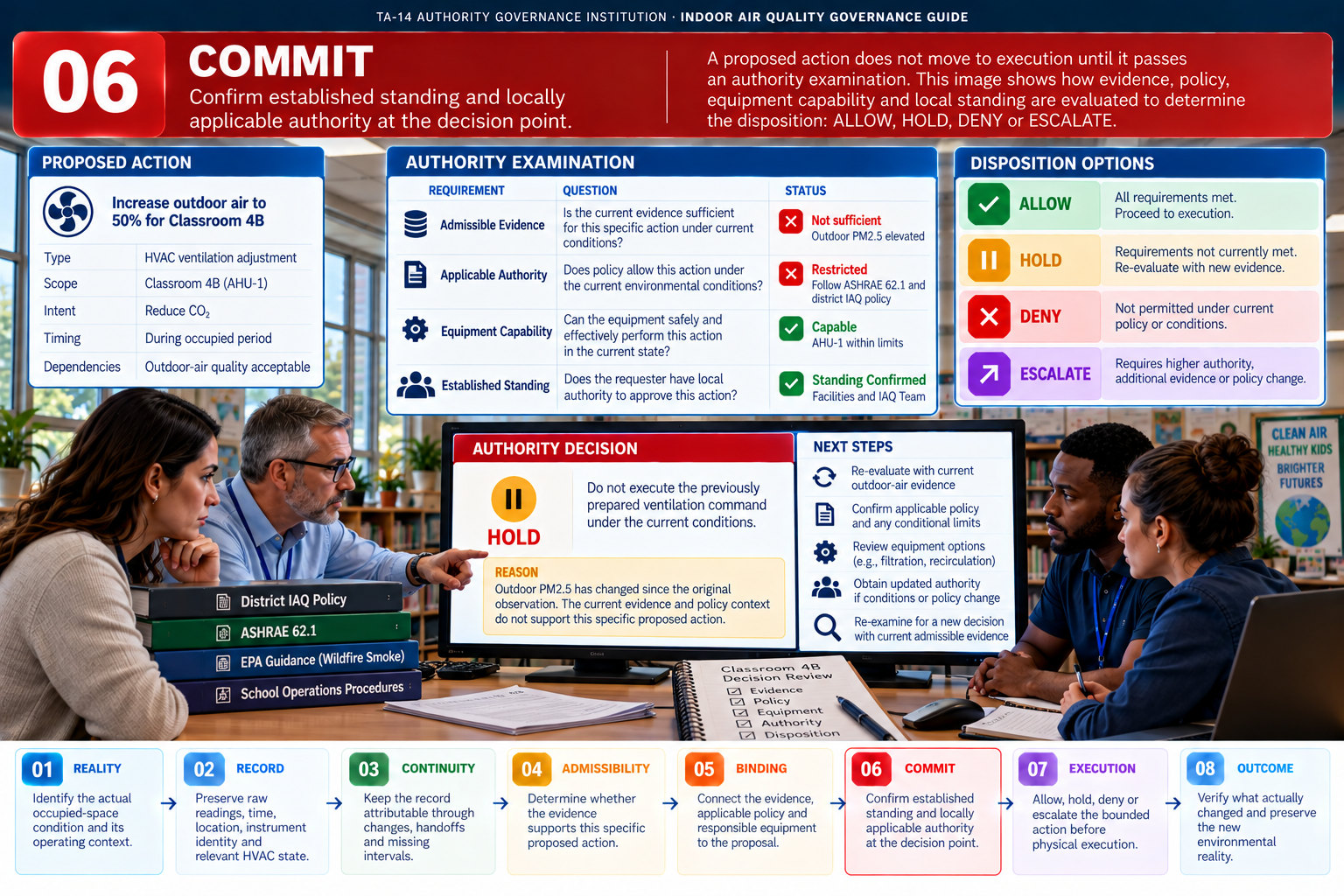
Confirm established standing and locally applicable authority at the decision point.
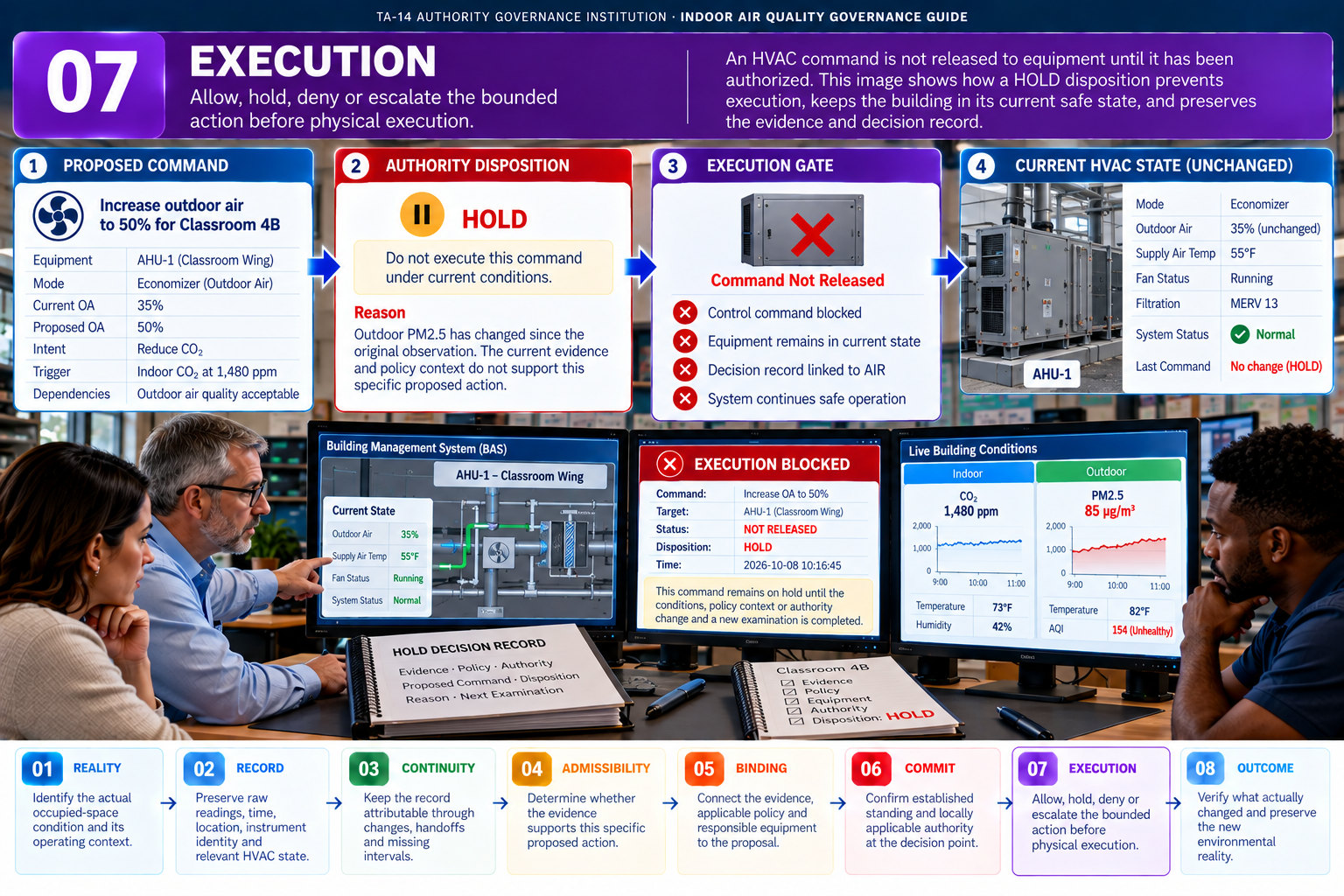
Allow, hold, deny or escalate the bounded action before physical execution.
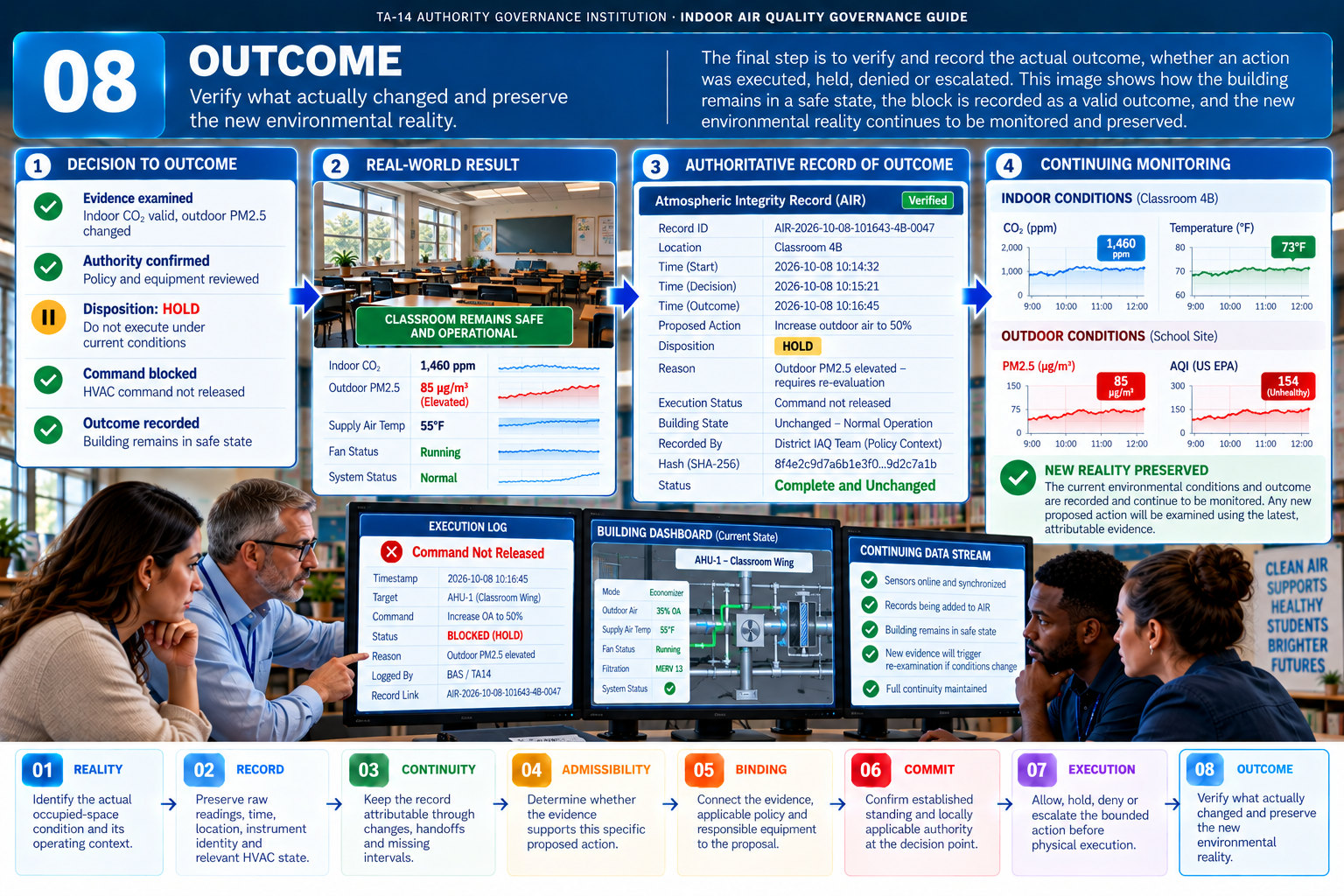
Verify what actually changed and preserve the new environmental reality.
EIGHT TEACHING IMAGES · ILLUSTRATIVE ONLY
These are hypothetical teaching illustrations, not live readings, certified evidence, or real authorization records. Scroll freely and examine each stage.
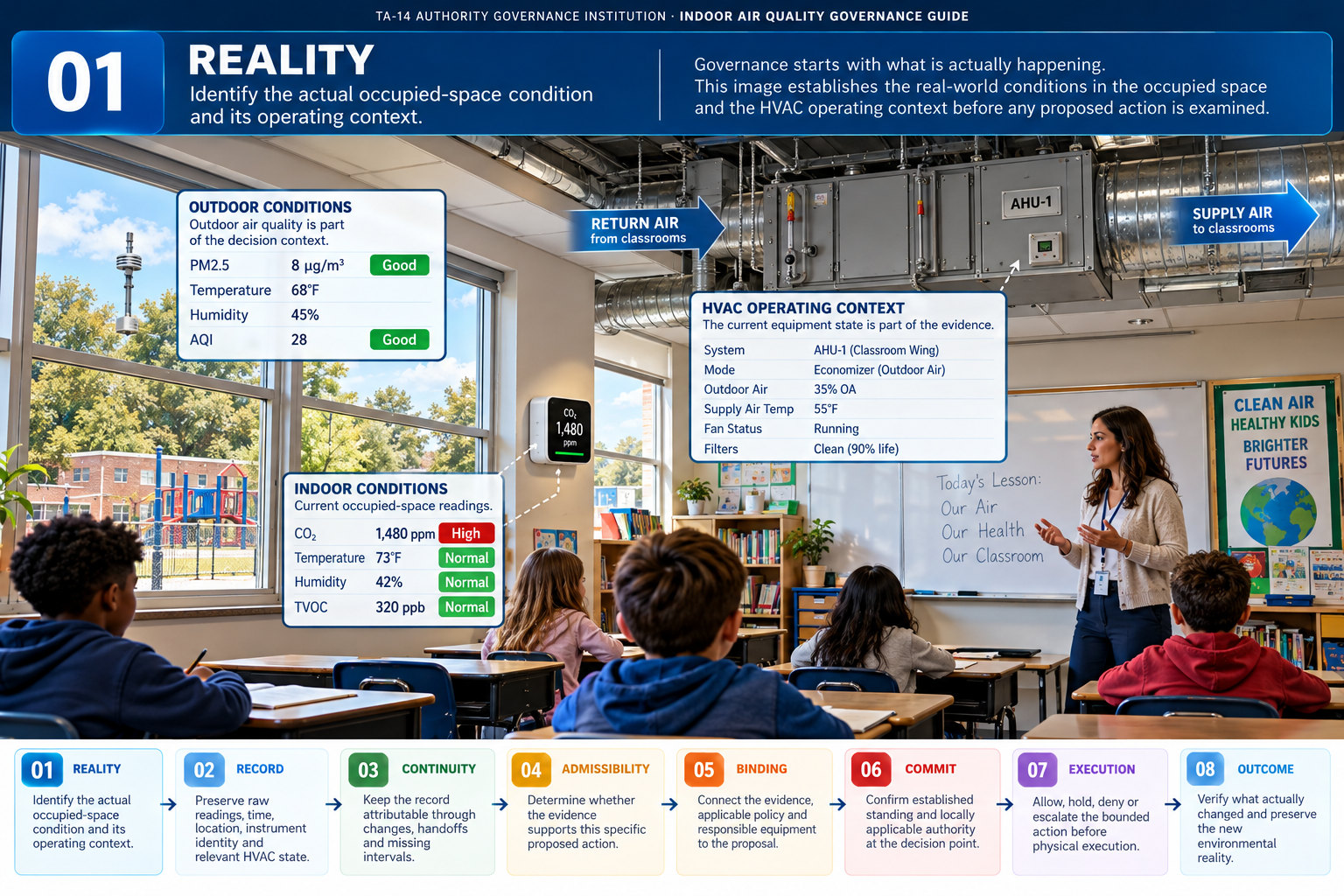
01 — REALITY. We begin with the actual classroom, not a dashboard conclusion. Occupancy, indoor carbon dioxide, outdoor particulate matter, and the operating state of the air-handling system establish the physical context. Observation alone is not permission to intervene.
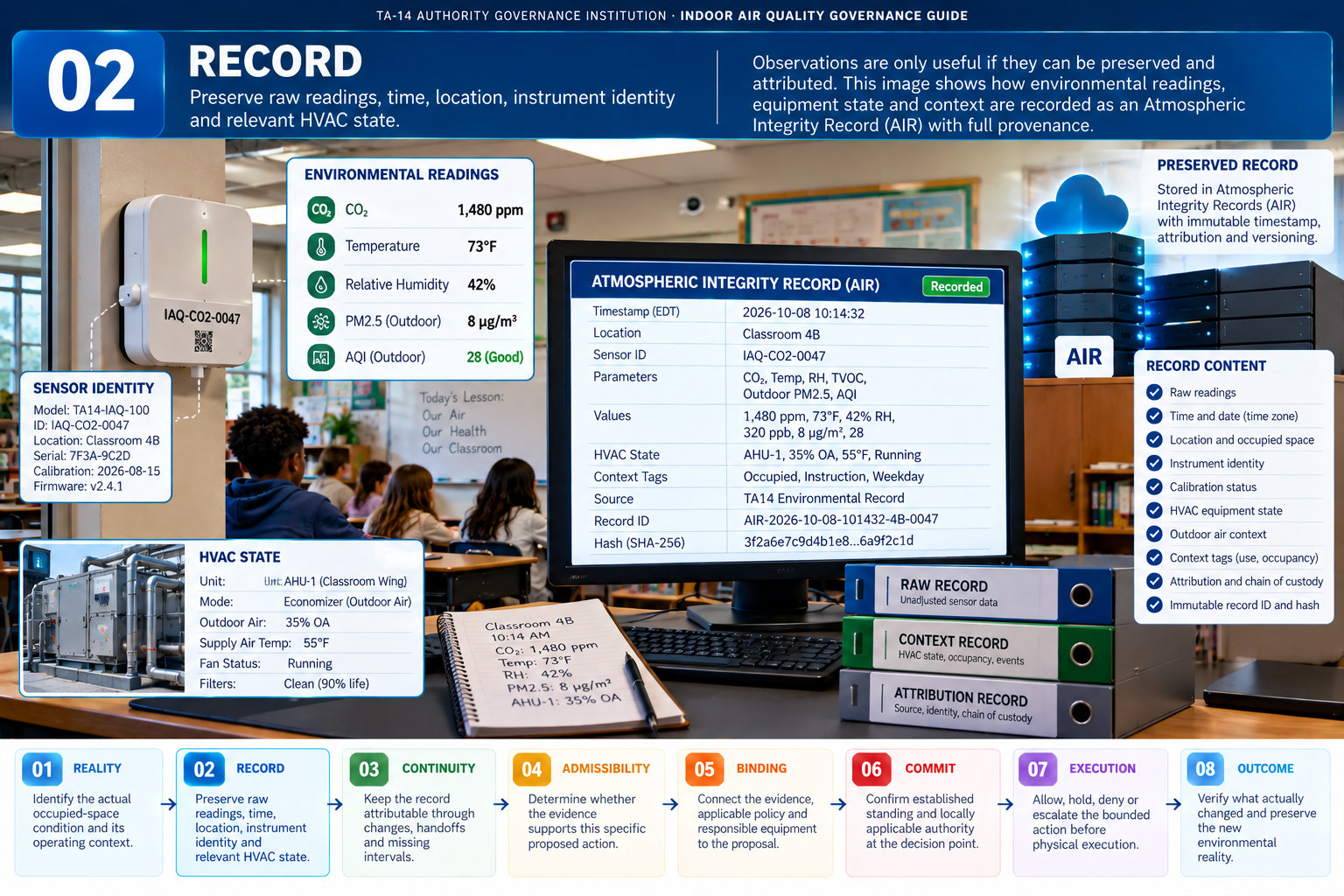
02 — RECORD. Preserve the raw readings, instrument identity, timestamp, location, and HVAC state. The Atmospheric Integrity Record must retain what was actually observed and where it came from. A summary cannot replace its original evidence.
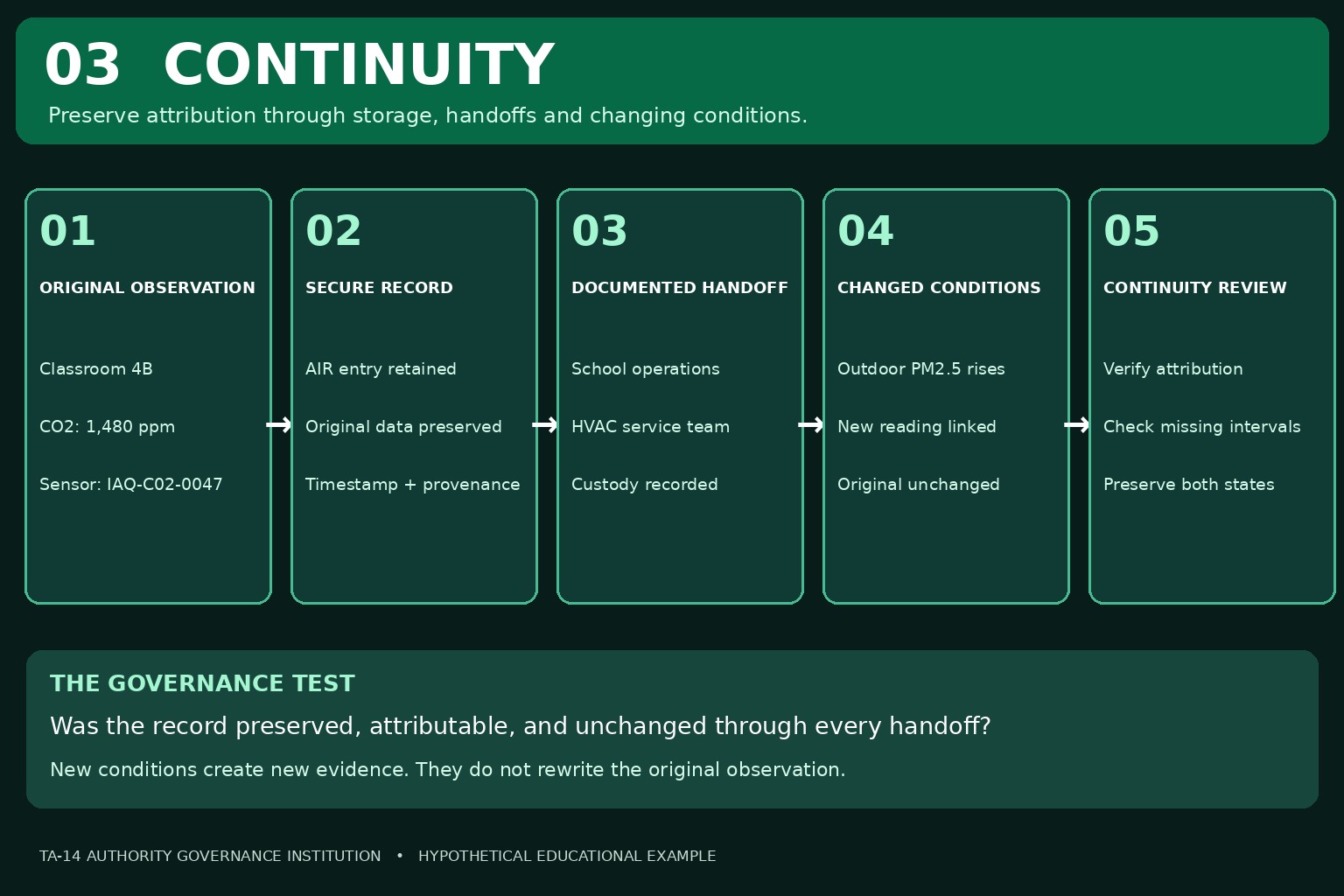
03 — CONTINUITY. The original evidence must remain attributable as it moves through storage, processing, handoffs, and time. Changed conditions do not erase the original record. They change what that record can support now.
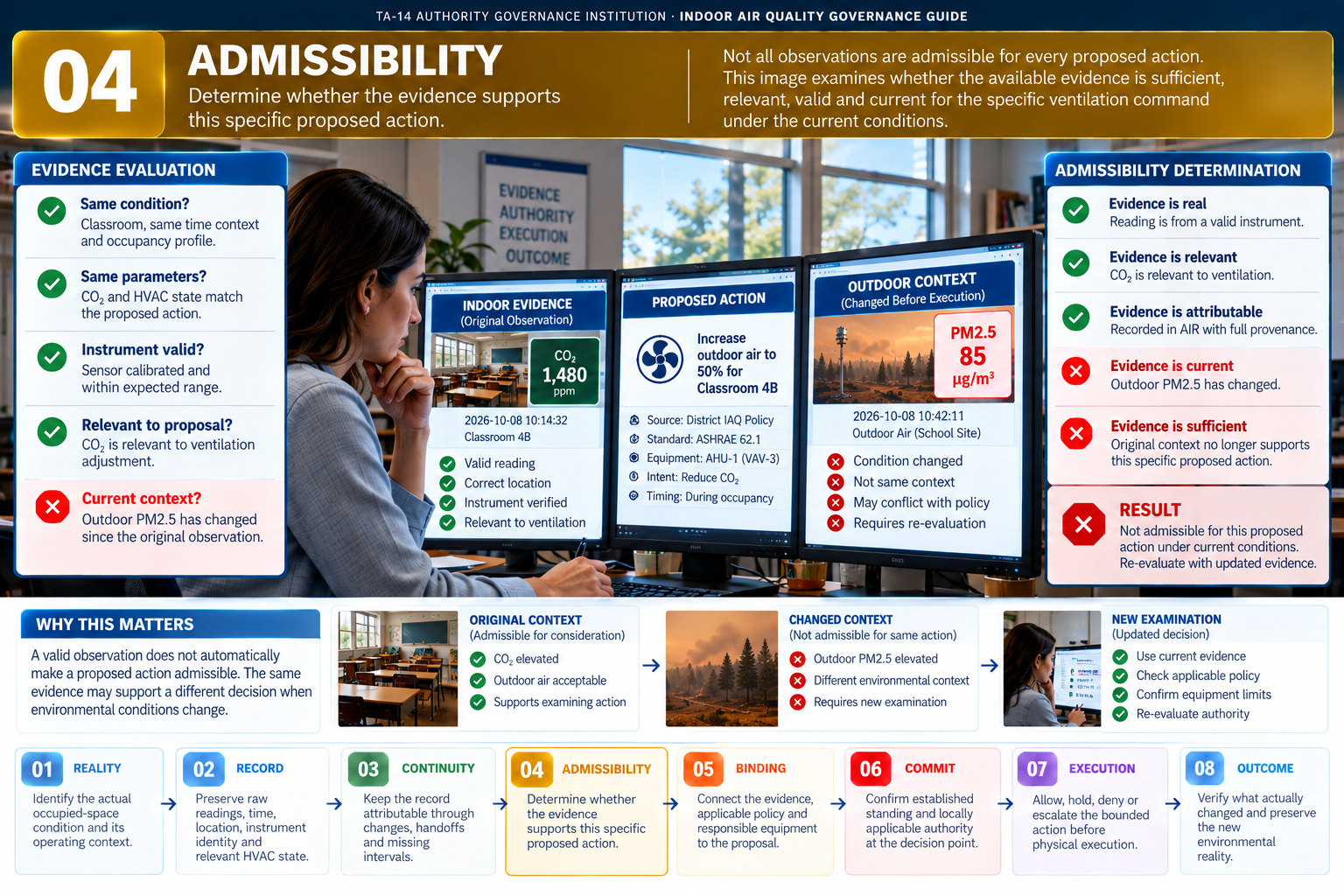
04 — ADMISSIBILITY. A preserved reading may be authentic but insufficient for the proposed ventilation action. The question is whether current evidence is relevant, reliable, and sufficient for this particular consequence.
05 — BINDING. Connect the evidence to the specific HVAC asset, applicable policy, operating constraints, responsible decision maker, and proposed action. An observation does not independently grant authority.
06 — COMMIT. Before any physical action, test admissible evidence, applicable authority, and established standing. With wildfire smoke changing outdoor air, the earlier proposal is held pending renewed examination.
07 — EXECUTION. HOLD means the prepared ventilation command is not released. The equipment remains under its existing authorized control. Capability is not authority.
08 — OUTCOME. Verify and record what actually happened, including non-execution. Preserve the held command, decision context, equipment state, and new environmental observations. A documented HOLD is an outcome.
WORKED EXAMPLE · ILLUSTRATIVE
An occupied classroom's CO₂ level supports consideration of additional ventilation. Before a prepared HVAC command executes, outdoor PM2.5 rises with wildfire smoke. The earlier observation does not automatically authorize the same command under changed conditions.
Indoor CO₂ supports examining a ventilation response while the original outdoor-air context is acceptable.
Outdoor PM2.5 rises before execution. The evidence context supporting the prepared command is no longer the same.
Refresh the outdoor-air record, examine district IAQ policy and equipment constraints, and confirm locally established authority before a new commit.
This is a teaching scenario, not a claim that TA-14 controls a real school or that HOLD is the correct determination for every building.
EXAMINE THE SCHOOL-AIR SCENARIO →CHOOSE YOUR NEXT STEP
REFERENCE LIBRARY