TA14 AUTHORITY GOVERNANCE INSTITUTION · INDEPENDENT TECHNICAL PRE-EXAMINATION
From Construction Completion to Authorized Production
The Semiconductor Fab Consequence Boundary
An expanded eight-image practitioner examination of why a completed and commissioned facility is not automatically authorized to begin or resume semiconductor production.
PRE-EXAMINATION · BASELINE NOT FROZEN · NO FORMAL DISPOSITION · NO FAB, CONFERENCE, RESEARCHER OR INSTITUTIONAL ENDORSEMENT. Educational illustrations are not original field records or evidence of any real fab's readiness.
↓ DOWNLOAD TECHNICAL GOVERNANCE REFERENCE v2.0 (PDF)Expanded practitioner edition: detailed evidence matrices, acceptance boundaries, scenario questions and examination criteria accompany each illustration. Illustrative examples are not ASHRAE requirements or operating instructions. The downloadable v2.0 reference remains the earlier edition pending review.
Five gates. Five different claims.
The fab is built. The systems are commissioned. Who has authority to start production, and what evidence makes that decision defensible?
- Installed: construction scope documented; performance not yet established.
- Commissioned: defined tests accepted within their scope; integrated performance may remain open.
- Integrated operation: interacting systems tested under documented conditions; acceptance is separate.
- Operational acceptance: defined facility conditions and exceptions accepted; production permission remains distinct.
- Production authorization: applicable decision-makers establish standing, evidence sufficiency and permission for the specific process and current context.
SECTION 01 / 08
Construction completion is not production authorization
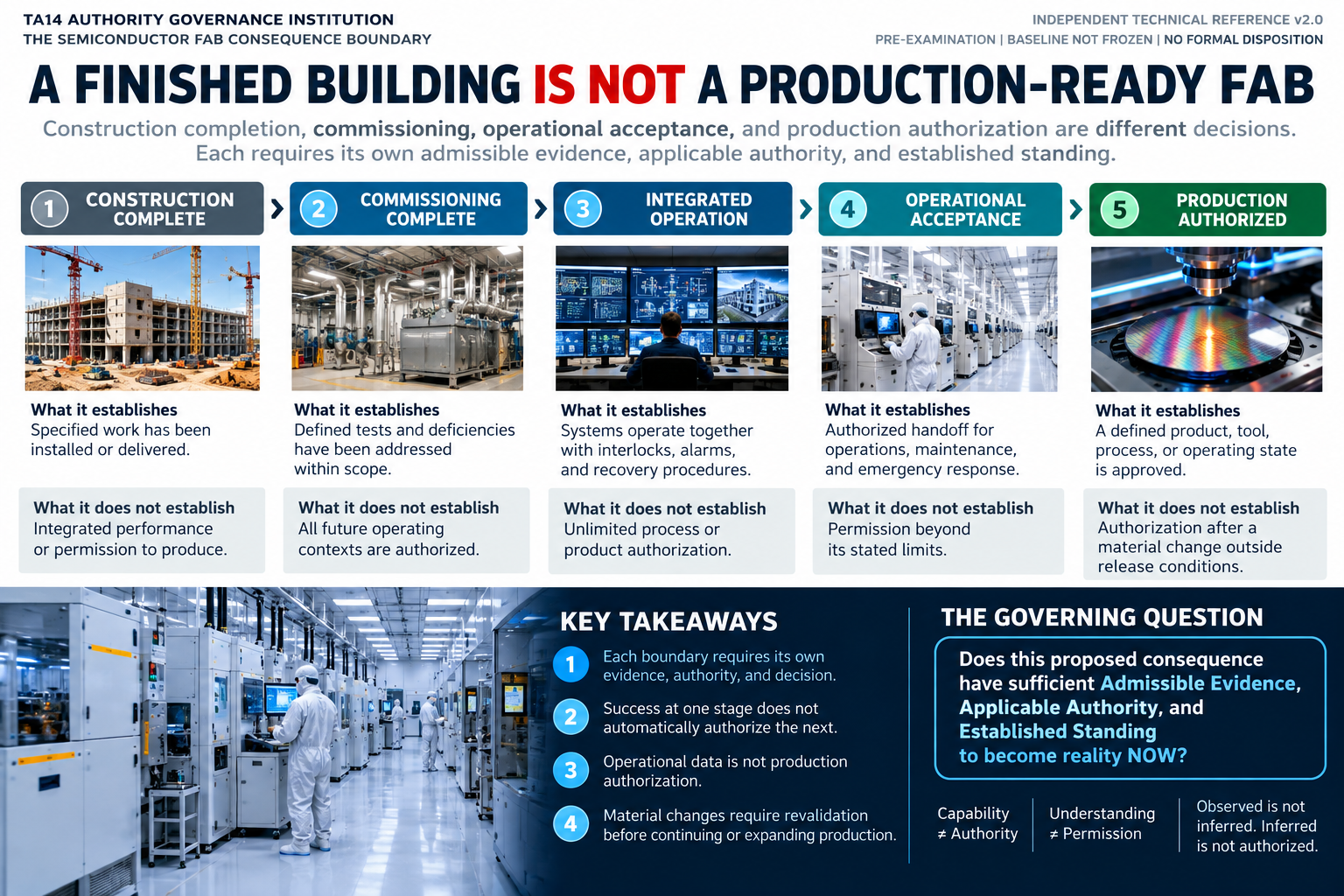
Section one. Construction completion is not production authorization. Examine five separate gates. First, installation establishes the documented construction scope, as-built identity, and unresolved punch items. Second, commissioning evaluates approved functional tests within defined configurations. Third, integrated operation examines interacting cleanroom systems, critical utilities, controls, alarms, and representative loads. Fourth, operational acceptance establishes who takes responsibility for procedures, exceptions, maintenance, and current facility conditions. Fifth, production authorization asks which named decision-maker can release which process, under what conditions, and for how long. Do not merge these claims. A cleanroom fan may pass its functional test while the pressure cascade under full production load remains untested. Likewise, an accepted facility handoff may not constitute a process-quality release. At every gate, ask for the original test evidence, the tested conditions, the outstanding exceptions, the approving role, and the precise acceptance boundary. If a claim has not been established, preserve that gap rather than calling the whole fab ready.
PRACTITIONER EXAMINATION · SECTION 01
Gate-by-gate acceptance dossier
Five gates are five different claims, not five labels for the same approval. A facility may satisfy one gate while the next remains unresolved.
| Evidence boundary | What must be established | Examination caution |
|---|---|---|
| Installed | As-built boundaries, equipment tags, installation checks, open items | Construction closeout does not establish functional performance |
| Commissioned | Approved test scripts, witnessed results, calibration, deficiencies and retests | A component pass is limited to its tested configuration |
| Integrated operation | Interface tests, utility interactions, control sequences, alarm response and representative load conditions | Isolated acceptance does not establish coupled-system behavior |
| Operational acceptance | Operating procedures, maintenance ownership, training, accepted exceptions and responsible signoffs | Facility handoff does not by itself release a manufacturing process |
| Production authorization | Process-specific criteria, current operating state, product-impact review, authorized decision and bounded release | Permission applies only to its defined process, conditions and duration |
Practitioner challenge: Which gate has actually been evidenced, and who is empowered to accept the next one?
SECTION 02 / 08
The eight-anchor consequence chain
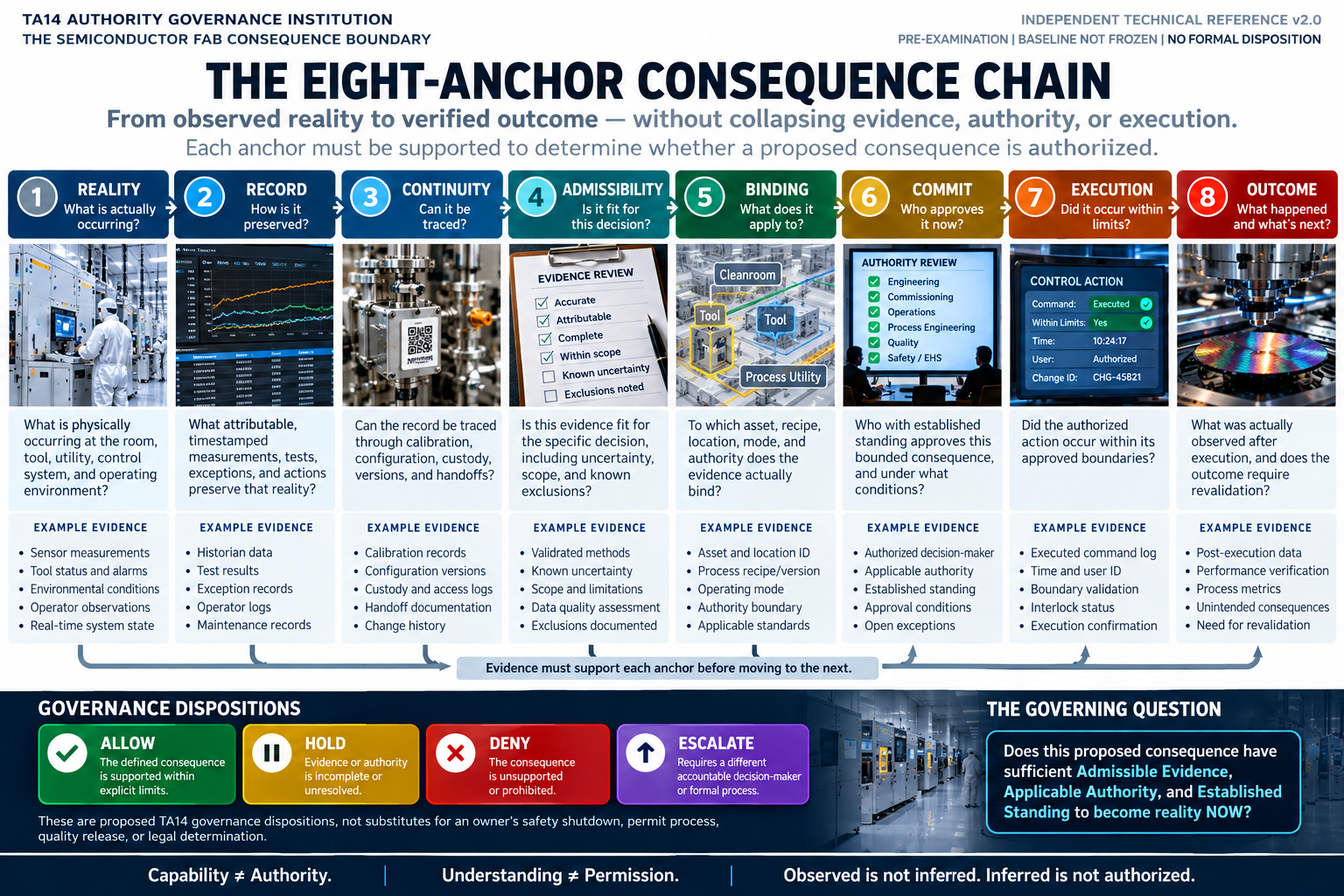
Section two. Follow the eight-anchor consequence chain. Reality means what actually happened, not what the model predicted. Record means source readings, timestamps, alarms, instrument identities, and original observations. Continuity connects those records to equipment, zones, configurations, and production intervals without losing custody or context. Admissibility asks whether evidence is reliable, complete enough, and applicable to this specific decision. Binding identifies the relevant procedure and the locally established authority. Commit records a named, accountable disposition with scope, conditions, and validity. Execution is the physical action taken under that bounded decision. Outcome is the observed result, not simply the command that was issued. Imagine a pressure alarm that clears automatically. The cleared alarm is a record of an operating state, not a release decision. Ask which anchor is unsupported, and stop the inference there. A later approval cannot retroactively manufacture missing raw data. The chain is intended to make disagreement visible and the decision reconstructable.
PRACTITIONER EXAMINATION · SECTION 02
Eight anchors as an auditable decision record
Each anchor requires an identifiable input and a reviewable output. A later signature cannot cure missing upstream evidence.
| Evidence boundary | What must be established | Examination caution |
|---|---|---|
| REALITY | Actual pressure, particle, utility, control and equipment conditions | Separate observations from interpretations |
| RECORD | Time-synchronized source records and system identities | Retain raw readings and original exceptions |
| CONTINUITY | Link readings to assets, zones, configurations and production intervals | Document gaps, transformations and custody |
| ADMISSIBILITY | Assess relevance, calibration, completeness and uncertainty | Mark unsupported claims unresolved |
| BINDING | Map applicable requirements and authorized decision rights | Do not infer permission from system capability |
| COMMIT | Capture ALLOW, HOLD, DENY or ESCALATE with reasons and scope | Identify signer, time, validity and conditions |
| EXECUTION | Enforce only the bounded permission | Log actual actuation and overrides |
| OUTCOME | Compare resulting conditions with required outcomes | Retain new evidence and trigger reassessment |
Practitioner challenge: Can an independent examiner reconstruct the decision from raw records through observed outcome?
SECTION 03 / 08
Evidence required before acceptance
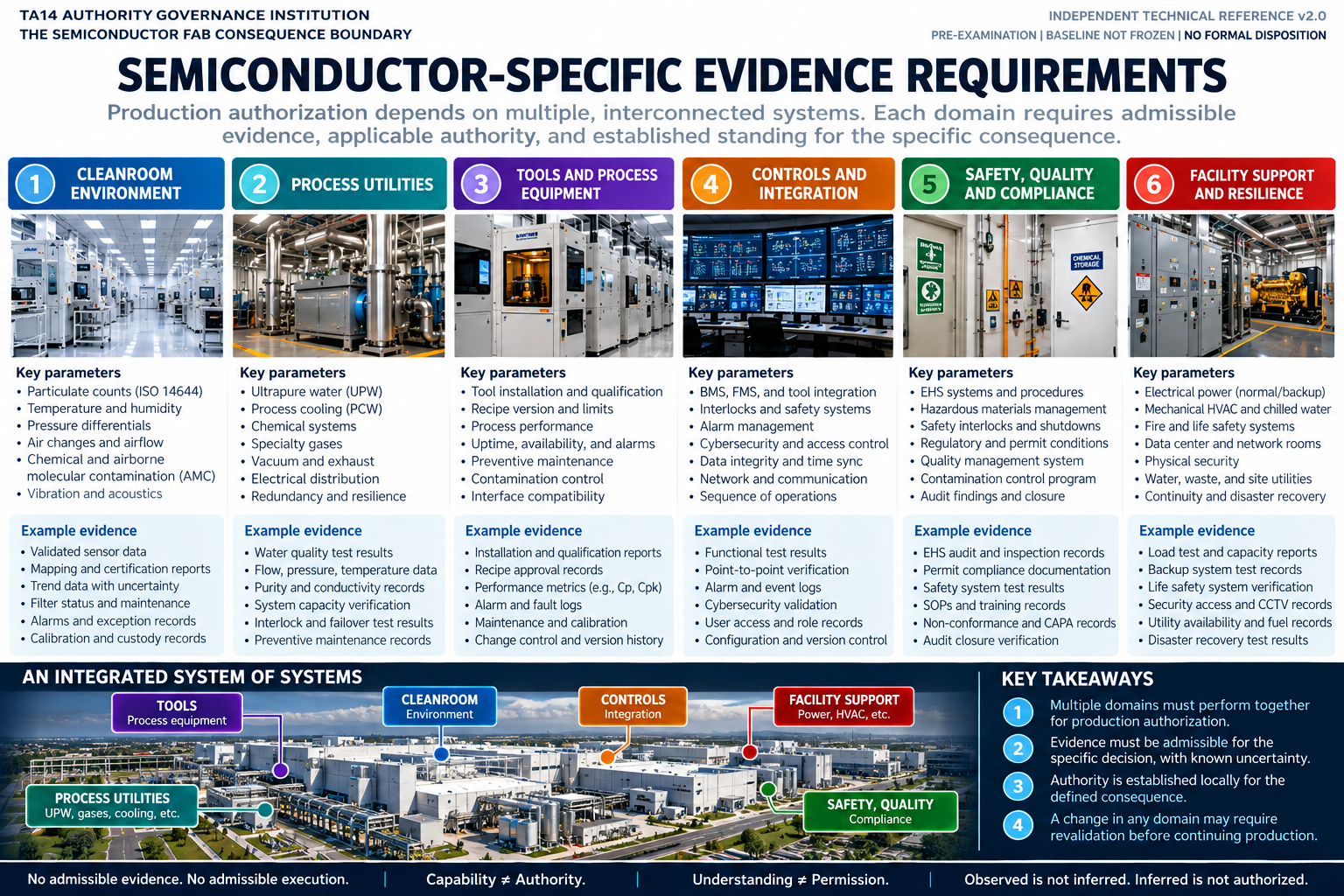
Section three. Evidence is not admissible simply because a PDF or dashboard exists. Begin with provenance: what instrument or system produced the original observation, and who controls that record? Examine calibration, measurement range, uncertainty, sample interval, and instrument health. Check whether timestamps are synchronized and whether any gaps, overrides, or alarm suppressions are visible. Tie each result to the exact zone, asset, control sequence, filtration state, process load, and version of the operating configuration. Preserve raw measurements separately from normalized values or engineering interpretations. Review approved acceptance criteria, witnessed tests, deficiencies, retests, and accountable signoffs. A result collected under an earlier configuration may remain historically valid while being insufficient for today's release. An examiner should be able to follow each material claim back to a source and identify its limits. The practitioner challenge is simple: remove one source record or configuration link. Which claimed readiness decision can no longer be defended?
PRACTITIONER EXAMINATION · SECTION 03
Evidence quality and traceability
A document's presence is not evidence of its applicability. Evaluate what each record can support in the current production context.
| Evidence boundary | What must be established | Examination caution |
|---|---|---|
| Provenance | Original data source, instrument identifier, owner and immutable source reference | Who generated the record? |
| Measurement quality | Calibration, range, uncertainty, sampling rate and instrument health | Was the instrument fit for this claim? |
| Time and configuration | Clock synchronization, firmware, control logic, filter status and process load | Does this test represent the present state? |
| Completeness | Missing intervals, alarms, bypasses, deviations and open deficiencies | What evidence is absent? |
| Acceptance linkage | Approved criteria, witnessed test, accountable acceptance and exception disposition | Who accepted what, and within which scope? |
| Record separation | Preserve raw observation separately from normalized or adjusted interpretations | Can the original observation still be examined? |
Practitioner challenge: Which claim becomes unsupported if a source record or configuration link fails?
SECTION 04 / 08
Cleanroom pressure excursion
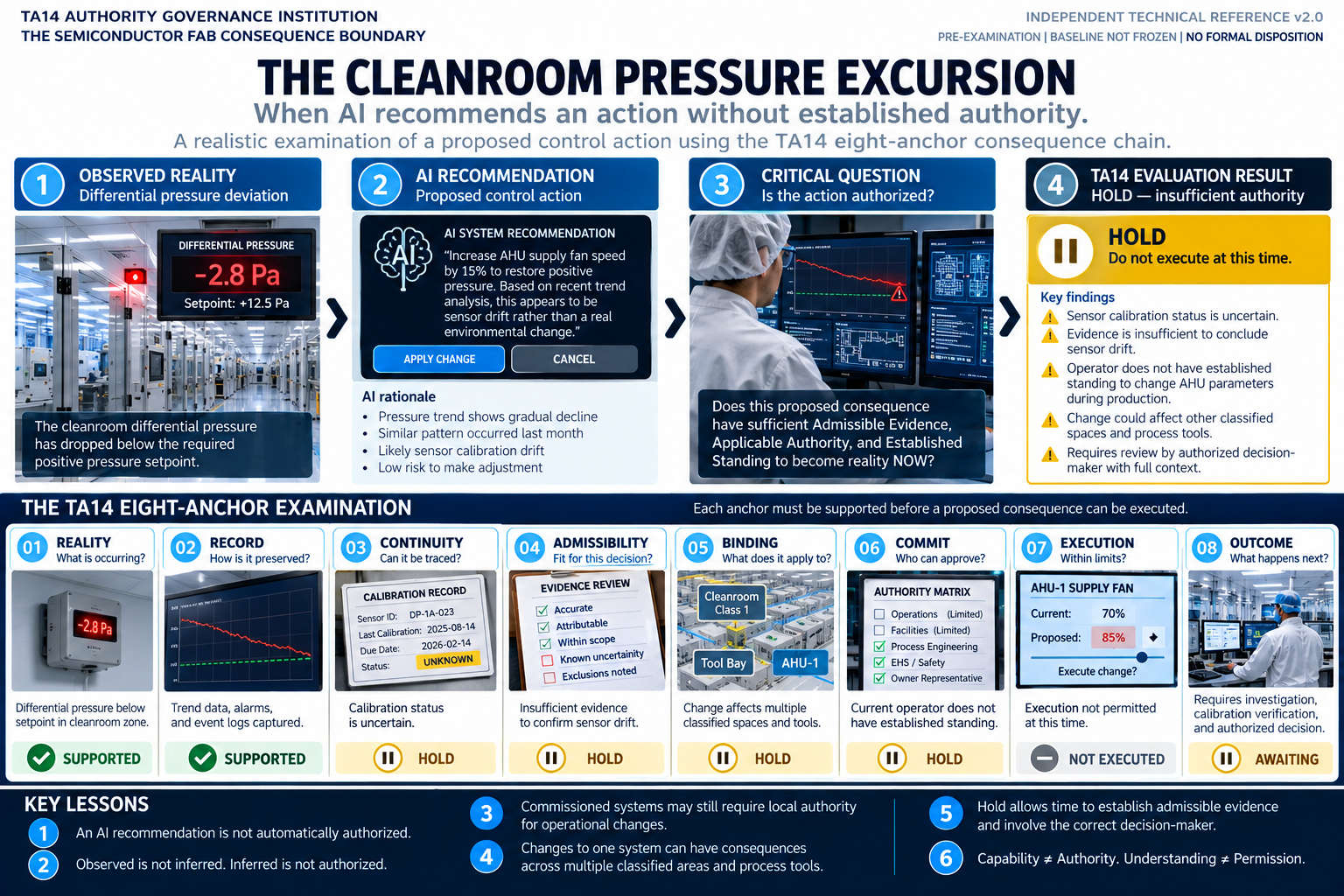
Section four. Consider a hypothetical cleanroom pressure excursion. An alarm reports a differential outside the locally approved range. Later, the display returns to its expected value. That recovery is an observation, not proof that contamination risk or process impact has been resolved. First preserve the raw trend, alarm sequence, onset, duration, adjacent-zone readings, and any missing samples. Then validate sensor calibration, health, clocks, and corroborating measurements. Reconstruct which doors, fans, dampers, filtration systems, controls, and operator interventions were involved. Map the affected rooms, tools, materials, and manufacturing intervals without assuming every process was exposed. Apply the facility's actual contamination-control, quality, environmental health and safety, and production procedures. Determine separately who may restore facility operation and who may release affected processes or product. Finally, perform whatever recovery checks the applicable procedures require and preserve post-resumption observations. In this teaching case, the affected process interval and release standing remain unresolved. The disposition is HOLD, not because a universal pressure limit was exceeded, but because evidence or authority is incomplete. This is not a live fab decision.
PRACTITIONER EXAMINATION · SECTION 04
Pressure excursion: incident reconstruction and bounded release
Hypothetical case: an alarm indicates a zone pressure excursion, then the display returns to range. Recovery of one reading does not prove product impact is resolved.
| Evidence boundary | What must be established | Examination caution |
|---|---|---|
| Detect and preserve | Capture original alarm sequence, onset, duration, differential trend and adjacent-zone readings | No universal pressure threshold is assumed |
| Validate instruments | Check sensor status, calibration, clocks, sampling gaps and alternate observations | A faulty sensor and a real excursion require different dispositions |
| Map affected boundary | Identify rooms, tools, air paths, open process steps and production intervals | Do not assume every lot or tool was exposed |
| Assess control response | Examine fan states, dampers, doors, filtration, operator actions and trend history | A restored setpoint does not prove the cause was removed |
| Apply facility procedures | Identify applicable contamination-control, quality, EHS and process requirements | Local documented criteria govern, not this teaching example |
| Determine release standing | Record who may authorize facility recovery versus process and product release | Separate facilities restart from production resumption |
| Verify and monitor | Complete required checks, bounded release record and post-resumption observations | Reopen examination if conditions recur |
Practitioner challenge: If affected production intervals or release authority remain unestablished, HOLD the proposed resumption.
ILLUSTRATIVE EXAMINATION · NOT A LIVE FAB DECISION
May production resume after a cleanroom pressure excursion?
Assume an excursion is recorded but the affected process interval or required authorization remains unestablished. No universal pressure threshold is assumed.
- REALITY: Establish what was observed; distinguish inference.
- RECORD: Preserve readings, alarms, timestamps and instrument status.
- CONTINUITY: Connect the event to rooms, equipment and production intervals.
- ADMISSIBILITY: Test provenance, reliability, completeness and applicability.
- BINDING: Identify procedures and locally established decision authority.
- COMMIT: Record an accountable disposition with scope and conditions.
- EXECUTION: Resume only within the authorized boundary.
- OUTCOME: Verify operating state and preserve resulting evidence.
ILLUSTRATIVE DISPOSITION: HOLD
HOLD applies here because necessary evidence or authority remains incomplete. It is not a determination about a real fab.
SECTION 05 / 08
Authority across the fab handoff
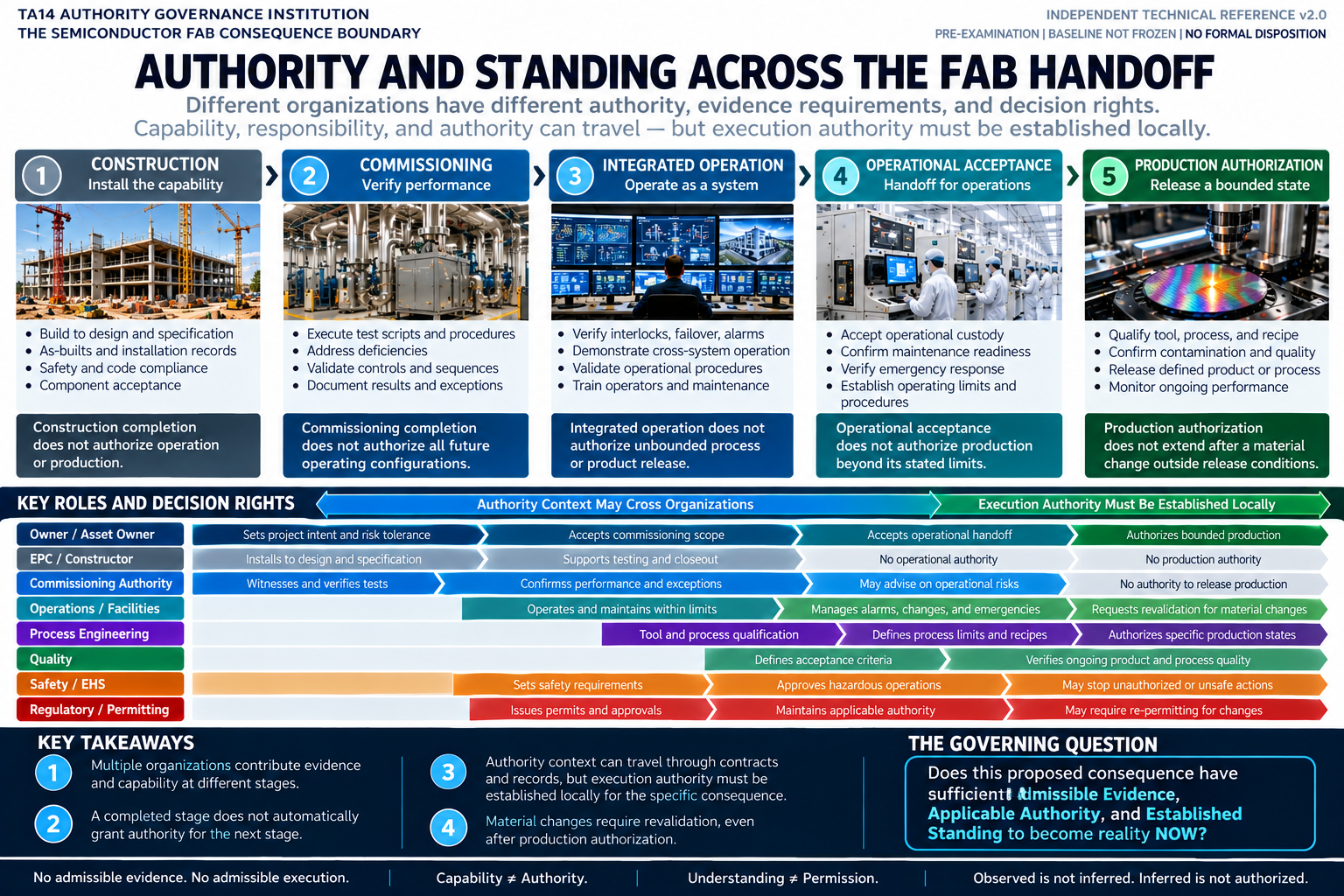
Section five. Responsibility is not automatically authority. The construction contractor may provide as-built records and closeout evidence. The commissioning provider may witness defined tests and report deficiencies. Facilities operations may establish current utility and environmental state. A process owner may determine manufacturing readiness for particular tools or intervals. Quality and safety functions may impose separate acceptance and release requirements. A duly designated production authority may issue a bounded permission. None of these roles should be assumed to inherit every other role's decision rights through handoff. Ask for the actual delegation, governing procedure, signature authority, constraints, and effective time. Consider a dispute: facilities confirms stable pressure, but quality has not completed an impact assessment. Facilities evidence may be necessary, but it is not automatically sufficient for production release. The governing examination must preserve both positions and identify the missing binding authority. A transfer of documentation is not the same thing as a transfer of execution permission.
PRACTITIONER EXAMINATION · SECTION 05
Responsibility, evidence ownership and decision rights
Responsibility to provide evidence does not automatically confer authority to accept risk or release production.
| Evidence boundary | What must be established | Examination caution |
|---|---|---|
| Contractor | Installation, as-builts, punch items and scope exceptions | Cannot unilaterally authorize process production |
| Commissioning provider | Witnessed test scope, results, deficiencies and retest record | Test acceptance is bounded by approved scope |
| Facilities operations | Current utility and environmental conditions, alarms and maintenance state | Operating control is not necessarily product release |
| Process owner | Tool and process readiness, affected intervals and manufacturing conditions | Process scope must be explicit |
| Quality / EHS | Applicable quality release and safety requirements | Actual signoff rights depend on local procedures |
| Production authority | Final bounded release where duly delegated | Standing, delegation, validity and constraints must be recorded |
Practitioner challenge: Where are decision rights documented, and what happens when two functions disagree?
Responsibility is not automatically authority
| Role | Evidence or responsibility to establish |
|---|---|
| Construction contractor | Installed scope, as-built documentation and exceptions |
| Commissioning authority | Test scope, witnessed results and deficiencies |
| Facilities operator | Current environmental and utility operating conditions |
| Process owner | Process-specific readiness and affected production boundary |
| Quality and safety functions | Applicable acceptance, risk and release requirements |
| Authorized production decision-maker | Standing and recorded permission for the proposed consequence |
Illustrative roles only; actual authority depends on facility arrangements.
SECTION 06 / 08
Changed-context revalidation
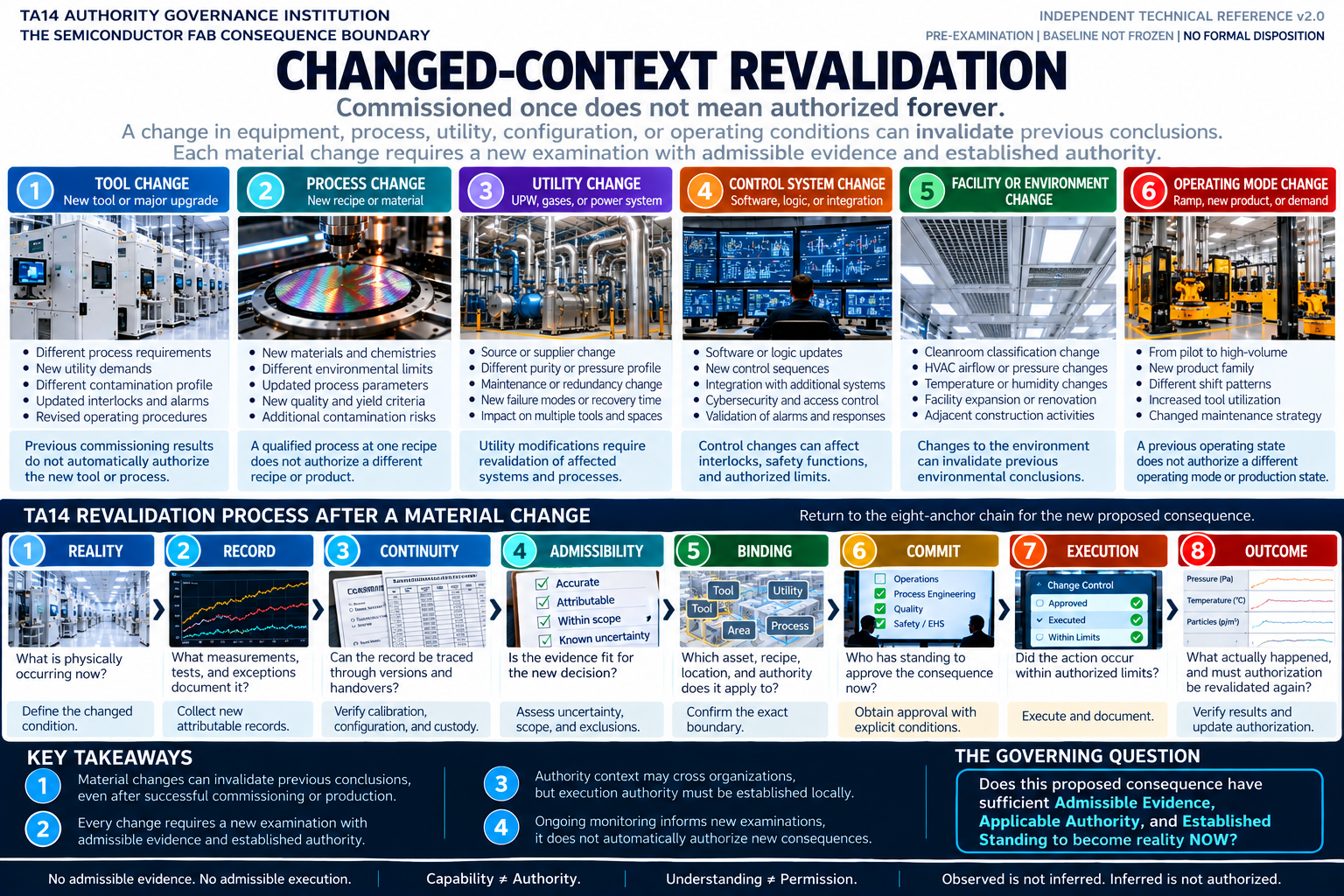
Section six. Commissioned once does not mean authorized forever. Consider a filter replacement, a changed pressure-control sequence, a moved tool, or a revised process load. Begin with the actual configuration delta and the time it occurred. Trace dependencies to zones, utilities, controls, process tools, and previous acceptance tests. Determine which historical results remain applicable, which need limited revalidation, and which no longer support a current claim. Preserve the original acceptance; do not silently rewrite it. Select retests based on the affected boundary and documented facility requirements rather than automatically repeating everything or nothing. Identify who may approve the change, who accepts restored operation, and who can authorize process resumption. Record conditions, exceptions, rollback or revocation paths, and post-change verification. The practitioner question is not merely whether the system runs. It is whether the evidence and authority supporting this particular consequence are still current after the change.
PRACTITIONER EXAMINATION · SECTION 06
Changed context: invalidate, revalidate, or constrain
Acceptance evidence is conditional on the tested configuration. Change control should determine which prior claims remain applicable.
| Evidence boundary | What must be established | Examination caution |
|---|---|---|
| Trigger | Filter replacement, control sequence change, tool move, utility instability or process-load change | Identify the actual delta and its time |
| Impact map | Trace changed assets to dependent zones, tools, processes and prior tests | Do not reflexively repeat every test or none |
| Evidence decision | Retain historical acceptance, mark superseded claims, select necessary retests | Old evidence remains historical, not automatically current |
| Authority decision | Identify change approver, operational acceptance and production-release rights | Re-establish local execution authority |
| Return to service | Document test results, exceptions, authorized limits and outcome checks | Revocation and rollback paths must be testable |
Practitioner challenge: Which previous acceptance claims are still applicable after this specific change?
Changed-context revalidation
Filter replacement, revised control logic or changed process load may alter the conditions under which earlier evidence was accepted. Preserve original acceptance, document the change, re-examine what is affected and establish current authorization locally.
SECTION 07 / 08
A bounded governance pilot
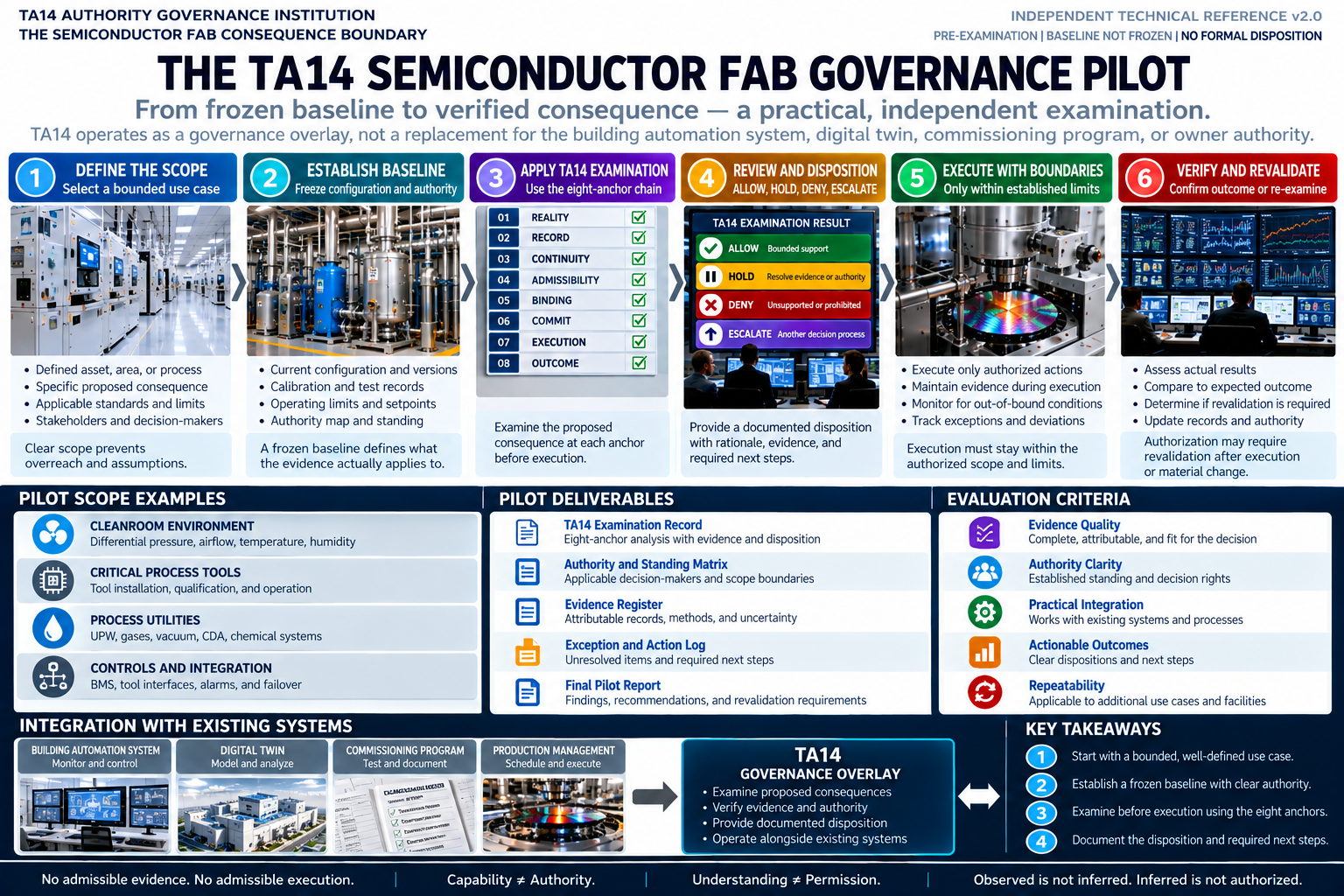
Section seven. A bounded governance pilot should be designed to be challenged. Define one facility zone, interface, or production-resumption decision. State what is outside scope. Identify the registered governance requester, but remember that registration does not grant operating authority inside a fab. Name the locally recognized participants and decision rights. Freeze a versioned evidence baseline with source references, timestamps, configuration, and known gaps. Declare acceptance criteria before examining the outcome, including evidence that would contradict the desired result. Build an evidence register and authority matrix. Allow four dispositions: ALLOW, HOLD, DENY, and ESCALATE. Each must include its rationale and limits. Protect confidential process information and obtain permission before publication. This showroom is educational; it is not a completed formal examination, does not certify a fab, and does not command equipment. A good pilot makes an unfavorable finding just as visible as a favorable one.
PRACTITIONER EXAMINATION · SECTION 07
Pilot charter and examination deliverables
A bounded governance pilot should be falsifiable, repeatable and explicitly separate from real-time facility control.
| Evidence boundary | What must be established | Examination caution |
|---|---|---|
| Scope | One zone, system interface or production-resumption decision | Name excluded assets and consequences |
| Standing | Registered governance requester and locally recognized decision participants | Registration alone does not grant fab authority |
| Frozen baseline | Versioned evidence index, timestamp, configuration and known gaps | No retroactive replacement of source records |
| Criteria | Predeclared acceptance tests and contradiction conditions | Permit unfavorable findings |
| Disposition | ALLOW / HOLD / DENY / ESCALATE with evidence and authority rationale | Teaching examples do not issue live permissions |
| Outputs | Evidence register, authority matrix, findings, open questions and verification plan | Publish only with approved permissions and confidentiality controls |
Practitioner challenge: What specific evidence would contradict the proposed readiness claim?
Bounded pilot entry criteria
Identify one facility boundary, one proposed consequence, a registered governance requester with standing, a frozen evidence baseline, named authority, acceptance criteria and a documented disposition path. This teaching showroom is not a completed formal examination.
SECTION 08 / 08
From proof to governed production
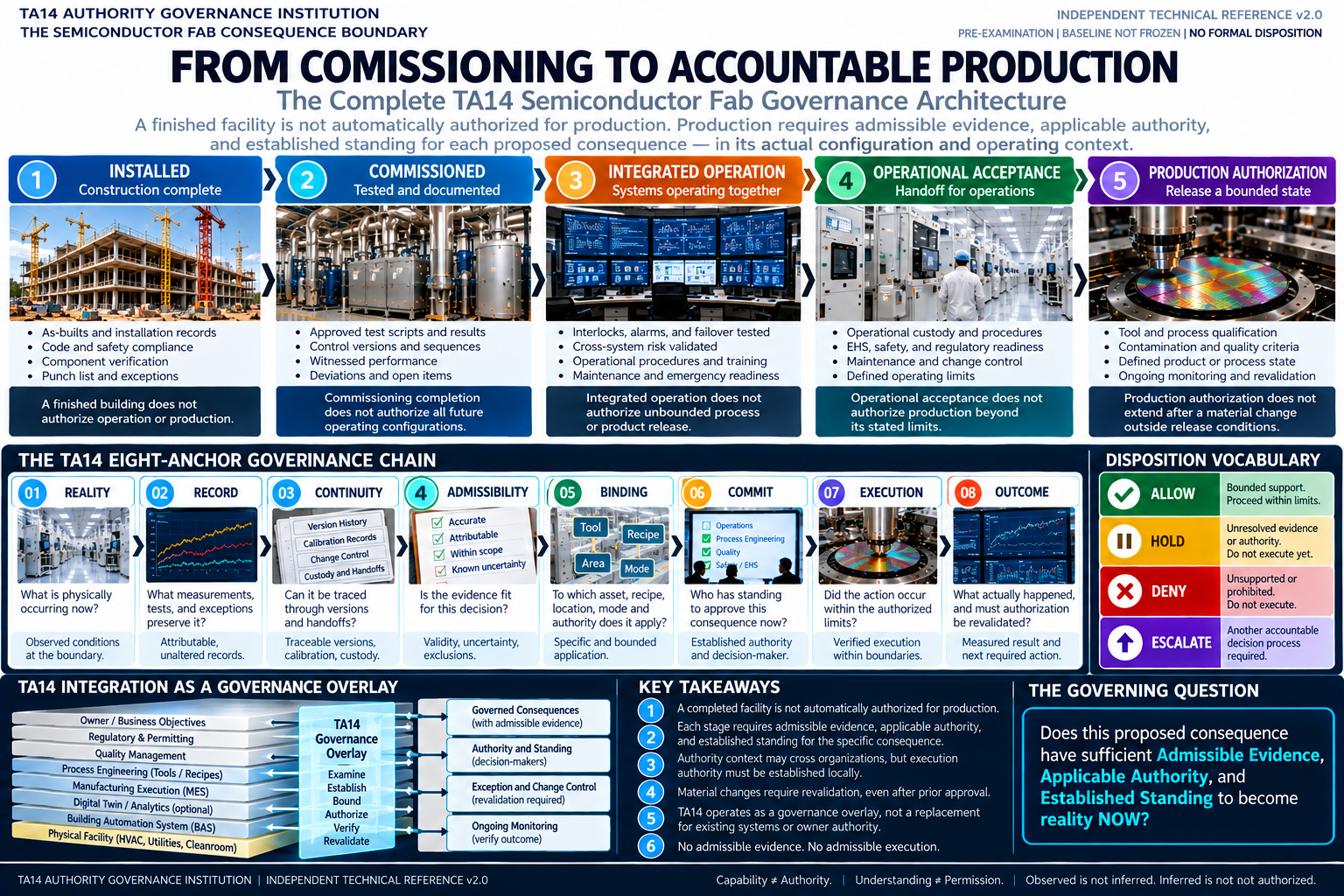
Section eight. Trace the final boundary from evidence to governed production. Before commitment, confirm that the records are admissible for the decision, the applicable authority is established locally, and the decision-maker has standing now. At commitment, capture the specific assets and processes, allowed actions, conditions, time limits, and any required monitoring. During execution, distinguish the issued permission from the physical action actually taken. Preserve overrides, alarms, deviations, and the possibility of revocation. After execution, examine measured outcomes, including any unexpected environmental or process consequences. If conditions change, reassess rather than assuming the earlier permission remains valid. Capability is not authority. An authorized command is not proof of a successful outcome. No admissible evidence, no admissible execution. Ask the governing question exactly: Does this proposed consequence have sufficient Admissible Evidence, Applicable Authority, and Established Standing to become reality NOW? The teaching architecture can expose missing proof. It does not replace the people and procedures authorized to run a real semiconductor facility.
PRACTITIONER EXAMINATION · SECTION 08
From authorization to observed consequence
A production release is a bounded decision, not an everlasting property of a commissioned building.
| Evidence boundary | What must be established | Examination caution |
|---|---|---|
| Before commit | Confirm evidence sufficiency, decision authority, standing and current operating context | No admissible evidence; no admissible execution |
| At commit | Capture decision identifier, authorized assets/processes, limits, expiry and conditions | Capability is not authority |
| During execution | Record actual state transitions, overrides, alarms and boundary violations | An authorization record is not proof of execution |
| After execution | Verify environmental state, process outcomes and any new deviations | An outcome cannot be assumed from a command |
| On change or revocation | Reassess evidence, constrain or stop affected actions, document recovery | Commissioned once does not mean authorized forever |
Practitioner challenge: Can the owner demonstrate that the authorized consequence, rather than merely the intended command, occurred?
The governing question
Does this proposed consequence have sufficient Admissible Evidence, Applicable Authority, and Established Standing to become reality NOW?
ALLOW · HOLD · DENY · ESCALATE
No admissible evidence. No admissible execution. This showroom does not itself grant execution authority.
TA14 examines the boundary between evidence and authorized consequence. This teaching showroom does not certify a fab, replace facility authorities or issue production permission.