From environmental measurement to authorized building action
A virtual public library begins in Lagos, Nigeria, with a single question: should its windows be open or closed when outdoor pollution is a concern? The same building is then moved to Canada. Observe how evidence, governing instructions, standing and environmental consequences must be re-established before an action can be permitted.
HYPOTHETICAL EDUCATIONAL EXERCISE. No real Lagos or Canadian facility, live data, approved control sequence, verified legal duty, certified performance, partner endorsement or operational deployment is asserted. Measurements, statuses and thresholds shown in the artwork are illustrative.
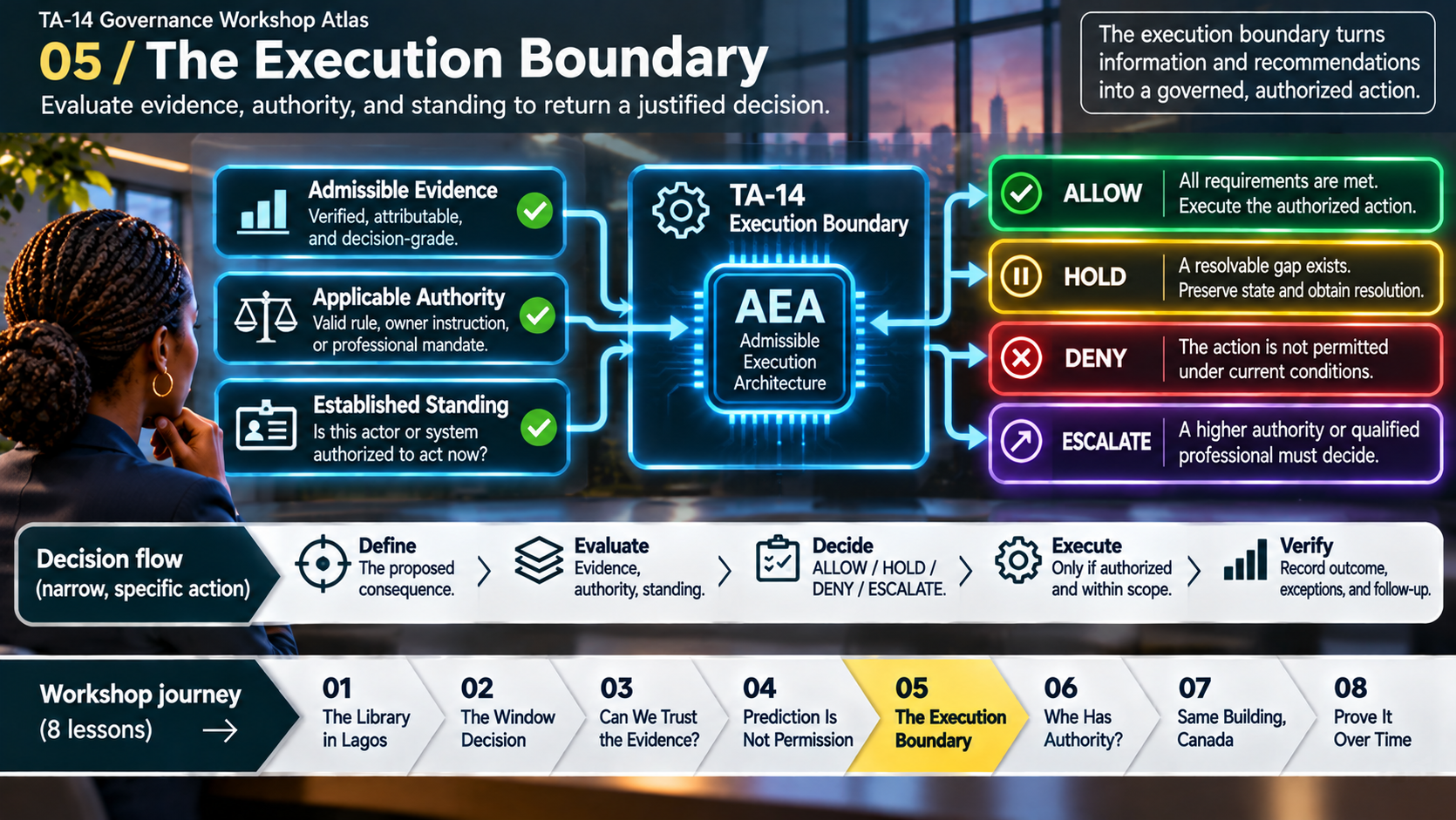
Does this proposed consequence have sufficient Admissible Evidence, Applicable Authority, and Established Standing to become reality NOW?
Atmospheric Integrity Records (AIR) support attributable observations. Environmental Integrity Governance (EIG) examines combined environmental effects. Admissible Execution Architecture (AEA) evaluates whether a specified action can proceed now. A sensor observation or AI forecast never, by itself, confers execution authority.
THE GUIDED WORKSHOP
Eight distinct questions. One consequential action.
Follow the numbered teaching sections on the image. The page does not auto-scroll.
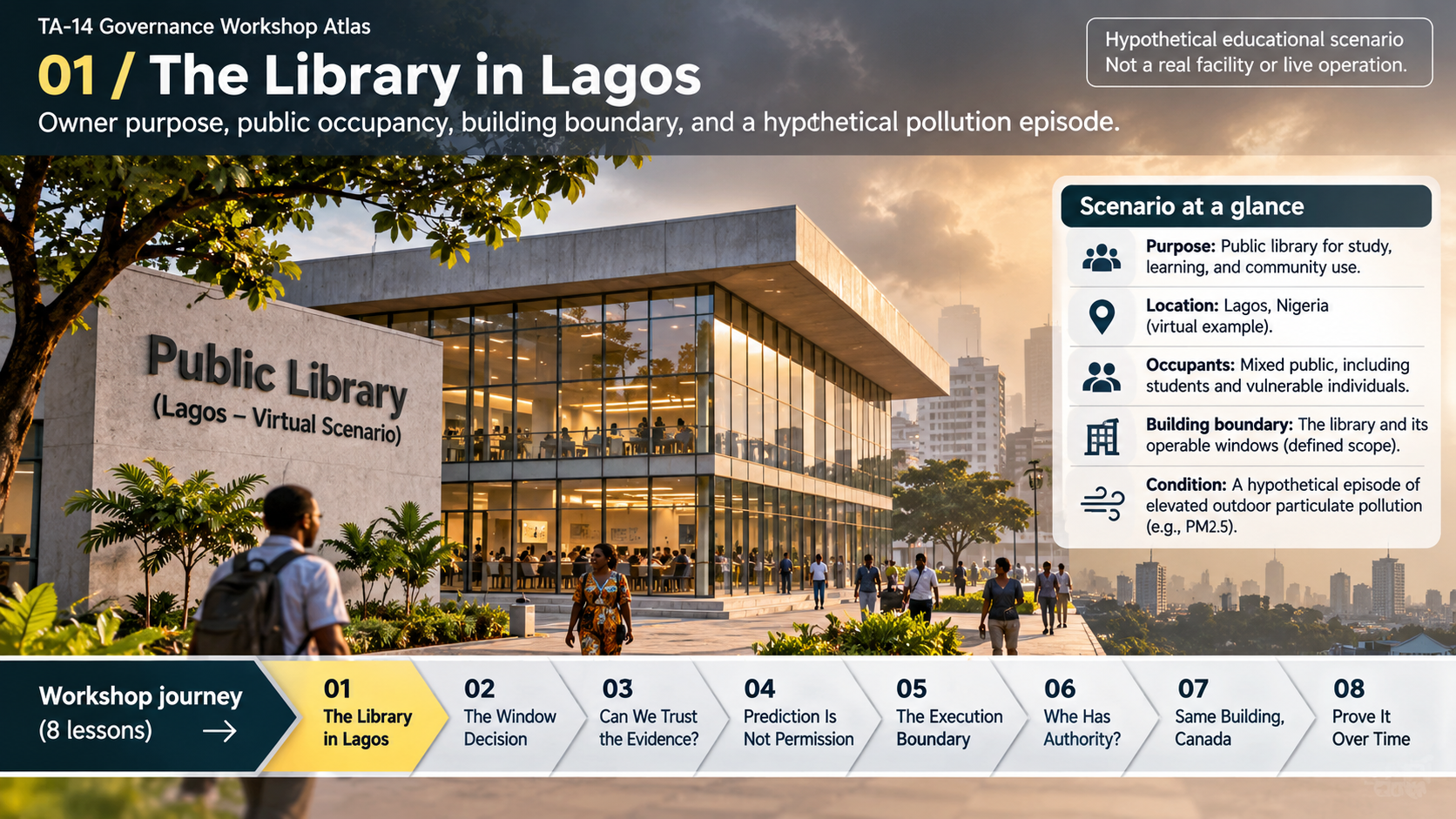
A virtual library is placed in Lagos, Nigeria, to examine one simple problem: when outdoor pollution is elevated, may its operable windows remain open? The building and pollution event are hypothetical. The owner purpose, occupied zones, vulnerable users, window boundaries and actual control responsibilities must be specified before any decision is justified.
WHAT YOU LEARNED
Establish the owner purpose, exact building boundary, occupants, and proposed consequence before considering automation.
WHAT COMES NEXT
Define the window action and its competing environmental consequences.
Follow the numbered teaching sections on the image. The page does not auto-scroll.
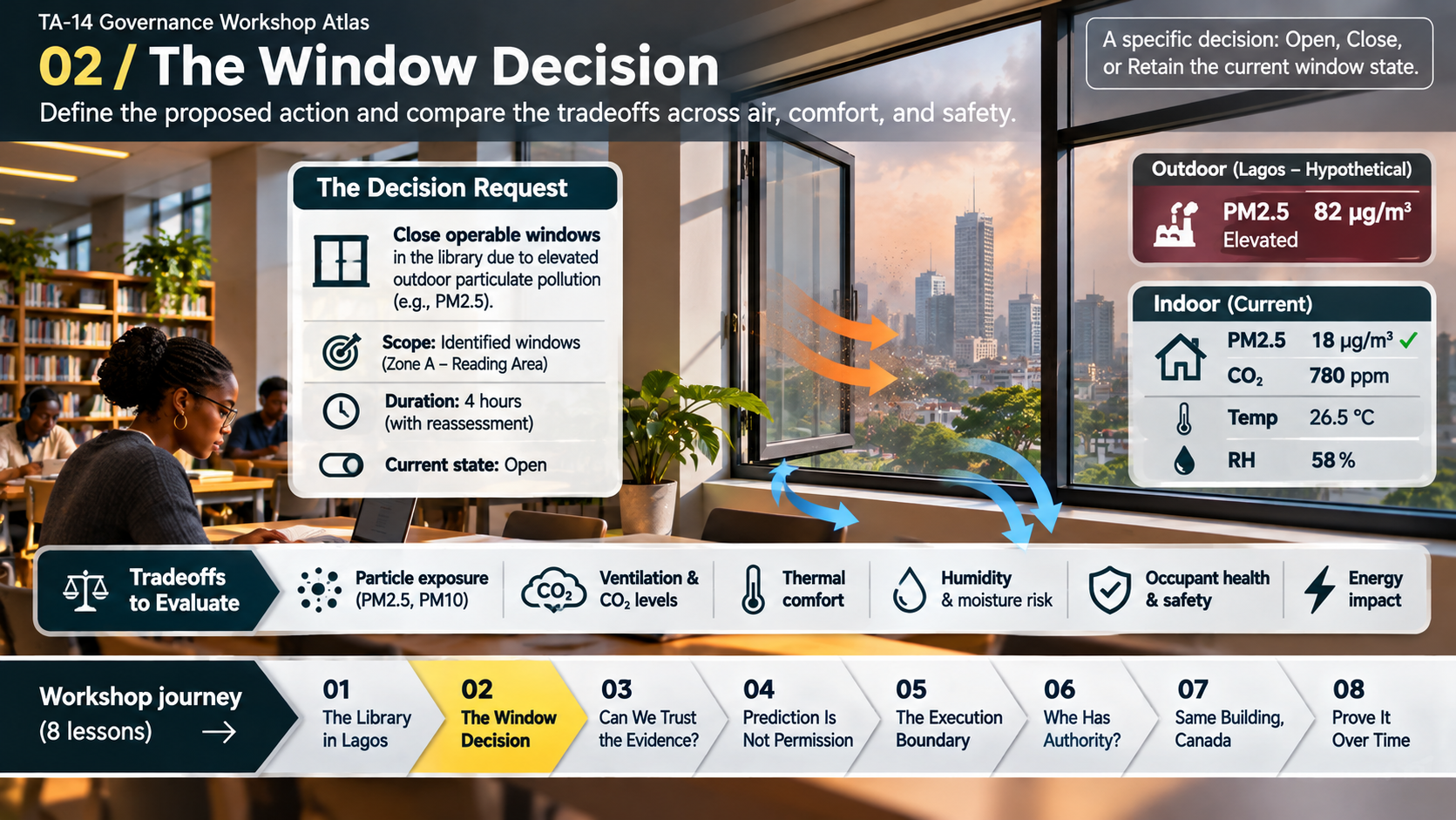
The hypothetical proposed action is to close specified operable windows for a defined duration. Opening or closing changes more than one variable. Outdoor and indoor particulate exposure, carbon dioxide, ventilation, temperature, relative humidity, energy, accessibility and occupant safety may move in different directions. The displayed readings, duration and thresholds are fictional workshop inputs, not site measurements or validated operating limits.
WHAT YOU LEARNED
An exact action must be defined and evaluated against multiple environmental consequences.
WHAT COMES NEXT
Test whether the observations are trustworthy enough to support that action.
Follow the numbered teaching sections on the image. The page does not auto-scroll.
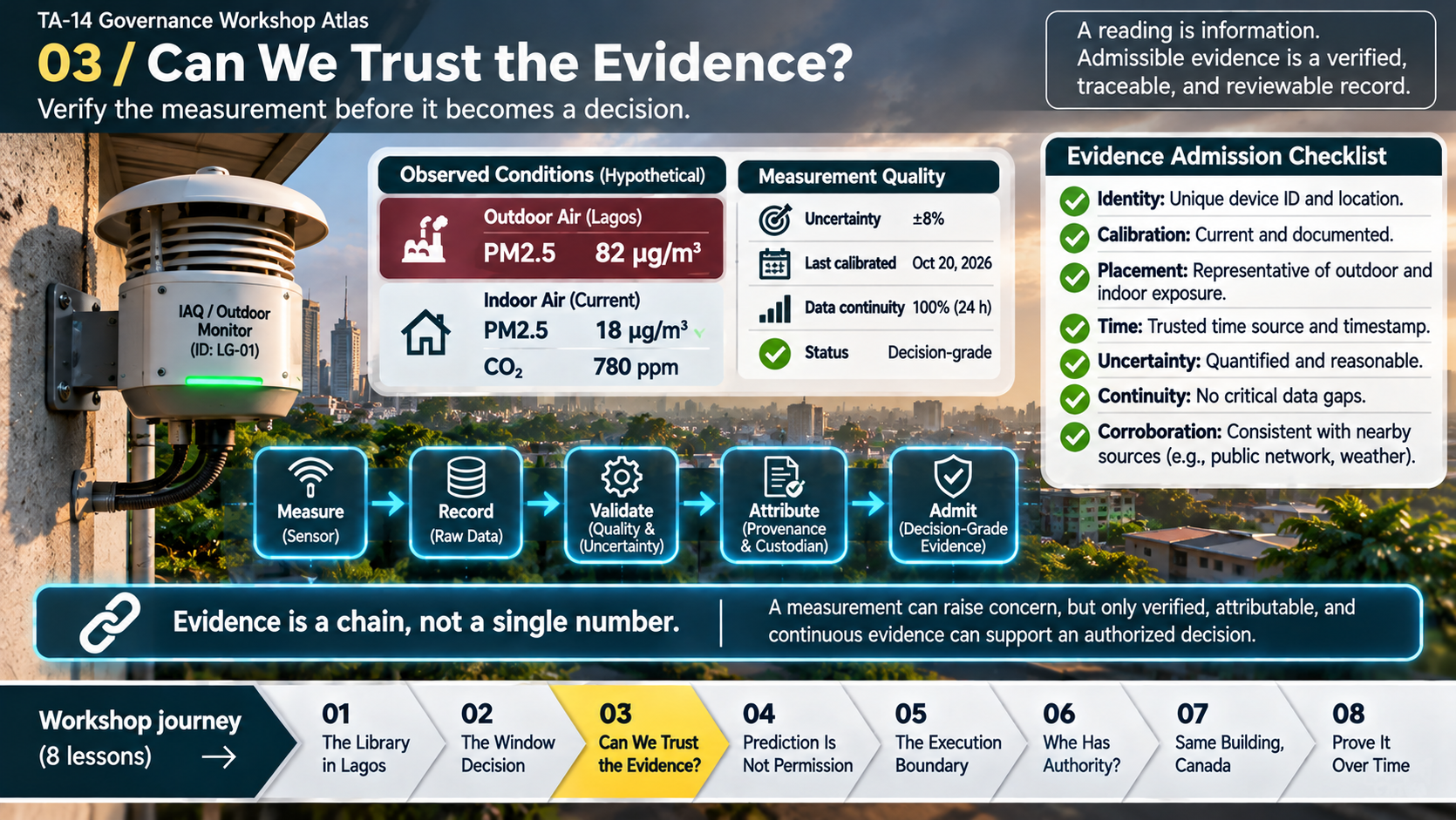
One outdoor PM2.5 value cannot by itself establish admissible evidence. An Atmospheric Integrity Record should preserve instrument identity, location and placement, custodian, calibration, time source, timestamps, missing data, uncertainty, corroboration and revision history. The green checks and calibration example in this image are illustrative only. A reviewer must be able to inspect contradictory and missing information rather than accept a confidence badge.
WHAT YOU LEARNED
Decision-grade evidence is attributable, time-relevant, quality-assessed and independently challengeable.
WHAT COMES NEXT
Separate what an AI model predicts from what anybody has permission to do.
Follow the numbered teaching sections on the image. The page does not auto-scroll.
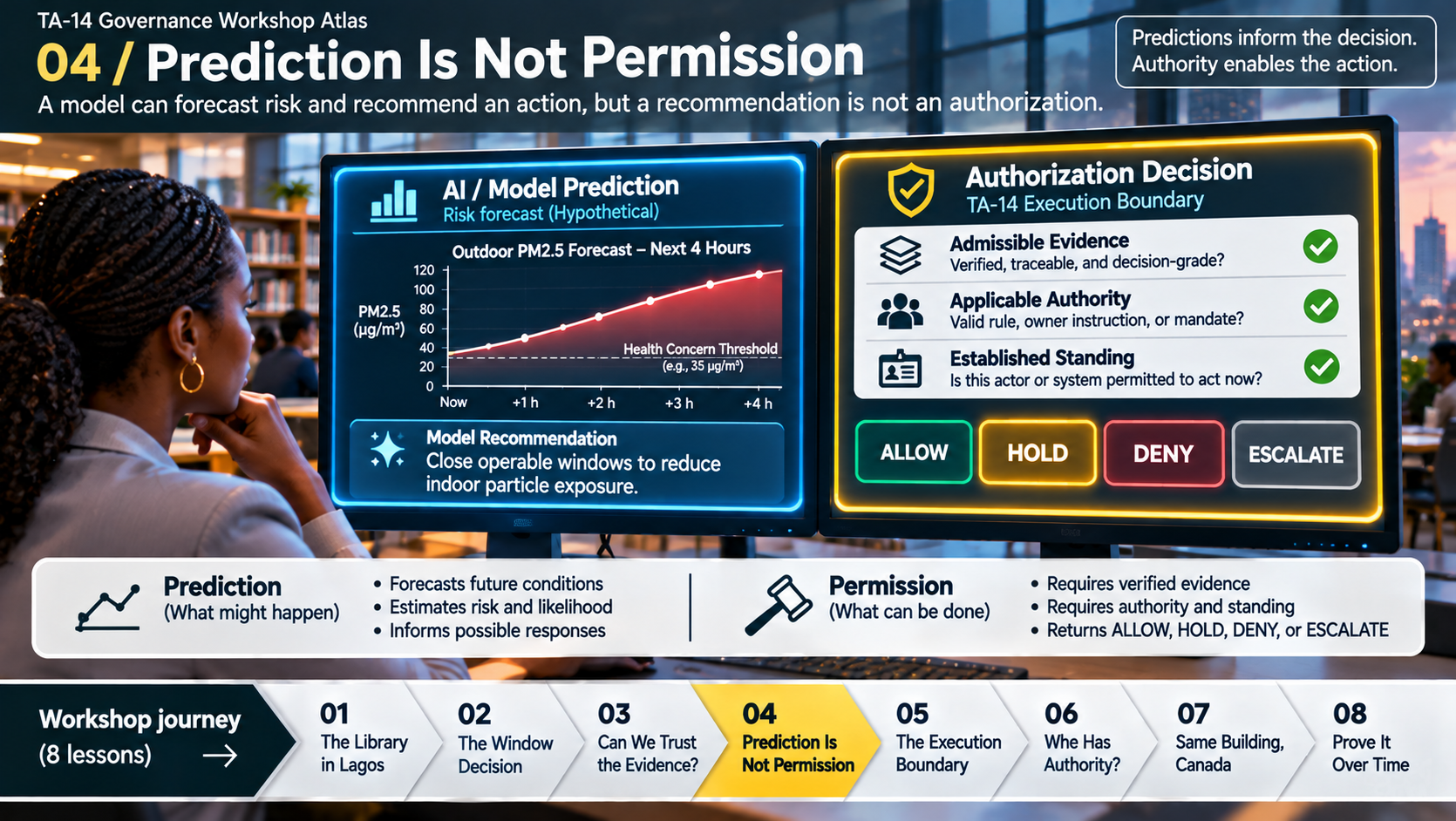
An analytics model might forecast rising outdoor particles and recommend closing windows. A forecast is a claim about possible future conditions. It is not an instruction with independent authority to operate building equipment. Before execution, Admissible Execution Architecture evaluates Admissible Evidence, Applicable Authority and Established Standing for the precise proposed action now. The chart and green checkmarks are conceptual, not evidence of a configured or validated authorization gate.
WHAT YOU LEARNED
Prediction may inform an authorized decision; prediction is never the source of permission.
WHAT COMES NEXT
Examine the four outcomes of the execution boundary.
Follow the numbered teaching sections on the image. The page does not auto-scroll.
A proposed consequential action reaches the AEA boundary. ALLOW means the action-specific requirements are satisfied within an approved scope. HOLD means a potentially resolvable gap prevents this discretionary action now. DENY rejects a prohibited request. ESCALATE routes the unresolved issue to the designated professional or authority. An outcome for one window command is not a general building-wide permission. Independently authorized fire, smoke-control and emergency actions must not be obstructed by a discretionary HOLD.
WHAT YOU LEARNED
An execution decision is narrow, time-specific, reasoned and reviewable; an emergency safety path retains its separate authority.
WHAT COMES NEXT
Ask who may actually invoke the governing instruction.
Follow the numbered teaching sections on the image. The page does not auto-scroll.
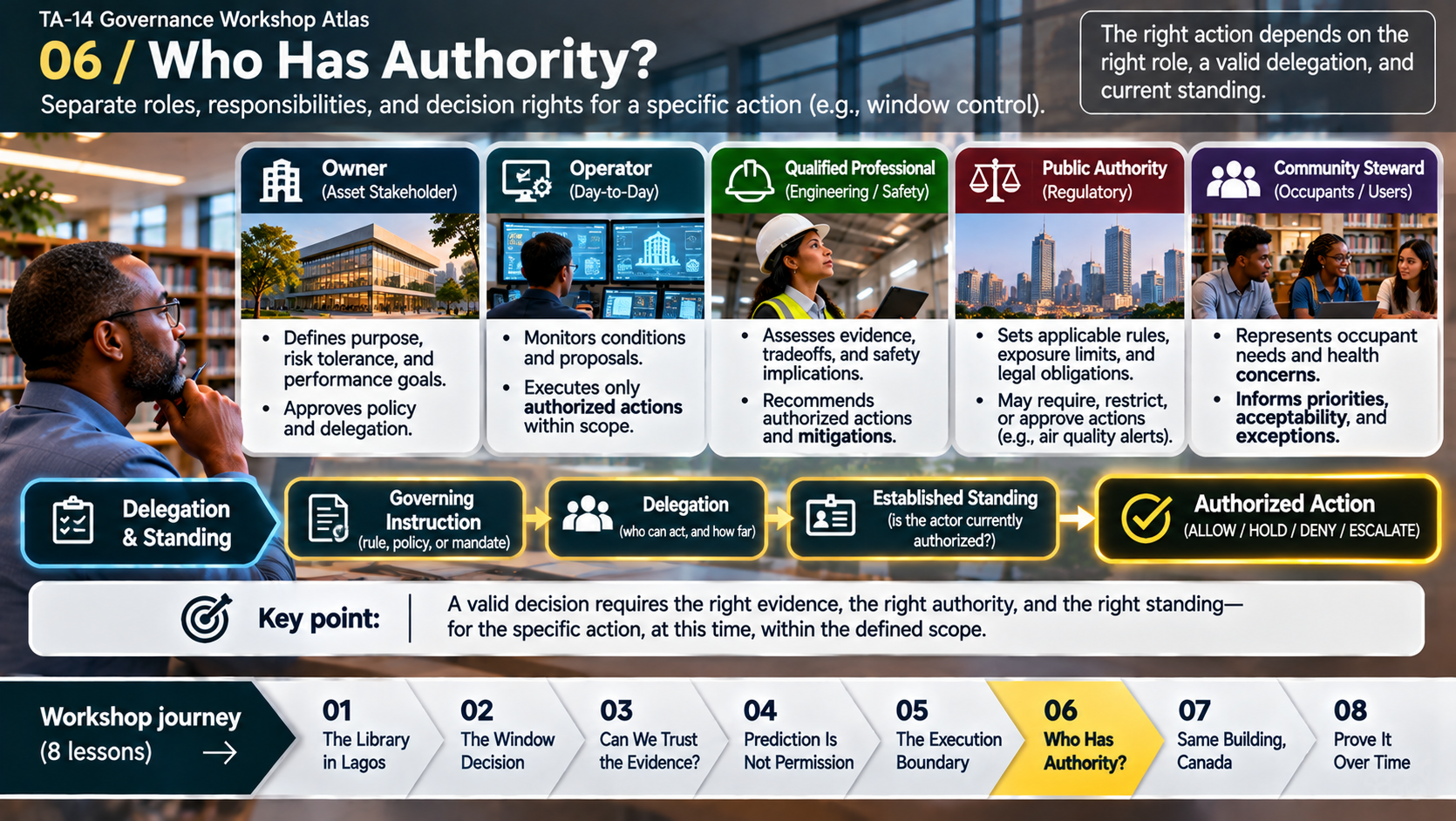
The asset owner may state the public-service objective, an operator may work within delegated control scope, a qualified engineer may establish technical safety constraints, a public authority may impose applicable obligations, and community representatives may have defined stewardship roles. These are illustrative roles, not legal assignments. Applicable Authority identifies the verified governing instrument; Established Standing establishes whether this particular actor may rely on it for these windows and conditions right now.
WHAT YOU LEARNED
Having a relevant role is not the same as holding a valid, current delegation for the proposed action.
WHAT COMES NEXT
Reconsider the exact same virtual library in a different jurisdiction.
Follow the numbered teaching sections on the image. The page does not auto-scroll.
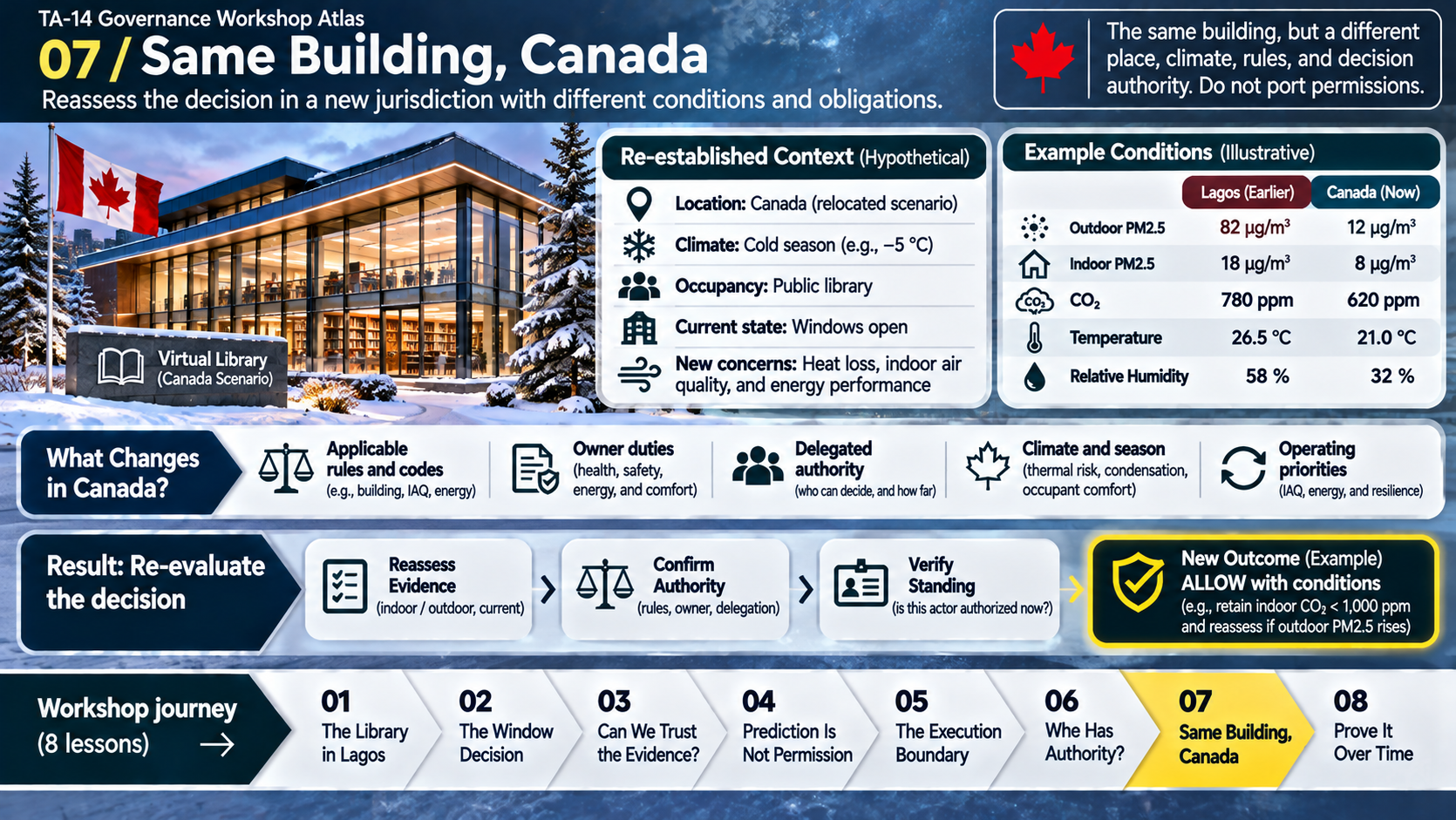
Move the virtual library from Lagos to Canada. The digital building geometry may be unchanged, but local conditions, climate, building and safety rules, owner obligations, occupancy, equipment and delegated authority must be re-established. This image shows illustrative readings and a conditional ALLOW label; neither verifies Canadian law, a real indoor environment, or a legitimate window-control delegation. No Lagos authorization transfers automatically across borders.
WHAT YOU LEARNED
The same model cannot carry environmental assumptions or permissions into a different jurisdiction without revalidation.
WHAT COMES NEXT
Show how the decision is recorded and re-examined over the asset lifetime.
Follow the numbered teaching sections on the image. The page does not auto-scroll.
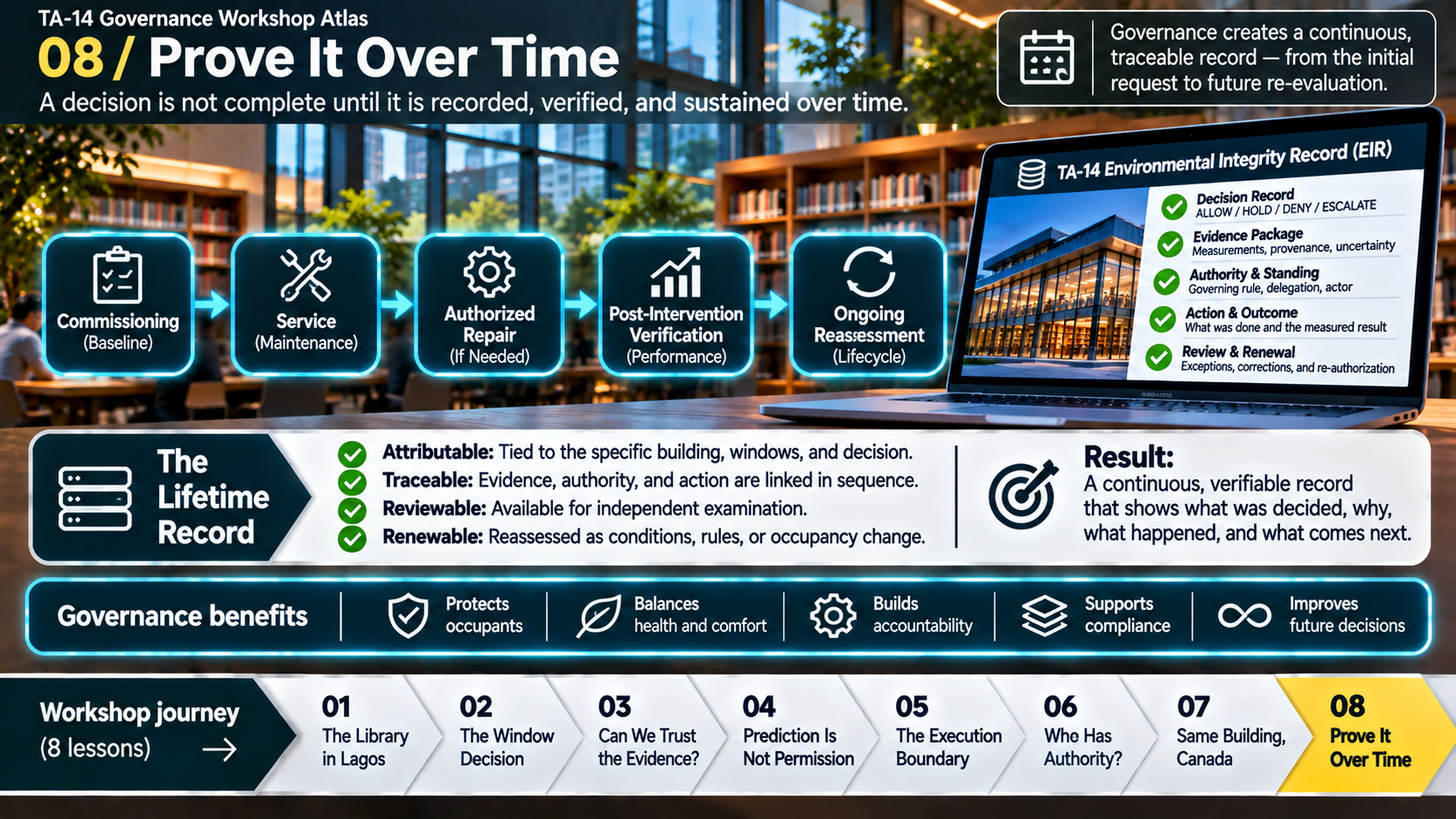
A responsible window decision is not complete merely because a command was issued. An environmental integrity record should connect the request, admitted observations, governing rule, actor standing, outcome, actual equipment state, post-action environmental verification, exceptions, repairs, reauthorization and future assessment. The illustrated completed record is hypothetical and does not imply any facility has been commissioned. Independent reviewers should be able to challenge every material claim.
WHAT YOU LEARNED
A lifetime record preserves what was proposed, why it was authorized or held, what happened, and what must be reviewed next.
WHAT COMES NEXT
Take the independent examination and inspect the companion PDF.
FIVE-STAGE WINDOW DECISION
From observation to verified consequence
01 / OBSERVE
Preserve actual indoor and outdoor conditions, source identity, timestamps and uncertainty.
02 / INTERPRET
Assess particle exposure alongside ventilation, CO2, comfort and safety tradeoffs.
03 / AUTHORIZE
Verify the applicable governing instrument and the requesting actor's standing.
04 / DECIDE
Return ALLOW, HOLD, DENY or ESCALATE for the specific window command.
05 / VERIFY
Record commanded and observed state, environmental outcome, exceptions and reassessment.
Worked hypothetical: the outdoor sensor has uncertain calibration, a model recommends closing windows, and no valid vendor delegation is documented. HOLD the discretionary vendor command pending review and reauthorization. This does not prove that leaving windows open is safe and must not obstruct separately authorized life-safety actions.
OPEN INDEPENDENT EXAMINATION
Challenge the evidence and the authority
A sensor exceeds a proposed threshold but calibration is uncertain. What would resolve an evidence HOLD?
A vendor requests automatic closure without documented delegation. Is the request HELD or DENIED, and by whom?
A discretionary HOLD coincides with separately authorized smoke control. How is the emergency path preserved?
What exactly must be revalidated before a Lagos rule or delegation can be used in a Canadian library?
Which post-action measurements, operator attestations and exceptions prove the intended outcome was achieved?
What the workshop does not establish
It does not establish site measurements, local legal requirements, actual control integration, certified engineering design, commissioning, public-health outcomes, an approved partnership or a commercial commitment. The goal is to make the unanswered questions clear enough for independent testing.
Apply the governance principles to three hypothetical cases relevant to air-quality intervention. Choose a determination, then examine the reasoning. These cases teach the distinction between Admissible Evidence, Applicable Authority, and Established Standing; they do not issue real-world authorization.
CASE 01
Evidence is not yet admissible
A proposed consequence is supported by an observation, but the source attribution or record continuity is missing. What should happen before execution? Consider this in the context of air-quality intervention.
CASE 02
The actor exceeds authority
The record is current and reliable, but the proposed consequence falls outside the scope of applicable authority. What is the supported determination?
CASE 03
A higher authority is required
The proposed consequence triggers a documented requirement for review by another designated authority. What is the appropriate route?
Independent educational examples only. The questions are hypothetical and do not assess a real institution, building, person, or operating system. Actual governance determinations require case-specific evidence, applicable authority, established standing, and bounded review.