ONUMA / BIMGENIE · EXTERNALLY GENERATED OPERATIONAL CASE
The evidence reached the room.
Authority stopped at the physical boundary.
BIMgenie carried a reported condition through the confirmed occupant → facility manager → technician sequence. ACA examined represented topology. AEA determined what the resulting record could—and could not—authorize.
THE OPERATIONAL OBJECT
What BIMgenie actually established.
“The light in this room is not illuminating. The local Circuit 2 breaker appears ON and is not visibly tripped.”BIMgenie Work Order 3593-22790 · preserved as a reported condition
TWO ARCHITECTURES · TWO CONSEQUENCE BOUNDARIES
What does the model support?
The frozen Turtle evidence supports a bounded represented electrical relationship associated with LT-2. Forward and reverse traversal converged on the represented path.
SUPPORTED · REPRESENTED TOPOLOGY ONLYReview the ONUMA/BIM rerun →What may become consequence?
The assignment supports identifying the room and affected object, observing accessible conditions, comparing visible identifiers, preserving discrepancies, and returning evidence.
ALLOW INVESTIGATION · HOLD INTERVENTIONOpen the AEA Registry record →CURRENT EVIDENCE LIMITS
The record must not say more than reality has supplied.
- 01
The affected physical light has not yet been verified as LT-2.
- 02
Panelboard Distribution V03 has not yet been independently established as physically identical to DB-2.
- 03
“Appears ON” is a reported observation, not verified energized state.
- 04
The cause of the lighting condition has not been established.
- 05
No breaker operation, panel access, measurement, switching, repair, or replacement is authorized by this record.
CURRENTLY ADMISSIBLE NEXT ACTION
Non-intervention evidence collection
Confirm the assigned location, identify the affected physical light, observe accessible current conditions, compare visible labels with the represented record, preserve discrepancies, and return new evidence to the same work order.
Physical electrical consequence
Breaker operation, panel access, electrical measurement, switching, energization or de-energization, repair, replacement, rewiring, alteration, and work-order closure remain outside current standing.
Represented topology
Bounded investigation
New field evidence required
FOUR-VISUAL EDUCATIONAL EXAMINATION
From preserved building knowledge to accountable consequence.
Each illustration spans the full width of this page. Read how we arrived at it, what the examination establishes, and what comes next. These are conceptual teaching materials, not evidence for BIMgenie Work Order 3593-22790 or proof of a deployed ONUMA-TA-14 integration.
The Building Knows. Who Authorizes Reality?
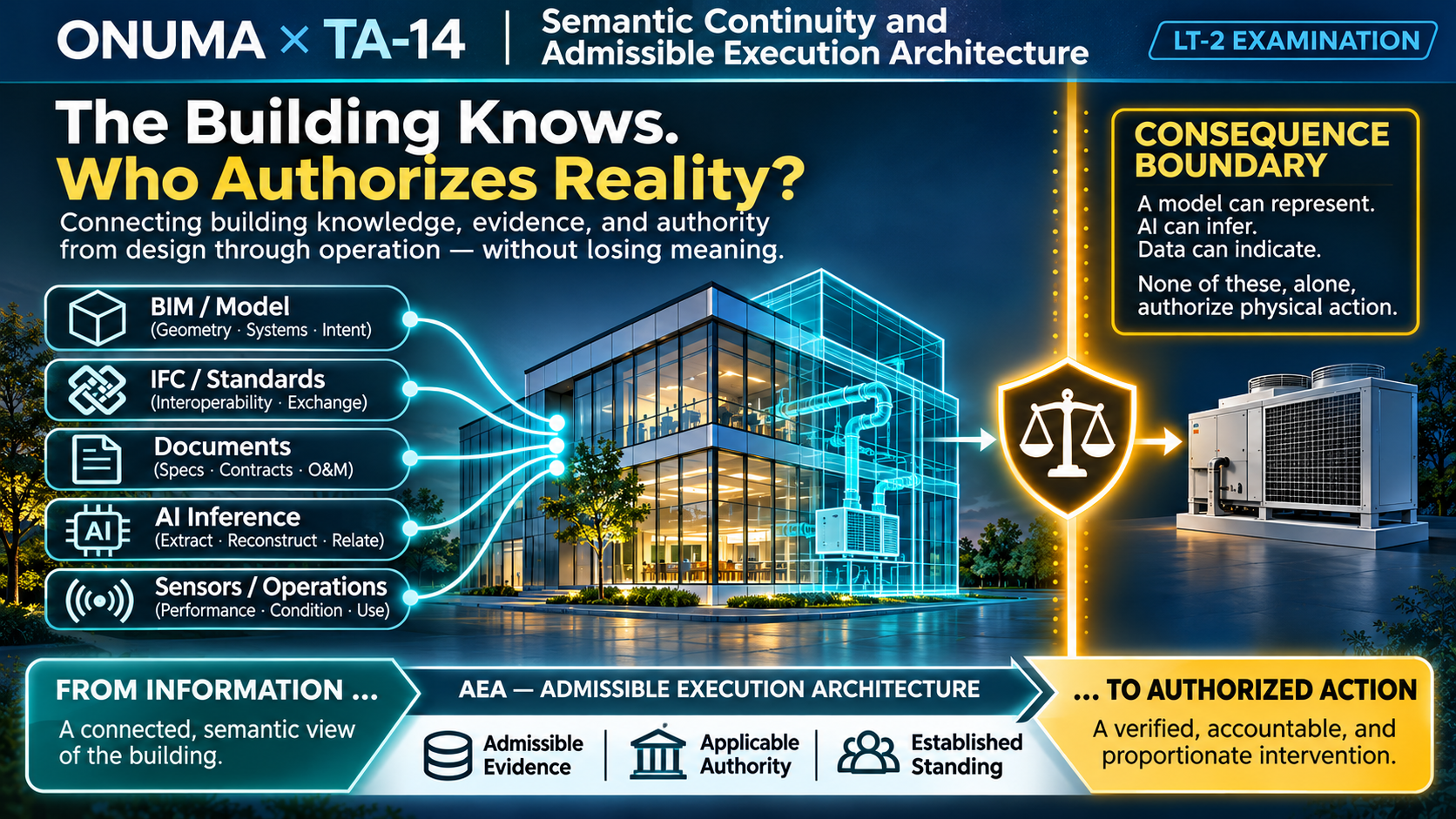
How we got here
BIM, IFC, documents, sensors, and AI-generated inferences can describe parts of a building. Before any action, we must distinguish represented knowledge from the physical condition currently established.
What we just learned
Connected information can support decisions without independently authorizing physical intervention.
What we're about to learn
Follow that knowledge from original design through construction, operation, modifications, and ownership transfer. Which relationships survive those handoffs?
A building model may identify equipment. AI may infer a condition. Sensors may indicate change. None of these, alone, establishes the evidence, authority, and standing needed for a physical consequence.
Voice depends on the voices available on your device. Written narration is always available.The Information Continuity Chain
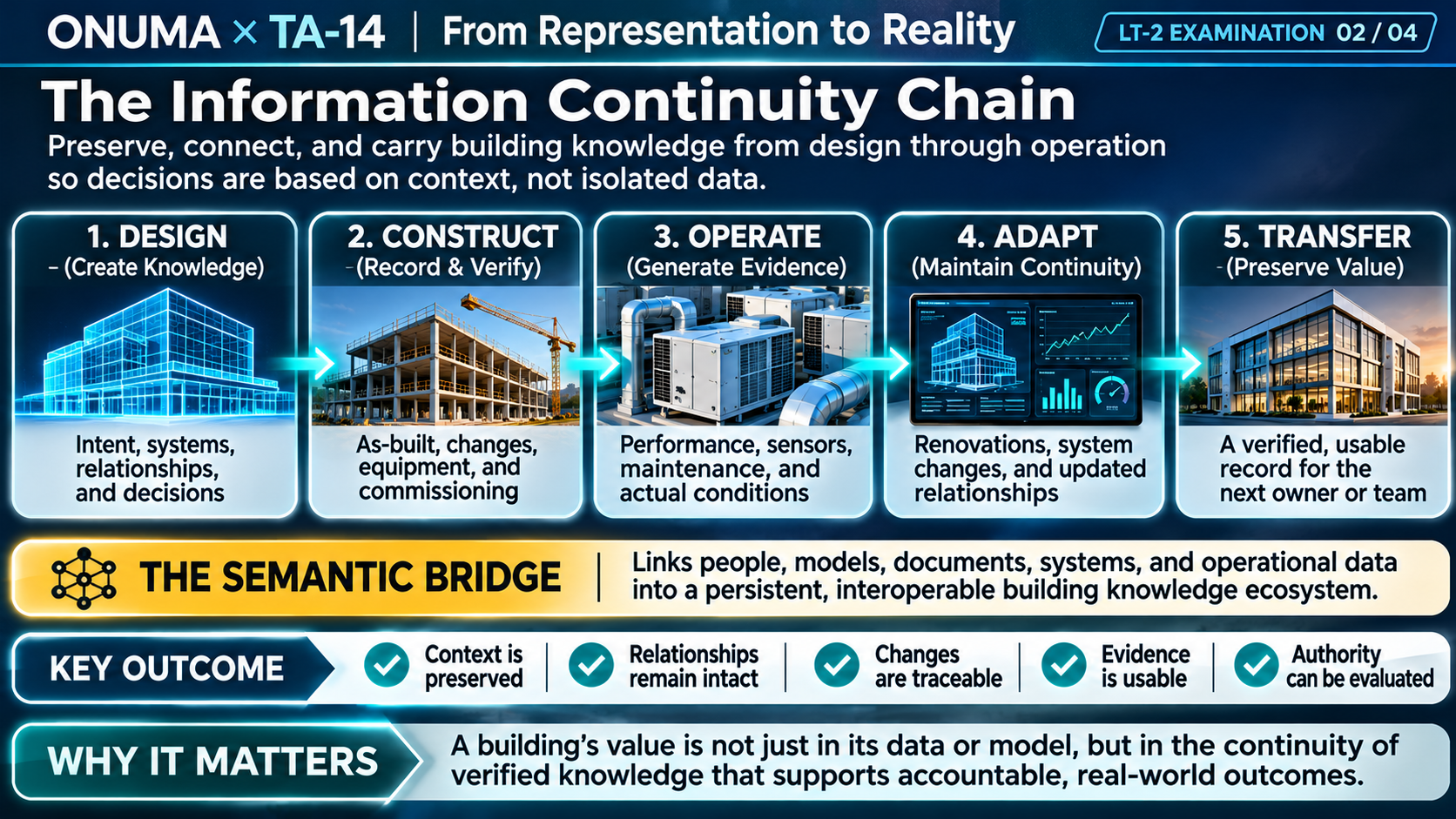
How we got here
The first examination established that information can inform decisions without granting permission to act. Now we trace what happens to that information as a building changes over time.
What we just learned
Meaningful building knowledge should survive software changes, project handoffs, and ownership transfers.
What we're about to learn
Once knowledge has been connected and its gaps identified, ask what evidence, authority, and standing are required before a proposed intervention may occur.
Design decisions, as-built changes, live performance, and maintenance history should remain connected through the life of a building. Semantic continuity preserves meaning; admissibility still needs to be examined when action is proposed.
Voice depends on the voices available on your device. Written narration is always available.The Consequence Boundary
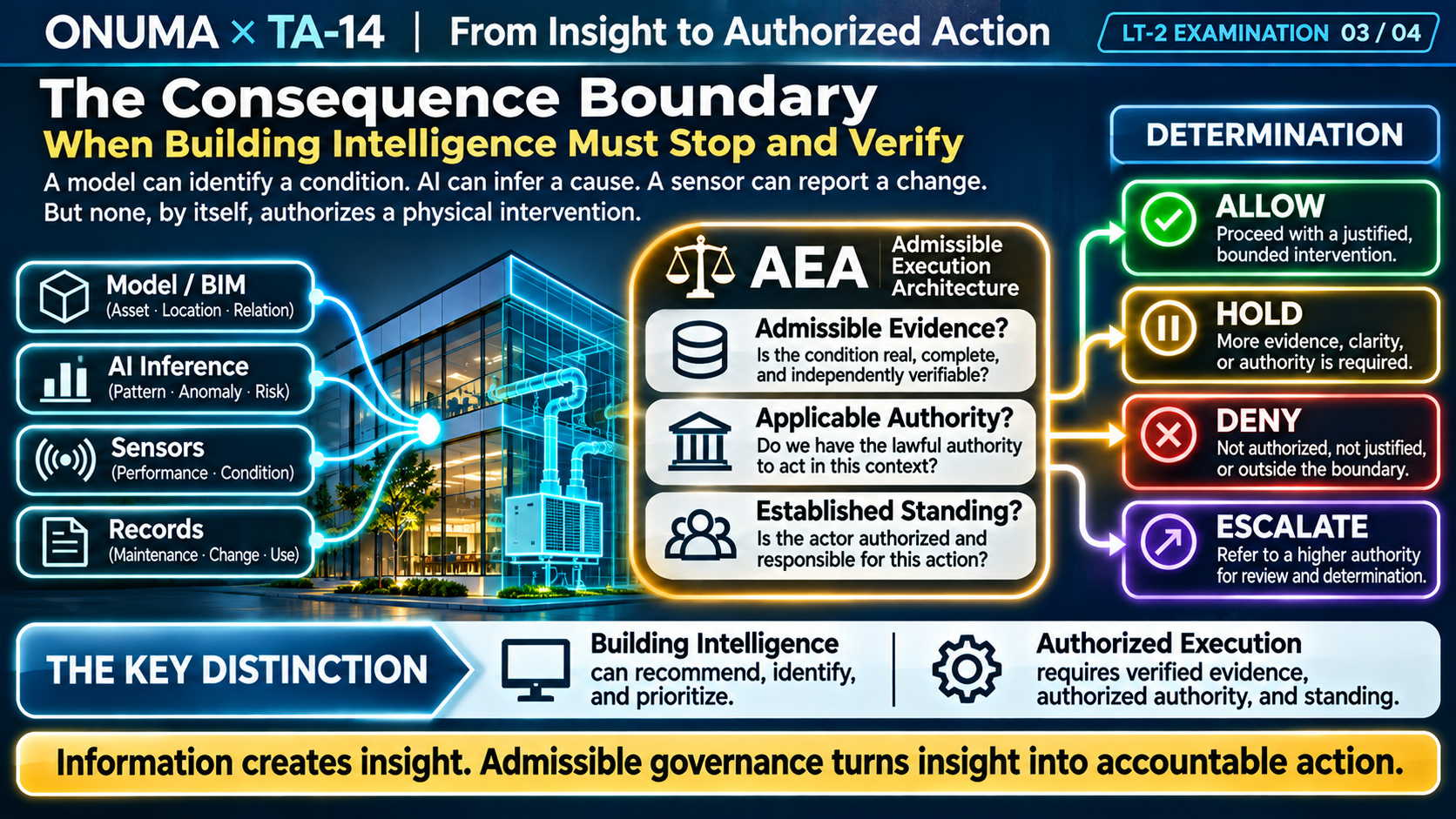
How we got here
Semantic continuity has connected the records, but a connected record may still be incomplete, inferred, or outdated. The execution boundary must examine the proposed consequence, not merely the available data.
What we just learned
The transition from information to action requires an explicit, evidence-bound decision.
What we're about to learn
Examine what happens after a bounded determination: evidence collection, separately justified intervention where applicable, and measured verification of the outcome.
Admissible Execution Architecture examines Admissible Evidence, Applicable Authority, and Established Standing. Its decisions can allow, hold, deny, or escalate a proposed consequence. HOLD is a valid protective outcome, not a failure.
Voice depends on the voices available on your device. Written narration is always available.From Authorized Intervention to Verified Outcome
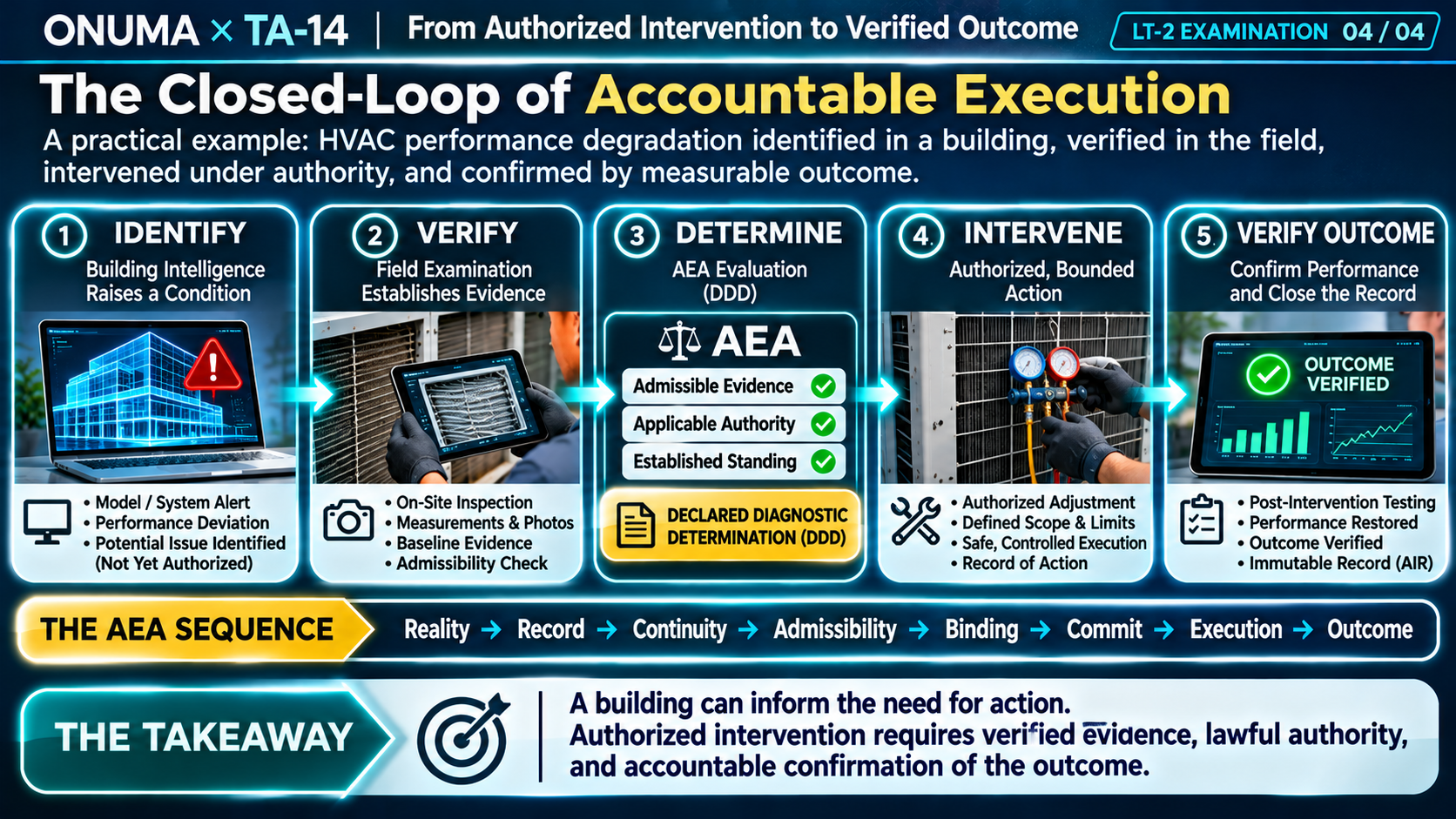
How we got here
The AEA boundary distinguishes permitted investigation from intervention on HOLD. This final illustration applies that distinction to a separate conceptual HVAC workflow; it is not evidence of work performed in the LT-2 electrical case.
What we just learned
An authorized work order does not, by itself, establish that the intended result was achieved.
What we're about to learn
Read the Version 2.0 technical examination, then return to LT-2 Work Order 3593-22790 and challenge which propositions are supported, which remain unresolved, and what new evidence could change the HOLD.
In this separate illustrative HVAC workflow, technicians gather and freeze baseline evidence before a system-issued diagnostic determination. Any justified intervention is bounded by authority and followed, when applicable, by post-intervention verification.
Voice depends on the voices available on your device. Written narration is always available.The Building Knows. Who Authorizes Reality?
11-page educational companion covering semantic continuity, ACA and AEA boundaries, the LT-2 evidence matrix, and independent examination criteria. The PDF is hosted in the public TA-14 GitHub repository.
Return to the LT-2 evidence record above. That record permits bounded investigation while physical electrical intervention remains on HOLD until new field evidence supports a fresh determination.